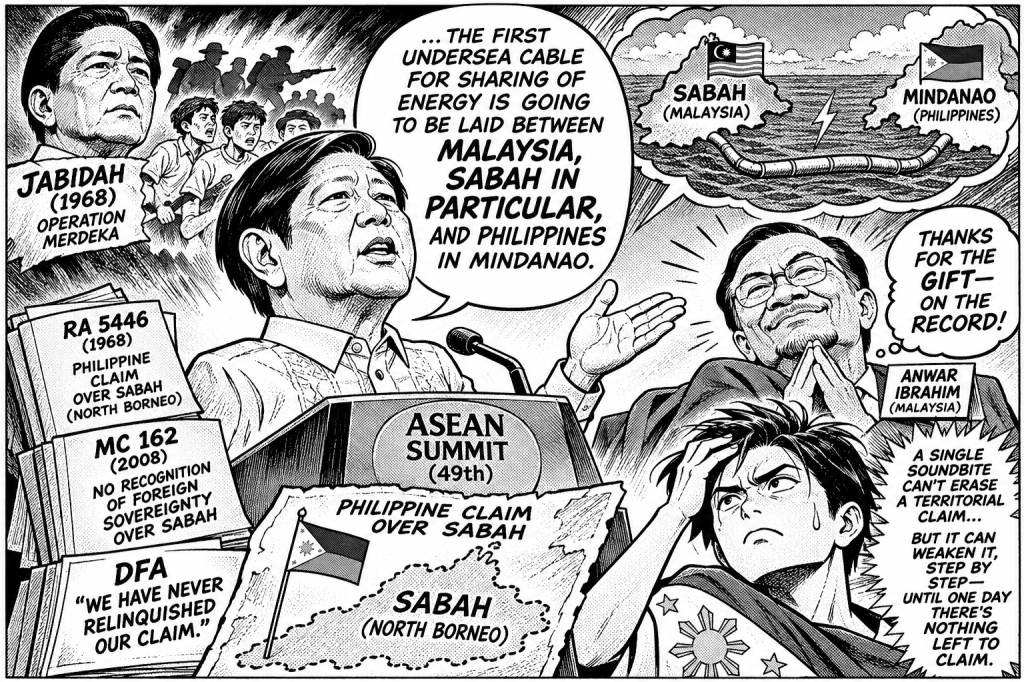
The President needed one sentence to undo six decades of diplomatic discipline—and the DFA is still drafting its clarification.
By Louis “Barok” C. Biraogo | November 22, 2026
BEAR with me, because this one needs to be said slowly. The President of the Republic of the Philippines, who promised during the 2022 campaign to “protect every inch of Philippine territory,” stood before the world at the 49th Association of Southeast Asian Nations (ASEAN) Summit and casually referred to Sabah as part of Malaysia. Not “North Borneo, over which we maintain a historic claim.” Not “the territory currently administered by Malaysia, subject to unresolved sovereignty questions.” Just: “Malaysia, Sabah in particular.”
And the Republic barely blinked.
If this were a law school exam, I’d fail the entire administration for missing the most obvious issue-spotter in Philippine foreign policy since the 2016 Arbitral Award. But this isn’t a hypothetical. This is the actual President of the actual Philippines, speaking at an actual international summit, in actual November 2026, while the Senate is trying a Vice President and the International Criminal Court (ICC) is breathing down the necks of everyone who ever shook hands with a Duterte. The timing is so suspicious it practically screams “look over here, not over there.”
But let’s not get ahead of ourselves. Let’s do what the Department of Foreign Affairs (DFA) should have done before the President opened his mouth: examine the documents.
THE CABLE THAT CAME IN FROM THE COLD
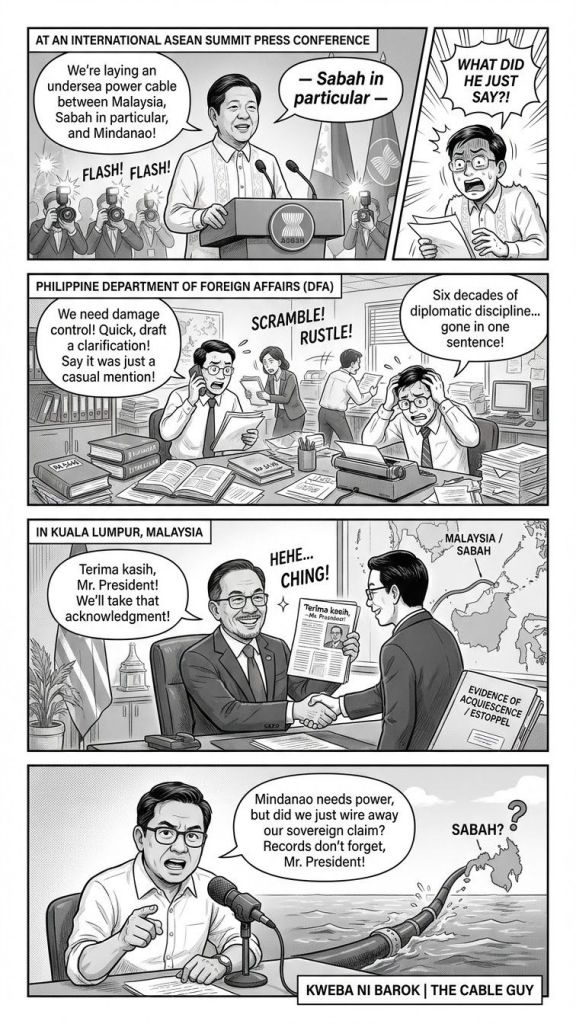
According to VERA Files and INQUIRER.net, Marcos announced on November 17 that “the first undersea cable for sharing of energy is going to be laid between Malaysia, Sabah in particular, and Philippines in Mindanao” under the enhanced ASEAN Power Grid Memorandum of Understanding (MOU). The phrase “Sabah in particular” is doing an enormous amount of legal and diplomatic labor for a prepositional phrase. It is, in effect, a verbal signature: a presidential acknowledgment that Sabah belongs to Malaysia, uttered without reservation, without caveat, and without any apparent consultation with the DFA’s legal office.
Now, before the Malacañang spin doctors begin their damage control (and they will, because they always do), let me be clear about what the law says. Under international law, particularly the doctrine of estoppel as articulated in the International Court of Justice (ICJ)’s Temple of Preah Vihear decision, a clear, public statement by a Head of State with plenary authority to bind the nation in foreign affairs can estop a state from later asserting a contrary territorial claim. In plain English: when the President says Sabah is Malaysia’s, the Philippines may be legally stuck with that statement.
Does that mean the Philippines has formally dropped its claim? Not necessarily. As VERA Files reported on November 20, DFA officials insist that dropping the claim requires “an express, deliberate, and unequivocal act”: a treaty ratified by the Senate, a formal renunciation, an official diplomatic note. A press briefing, they argue, is not a legal instrument.
Republic Act No. 5446 (RA 5446), Section 2, remains unrepealed, preserving the Philippine claim “without prejudice to the delineation of the baselines of the territorial sea around the territory of Sabah, situated in North Borneo, over which the Republic of the Philippines has acquired dominion and sovereignty.” The March 2025 Philippine diplomatic note to the United Nations expressly stated that the country “has never relinquished its sovereignty over North Borneo.”
So the claim survives on paper. But here’s the question that should terrify every Filipino who cares about territorial integrity: for how long?
THE JABIDAH GHOST THAT WON’T DIE
Let me take you back to 1968. Operation Merdeka. The Jabidah Massacre. Young Moro recruits, trained on Corregidor for a covert mission to infiltrate Sabah, allegedly killed when they mutinied upon learning the true nature of their mission. The official story is that they were soldiers. The unofficial story, the one that has never quite died, is that they were pawns in a geopolitical game that Marcos Sr. was playing with Malaysia. Some say the father quietly shelved the Sabah claim in the 1970s in exchange for Malaysian non-interference in the Moro rebellion and Middle Eastern petrodollars. Others say he simply lost interest.
Now, nearly six decades later, the son is standing at an ASEAN Summit casually referring to Sabah as Malaysia’s. The echoes are deafening.
Is this a coincidence? Or is it a pattern?
I don’t have access to the Palace’s inner sanctum, but I can read the diplomatic tea leaves. On November 17, the same day Marcos made his announcement, Malaysian Prime Minister Anwar Ibrahim met with French President Emmanuel Macron in Kuala Lumpur, explicitly citing Marcos’s “readiness” for the Sabah-Mindanao link while seeking French technical and financial backing for the ASEAN Power Grid. Anwar moved fast. Too fast. Either he knew what Marcos was going to say before Marcos said it, or he recognized an opportunity and seized it. Either way, the sequence of events raises a question the DFA has yet to answer: was this coordinated?
And what about Sabah itself? On November 20, former Sabah Chief Minister Datuk Yong Teck Lee publicly questioned the announcement, noting that an undersea power link to Mindanao is absent from the Sabah Energy Masterplan and Road Map 2040. He demanded clarity from the Energy Commission of Sabah and Malaysian federal authorities, hinting at backchannel negotiations that bypassed state regulators.
In other words, even the Malaysians weren’t fully briefed. This wasn’t a carefully negotiated agreement between sovereign states. This was a presidential improvisation that caught everyone, including the supposed beneficiary, off guard.
THE “NO DEAL YET” DEFENSE: A CONVENIENT TRUISM
By November 20, the administration’s talking points had crystallized. Energy Secretary Sharon Garin reportedly clarified that no agreement has yet been concluded, that feasibility studies remain to be undertaken and funded, that the exact route has not been determined, that there is no timetable for construction. In other words: nothing to see here, folks. Just a hypothetical cable that may or may not ever be built.
This defense is simultaneously true and irrelevant. Yes, there is no signed agreement. Yes, the project is preliminary. But the damage, if there is damage, was done the moment the President opened his mouth.
Malaysia can archive that verbatim statement in its diplomatic dossiers. If the Sabah dispute ever reaches an international tribunal, Kuala Lumpur can cite Marcos’s own words as evidence of inconsistent Philippine state practice and acquiescence. The absence of a signed agreement does not erase the existence of a presidential statement. If anything, it makes the statement more dangerous, because it was casual, extemporaneous, and unguarded: precisely the kind of off-the-cuff remark that international lawyers love to weaponize.
And let’s not forget Memorandum Circular No. 162, issued in 2008. Section 1 expressly prohibits any government department, agency, or instrumentality from making “any act or statement directly or indirectly recognizing foreign sovereignty over North Borneo/Sabah or denying Philippine title or historical and legal rights.” Section 2 requires DFA clearance or consultation for any official activity, act, or statement concerning Sabah. Did the President’s statement comply with MC 162? The Palace has not said. The DFA has not said. The silence is telling.
THE “NON-PREJUDICE” HUSTLE
If you want to understand how the Philippines will get out of this mess, look no further than the time-honored diplomatic formula: the non-prejudice clause. As international law scholar Romel Bagares observed, both countries could simply agree that the energy-grid arrangement “shall not be construed as altering, waiving, or prejudicing either party’s position on territorial sovereignty.” The DFA will issue a clarification. The Malaysians will nod politely. The cable will proceed. The claim will remain on the books. And everyone will pretend that nothing happened.
This is, I suppose, the “mature” solution. It is also the coward’s solution. It allows the President to escape accountability for a careless remark, allows Malaysia to bank the statement as a tacit concession, and allows the Philippine public to be lulled into believing that their territory is safe because a statute says so.
But let me ask the uncomfortable question: what happens next time? And the time after that? A claim can survive in a statute while dying as a national policy. It can be preserved in a diplomatic note while being hollowed out by a thousand casual concessions. Each individual act may be defensible. Cumulatively, they constitute surrender.
THE ENERGY SECURITY SMOKESCREEN
I am not naive. Mindanao needs power. The region has suffered from chronic grid deficits, high electricity costs, and unreliable supply. A submarine cable connecting Mindanao to Malaysian power sources could stabilize the grid, lower costs, and spur economic growth. These are legitimate national interests.
But let me ask a simpler question: why Sabah? Malaysia has other energy sources. Sarawak, for instance, has abundant hydropower and is geographically closer to Mindanao than Sabah. The Energy Secretary herself mentioned Sarawak as a potential alternative. If the goal is energy security, why not route the cable through Sarawak and avoid the Sabah controversy entirely?
The answer, I suspect, is that Sabah was never the point. The point was to signal something to Malaysia, and to the world, and perhaps to the Sulu heirs who have been pursuing their own arbitration claims over the 1878 pajak lease. The point was to send a message, without actually sending a message, that the Philippines is willing to move on.
And that is why this is not just a diplomatic gaffe. It is a policy choice disguised as a slip of the tongue.
THE SENATE AND THE SUPREME COURT: THE LAST LINES OF DEFENSE
There is a way to fix this. The Senate could pass a resolution asserting RA 5446 and demanding a formal DFA clarification. Private petitioners could seek injunctive relief from the Supreme Court under Province of North Cotabato v. Government of the Republic of the Philippines Peace Panel on Ancestral Domain, which held that the Executive Branch cannot commit the State to arrangements that impair national sovereignty or territorial integrity. The Court’s ruling in Saguisag v. Executive Secretary affirmed that executive agreements cannot contravene the Constitution or existing statutes. These are not abstract principles. They are constitutional commands.
But will anyone actually enforce them? The Senate is currently preoccupied with the impeachment trial of Vice President Sara Duterte. The Supreme Court is notoriously deferential to the Executive on matters of foreign policy, as evidenced by Biraogo v. Del Rosario, which dismissed a petition to compel the DFA to elevate the Sabah claim to the ICJ on the ground that the timing, manner, and strategy of pursuing territorial claims fall within the Executive’s non-justiciable political discretion. The courts may not save us. The Senate may not save us.
That leaves the public. And the public is easily distracted.
THE QUESTION NO ONE WANTS TO ASK
Here is the question that the DFA, the Palace, and the Malaysian government are all hoping you won’t ask: If the Philippines did not intend to recognize Malaysian sovereignty over Sabah, why did the President refer to it as part of Malaysia?
The answer may be bureaucratic incompetence. It may be diplomatic carelessness. It may be a deliberate signal. It may be all three. But the effect is the same: the Philippines’ diplomatic credibility has been damaged, the claim has been weakened, and Malaysia has been handed a gift it did not even have to ask for.
The administration will try to spin this as a misunderstanding. The DFA will issue a clarification. The cable will proceed. The claim will remain on the books. And everyone will move on.
But I am not moving on. Because I remember Jabidah. I remember the young Moro recruits who died for a mission they were never told the truth about. I remember the silence that followed. I remember the way the truth was buried, and the way the powerful moved on.
This time, we should not move on. This time, we should demand answers. This time, we should ask: What did the President actually mean?
And if the Palace cannot answer that question, they should not be surprised when the rest of us start drawing our own conclusions.
BOTTOM LINE
The Philippine claim to Sabah is not dead. But it is wounded. And the wound was inflicted not by Malaysia, not by the ICJ, not by the forces of history, but by the President of the Philippines, in a single, careless sentence, at a press briefing, in Pasay City.
The cable may never be built. The MOU may never be signed. The “non-prejudice” clause may paper over the whole affair. But the statement is on the record. And records, unlike Presidents, do not forget.
Key Citations
A. Legal & Official Sources
- Bagares, Romel. “The Sabah Question in International Law.” University of the Philippines College of Law, PDF publication. https://law.upd.edu.ph/wp-content/uploads/2024/12/04-The-Sabah-Question-in-International-Law-Judge-Frank-E.-Lobrigo-ret..pdf.
- Louis “Barok” C. Biraogo v. Hon. Alberto F. Del Rosario. G.R. No. 206323, Supreme Court of the Philippines, 11 Apr. 2013. Digest PH, http://www.digest.ph/decisions/biraogo-v-del-rosario.
- International Court of Justice. Temple of Preah Vihear (Cambodia v. Thailand). Merits, Judgment, 15 June 1962. https://www.icj-cij.org/case/45.
- Permanent Court of Arbitration. The South China Sea Arbitration (Philippines v. China). Award, 12 July 2016. https://pca-cpa.org/en/cases/7/.
- Philippines. An Act to Amend Section One of Republic Act Numbered Thirty Hundred and Forty-Six, Entitled “An Act to Define the Baselines of the Territorial Sea of the Philippines”. Republic Act No. 5446, 18 Sept. 1968. The Lawphil Project, https://lawphil.net/statutes/repacts/ra1968/ra_5446_1968.html.
- Philippines. Memorandum Circular No. 162: Guidelines on Matters Pertaining to North Borneo (Sabah). 20 Aug. 2008. https://lawphil.net/executive/mc/mc2008/mc_162_2008.html.
- Philippines. Department of Foreign Affairs. “DFA Reasserts Philippines’ Claim over Sabah.” Philippine News Agency, 20 Feb. 2026. https://www.facebook.com/share/19nBh8mbK6/.
- Philippines. Philippine Mission to the United Nations. Note No. 244-2025. 19 Mar. 2025. https://www.un.org/Depts/los/clcs_new/submissions_files/phl1/20250319Phl1NvUn004.pdf.
- Division for Ocean Affairs and the Law of the Sea. “Submissions to the Commission: Partial Submission by the Republic of the Philippines.” Commission on the Limits of the Continental Shelf, United Nations, 27 July 2026, http://www.un.org/depts/los/clcs_new/submissions_files/submission_phl1_2024.htm.
- Philippines. Presidential Communications Office. “Press Conference by His Excellency Ferdinand R. Marcos Jr., President of the Republic of the Philippines.” 17 Nov. 2026. https://pco.gov.ph/presidential-speech/press-conference-by-his-excellency-ferdinand-r-marcos-jr-president-of-the-republic-of-the-philippines/.
- Philippines. Supreme Court. Province of North Cotabato v. Government of the Republic of the Philippines Peace Panel on Ancestral Domain. G.R. No. 183591, 14 Oct. 2008. The Lawphil Project, https://lawphil.net/judjuris/juri2008/oct2008/gr_183591_2008.html.
- Philippines. Supreme Court. Saguisag v. Executive Secretary. G.R. No. 212426, 12 Jan. 2016. The Lawphil Project, https://lawphil.net/judjuris/juri2016/jan2016/gr_212426_2016.html.
- Severino, Rodolfo C. “The Claim to Sabah.” Where in the World Is the Philippines?, Cambridge University Press, 2015. https://www.cambridge.org/core/books/abs/where-in-the-world-is-the-philippines/claim-to-sabah/DD9CC1D6762610C1928CADFBD50003ED.
B. News Reports
- BusinessMirror. “DFA Mum on Sabah-Mindanao Cable; DOE Says No Deal Yet.” BusinessMirror, 20 Nov. 2026, https://businessmirror.com.ph/2026/11/20/dfa-mum-on-sabah-mindanao-cable-doe-says-no-deal-yet/.
- Docot, John Raniel B. “Marcos Announces First Undersea Power Link between Sabah, Mindanao.” VERA Files, 18 Nov. 2026, https://verafiles.org/articles/marcos-announces-first-undersea-power-link-between-sabah-mindanao.
- Lee, Stephanie. “Where Does Sabah Stand on Proposed Undersea Power Cable to Mindanao, Asks Ex-CM Yong.” The Star, 20 Nov. 2026, https://www.thestar.com.my/news/nation/2026/11/20/where-does-sabah-stand-on-proposed-undersea-power-cable-to-mindanao-asks-ex-cm-yong.
- “Malaysia Seeking French Support for Asean Power Grid, Says Anwar.” Free Malaysia Today, 17 Nov. 2026, https://www.freemalaysiatoday.com/category/nation/2026/11/17/malaysia-seeking-french-support-for-asean-power-grid-says-anwar.
- Mendoza, John Eric. “Marcos: Future Undersea Power Cable to Link Sabah and Mindanao.” INQUIRER.net, 18 Nov. 2026, https://globalnation.inquirer.net/348563/marcos-future-undersea-power-cable-to-link-sabah-and-mindanao.
- Tordesillas, Ellen. “Has the Philippines Dropped Its Claim on Sabah?” VERA Files, 20 Nov. 2026, https://verafiles.org/articles/has-the-philippines-dropped-its-claim-on-sabah.
Matching and cleanup notes
Unmatched and deleted (nothing in the body refers to them): the three ICJ Ligitan/Sipadan and Pedra Branca entries, the Singapore MFA “Pedra Branca” page, Magallona v. Ermita, Bayan Muna v. Romulo, Tañada v. Angara, RA 9522, RA 12064, RA 6713, EO 292, and the 1987 Constitution.
Added: Temple of Preah Vihear and the 2016 Arbitral Award, which the body mentions and which had no entries.
URLs: I could only confirm the two VERA Files links as live. I could not confirm the others, because the network was off and my searches did not return them. I left them as you supplied them rather than swap in guesses, so please tap-test these:
- the INQUIRER.net, BusinessMirror, The Star and Free Malaysia Today articles
- the PNA, PCO and UN Note links
- the MC 162 link, which may be an .html page on lawphil rather than a PDF
- Biraogo v. Del Rosario: I couldn’t confirm G.R. No. 206323 or the Sabah holding the body attributes to it.
Body text: No words were changed apart from the required first-mention insertions for the DFA, ICC, ASEAN, MOU, ICJ and RA 5446.




Leave a Reply