By Louis “Barok” C. Biraogo — November 22, 2026
Checks for Everyone, Classrooms for No One
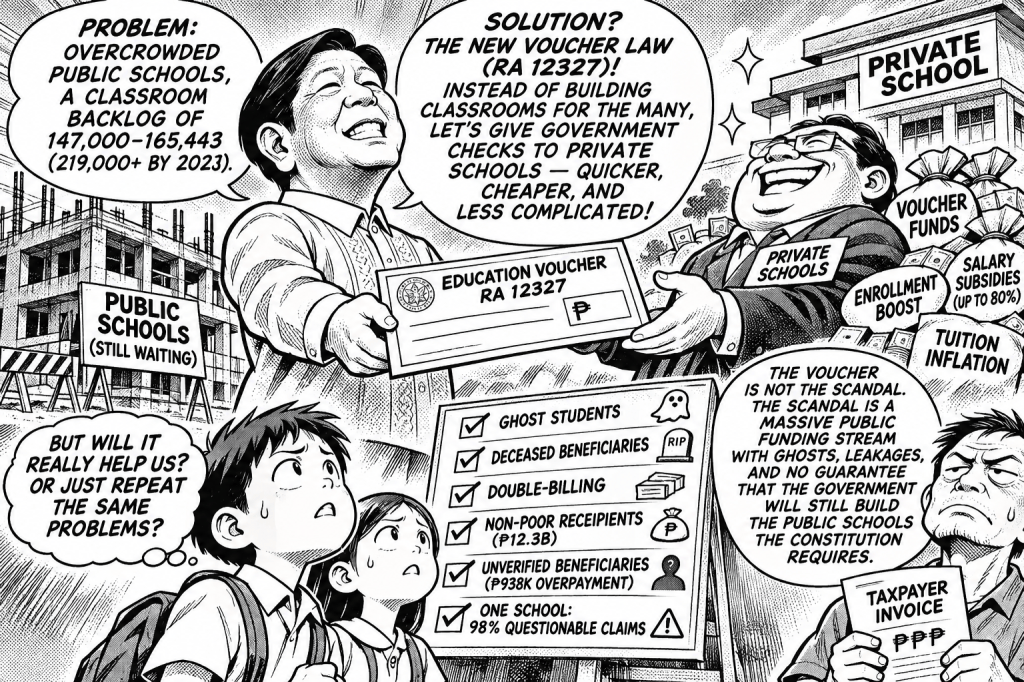
Nothing warms the heart quite like a government that has finally discovered the solution to decades of educational neglect: give the money to someone else. Republic Act No. 12327 (Basic Education Voucher Assistance Act), signed on November 12, 2026, and announced eight days later, is being peddled as landmark reform. In the grand tradition of Philippine education policy—from Government Assistance to Students and Teachers in Private Education (GASTPE) to Expanded Government Assistance to Students and Teachers in Private Education (E-GASTPE) to the Senior High School Voucher Program—we are told, with a straight face, that the answer to overcrowded public schools is to hand out checks to private schools and hope for the best.
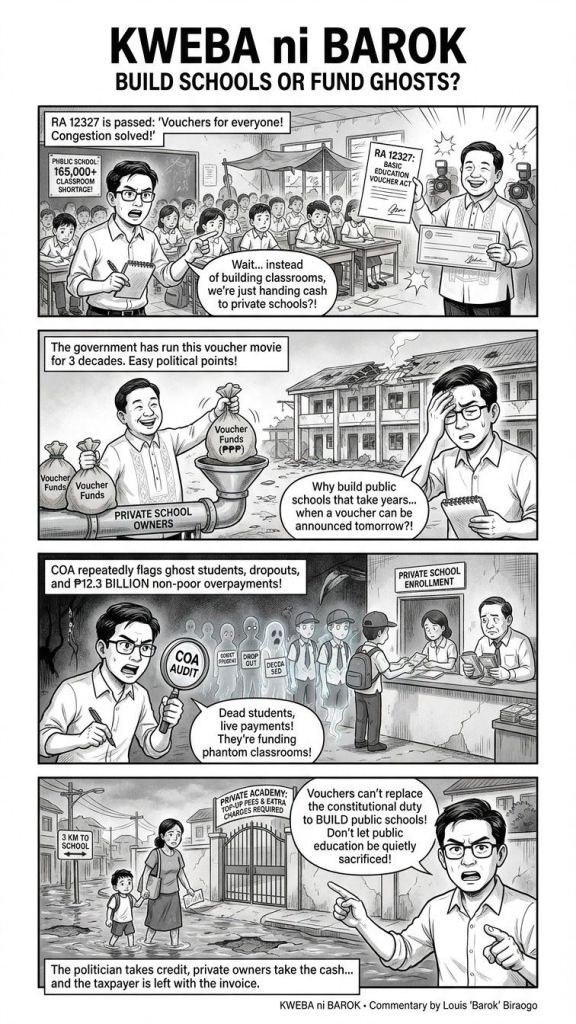
If that sounds familiar, it should. The government has been running this voucher movie for over three decades. The plot has not changed. Only the budget has.
Fine Print, Finer Promises
RA 12327 institutionalizes and expands government-funded vouchers for students from kindergarten through senior high school, targeting “middle-middle-income households and below” with higher amounts for lower-income families. It prioritizes learners from congested public schools—those exceeding Department of Education (DepEd) classroom-capacity standards or using multiple shifts—creates a Bureau of Private Education within DepEd, promises a public registry of participating schools, mandates payments within sixty days, and includes anti-fraud provisions. That last part is government-speak for: we know the last programs were riddled with fraud, and this time we’re really, really going to be careful.
The Constitution Says Yes. Relax.
The constitutional defense is not flimsy—Article XIV, Section 2(3) expressly authorizes subsidies for deserving students in both public and private schools, particularly the underprivileged. So let us dispense with the lazy argument that this is inherently unconstitutional. It is not.
The question is not whether the government can fund private education. The question is whether it will use this as a substitute for building public schools—a much harder question the law’s cheerleaders have conveniently avoided.
Vouchers Today, Classrooms Whenever
The law explicitly states that vouchers are part of a broader classroom-shortage strategy, including construction, rehabilitation, and public-private partnerships. This is a crucial safeguard. If vouchers are supplementary, they can serve as a useful pressure valve. But if they become the primary response to congestion, we are witnessing the quiet privatization of public responsibility. And the early signals are not reassuring.
DepEd has reported a classroom backlog of 147,000 to 165,443, with projections exceeding 219,000 by 2028. Building classrooms takes years—land acquisition, permits, procurement, construction, staffing. A voucher can be announced tomorrow. The political incentive is therefore overwhelming: why build classrooms for the many when you can subsidize vouchers for the few and claim you have solved the problem?
The Path of Least Resistance (Paved and Lit)
The temptation to declare victory through beneficiary counts while public schools continue to rot is not hypothetical. It is the path of least resistance, and this administration has never been known for resisting paths of least resistance.
Season Two: Now With More Ghosts
But the most damning evidence that this law is not the bold reform it claims lies in its predecessor programs. The new law does not repeal the old voucher framework so much as layer itself on top. And the old framework has been a recurring scandal.
Dead Students, Live Payments
The Commission on Audit (COA) has repeatedly flagged unverified beneficiaries, ghost students, dropouts, deceased students receiving vouchers, double-billing, and mismatched records. One school had approximately 98 percent questionable claims. In September 2026, COA flagged 58 unverifiable Senior High School voucher beneficiaries, resulting in approximately ₱938,000 in overpayments. Senator Win Gatchalian raised concerns that ₱12.3 billion in vouchers went to non-poor beneficiaries. DepEd has filed cases, secured convictions, terminated schools, and withheld hundreds of millions in suspicious claims. These are not minor administrative glitches. This is systemic leakage.
A Fancy Alarm on a House With No Doors
The new law responds with centralized verification, audits, inspections, whistleblower protection, and penalties of ₱100,000 to ₱500,000 for fraudulent claims, including restitution and possible prosecution under Republic Act No. 3019 (Anti-Graft and Corrupt Practices Act) for colluding officials. Good provisions on paper. But the historical record suggests a deeper problem: the government pays private schools based largely on information the schools themselves submit, and the verification apparatus has been woefully inadequate. Expanding the program without fixing the verification architecture is like installing a fancy new alarm system on a house with no doors.
Follow the Peso
And who benefits? Private-school owners and operators, naturally. The law creates a new public funding stream flowing directly into private institutions. Private schools have legitimate reasons to participate—filling unused capacity, improving financial sustainability, retaining teachers through salary subsidies of up to 80 percent of public school counterparts. But they also have an economic incentive to maximize voucher revenue.
The Student Is Merely the Delivery Address
The classic principal-agent problem applies: the government pays, the private school delivers, the student is the intended beneficiary, and the government may not directly observe the quality or authenticity of every service delivered. The result, predictably, could be tuition inflation, cream-skimming of easier-to-educate students, and a quiet understanding that the voucher is not really for the child—it is for the institution.
“Free” Education, Terms and Conditions Apply
Then there is the equity problem. The law covers “middle-middle-income households and below,” but a voucher is not automatically equivalent to free education. If it covers only a portion of tuition, the poorest families may still be excluded by incidental costs—uniforms, transportation, meals, laboratory fees, top-ups that schools can require. The program may formally offer school choice to poor families while practically delivering it only to families who can afford the remaining costs. This is not conjecture; it is the predictable outcome of a voucher design that does not account for the full cost of attendance.
Three Kilometers of Flooded Street
The law’s accessibility standard—schools within approximately three kilometers of a student’s residence—is similarly naive. Three kilometers may be walkable for a healthy adult. It is not walkable for a kindergarten child, a student with a disability, or a child navigating flooded streets in a country where pedestrian infrastructure is an afterthought. The reliance on distance-based rules without accounting for road safety, transportation costs, and disability access will disproportionately harm the very students the program claims to prioritize.
A Voucher to Nowhere
The regional equity problem is equally severe. Private-school capacity is not evenly distributed. Urban areas may have numerous participating schools; remote provinces, conflict-affected areas, and geographically isolated communities may have few or none. Equitable allocation of money is not the same as equitable access to schools. A region could receive funding on paper and still have no private schools capable of accepting beneficiaries. The Bangsamoro Autonomous Region in Muslim Mindanao (BARMM), which has historically faced the most severe educational deprivation, may find itself with vouchers but nowhere to spend them.
Public Schools, Left on Read
And what about the public schools that will now face the drain of students and political attention? Public-school teachers may see reduced overcrowding as a benefit, but they also fear—with justification—that voucher expansion will become an excuse for underfunding public education. If voucher budgets expand rapidly while classroom construction budgets stagnate, public-school maintenance is neglected, and teacher shortages continue, then the program may gradually become a substitute for public investment. That would contradict the law’s own recognition that vouchers must be part of a broader classroom-construction strategy. The law’s existence does not prevent its misuse. Only political will and sustained public pressure can do that.
Cui Bono? Not the Kid, Apparently
The most intriguing question, as always, is who benefits and why. President Marcos gets a visible education reform—a legacy initiative with measurable beneficiaries. Congress gets a legislative accomplishment and influence over education appropriations. DepEd gets a new bureau and expanded institutional authority. Private-school owners get enrollment and revenue. Teachers in private schools get training and salary subsidies. Parents and students get—well, the promise of school choice, which is nice if you can afford the top-up and if there is a participating school within reach and if the school does not find a way to exclude your child.
Not Crooked, Just Unproven
None of this is to say that RA 12327 is inherently corrupt or that its supporters are acting in bad faith. The law has genuine constitutional grounding, and there is a legitimate policy case for using existing private-school capacity to relieve congestion. But the gap between the law’s promise and its implementation is where the scandal lives. The government has created a massive public funding stream without proving that beneficiaries are real, that schools are qualified, that costs are reasonable, and that the public education system is not being quietly sacrificed.
The Constitution Doesn’t Take Vouchers Instead
The constitutional mandate to maintain a free public education system does not disappear just because a voucher is available. The government cannot simply argue that private schools are now available, so it no longer needs to build public classrooms. That would be a legally and politically dangerous interpretation, and the Supreme Court—should it ever be asked—would likely reject it.
Homework for the Public
What should the public watch over the next twelve to thirty-six months? Verify the beneficiaries. Check the public registry. Compare voucher spending to classroom construction budgets. Demand annual reports on congestion, learning outcomes, and equity. If voucher expansion is accompanied by aggressive public-school investment, the law may deserve to be considered a successful reform. If vouchers become a financial pipeline to private-school operators, generate ghost beneficiaries, inflate tuition, or serve as a political substitute for classroom construction, then the law’s promise will have been converted into another public expenditure with private beneficiaries and insufficient public accountability.
The Taxpayer Gets the Invoice
The voucher is not the scandal. The scandal is what happens when the government creates a massive public funding stream without proving that the beneficiaries are real, the schools are qualified, the costs are reasonable, and the public education system is not being quietly sacrificed. RA 12327 may become a genuine instrument of educational liberation—or another bureaucratic marketplace where the child is the advertised beneficiary, the school is the paid provider, the politician takes the credit, and the taxpayer is left holding the invoice. The difference will be determined by transparency, independent audit, real learning outcomes, and whether the government continues to build the public schools that the Constitution obliges it to maintain.
Don’t Hold Your Breath
So far, the signs are not encouraging. But then, they rarely are.
Key Citations
A. Legal & Official Sources
- Congressional Policy and Budget Research Department. “PB2024-06: Addressing Policy Gaps and Issues in the Expanded Government Assistance to Students and Teachers in Private Education (E-GASTPE) Program.” CPBRD, House of Representatives, cpbrd.congress.gov.ph/pb2024-06-addressing-policy-gaps-and-issues-in-the-expanded-government-assistance-to-students-and-teachers-in-private-education-e-gastpe-program/.
- EDCOM 2. “Landmark Basic Education Voucher Act Signed to Ease Public School Congestion.” Second Congressional Commission on Education, 20 Nov. 2026, edcom2.gov.ph/landmark-basic-education-voucher-act-signed-to-ease-public-school-congestion/.
- Gatchalian, Win. “Gatchalian Airs Frustration: ₱12.3 Billion in Vouchers Went to Non-Poor Beneficiaries.” Senate of the Philippines, 20 Jan. 2026, senate.gov.ph/media/news-release/gatchalian-airs-frustration123-billion-in-vouchers-went-to-non-poor-beneficiaries.
- Paqueo, Vicente B., et al. Strengthening and Expanding Government Assistance for Private Education. Discussion Paper Series No. 2025-17, Philippine Institute for Development Studies, 8 July 2025, doi.org/10.62986/dp2025.17.
- Philippine Constitution. 1987 Constitution of the Republic of the Philippines, art. XIV, sec. 2. LawPhil, lawphil.net/consti/cons1987.html.
- “President Marcos Signs Law Expanding Students’ Access to Quality Education via Voucher Assistance Program.” Presidential Communications Office, 20 Nov. 2026, pco.gov.ph/news_releases/president-marcos-signs-law-expanding-students-access-to-quality-education-via-voucher-assistance-program/.
- Republic Act No. 3019. Anti-Graft and Corrupt Practices Act. 17 Aug. 1960, lawphil.net/statutes/repacts/ra1960/ra_3019_1960.html.
- Republic Act No. 6728. Government Assistance to Students and Teachers in Private Education Act. 10 June 1989, lawphil.net/statutes/repacts/ra1989/ra_6728_1989.html.
- “The 1987 Constitution of the Republic of the Philippines – Article XIV.” Official Gazette of the Republic of the Philippines, http://www.officialgazette.gov.ph/constitutions/the-1987-constitution-of-the-republic-of-the-philippines/the-1987-constitution-of-the-republic-of-the-philippines-article-xiv/.
B. News Reports
- ABS-CBN News. “COA Flags ‘Unverifiable’ SHS Voucher Beneficiaries That Led to P938k Overpayments.” ABS-CBN News, 28 Sept. 2026, http://www.abs-cbn.com/news/nation/2026/9/28/coa-flags-unverifiable-shs-voucher-beneficiaries-that-led-to-p938k-overpayments-1926.
- ABS-CBN News. “New Law Establishes Basic Education Voucher Program to Help Address Classroom Backlog, Congestion.” ABS-CBN News, 20 Nov. 2026, http://www.abs-cbn.com/news/nation/2026/11/20/new-law-establishes-basic-education-voucher-program-to-help-address-classroom-backlog-congestion-1431.
- “Angara Warns Voucher Scammers as DepEd Tightens Anti-Fraud Safeguards.” The Manila Times, 9 Nov. 2026, http://www.manilatimes.net/2026/11/09/tmt-newswire/angara-warns-voucher-scammers-as-deped-tightens-anti-fraud-safeguards/2464964.
- “COA Flags DepEd Issuance of Vouchers to Deceased Students, Dropouts.” GMA News Online, GMA Network, 29 Sept. 2026, http://www.gmanetwork.com/news/topstories/nation/1004155/coa-flags-deped-issuance-of-vouchers-to-deceased-students-dropouts/story/.
- “DepEd Finds One School with 98% Possible ‘Ghost Students’ in Voucher Program.” Philstar.com, 20 Mar. 2025, http://www.philstar.com/headlines/2025/03/20/2429810/deped-finds-one-school-98-possible-ghost-students-voucher-program.
- “Marcos Signs Basic Education Voucher Law (RA 12327).” Newspapers.ph, 20 Nov. 2026, newspapers.ph/2026/11/marcos-signs-basic-education-voucher-assistance-act-ra-12327/.
- “Marcos Signs Law Expanding Education Voucher Program.” Manila Standard, 20 Nov. 2026, manilastandard.net/news/314820822/marcos-signs-law-expanding-education-voucher-program.html.
- “Marcos Signs Law Expanding Vouchers to Kindergarten, Elementary Students.” Philstar.com, 20 Nov. 2026, http://www.philstar.com/headlines/2026/11/20/2571466/marcos-signs-law-expanding-vouchers-kindergarten-elementary-students.
- “Voucher Program Now Covers Kinder to Grade 12 under New Law.” Rappler, 20 Nov. 2026, http://www.rappler.com/philippines/marcos-signs-basic-education-voucher-assistance-act/.

- “Ang Hirap Maging Mahirap”: The PAO Scandal That Proves Government Contempt Is Nothing New
- “Far-Off” My Axx: Malacañang’s Claire Castro Drowns in Her Own Legal Gaslighting
- “Forthwith” to Farce: How the Senate is Killing Impeachment—And Why Enrile’s Right (Even If You Can’t Trust Him)
- “HINDI AKO NAG-RESIGN!”

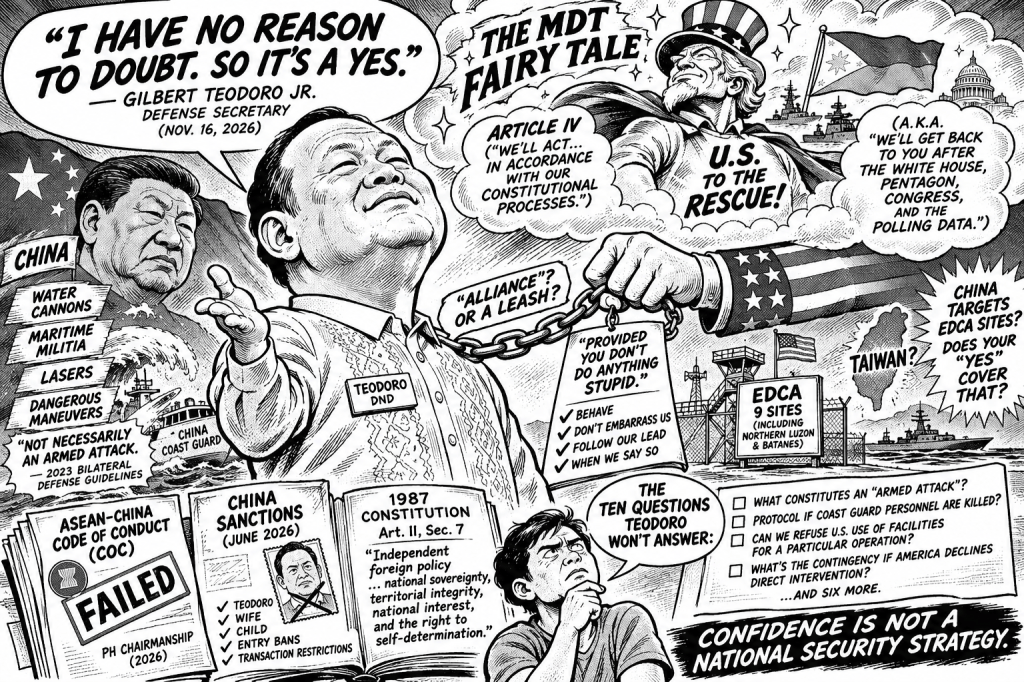
- “I Have No Reason to Doubt”: Teodoro’s MDT Fairy Tale
- “I Know Nothing”: Baste Duterte’s Amnesia Defense Meets ₱33M in GenCorp Contracts
- “I’m calling you from my new Globe SIM. Send load!”

- “Mahiya Naman Kayo!” Marcos’ Anti-Corruption Vow Faces a Flood of Doubt

- “Manageable” Debt, Unmanageable Corruption: The ₱19.66-Trillion Lie
- “Manageable” Debt, Unmanageable Lies: DBM’s ₱21 Trillion Fairy Tale
- “Meow, I’m calling you from my new Globe SIM!”

- “Natrabaho”: One Word, One Ombudsman, and a Judiciary on Trial




Leave a Reply