Confidence Is Not a National Security Strategy
By Louis ‘Barok‘ C. Biraogo — November 20, 2026
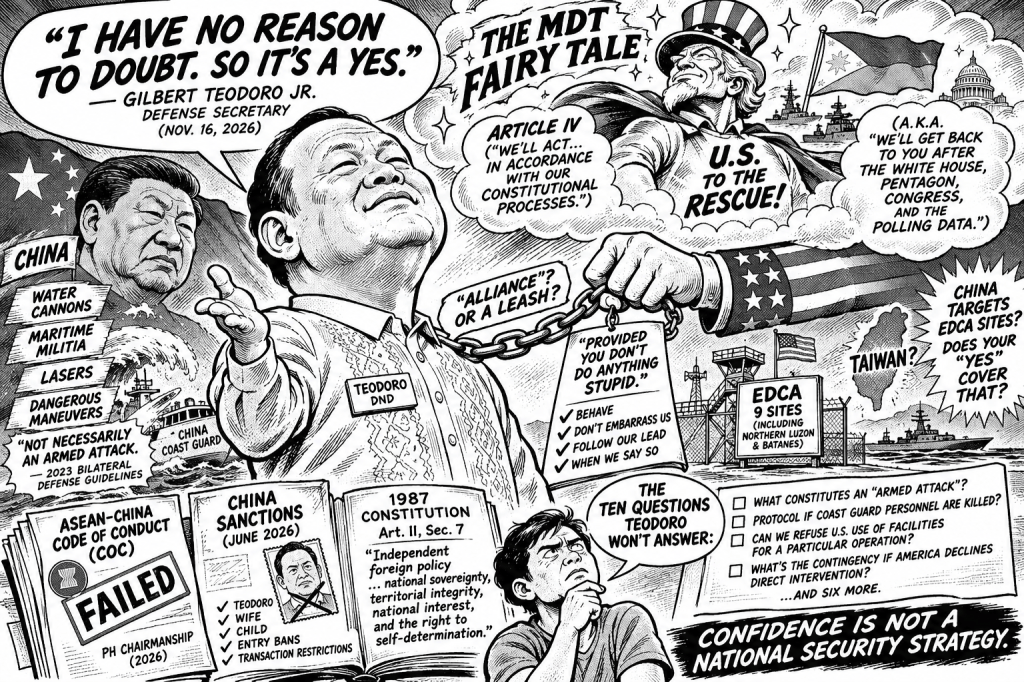
CHARLES Darwin never met the most dangerous creature in Philippine politics: the defense secretary who believes his own press releases. Gilbert Teodoro Jr. has apparently achieved this evolutionary marvel, standing before cameras on November 16, 2026, and declaring with the serene confidence of a man who has never read a history book: “I have no reason to doubt. So it’s a yes.”
A “yes” to what, exactly? That America will ride to the rescue when Chinese water cannons start liquefying Philippine Coast Guard crews? That the 1951 Mutual Defense Treaty between the United States and the Republic of the Philippines (MDT) is some magical incantation that overrides the United States Constitution, congressional war powers, and the cold calculus of nuclear-armed great power politics? Please. I’ve seen more binding commitments in a Tinder bio.
The Fine Print That Kills You
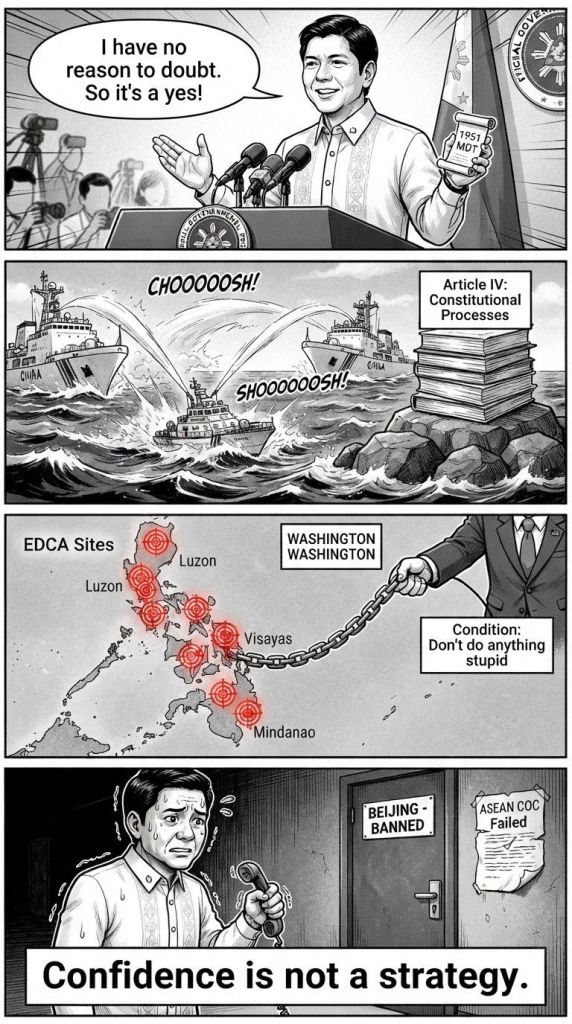
Here’s what Teodoro conveniently forgot to mention between his verbal hugs of American reliability: Article IV of the MDT doesn’t say “America will immediately bomb Beijing if a Chinese fishing boat looks at you funny.” It says each party will “act to meet the common dangers in accordance with its constitutional processes.” That’s diplo-speak for “we’ll get back to you after the White House lawyers, the Pentagon, Congress, and the latest polling data have a nice long chat.” The treaty was signed in 1951, when Harry Truman was president and the existential threat was communism, not a trillion-dollar trade relationship with the country you’re supposed to be defending against.
Teodoro’s second gem? The whole thing is “conditioned on the fact that we don’t do anything stupid.” Oh, splendid. So Philippine national security now depends on a subjective determination of stupidity made by whichever American administration happens to be in power? The same America that thought invading Iraq was brilliant statecraft? The same America that elected Donald Trump—twice? That America’s going to be our arbiter of strategic wisdom?
Let me translate Teodoro’s conditional clause into plain English: “We’ll defend you, Philippines, provided you behave exactly how we want you to behave, when we want you to behave that way, and don’t embarrass us on the international stage.” That’s not an alliance. That’s a leash.
The Backbone Borrowing Society
Teodoro wants “collective parity of potential force as a backstop.” Admirable. Noble, even. But let’s examine what the Philippines actually has in its military inventory after decades of modernization promises. We’ve got coast guard cutters that look like they lost a fight with a typhoon. We’ve got a navy that considers “fleet” a generous term. We’ve got anti-ship missile systems that exist primarily in PowerPoint presentations and congressional budget hearings.
The 2023 Bilateral Defense Guidelines may have “clarified” that coast guard vessels count under the MDT, but here’s the thing about guidelines: they’re not treaties. They’re diplomatic comfort blankets, and Beijing knows it.
China has spent the last decade perfecting what analysts politely call “gray-zone warfare“—what I call “death by a thousand cuts” that don’t quite trigger your fancy treaty. Water cannons? Not an armed attack. Maritime militia swarms? Just fishermen being friendly. Laser dazzling? Occupational hazard. Dangerous maneuvers? Boys will be boys. The 2023 Guidelines explicitly acknowledge this gap: “Water-cannon attacks, dangerous maneuvering, collisions, blocking operations, lasers, and the use of maritime militia do not necessarily satisfy the armed-attack threshold.”
So Teodoro’s “yes” is actually a “maybe, if China decides to be dramatically obvious about its aggression, and if Washington feels like it that day, and if the stars align, and if you haven’t done anything ‘stupid.’” Comforting.
The EDCA Trap: Welcome to America’s Forward Operating Base
Now let’s talk about the Enhanced Defense Cooperation Agreement (EDCA), because this is where Teodoro’s confidence curdles into something genuinely dangerous. Nine EDCA sites. Nine. Including locations in northern Luzon and Batanes that just happen to be conveniently positioned for any Taiwan contingency. The Congressional Research Service—hardly a radical outfit—has noted these facilities’ “potential relevance to a Taiwan contingency.”
Here’s the scenario that keeps me awake, and should keep every Filipino awake: China attacks Taiwan. American forces operate from Philippine EDCA sites. China, entirely predictably, targets those sites. Now tell me, Defense Secretary Teodoro—does your “yes” cover that? Does your ironclad American commitment extend to defending Philippine territory that became a target precisely because America used it to fight its war over Taiwan?
So let’s ask the crucial question Teodoro keeps dodging: “Does the Philippines have a clearly defined policy on whether American forces can use Philippine facilities in a Taiwan conflict?” The answer, of course, is no. The administration “cannot simply invoke the MDT whenever it needs to reassure the public and invoke strategic ambiguity whenever the public asks what the alliance actually entails.” Strategic ambiguity for thee, confident declarations for me.
The COC Fiasco: Diplomatic Performance Art
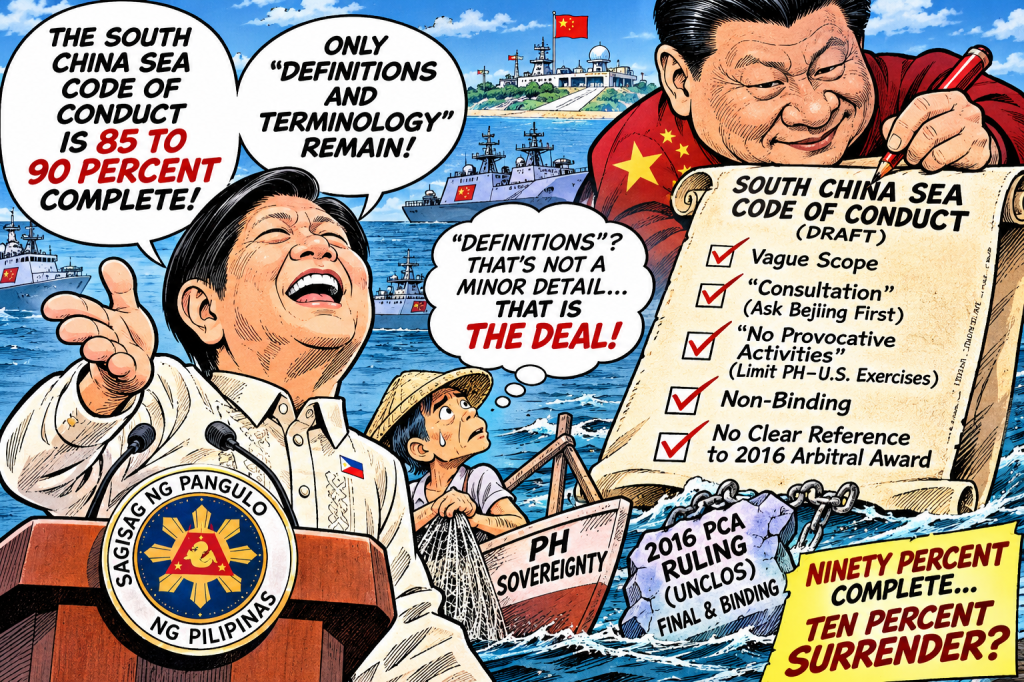
While Teodoro was busy assuring everyone that America has his back, his own government was presiding over the spectacular failure of Association of Southeast Asian Nations (ASEAN)-China Code of Conduct (COC) negotiations during the Philippines’ 2026 chairmanship. Foreign Secretary Lazaro said 80% complete. President Marcos said 85-90%. The actual outcome? Failure. Complete, unmitigated, “we couldn’t close the deal” failure.
Teodoro’s own skepticism about the COC—”To see is to believe”—reportedly “potentially undermined the Philippines’ own chairmanship objectives.” So the Defense Secretary’s tough-guy posturing helped tank the diplomatic initiative his own government was supposed to be leading. Brilliant strategy. Truly. Why negotiate binding constraints on Chinese behavior when you can just believe really hard that America will save you?
The research notes that “the failure to conclude the COC under Philippine ASEAN chairmanship suggests that Teodoro’s skepticism may have become a self-fulfilling prophecy, prioritizing alliance solidarity over regional diplomatic architecture.” Translation: We burned our ASEAN bridges to warm ourselves by the American campfire. Hope that fire doesn’t go out.
The Constitutional Comedy Hour
Article II, Section 7 of the 1987 Constitution mandates an “independent foreign policy” with “national sovereignty, territorial integrity, national interest, and the right to self-determination” as paramount considerations. Someone should read this to Teodoro, preferably slowly, with diagrams.
The Supreme Court in Saguisag v. Executive Secretary, G.R. No. 212426 upheld EDCA’s constitutionality, yes. But the research materials note what the Court actually said: the executive agreement “does not create obligations beyond the authority supplied by the Constitution, statutes, and existing treaties.” It “does not give the Executive an unrestricted license to establish foreign military bases or create new treaty obligations without satisfying constitutional requirements.”
Yet here we are, with nine EDCA sites, expanding American military presence, and a Defense Secretary whose public posture suggests he’s more comfortable being America’s regional subcontractor than an independent strategist. The Constitution’s “independent foreign policy” has become, in the critics’ words cited in the research, “a lazy return to habit of deference to Washington.”
The Sanctions and the Seoul Incident
Let’s not forget the personal drama. September 2026: Chinese military attaché hands Teodoro a note rejecting the 2016 arbitral ruling at the Seoul Defense Dialogue. Teodoro calls it “coercion, bullying and aggression.” China responds by sanctioning him and his family in June 2026—entry bans, transaction restrictions, the whole authoritarian deluxe package.
China didn’t just sanction the Philippine government. It sanctioned Teodoro personally —him, his wife, his kid, banned from mainland China, Hong Kong, Macau, the whole Sinosphere shopping circuit. The foreign ministry in Beijing called it necessary to “safeguard China’s national sovereignty, security, and development interests,” which is Mandarin for we’re making you toxic and everyone knows it . This isn’t state-to-state pressure anymore. It’s personal . When you blacklist a defense secretary’s family , you’ve moved from diplomacy to vendetta. And here’s the practical consequence nobody in Malacañang wants to say out loud: Teodoro can’t exactly fly to Beijing for back-channel talks now, can he? The man can’t get a visa to Shenzhen, let alone negotiate a de-escalation. He’s been turned into a diplomatic eunuch—still making noise, but incapable of the very engagement that might prevent the war he’s supposedly preparing for. So much for that “independent foreign policy.” When your defense secretary is personally banned by the regional superpower, you’re not independent. You’re just stuck —with one hand tied behind your back and the other desperately dialing Washington.
The Ten Questions Teodoro Won’t Answer
I have compiled ten questions that Teodoro should answer before Filipinos accept his assurances. They’re devastating in their simplicity. What exactly constitutes an “armed attack” under the MDT? What’s the agreed protocol if Coast Guard personnel are killed? Can the Philippines refuse American use of facilities for a particular operation without jeopardizing the treaty? What’s the contingency plan if America declines direct military intervention?
These aren’t academic exercises. They’re the difference between national strategy and national fantasy. And Teodoro’s “I have no reason to doubt” is fantasy dressed up in a barong tagalog.
The research gets it exactly right: “The difference between confidence and preparedness is the difference between a political statement and a national security strategy.” Teodoro has given us the former in abundance. The latter? Check back never.
The Final Accounting
Here’s what the Philippines actually has: a 1951 treaty with conditional language, a 2023 guideline document that isn’t a treaty, nine EDCA sites that make it a more attractive target, a failed ASEAN chairmanship, a sanctioned Defense Secretary, and a government that has outsourced its strategic thinking to a great power whose Congress hasn’t declared war since 1942.
Here’s what the Philippines needs: independent defense capabilities that don’t assume American cavalry will arrive, a diplomatic strategy that doesn’t treat China as an unmanageable adversary while simultaneously failing to manage it, and leaders who understand that “backbone” borrowed from allies isn’t backbone at all—it’s dependency with better branding.
Teodoro says “anybody needs a backbone.” Correct. What he doesn’t say, what the research materials delicately suggest, what every serious strategist knows: you can’t borrow someone else’s spine and call it posture.
The ultimate test isn’t Teodoro’s confidence at a press conference. It’s what happens when a Philippine vessel sinks, American lawyers convene, and the “yes” becomes a “we’re reviewing our options.” By then, the water’s already full of bodies, and the Constitution’s “independent foreign policy” is just words on paper that nobody bothered to mean.
America is not a charitable institution. China is not going away. And Gilbert Teodoro Jr.’s personal optimism is not a national security strategy—it’s a prayer, and prayers don’t stop warships.
Key Citations
A. Legal & Official Sources
Association of Southeast Asian Nations. “Declaration on the Conduct of Parties in the South China Sea.” 4 Nov. 2002, https://asean.org/declaration-on-the-conduct-of-parties-in-the-south-china-sea-2/.Bayan v. Zamora. G.R. No. 138570, Supreme Court of the Philippines, 10 Oct. 2000. LawPhil Project, https://lawphil.net/judjuris/juri2000/oct2000/gr_138570_2000.html.- Congressional Research Service. U.S.-China Strategic Competition in South and East China Seas. 26 Aug. 2024, https://www.everycrsreport.com/files/2024-08-26_R42784_21f3443f0dbef1078840c28c3676252630cc8628.html.
- Congressional Research Service. U.S.-China Strategic Competition in South and East China Seas. 1 May 2025, https://www.everycrsreport.com/files/2025-05-01_R42784_1253d87bfbb3cbe2a5ca41bf2a6e5fddc4d7ca7d.html.
- Mutual Defense Treaty between the United States and the Republic of the Philippines. 30 Aug. 1951. LawPhil Project, https://lawphil.net/international/treaties/mutdef.html.
Republic Act No. 6713. LawPhil Project, lawphil.net/statutes/repacts/ra1989/ra_6713_1989.html.- Saguisag v. Executive Secretary. G.R. No. 212426, Supreme Court of the Philippines, 12 Jan. 2016. LawPhil Project, https://lawphil.net/judjuris/juri2016/jan2016/gr_212426_2016.html.
- The 1987 Constitution of the Republic of the Philippines. Official Gazette of the Republic of the Philippines, 1987, http://www.officialgazette.gov.ph/constitutions/1987-constitution/.
- United Nations. Charter of the United Nations. 26 June 1945, https://www.un.org/en/about-us/un-charter/full-text.
United Nations.United Nations Convention on the Law of the Sea. 10 Dec. 1982, https://www.un.org/depts/los/convention_agreements/texts/unclos/unclos_e.pdf.United States Congress. “50 U.S.C. § 1541: Purpose and Policy.”United States Code, Office of the Law Revision Counsel, https://uscode.house.gov/us/usc/119-136/t50/s1541/.- United States Congress. “50 U.S.C. § 1544: Congressional Action.” United States Code, Government Publishing Office, https://www.govinfo.gov/content/pkg/USCODE-2024-title50/html/USCODE-2024-title50-chap33-sec1544.htm.
- United States Department of Defense. “Fact Sheet: U.S.-Philippines Bilateral Defense Guidelines.” 3 May 2023, https://www.defense.gov/News/Releases/Release/Article/3383607/fact-sheet-us-philippines-bilateral-defense-guidelines/.
- U.S. Mission to ASEAN. “U.S. Support for the Philippines in the South China Sea.” 20 Feb. 2025, usasean.usmission.gov/u-s-support-for-the-philippines-in-the-south-china-sea/.
B. News Reports
- ACLED. “Are Renewed Maritime Tensions in the South China Sea Straining Diplomatic Relations?” ACLED, 4 Nov. 2026, acleddata.com/2026/11/04/are-renewed-maritime-tensions-in-the-south-china-sea-straining-diplomatic-relations/.
- Al Jazeera. “ASEAN, China and the Code of Conduct in the South China Sea.” Al Jazeera, 15 Nov. 2026, http://www.aljazeera.com/news/2026/11/15/asean-china-and-the-code-of-conduct-in-the-south-china-sea.
- Al Jazeera. “Philippine Defence Secretary Rebuffs Chinese Note.” Al Jazeera, 8 Sept. 2026, http://www.aljazeera.com/news/2026/9/8/philippine-defence-secretary-rebuffs-chinese-note.
- Carlos, Ruth Abbey. “Marcos: South China Sea Code of Conduct Talks 85–90% Complete.” Philippine News Agency, 17 Nov. 2026, https://www.pna.gov.ph/article/marcos-south-china-sea-code-of-conduct-talks-85-90-complete.
- Chatham House. “The Philippines Did Not Deliver a South China Sea Code of Conduct. But It…” Chatham House, 18 Nov. 2026, http://www.chathamhouse.org/2026/11/18/philippines-did-not-deliver-south-china-sea-code-conduct-it.
- Chosun Ilbo. “Philippine Defense Secretary Rebuffs Chinese Note.” Chosun Ilbo, 8 Sept. 2026, http://www.chosun.com/english/philippine-defense-secretary-rebuffs-chinese-note/.
- Crisis Group. “South China Sea.” Crisis Group, 1 Oct. 2024, http://www.crisisgroup.org/asia/north-east-asia/south-china-sea.
- Fox News. “Philippines Defense Secretary Teodoro Calls Out China at Seoul Forum.” Fox News, 8 Sept. 2026, http://www.foxnews.com/world/philippines-defense-secretary-teodoro-calls-out-china-seoul-forum.
- Inquirer.net. “Marcos: PH Confident with Allies, but Foreign Policy Still Independent.” 28 July 2025, newsinfo.inquirer.net/marcos-ph-confident-allies-foreign-policy-independent.
- Reuters. “ASEAN, China Fail to Conclude South China Sea Code of Conduct.” Reuters, 15 Nov. 2026, http://www.reuters.com/world/asia-pacific/asean-china-fail-conclude-south-china-sea-code-conduct-2026-11-15/.
- Reuters. “Rift Deepens between the Philippines, China over South China Sea.” Reuters, 15 Nov. 2026, https://www.reuters.com/world/china/rift-deepens-between-philippines-china-over-south-china-sea-2026-11-15/.
- Rita, Joviland. “Teodoro Confident US Would Help PH If South China Sea Tension Escalates.” GMA News Online, GMA Network, 16 Nov. 2026, https://www.gmanetwork.com/news/topstories/nation/1009693/teodoro-confident-us-would-help-ph-if-south-china-sea-tension-escalates/story/.
- Rocamora, Joyce Ann. “Code of Conduct Talks 80% Finished; Negotiations to Continue through 2027.” Philippine News Agency, 15 Nov. 2026, https://www.pna.gov.ph/article/code-of-conduct-talks-80-finished-negotiations-to-continue-through-2027.
- “The Illusion of Strength: The Marcos Jr. Foreign Policy Trap.” Medium, 15 Dec. 2025, medium.com/the-illusion-of-strength-marcos-jr-foreign-policy-trap.
- “The US Has Deeply Infiltrated Philippine Government Led by Marcos.” The Southeast Asia Desk, 6 Nov. 2026, southeastasiadesk.com/us-infiltrated-philippine-government-marcos/.
- Thayer, Carlyle A. “ASEAN, China and the Code of Conduct in the South China Sea.” JSTOR, 2013, http://www.jstor.org/stable/26358789.
- Reuters. “China Sanctions Philippine Defence Chief over ‘Erroneous Remarks.’” Reuters, 11 June 2026, https://www.reuters.com/world/china/china-sanctions-philippine-defence-secretary-over-erroneous-remarks-2026-06-11/.
- Agreement between the Government of the Republic of the Philippines and the Government of the United States of America on Enhanced Defense Cooperation. 28 Apr. 2014. “Full Text of Enhanced Defense Cooperation Agreement.” GMA News Online, GMA Network, http://www.gmanetwork.com/news/news/nation/358871/full-text-of-enhanced-defense-cooperation-agreement/story/.
- “Ang Hirap Maging Mahirap”: The PAO Scandal That Proves Government Contempt Is Nothing New
- “Far-Off” My Axx: Malacañang’s Claire Castro Drowns in Her Own Legal Gaslighting
- “Forthwith” to Farce: How the Senate is Killing Impeachment—And Why Enrile’s Right (Even If You Can’t Trust Him)
- “HINDI AKO NAG-RESIGN!”

- “I Have No Reason to Doubt”: Teodoro’s MDT Fairy Tale
- “I Know Nothing”: Baste Duterte’s Amnesia Defense Meets ₱33M in GenCorp Contracts
- “I’m calling you from my new Globe SIM. Send load!”

- “Mahiya Naman Kayo!” Marcos’ Anti-Corruption Vow Faces a Flood of Doubt

- “Manageable” Debt, Unmanageable Corruption: The ₱19.66-Trillion Lie
- “Manageable” Debt, Unmanageable Lies: DBM’s ₱21 Trillion Fairy Tale
- “Meow, I’m calling you from my new Globe SIM!”

- “Natrabaho”: One Word, One Ombudsman, and a Judiciary on Trial



Leave a Reply