When the Head Prosecutor Whispers What the Whole Republic Is Screaming
By Louis ‘Barok‘ C. Biraogo — August 7, 2026
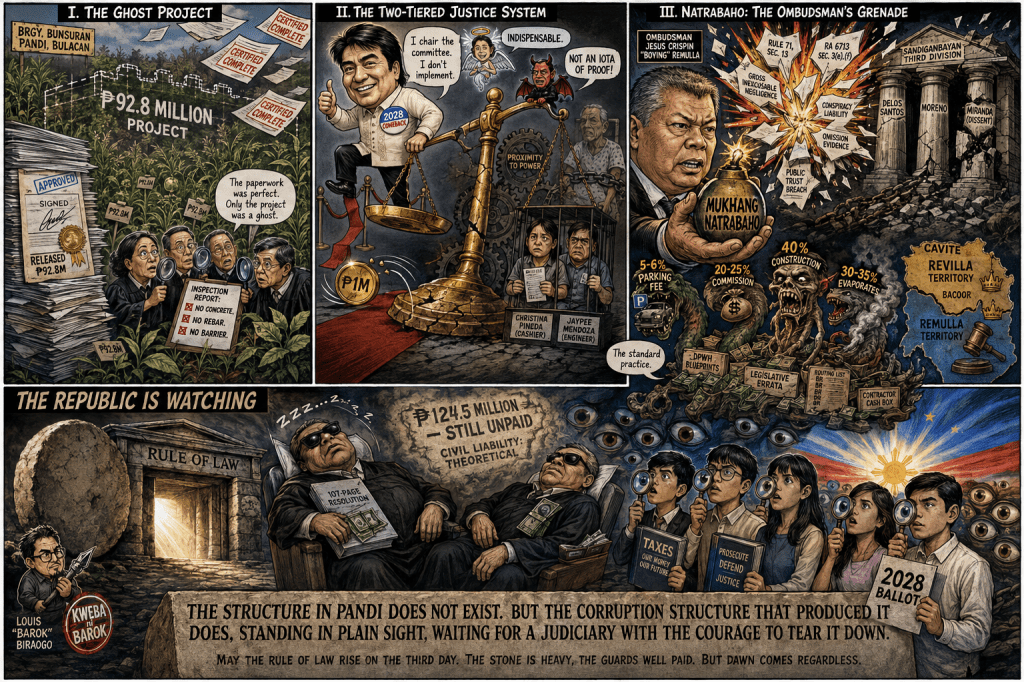
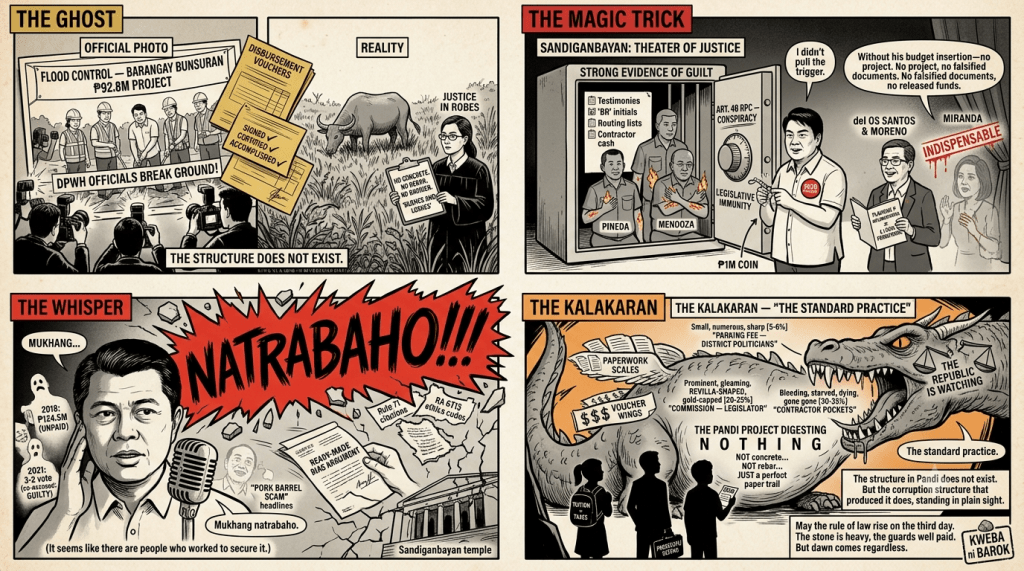
THE structure does not exist. The Sandiganbayan justices went to Barangay Bunsuran, Pandi, Bulacan, and saw for themselves: no concrete, no rebar, no flood control barrier. Just, as the inspection report noted, “bushes and lushes.” Yet ₱92.8 million had been released. Disbursement vouchers signed. Accomplishment reports certified. The paperwork was perfect. Only the project was a ghost.
What happens next is a magic trick. The senator who allegedly caused this ghost to be funded, who allegedly expected a kickback, walks free on a ₱1-million bond. The Department of Public Works and Highways (DPWH) cashier and engineer who processed the paperwork remain behind bars. The Sandiganbayan majority calls this a faithful application of the “strong evidence of guilt” standard. Justice Karl Miranda, dissenting, calls Bong Revilla’s role “indispensable.” The Ombudsman mutters two words: “Mukhang natrabaho.”
A bail hearing becomes a constitutional stress test. The Republic is failing.
I. The Indispensable Senator and the Vanishing Conspiracy
The majority’s 107-page resolution—penned by Associate Justice Fritz Bryn Anthony Delos Santos, with Associate Justice Ronald Moreno concurring—declares there is “not an iota of proof” that Revilla explicitly or implicitly agreed to receive kickbacks with the understanding that funds would be recovered through malversation.
Read that again. The majority demands a signed receipt. A notarized kickback agreement. This is not a standard of proof. It is a shield for the powerful.
The evidence presented was not trivial. Former DPWH Undersecretary Roberto Bernardo testified to delivering money to Revilla’s Cavite residence and described a P1.5-billion allocation with a 25-percent “commitment” rate. Former DPWH engineer Henry Alcantara testified to transmitting project lists. DPWH Regional Director Gerard Opulencia testified to raising money from contractors. Documentary evidence included lists bearing Revilla’s initials and a DPWH routing list marked “For Funding Sen. Bong Revilla.”
The majority’s response? Those acts occurred during the planning stage. Malversation occurred during implementation. Revilla, as a legislator, had no participation in implementation.
This is the legal equivalent of arguing the man who hires a hitman did not pull the trigger. Article 48 of Act No. 3815 (the Revised Penal Code) punishes complex crimes where a single act constitutes multiple felonies and does not require the principal to be present at every stage. The act of one conspirator is the act of all. That is first-year criminal law. By severing planning from execution, the majority has invented a new rule: legislators who create the conditions for corruption bear no responsibility for the corruption they create.
Justice Miranda’s dissent dismantles this. Revilla was “indispensable.” Without his budget insertion—effected through a legislative errata—there would be no project. No project, no falsified documents. No falsified documents, no released funds. The chain of causation is unbroken. The majority simply chose not to follow it.
II. The Two-Tiered Justice System, Live and Uncut
Bong Revilla is free. Christina Pineda, the DPWH cashier, is not. Jaypee Mendoza, the engineer, is not. The alleged mastermind is at home preparing a 2028 comeback. The subordinates who executed his will remain in detention.
The majority explains: the DPWH officials had direct custody of funds, signed falsified documents, and were accountable officers under Article 217 of the Revised Penal Code. Revilla had no such custody. Legally, a distinction. Morally, an obscenity.
Article III, Section 1 of the 1987 Constitution guarantees equal protection. The New Code of Judicial Conduct for the Philippine Judiciary (A.M. No. 03-05-01-SC) mandates that justice must be seen to be done. The public sees a senator walk while a cashier rots. Whatever the legal merits, the public sees what it sees: a justice system where proximity to power is the most reliable predictor of liberty.
The comparison to political detainees is unavoidable. Elderly, ill prisoners like 77-year-old Vicente Ladlad have been detained for years without conviction. Revilla, facing a ghost project where no structure exists, is free within a year of indictment. This asymmetry is not anomaly. It is design.
III. The “Natrabaho” Earthquake
Ombudsman Jesus Crispin Remulla knew what he was doing. A veteran lawyer, former Justice Secretary, and scion of the Remulla dynasty—arch-rivals of the Revillas for Cavite’s political soul—he did not casually say the bail looked “natrabaho.” He launched a grenade into the architecture of inter-branch relations.
Rule 71 of the Rules of Court punishes statements degrading the administration of justice. Republic Act No. 6713 (Code of Conduct and Ethical Standards for Public Officials and Employees) requires public officials to deal with other institutions professionally. Publicly suggesting a collegial court was compromised flirts with contempt and hands the defense a ready-made bias argument.
And yet, is he wrong to be suspicious?
This is not Revilla’s first escape. In 2018, the Sandiganbayan acquitted him of plunder in the pork barrel scam while ordering him to return P124.5 million—still unpaid. In 2021, a 3-2 vote acquitted him of graft. His co-accused, including his staff member, were convicted and sentenced to reclusion perpetua. The pattern is undeniable: the principal walks, subordinates absorb the sanctions, civil liability becomes theoretical abstraction. The Pandi bail ruling is the third movement in a symphony of impunity.
The Ombudsman’s procedural move—filing a motion for reconsideration before seeking a Rule 65 certiorari petition—is legally correct. He must exhaust remedies before alleging grave abuse of discretion. But the certiorari bar is punishingly high: he must show not error, but arbitrariness so extreme it constitutes a jurisdictional defect. Even Miranda’s dissent may not clear that threshold.
IV. The Dynastic Subtext
This case is a dynastic war by other means. The Revillas of Bacoor and the Remullas of Cavite’s political establishment have been rivals for decades. Bong Revilla is a former senator; his wife Lani Mercado is a congresswoman; his children occupy elective posts. Boying Remulla is the Ombudsman; his brother Jonvic is the DILG Secretary; his family has produced governors and congressmen.
When the Ombudsman prosecutes a Revilla, it is never just about evidence. It is simultaneously a legal proceeding and a political contest. Every procedural victory is capital. Every legal defeat is humiliation. The Remullas have institutional incentive to secure conviction. The Revillas have personal incentive to portray themselves as victims of weaponized justice.
This does not mean the case is fabricated. The documentary evidence exists. The ghost project does not exist—which is the point. But it means the public cannot trust the case is prosecuted solely for justice. It is prosecuted, in part, for Cavite. Revilla’s defense has a narrative to sell: “They are not prosecuting a crime; they are prosecuting a man.”
V. The Kalakaran That Devours the Republic
This case is not about one senator or one ghost project. It is about a corruption system so embedded it has a name: kalakaran. The standard practice.
Senator Lacson’s 2025 privilege speech laid out the architecture: 5-6 percent as a “parking fee” for district politicians, 20-25 percent as commission for the legislator who secured budget inclusion, and—at best—40 percent for actual construction. The remaining 30-35 percent evaporates into contractor pockets.
The Pandi ghost is not anomaly. It is specimen. Under this formula, a P92.8-million appropriation yields approximately P55.68 million in kickbacks and zero in construction. The project site is a monument to the system’s perfection: paperwork complete, funds disbursed, flood control barrier existing only in collective imagination.
When the anti-graft court treats kalakaran as isolated, legally distinct acts rather than an integrated conspiracy, it ignores reality. The Supreme Court in People v. Dumlao and Basco v. Rapatalo has held that bail hearings require summary assessment of the totality of evidence. The totality here includes DPWH insider testimony, documentary records of Revilla’s budget intervention, a physical inspection revealing nothing, and the documented kalakaran that explains why these pieces fit together. The majority’s atomization of this evidence is not faithful adjudication. It is willful blindness.
VI. The Citation Game: Enrile as Misdirection
The resolution reportedly invokes Enrile v. Sandiganbayan (G.R. No. 213847, August 18, 2015) for the proposition that bail may issue when evidence of guilt is not strong. This is misdirection.
The Enrile ruling allowed the ailing Senator Juan Ponce Enrile provisional liberty on humanitarian grounds despite assuming evidence might be strong. The decision rested on constitutional guarantees against undue restraint and bail’s purpose as security for appearance. It did not hold evidence was weak. It held that even strong evidence could yield to humanitarian considerations.
The Revilla majority borrows Enrile’s rhetorical weight for a legally distinct proposition—an “evidence not strong” holding unrelated to humanitarian concerns. The Ombudsman’s motion for reconsideration should press this. If the Sandiganbayan is releasing alleged plunderers, it should at least cite the right cases.
VII. What Comes Next
The motions for reconsideration will likely be resolved within weeks. The Third Division can deny them, grant them and reverse itself (institutionally costly), or deny reconsideration while clarifying reasoning to address Miranda’s points.
If denied, the Ombudsman faces the certiorari gauntlet. The Supreme Court can decline to disturb the bail grant or annul it and order re-detention—a rare intervention. It could also clarify Enrile’s actual scope, correcting the citation ambiguity.
Whatever happens on bail, the malversation case proceeds to trial, where the standard is proof beyond reasonable doubt—a standard Revilla’s team has defeated twice. The Ombudsman’s task is not merely winning bail. It is building a trial record strong enough that even a reluctant court cannot reasonably acquit.
VIII. The Unpaid P124.5 Million
The Ombudsman has repeatedly invoked Revilla’s unpaid civil liability from the 2018 acquittal. The paradox is real: how can one be ordered to return money a court found him not guilty of stealing? Civil liability can survive an acquittal based on reasonable doubt rather than a finding the act did not occur. But the paradox points to deeper dysfunction: the state’s near-total inability to recover assets from the politically powerful. The unpaid judgment is a monument to the gap between legal accountability and actual consequence.
IX. A Call to the Republic
We are left staring at a field of bushes and lushes in Bulacan, holding a 107-page resolution insisting there is no proof against the senator whose initials are on the routing list, while a cashier and engineer sit in detention. The majority has spoken. What it has said is that kalakaran is legal, that the indispensable conspirator is not a conspirator, that the architecture of Philippine corruption is safe from judicial scrutiny so long as no one signs a confession.
The rule of law cannot survive where senators are immune from ghost projects and cashiers are not. It cannot survive where the kalakaran is common knowledge and courts treat it as legally invisible. It cannot survive where dynastic rivals use prosecution as weapon and courts as shield.
What is required: a reversal of this bail ruling, yes. But more—a systematic dismantling of the kalakaran. Comprehensive DPWH procurement reform eliminating discretionary pools from which legislators extract commissions. A strengthened Ombudsman investigative capacity that builds cases even reluctant courts cannot dismiss. A judicial culture that treats the totality of circumstantial evidence in conspiracy cases as sufficient rather than demanding signed confessions.
Most of all, a citizenry that refuses to accept the pattern. The youth who will inherit this Republic—students whose taxes will fund ghost projects, young lawyers who will prosecute or defend them, future voters choosing between dynastic candidates—must see this case as a choice between accountability and impunity. The choice will be made not in paneled chambers but in the public square, by those who refuse to believe the kalakaran is inevitable simply because it is old.
The structure in Pandi does not exist. But the corruption structure that produced it does, standing in plain sight, waiting for a judiciary with the courage to tear it down. May the rule of law rise on the third day. The stone is heavy, the guards well paid. But dawn comes regardless, and with it, the possibility of an accounting.
The Republic is watching. 🪨
Key Citations
A. Legal & Official Sources
- The 1987 Constitution of the Republic of the Philippines. Official Gazette of the Republic of the Philippines, 1987, http://www.officialgazette.gov.ph/constitutions/1987-constitution/.
- Act No. 3815. The Revised Penal Code. 1930, lawphil.net/statutes/acts/act1930/act_3815_1930.html.
- Republic Act No. 6713. An Act Establishing a Code of Conduct and Ethical Standards for Public Officials and Employees. 1989, lawphil.net/statutes/repacts/ra1989/ra_6713_1989.html.
- A.M. No. 03-05-01-SC. New Code of Judicial Conduct for the Philippine Judiciary. 27 Apr. 2004, http://www.ecodalplus.com/ecodals/legal-and-judicial-ethics/Code-of-Judicial-Conduct.
- Rules of Court, Rule 71. 1997, lawphil.net/courts/rules/rc_1-71_civil.html.
- Rules of Court. Rule 65, Certiorari, Prohibition and Mandamus. 1997 (as amended), lawphil.net/courts/rules/rc_1-71_civil.html#r65.
- Enrile v. Sandiganbayan. G.R. No. 213847, 18 Aug. 2015, lawphil.net/judjuris/juri2015/aug2015/gr_213847_2015.html.
- Basco v. Rapatalo. A.M. No. RTJ-96-1335, 5 Mar. 1997, lawphil.net/judjuris/juri1997/mar1997/am_96_1335_1997.html.
- People v. Dumlao. G.R. No. 168918, 2 Mar. 2009, lawphil.net/judjuris/juri2009/mar2009/gr_168918_2009.html.
B. News Reports
- Panti, Llanesca T. “Ombudsman Appeals Bong Revilla’s Temporary Freedom in Flood Control Project Case.” GMA News Online, GMA Network, 5 Aug. 2026, http://www.gmanetwork.com/news/topstories/nation/997469/ombudsman-appeals-bong-revilla-s-temporary-freedom-in-flood-control-project-case/story/.
- Mangaluz, Jean. “Bong Revilla Was Granted Bail in Flood Control Case.” GMA News Online, GMA Network, 1 Aug. 2026, http://www.gmanetwork.com/news/topstories/nation/997019/explainer-why-bong-revilla-was-granted-bail-in-flood-control-case/story/.
- Lalu, Gabriel. “Bong Revilla Acquitted of Plunder.” Inquirer.net, Philippine Daily Inquirer, 7 Dec. 2018, newsinfo.inquirer.net/1060679/bong-revilla-not-guilty-of-plunder-sandiganbayan.
- “Out on Bail, Revilla Still Owes Gov’t P124.5M, Says Ombudsman.” Inquirer.net, Philippine Daily Inquirer, 1 Aug. 2026, newsinfo.inquirer.net/2275418/out-on-bail-revilla-still-owes-govt-p124-5m-says-ombudsman.
- “Dissenting Sandigan Justices: Bong Revilla Can’t Be Innocent.” Inquirer.net, Philippine Daily Inquirer, 8 July 2021, newsinfo.inquirer.net/1457151/dissenting-sandigan-justices-bong-revilla-cant-be-innocent.
- Lacson, Panfilo. “Flooded Gates of Corruption: Privilege Speech on Flood Control Projects.” Office of Senator Ping Lacson, 20 Aug. 2025, pinglacson.net/2025/08/20/flooded-gates-of-corruption-privilege-speech-on-flood-control-projects/.
- “Ang Hirap Maging Mahirap”: The PAO Scandal That Proves Government Contempt Is Nothing New

- “Far-Off” My Axx: Malacañang’s Claire Castro Drowns in Her Own Legal Gaslighting
- “Forthwith” to Farce: How the Senate is Killing Impeachment—And Why Enrile’s Right (Even If You Can’t Trust Him)

- “HINDI AKO NAG-RESIGN!”

- “I Know Nothing”: Baste Duterte’s Amnesia Defense Meets ₱33M in GenCorp Contracts

- “I’m calling you from my new Globe SIM. Send load!”

- “Mahiya Naman Kayo!” Marcos’ Anti-Corruption Vow Faces a Flood of Doubt

- “Manageable” Debt, Unmanageable Lies: DBM’s ₱21 Trillion Fairy Tale
- “Meow, I’m calling you from my new Globe SIM!”

- “Natrabaho”: One Word, One Ombudsman, and a Judiciary on Trial
- “No Special Jail for Crooks!” Boying Remulla Slams VIP Perks for Flood Scammers

- “Philippine-Controlled” or Yankee Gas Station? The Davao Fuel Depot Farce Exposed





Leave a comment