Inside the methodology that turned a courtroom testimony into a presidential surge.
By Louis ‘Barok’ C Biraogo — October 8, 2026
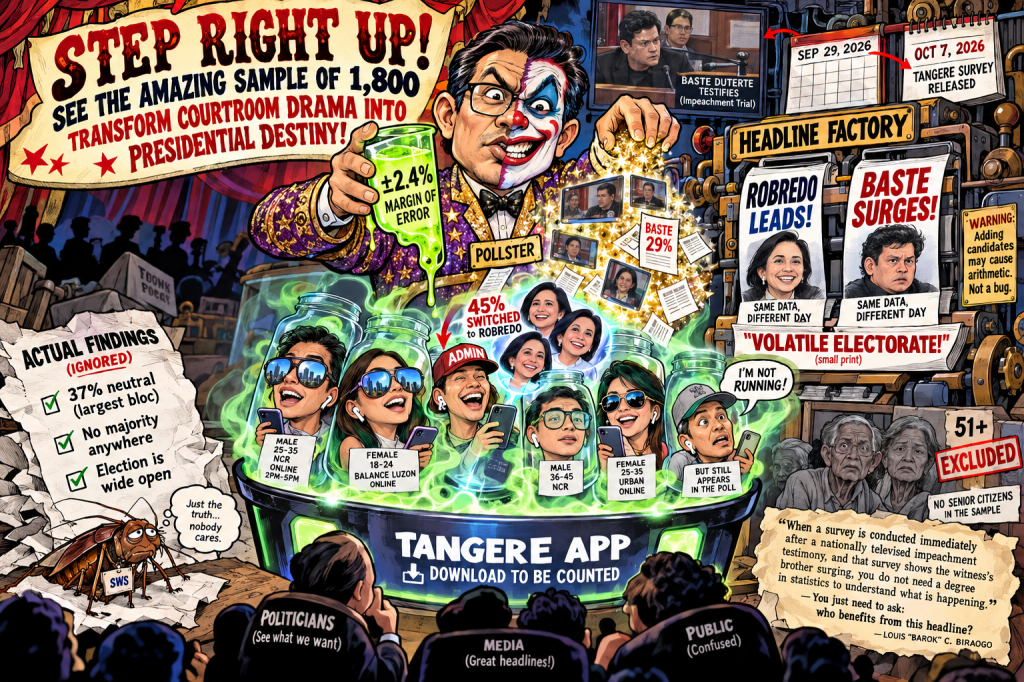
ALLOW me to ruin the party: the Tangere survey released on October 7, 2026, is not a scientific measurement of Filipino public opinion. It is a Rorschach test for a political class desperate to shape the narrative before the 2028 elections even begin.
And the numbers themselves—Robredo 29, Baste 22, Go 18, Tulfo 14—reveal less about what voters think than about what pollsters want us to think voters think.
Consider the timing. The survey was conducted September 30 to October 3, immediately after Baste Duterte’s nationally televised appearance before the Senate impeachment court. That appearance was not a policy speech. It was not a debate. It was a hostile-witness performance in his sister’s corruption trial.
Yet within days, a poll magically appears showing Baste near the top of a hypothetical presidential race.
This is not polling. This is political alchemy—turning a courtroom spectacle into a presidential launch.
The Margin of Error Is a Lie
Tangere proudly announces a “margin of error of plus or minus 2.4 percentage points at a 95 percent confidence level.” That number is technically accurate and practically meaningless.
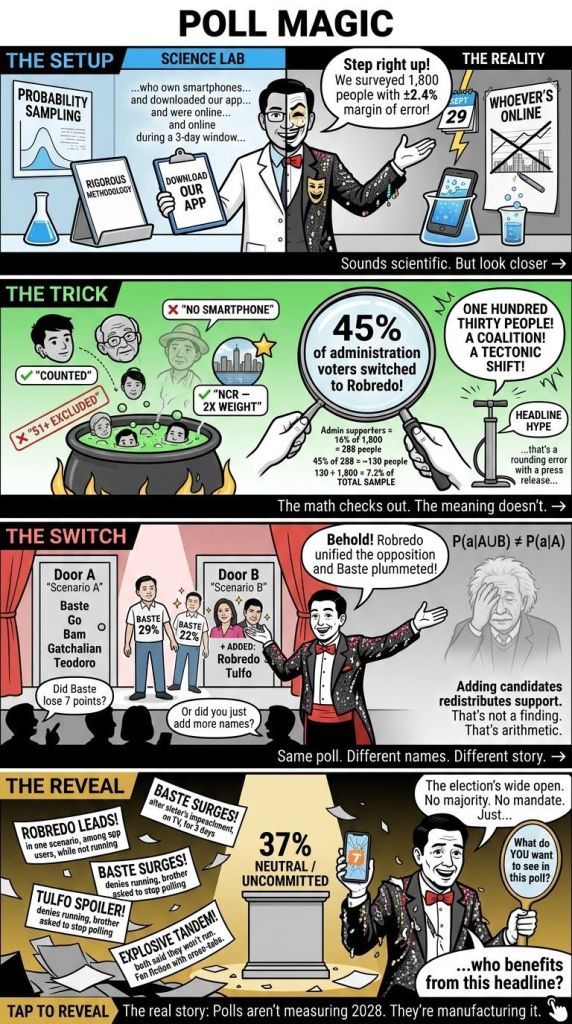
Why? Because Tangere’s methodology is not probability-based. It is a mobile-based respondent application using “stratified random sampling with quota-based sampling.” Translation: they poll people who have smartphones, who have downloaded their app, who have opted into their panel, and who happen to be online during a three-day window.
The 2023 Tangere senatorial survey explicitly excluded respondents over 51 years old. Think about that. In a country where senior citizens are among the most reliable voting blocs—where lolas and lolos still command enormous influence over family voting decisions—Tangere simply deleted them from the sample.
They later expanded their age range, but the pattern is clear: Tangere is not a pollster. It is a market research app that pivoted to political surveys because political surveys generate headlines.
The ±2.4 percent figure assumes every Filipino adult had an equal, known chance of being selected. They did not. They had an equal chance of owning a smartphone and being in Tangere’s panel. That is not the same thing.
The Two Scenarios Are Not Comparable. Period.
Tangere’s headline trick is to present two different candidate fields and pretend the difference between them measures voter movement. It does not.
In Scenario A, Baste leads with 29 percent. In Scenario B, Robredo leads with 29 percent and Baste falls to 22 percent. Tangere’s narrative: Robredo “instantly unified the opposition” and Baste lost seven points.
But look at the candidate lists. Scenario A had Baste, Go, Bam Aquino, Gatchalian, and Teodoro. Scenario B added Robredo and Tulfo. The set of choices changed entirely.
The mathematics of preference aggregation guarantee that adding candidates will redistribute support. That is not a finding. That is arithmetic.
To claim Baste lost seven points because of Robredo requires individual-level transition data—the same respondents asked about both scenarios. Tangere did not provide that.
The survey cannot distinguish between “Robredo took Baste’s voters” and “Tulfo took Baste’s voters” and “adding two new options changed how everyone answered.” The headline is a fabrication dressed as a finding.
The “45 Percent of Administration Voters Moved to Robredo” Claim Is Statistically Illiterate
Tangere breathlessly reports that 45 percent of administration supporters switched to Robredo in the expanded field. This is presented as a tectonic political shift.
Let us do the math. Administration supporters are 16 percent of 1,800 respondents—roughly 288 people. Forty-five percent of 288 is approximately 130 respondents.
Tangere wants us to believe that the movement of 130 people, selected via a smartphone app, tells us something profound about the Philippine body politic.
It does not. It tells us that among the tiny, self-selected slice of administration supporters who happen to use the Tangere app, about 130 clicked Robredo when Robredo’s name appeared on a list. That is not a coalition. That is a rounding error with a press release.
The 37 Percent “Neutral” Voters Are the Only Honest Number
Buried in the Tangere findings is the one statistic that deserves attention: 37 percent of respondents identify as neutral or uncommitted.
That is larger than the Duterte bloc (31 percent), the administration bloc (16 percent), and the opposition bloc (16 percent). No political camp owns a majority. The election is, as of this snapshot, genuinely open.
But Tangere uses this number not as a caution but as a teaser. The 37 percent becomes the “prize,” the “decisive swing vote,” the thing that makes their poll dramatic.
What they do not say is that a poll conducted primarily among app users may not accurately measure the sentiments of the voters who are not on their app—the rural poor, the elderly, the disconnected. The very demographic that might populate that 37 percent is the demographic most likely to be excluded from Tangere’s sample.
The Tulfo Factor: A Spoiler Being Manufactured in Real Time
Raffy Tulfo gets 14 percent in the expanded field. That is not a winning number. But Tangere’s cross-tabs suggest Tulfo draws from Baste and Go supporters, particularly male voters in the National Capital Region (NCR) and Balance Luzon.
This is the most politically intriguing finding, and it deserves more scrutiny than it received. Is Tulfo actually a spoiler? Or is he being positioned as a spoiler—a convenient third force that can be invoked to fragment the Duterte vote when necessary?
Remember: Tulfo has repeatedly and emphatically denied any presidential ambition. His brother Erwin demanded that survey firms stop including him in 2028 polls. Yet here he is again, at 14 percent, reshaping the arithmetic of a hypothetical race.
The Tulfos’ denials are loud. Their continued presence in surveys is louder.
The Robredo-Aquino Tandem: A Fantasy Ticket for a Fantasy Race
Tangere reports that 70 percent of Robredo supporters choose Bam Aquino as their vice president. This is presented as evidence of a “politically explosive” tandem.
But Robredo has ruled out running. Bam Aquino has ruled out running for vice president. The entire “tandem” exists only in the imagination of survey respondents who were asked a hypothetical question about candidates who have said they will not run.
This is not polling. This is fan fiction with cross-tabs.
What the Tangere Survey Actually Reveals
Strip away the headlines and the spin, and the Tangere survey reveals three things:
- Baste Duterte became nationally salient overnight. The impeachment trial gave him a platform. Whether that translates into durable support remains to be seen. The survey captured a moment, not a movement.
- Robredo remains the strongest single opposition figure. Her 29 percent in the expanded field, despite having said she is not running, confirms her unique standing. But a plurality in a fragmented field is not a mandate. It is a starting position.
- The electorate is volatile. The wildly different results across recent polls—Pulse Asia showing Sara at 49 percent in June-July, OCTA showing Sara-Robin ahead of Leni-Bam by 12 points, Tangere showing Baste at 29 and Robredo at 29—demonstrate that voters are not locked in. They are responding to names, to timing, to the news cycle.
The Bottom Line
Tangere is not the Social Weather Stations (SWS). It is not Pulse Asia. It is a market research app with a smartphone panel and a habit of releasing surveys at politically convenient moments.
Its findings should be treated as directional hints, not measurements. Its cross-tabs should be treated as anecdotes, not data.
The real story is not that Robredo “leads” or Baste “surges.” The real story is that the 2028 election is wide open, that no candidate has consolidated anything, and that the political class is using polls to create the illusion of momentum.
When a survey is conducted immediately after a nationally televised impeachment testimony, and that survey shows the witness’s brother surging, you do not need a degree in statistics to understand what is happening.
You just need to ask: who benefits from this headline?
Key Citations
A. Reports & Studies
- Remoto, Danton. “Analyzing the ‘Tangere’ Senatorial Survey of May 2023.” The Manila Times, 1 June 2023.
- Baroña, Franco Jose C. “Tulfo, Poe Lead 2028 Senate Poll.” The Manila Times, 18 Sept. 2026.
- De Vera-Ruiz, Ellalyn. “VP Duterte Leads 2028 Presidential Preference Poll, Followed by Robredo.” Manila Bulletin, 22 July 2026.
- Mateo, Janvic. “VP Sara-Robin Ahead of Leni-Bam in Hypothetical Matchup.” Philstar.com, 26 Sept. 2026.
- “Margin of Error: Definition, Uses, and Examples.” Investopedia.
B. News Articles
- Baroña, Franco Jose. “Robredo, Baste Duterte Emerge Top Presidential Bets in 2028 — Survey.” The Manila Times, 7 Oct. 2026, https://www.manilatimes.net/2026/10/07/news/robredo-baste-duterte-emerge-top-presidential-bets-in-2028-survey/2440594. Accessed 7 Oct. 2026.
- Apacible, Lisa Marie. “Impeachment Court Declares Baste Duterte Hostile Witness.” Daily Tribune, 29 Sept. 2026.
- “Raffy Tulfo Rules Out 2028 Presidential Bid: ‘I’m Very Happy as a Senator.’” Manila Bulletin, 5 May 2026.
- Daguno-Bersamina, Kristine. “Trillanes Urges Leni to Back Bam or Risa in 2028 Presidential Race.” Philstar.com, 23 Apr. 2026.
- Superable, Ram. “Erwin Rules Out 2028 Bid, Bam Says Won’t Run for VP.” Manila Standard, 19 Feb. 2026.
C. Official Websites
- Tangere. Tangere App.
- Social Weather Stations.
- Pulse Asia Research Inc.
- OCTA Research.
- ₱8B BBM Pork: CCTV for Every Captain’s Kumpare?
- ₱8.9 Billion, 331 Ghost Police Stations: The TIKAS Scandal Explained

- ₱8.4 Billion, 42,000 Barangays, 1 Election: The “Bawat Barangay Makikinabang” Vote-Buying Masterclass

- ₱75 Million Heist: Cops Gone Full Bandit

- ₱6.77B Ghost Haunts Duterte: RTC Dismisses Mans Carpio’s Desperate Plea
- ₱6.77 Billion and Zero Cash: The Sara Duterte SALN Math That Doesn’t Add Up

- ₱6.7-Trillion Temptation: The Great Pork Zombie Revival and the “Collegial” Vote-Buying Circus

- ₱58.53B, Zero Receipts: The LGSF Pork Barrel Nobody Wants to Name
- ₱53 Million Man Tells ₱695-a-Day Workers to Stop Being ‘Mayabang’: The Audacity of BSP’s Remolona

- ₱4.4 Billion and a Witness Who Can’t Explain It: The Duterte Impeachment’s Most Expensive Non-Answer
- ₱3.06 Billion for Evacuation Centers—But Nobody Knows Where They’ll Stand (Or If They’ll Exist)
- ₱16 Billion, 280 Accounts, 8 Helicopters: Boying Remulla’s Case Against the Yaps Is Not a Drill






Leave a comment