A Tragedy in Technocratic Tone-Deafness
By Louis ‘Barok’ C. Biraogo — September 1, 2026
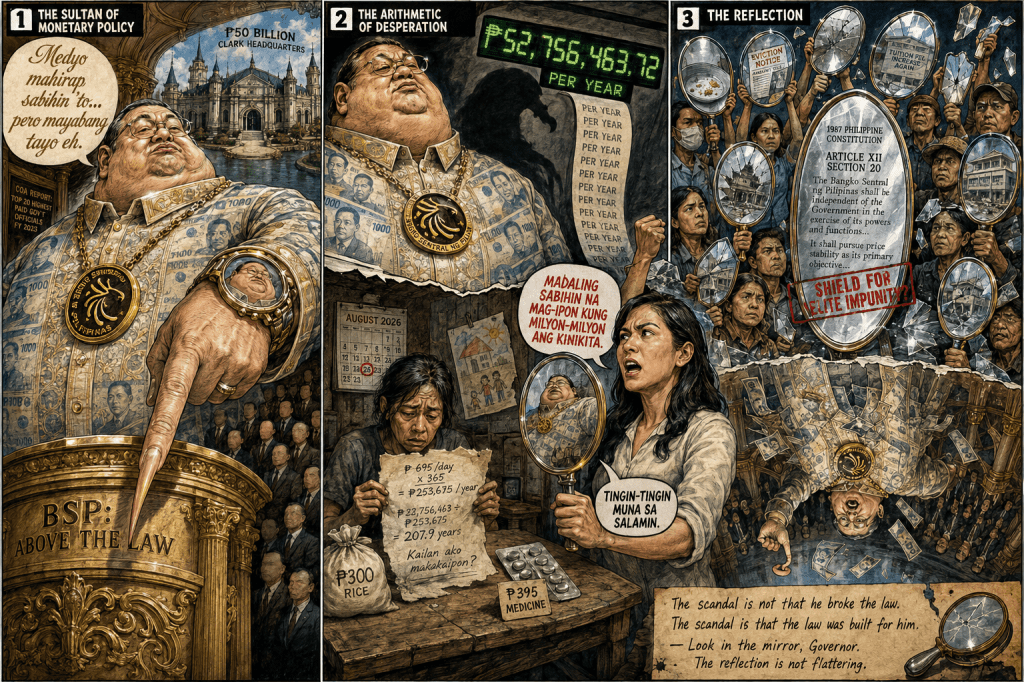
IN THE gilded annals of Philippine technocracy, there exists a particular breed of public servant who has mastered the art of living like a sultan while lecturing the starving masses on the virtues of asceticism.
The latest exhibit in this museum of moral blindness is Bangko Sentral ng Pilipinas (BSP) Governor Eli Remolona Jr., a man whose annual compensation could feed a small municipality for a year, wagging his well-manicured finger at Filipino workers for their “consumption culture.”
Let us be precise about the grotesque theater that unfolded in the Senate last week. Remolona, tasked with explaining the peso’s collapse, first dutifully recited the external factors—the US-Iran conflict, global inflation, the Federal Reserve’s hawkish stance.
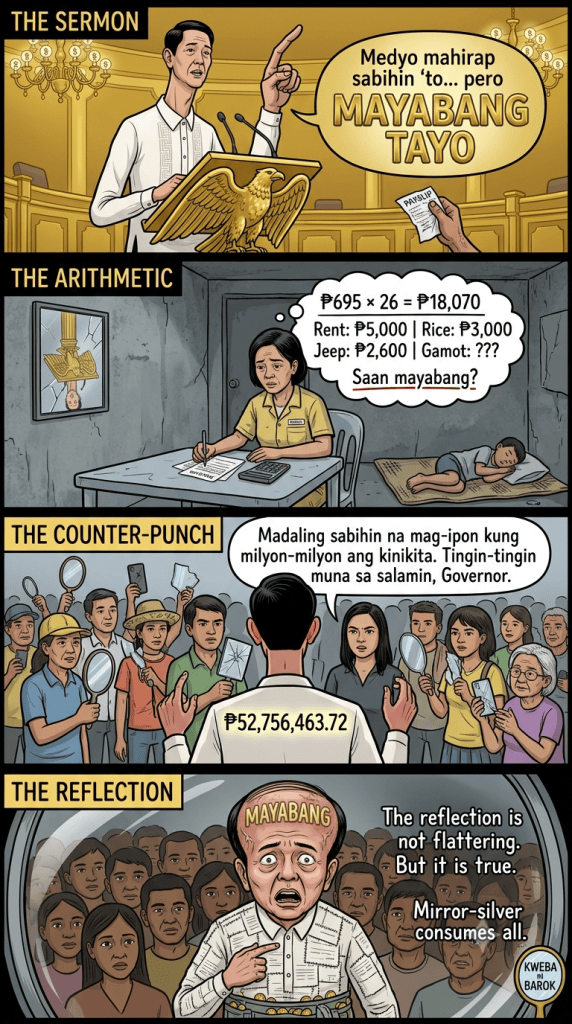
Then, unable to resist the siren call of elite condescension, he added the kicker: “Medyo mahirap sabihin ‘to… pero mayabang tayo eh. May consumption culture ang tawag.”
Translation: “It’s a bit hard to say this… but we’re boastful. It’s called a consumption culture.”
The audacity is breathtaking. Here is a man who pocketed P52.756 million in 2025—nearly nine times the President’s salary and more than triple what the Chairman of the US Federal Reserve earns for managing the world’s largest economy—lecturing Filipinos earning P695 a day about the sin of wanting things.
The mathematics of this moralizing is obscene. A minimum-wage worker in Metro Manila would need to labor for approximately 75 years, without spending a single centavo on food, shelter, or medicine, to earn what Governor Remolona takes home in a single year.
The Structural Violence of “Consumption Culture”
Representative Sarah Elago‘s blistering rebuttal was not merely political theater; it was an act of intellectual self-defense on behalf of millions of Filipinos whose “consumption” consists of deciding whether to buy rice or medicine.
Her counterpunch—”Madaling sabihin na mag-ipon kung milyon-milyon ang kinikita”—carries the weight of economic reality that technocrats conveniently ignore.
The data is damning. The Family Living Wage for a family of five in the National Capital Region ranges from P1,168 to P1,207 per day. The minimum wage is P695—a gap of P400 to P500 daily.
This is not a “culture” of consumption; it is a structural impossibility of savings. The bottom 50 percent of Filipino households spend more than half their income on food alone. What discretionary income exists is measured in pesos, not percentage points of GDP.
Yet Remolona, speaking from the marble halls of the BSP’s planned P50 billion headquarters, sees “mayabang” (boastfulness) where any honest observer would see desperation. This is not economic analysis; it is aristocratic contempt dressed in the language of monetary policy.
The Legal Shield of Elite Impunity
The legal architecture that enables this obscenity is as instructive as it is infuriating. Under Republic Act 7653, Section 15(c), BSP officials at Salary Grade 20 and above are exempt from the Salary Standardization Law.
This provision—slipped into legislation with the quiet efficiency that characterizes elite governance—has created a compensation regime where the BSP Governor’s pay is determined not by market forces, democratic accountability, or even rational public policy, but by the incestuous logic of central bank exceptionalism.
The Supreme Court, in Central Bank Employees Association v. BSP (G.R. No. 148208), upheld this dual compensation system on the basis that Congress can classify based on “substantial distinctions.”
The distinction here is clear: between those who make policy and those who suffer its consequences; between those who are exempt from austerity and those upon whom austerity is imposed; between the creditors and the debtors of the Philippine state.
The ethical violations are equally stark. Republic Act 6713, the Code of Conduct and Ethical Standards for Public Officials, requires “simple living” and “responsiveness to the public.”
One struggles to reconcile a P53 million annual salary—while the agency simultaneously plans a P50 billion headquarters—with even the most generous interpretation of “simple living.” The BSP Governor’s compensation is not merely generous; it is an insult to every Filipino who has been told to tighten their belt, consume less, and save more by people who have never known hunger.
The Red-Tagging Context: Courage Under Fire
To fully appreciate Elago’s intervention, one must understand the political environment in which she operates. The Gabriela Women’s Party, which she represents, has faced relentless red-tagging from the National Task Force to End Local Communist Armed Conflict (NTF-ELCAC).
The Department of Justice dismissed kidnapping and war crimes charges against her in 2020 for lack of probable cause, but the harassment continues. The Commission on Elections filed a complaint against her party under Resolution No. 11116. The Supreme Court has been petitioned to block her congressional seat.
This is not incidental context; it is essential to understanding the power dynamics at play. Elago speaks as a legislator whose very legitimacy is contested by the state’s security apparatus. She speaks as a woman in a political culture that remains profoundly patriarchal.
She speaks as a representative of workers whose interests are systematically excluded from the corridors of monetary policy. When she challenges the BSP Governor, she is not merely engaging in policy debate; she is asserting the right of the governed to question their governors, the right of the poor to interrogate the rich, the right of the marginalized to demand accountability from the powerful.
The Economic Truth Behind the Moralizing
Remolona’s defenders will argue that low savings rates are empirically documented and that consumption-driven growth creates trade imbalances. Both claims are technically true but deliberately incomplete.
The Philippine gross savings rate of 12-15 percent of GDP is indeed low by East Asian standards. But this statistic aggregates household behavior with corporate retained earnings and government fiscal policy.
The “consumption culture” of Filipino households is a marginal factor compared to corporate profit-hoarding, regressive taxation, and the structural extraction of wealth by the very elites who now lecture the poor about thrift.
The TRAIN Law (RA 10963) and CREATE Law (RA 11534) tell the true story of Philippine economic priorities. The former imposed excise taxes on fuel and sugary drinks—regressive measures that fall heaviest on the poor.
The latter slashed corporate income taxes from 30 percent to 20-25 percent and granted extensive tax holidays to multinational corporations. This is not a “culture” problem; it is a policy choice.
The Philippine state has systematically shifted the tax burden from capital to labor, from corporations to consumers, from the wealthy to the working class, and then wonders why the peso is weak.
The Scandal of Democratic Legitimacy
This controversy is not, in the strict legal sense, a scandal. Remolona’s salary is legal. His remarks are protected speech. There is no evidence of personal corruption beyond the legal plunder of the public treasury.
But in a deeper sense, this is the scandal that matters most: the scandal of a system that works exactly as designed, insulating technocrats from accountability while blaming the poor for structural failures they did not create.
The BSP’s independence—enshrined in Article XII, Section 20 of the Constitution—has become a shield for elite irresponsibility.
The Monetary Board’s fiscal autonomy has enabled the construction of a parallel universe where public officials earn private-sector compensation while enjoying government job security. The result is a governing class that is economically incentivized to misunderstand the lives of ordinary Filipinos.
Elago’s “tingin-tingin muna sa salamin” (look in the mirror) is more than a rhetorical flourish. It is a democratic demand: that those who make economic policy first examine their own privilege, their own consumption, their own complicity in the system they preside over.
It is an inversion of the surveillance gaze that has long characterized elite-popular relations in the Philippines—the poor are no longer the objects of moral scrutiny; they are its subjects.
The Road Ahead
What happens next will reveal much about the health of Philippine democracy. The most likely outcome is that this controversy, like so many before it, will be absorbed by the 24-hour news cycle and forgotten.
Remolona will issue a clarification that clarifies nothing. Elago will file a resolution that goes nowhere. The peso will continue its slide, the poor will continue their impossible arithmetic, and the technocrats will continue their comfortable lives.
But there is another possibility: that this moment becomes a catalyst for genuine reform. That the obscenity of a P53 million salary for a central banker becomes the rallying point for a broader movement against elite impunity.
That the “consumption culture” comment becomes shorthand for everything wrong with Philippine governance—the arrogance, the insularity, the moral blindness of a ruling class that has lost all connection to the people it purports to serve.
The choice, as always, lies with those who have the power to choose. But one thing is certain: the next time a technocrat lectures Filipinos about thrift, the response will not be silence. It will be the voice of Sarah Elago, and the millions she represents, demanding: “Tingin-tingin muna sa salamin.”
Look in the mirror, Governor. The reflection is not flattering.
Key Citations
A. Reports & Studies
- Commission on Audit. Report on Salaries and Allowances (ROSA) for 2025. Reported in Serquiña, Mariel Celine. “BSP chief Remolona still highest-paid gov’t official in 2025 – COA.” GMA News Online, 7 May 2026, https://www.gmanetwork.com/news/topstories/nation/986841/bsp-governor-remolona-highest-officials/story/.
- IBON Foundation. NCR Family Living Wage (as of March 2026). 13 Apr. 2026, https://www.ibon.org/flw-ncr-2603/.
- Congressional Policy and Budget Research Department. Updates on Family Income and Expenditure in the Philippines. House of Representatives, Mar. 2025, https://cpbrd.congress.gov.ph/wp-content/uploads/2025/03/FF2025-20-UPDATES-ON-FAMILY-INCOME-AND-EXPENDITURE-IN-THE-PHILIPPINES.pdf.
B. News Articles
- Bilyonaryo staff. “‘Mayabang tayo’: Remolona points finger at Pinoys’ spend-more, save-less culture as peso nosedives.” Bilyonaryo, 29 Aug. 2026, https://bilyonaryo.com/2026/08/29/mayabang-tayo-remolona-points-finger-at-pinoys-spend-more-save-less-culture-as-peso-nosedives/business/.
- Recuenco, Aaron. “DOLE announces historic P85-wage increase for Metro Manila workers.” Manila Bulletin, 30 June 2026, https://mb.com.ph/2026/06/30/dole-announces-historic-p85-wage-increase-for-metro-manila-workers.
- Ta-Asan, Keisha. “Own reserves to fund new BSP complex.” The Philippine Star, 22 Sept. 2025, https://www.philstar.com/business/2025/09/22/2474461/own-reserves-fund-new-bsp-complex.
- Patag, Kristine Joy. “DOJ junks kidnap raps vs Anakbayan, Elago in case of ‘missing’ activist.” Philstar.com, 26 Oct. 2020, https://www.philstar.com/headlines/2020/10/26/2052434/doj-junks-kidnap-raps-vs-anakbayan-elago-case-missing-activist.
- “Can domestic savings cover the country’s increasing investment needs?” BusinessWorld Online, 20 Feb. 2026, https://www.bworldonline.com/infographics/2026/02/20/731657/can-domestic-savings-cover-the-countrys-increasing-investment-needs-7/.
C. Official Websites & Legal Sources
- Republic Act No. 7653: The New Central Bank Act. Supreme Court E-Library, https://elibrary.judiciary.gov.ph/thebookshelf/showdocs/2/2027.
- Central Bank Employees Association, Inc. v. Bangko Sentral ng Pilipinas, G.R. No. 148208. 15 Dec. 2004, https://jur.ph/jurisprudence/digest/central-bank-employees-association-inc-v-bangko-sentral-ng-pilipinas.
- Republic Act No. 6713. Official Gazette of the Republic of the Philippines, 20 Feb. 1989, https://www.officialgazette.gov.ph/1989/02/20/republic-act-no-6713/.
- Republic Act No. 10963 (TRAIN Law). Official Gazette of the Republic of the Philippines, 19 Dec. 2017, https://www.officialgazette.gov.ph/2017/12/19/republic-act-no-10963/.
- Republic Act No. 11534 (CREATE Law). Official Gazette of the Republic of the Philippines, 26 Mar. 2021, https://www.officialgazette.gov.ph/2021/03/26/republic-act-no-11534/.
- “The 1987 Constitution of the Republic of the Philippines – Article XII.” Official Gazette of the Republic of the Philippines, https://www.officialgazette.gov.ph/constitutions/the-1987-constitution-of-the-republic-of-the-philippines/the-1987-constitution-of-the-republic-of-the-philippines-article-xii/.
- Commission on Elections. Resolution No. 11116. 19 Feb. 2025, https://www.comelec.gov.ph/php-tpls-attachments/2025NLE/Resolutions/com_res_11116.pdf.
- Bangko Sentral ng Pilipinas. Official website, https://www.bsp.gov.ph/.




Leave a Reply