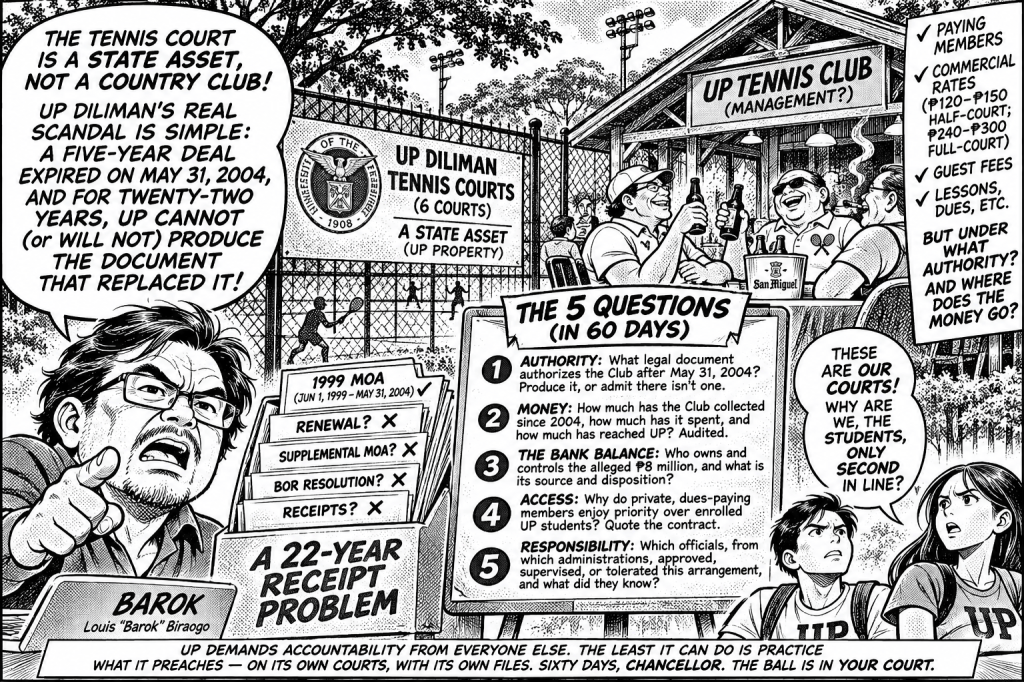
Inside the informal arrangement that turned six publicly owned tennis courts into a private fiefdom — and the five questions that could end it in 60 days
By Louis “Barok” C. Biraogo — November 21, 2026
GATHER round, because the best part of this scandal isn’t what you think. It’s not the ₱8 million that may or may not be sitting in a bank account somewhere. It’s not the smoking, the drinking, or the clubhouse with a “shared caged space” for lockers — the most polite description of a San Miguel–scented kennel I’ve ever read. What I love is that the University of the Philippines (UP), an institution that has spent four decades lecturing the country about accountability, apparently cannot produce a single document authorizing its own tennis club to operate after May 31, 2004. The premier public university, reduced to “we’ll get back to you” on a question a filing cabinet could have answered a generation ago.
This is where the UP Diliman Tennis Club, the UP administration, and every tennis-playing lawyer, businessman, and retired bureaucrat in Quezon City should start sweating. Because the documents that do exist establish three uncomfortable facts.
- First, a five-year management agreement was signed on October 8, 1999, and it expired on May 31, 2004.
- Second, nothing in the public record shows what replaced it.
- Third, in the intervening twenty-two years, the university has not managed to produce the receipts.
The Smoking Gun Is That There Is No Smoking Gun
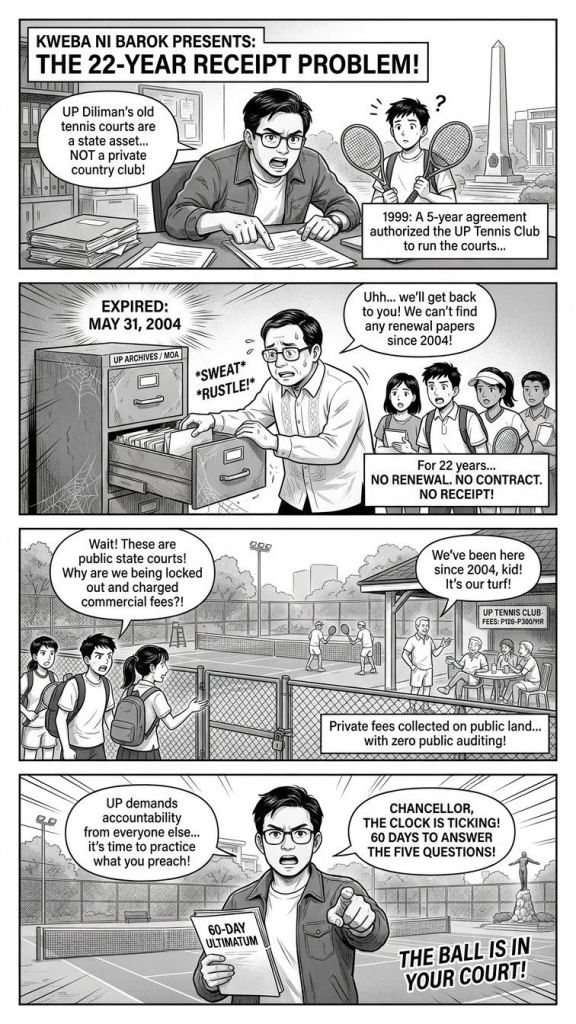
Start with the only document anyone can find. The UP Gazette, Vol. XXXI, No. 1, published a Memorandum of Agreement (MOA) between UP Diliman and the UP Tennis Club, signed October 8, 1999, authorizing the Club to “manage and operate” the old tennis courts near the College of Engineering from June 1, 1999, to May 31, 2004. Five years. Clean. Bounded.
That agreement was, in fairness, a real contract. It required the Club to maintain the courts, hire its own personnel, provide security and lighting and nets, make the courts available to bona fide students during physical education (PE) classes, and donate at least ₱30,000 annually to the UP Diliman varsity tennis team. That is not a rent-free fiefdom. That is a facilities management arrangement with consideration — consideration, mind you, of the ₱30,000-a-year variety, which at a public university is roughly the cost of a used Corolla spread across twelve months. If you think that’s a fair market rate for commercial use of six publicly owned tennis courts, I have a bridge near the Academic Oval to sell you.
Now here’s the question that should be on every student’s lips, every regent’s agenda, and every reporter’s notebook: What happened on June 1, 2004?
Because here is what the evidence shows: nothing. No renewal in the Gazette. No supplemental MOA in the public record. No Board of Regents resolution — and under Section 22(c) of Republic Act No. 9500, the UP Charter of 2008, the Board of Regents is the body that “plans, designs, approves and implements” land leases and property transactions.
If the Club’s authority was renewed after 2004, someone approved it. If someone approved it, there is a piece of paper. If there is a piece of paper, the University should produce it. The fact that it has not — or cannot — is not a technicality. It is the entire ballgame.
The “Tolerance” Defense Is Legally Cute and Institutionally Damning
I can already hear the Club’s defenders: relax, it’s tolerated possession, an informal arrangement, the University has always allowed it. Congratulations, you have just described adverse possession with extra steps and better tennis whites.
Yes, under Republic Act No. 386 (the Civil Code of the Philippines), possession by tolerance does not ripen into ownership, and the owner can withdraw permission at any time. That is precisely why this arrangement is indefensible. If the Club’s only claim to the courts after 2004 is the University’s silence, then the Club is a squatter in a polo shirt — and I use “squatter” knowing it’s a rhetorical grenade, because the legal distinction (tolerated possession is distinct from unlawful occupation until permission is withdrawn) matters in court and evaporates in a Facebook thread.
The real issue isn’t whether the Club is “squatting” in the criminal sense. It’s that a public university has, for two decades, outsourced control of a public asset to a private membership organization without a public document explaining why, on what terms, or at whose expense.
And don’t tell me about the 2023 Ylanan Street complex as a distraction. Yes, UP opened four International Tennis Federation (ITF)-compliant courts and a clubhouse on February 9, 2023, funded to the tune of ₱51.1 million by the Department of Public Works and Highways (DPWH). But the controversy is about the old courts — the six shell and hard courts near the College of Engineering that Spot.ph described in 2022 as charging ₱120 to ₱150 per half-court hour and ₱240 to ₱300 per full-court hour, plus a ₱100 guest fee. Those rates are public. Those rates are being collected. The question is: by whom, under what authority, and where does the money go?
Let’s Talk About the ₱8 Million, Because Someone Has To
The poster’s unnamed source claims the Club has ₱8 million in its bank account. I have no idea if that’s true. Nobody does. And that’s the point. An organization operating on public land, collecting public-facing fees, and claiming nonprofit status should not have an “alleged” bank balance. It should have audited financial statements. It should have receipts. It should have a revenue-sharing agreement with the University it ostensibly serves.
Instead, we have arithmetic. Assume the six courts generate thirty paid court-hours a day at ₱200 an hour. That’s ₱6,000 a day, ₱1.8 million a year, assuming 300 operating days. Double the utilization to sixty court-hours at ₱250 and you get ₱4.5 million annually — before lessons, membership dues, guest fees, equipment sales, and whatever ball-boy arrangement Spot.ph and the UP visitor page both obliquely confirm. None of that is profit. All of it is revenue someone should be able to explain.
Here’s the question the University has never answered: since June 1, 2004, how many pesos of that revenue has reached the UP treasury? The 1999 MOA required ₱30,000 a year to the varsity team. That’s it. That’s the consideration. If the Club has collected commercial rates for two decades while remitting the cost of a mid-range laptop annually, then the University has been — and I want to be precise — a landlord who forgot to charge rent.
The Tax Question Is the One Nobody Wants to Answer
The poster alleges the Club pays no income tax and no business tax. I have no Bureau of Internal Revenue (BIR) records and no tax-exemption ruling, so I will not accuse anyone of tax evasion. That’s the kind of recklessness that gets bloggers sued under Article 353 of Act No. 3815 (the Revised Penal Code) and Section 4(c)(4) of Republic Act No. 10175 (the Cybercrime Prevention Act of 2012). Borjal v. Court of Appeals protects fair comment on matters of public interest; it does not protect factual assertions you can’t back up. Disini v. Secretary of Justice reminds you that cyberlibel is a thing.
So let me phrase this carefully: under Section 30 of Republic Act No. 8424 (the National Internal Revenue Code of 1997), an athletic organization can qualify for income-tax exemption — but the exemption is conditional, and the last paragraph of Section 30 subjects income from properties or activities conducted for profit to tax anyway. The BIR’s own Revenue Memorandum Orders 20-2013, 34-2014, and 38-2019 lay out the conditions. The Quezon City Treasurer’s Office, under Republic Act No. 7160 (the Local Government Code of 1991), has its own questions about permits and local taxes.
So here is the responsible demand: BIR, check. Quezon City Treasurer, check. Commission on Audit (COA), check — and yes, I know Fernando v. Commission on Audit holds that COA jurisdiction over a private entity depends on its relationship with the State and the nature of the funds, so the Club is not automatically auditable. But if money collected on public property belongs, in whole or in part, to the University, the analysis changes.
The Club should want this audit. A clean audit is the best defense it could possibly have. That it hasn’t volunteered for one, and the University hasn’t ordered one, is telling.
The Graft Question: Section 3(e) Is Watching
Let’s escalate. Because the real scandal is not the Club. The Club is a private organization doing what private organizations do: maximizing its position. The real scandal is the public officials who let it.
Republic Act No. 3019 (the Anti-Graft and Corrupt Practices Act), Section 3(e), penalizes a public officer who causes undue injury to the government or gives a private party unwarranted benefits through manifest partiality, evident bad faith, or gross inexcusable negligence. Section 3(g) penalizes entering into contracts “manifestly and grossly disadvantageous” to the government. The Supreme Court, in Bawasanta v. People, has emphasized that the disadvantage must be gross and manifest — glaring, readily evident, not merely suboptimal in hindsight.
Fine. But twenty-two years of undocumented operation on a public asset, with no visible revenue share and no visible legal authority, is not “suboptimal.” It is the definition of a situation that should have been documented, formalized, or terminated by someone with a fiduciary duty to the University.
Don’t let the administration hide behind “institutional inertia.” Section 4 of Republic Act No. 6713 (the Code of Conduct and Ethical Standards for Public Officials and Employees) requires public officials to use government resources “efficiently, effectively, honestly and economically” and to act with justness and sincerity. People v. Macapugay lays out the elements of Section 3(e) — the public officer’s status, the exercise of official functions, the culpable manner of acting, the resulting injury or unwarranted benefit. Those elements require proof, not suspicion. But the investigation requires nothing more than a Chancellor with a spine and subpoena power over the University’s own records.
Here’s what makes this delicious: UP Diliman is currently embroiled in the DiliMall and GyudFood master-lease controversy, where vendors, students, transport groups, and residents have filed criminal and administrative complaints with the Office of the Ombudsman against current and former UP presidents over agreements allegedly “grossly disadvantageous to the government,” complete with one-year rent-free periods and displacement of original vendors — including, poetically, temporary stalls at the Old Tennis Court.
The University’s defense is that these are “utilization of assets,” not commercialization. The same defense is presumably available for the tennis courts. And it is exactly as convincing.
The Students: The Only People Nobody Is Actually Defending
Here’s the part that should make every UP student’s blood pressure spike. The 1999 MOA required the Club to make the courts available to bona fide students during PE classes and to provide facilities for intramural and varsity programs. That is a contractual obligation, not a favor. If the Club has restricted student access, prioritized paying members, or — as the poster alleges — given students one free weekday hour while weekends and peak hours favor outsiders, then the Club may be in breach of the only document anyone can find.
And the University’s own charter is not silent. Section 10 of RA 9500 mandates comprehensive sports programs. Section 3(f) recognizes sports as part of the educational mission. Section 22 says income from real properties “shall be used to further the ends of the national university.” Section 21 recognizes student councils as the primary student bodies advancing student interests.
So when the student council asks why private members get priority on publicly owned courts, the answer cannot be “that’s how it’s always been.” “That’s how it’s always been” is not a legal doctrine. It is a confession.
The Poster: Right About the Question, Reckless About the Answer
Because I am a fair and generous blogger, let me defend the poster for a moment. The management of public university property is a legitimate matter of public concern. Borjal protects fair comment. The poster had a reasonable basis to demand answers: the expired MOA, the fee collection, the student access, the absence of visible remittances. Those are real questions.
But the poster also called Club members squatters, accused them of tax evasion, and asserted an ₱8 million bank balance from an unnamed source. That is not investigative journalism. That is a libel suit with a Wi-Fi connection. The Revised Penal Code’s Article 353 definition of libel is broad, Article 354 presumes malice, and Section 4(c)(4) of RA 10175 makes it cyber.
Truth is a defense, good motive and justifiable ends are relevant — but you have to prove the facts, not just feel them strongly. The lesson is simple: expose aggressively, but distinguish established facts from allegations and conclusions. The poster did the first thing well and the second thing recklessly. And the tragedy is that the recklessness gives the University an excuse to dismiss the whole thing as a personal grudge between tennis players.
The Five Questions That Should Be Answered in Sixty Days
I am not asking for a revolution. I am asking for a filing cabinet. The UP Board of Regents should direct an independent legal, financial, and operational investigation and publish a report within sixty days answering five questions:
One — Authority. What legal document authorizes the UP Tennis Club to manage the old tennis courts after May 31, 2004? Produce it, or admit there isn’t one.
Two — Money. How much has the Club collected since 2004, how much has it spent, and how much has reached the University? Audited, not asserted.
Three — The Bank Balance. Who owns and controls the alleged ₱8 million, and what is its source and disposition?
Four — Access. Why should private, dues-paying members enjoy any priority over enrolled UP students on courts built and maintained with public resources? Quote the contract.
Five — Responsibility. Which officials, from which administrations, approved, supervised, or tolerated this arrangement, and what did they know?
The remedies are not mysterious. Option one: disclose every agreement since 1999 and let sunlight do the work. Option two: commission an independent audit covering the period from June 1, 2004 forward — collections, dues, lessons, guest fees, equipment, bank accounts, payments to UP, varsity contributions. Option three: if a valid arrangement exists, renegotiate it with transparent revenue sharing, student priority, posted rates, and a fixed term.
Option four: if it constitutes a transaction subject to public bidding under RA 9500, bid it out — with student access and varsity support weighted as heavily as the financial offer. Option five: bring the courts under the College of Human Kinetics (CHK) and run them directly. Option six, and the one I’d actually bet on: a shared-management committee with CHK, varsity, student council, administration, and tennis organization representatives — which preserves the community without preserving the fiefdom.
The Verdict
The Facebook post did not establish corruption. The available evidence does not establish tax evasion, illegal occupation, or a single peso of personal enrichment. The ₱8 million is unverified. The “squatter” label is legally premature, since the Club’s original possession was authorized by UP itself. Anyone who tells you this is a proven criminal case is selling you something.
But here is what the evidence does establish, and it is damning enough: a five-year public contract expired in 2004, and twenty-two years later the public university cannot or will not produce the document that replaced it. Commercial rates are being charged on public courts. A private membership organization exercises day-to-day control over a public asset. Students — the constitutional beneficiaries of a national university — are, at best, second in line. And the administration’s response to a legitimate governance question has been, so far, the institutional equivalent of a shrug in a tennis skirt.
UP built its reputation on demanding accountability from everyone else. Mendiola, the US Embassy, the national budget — UP students have marched for all of it. The least the University can do is practice what it preaches on its own campus, on its own courts, with its own filing cabinet. The courts belong to UP. The management must serve UP’s mission. And the documents must be public.
Sixty days, Chancellor. The clock is running. And this time, the ball is in your court.
Key Citations
A. Legal & Official Sources
- Anti-Graft and Corrupt Practices Act. Republic Act No. 3019, 17 Aug. 1960, lawphil.net/statutes/repacts/ra1960/ra_3019_1960.html.
- Bawasanta v. People. G.R. No. 219300, Supreme Court of the Philippines, 17 Nov. 2021, lawphil.net/judjuris/juri2021/nov2021/pdf/gr_219300_2021.pdf.
- Borjal v. Court of Appeals. G.R. No. 126466, Supreme Court of the Philippines, 14 Jan. 1999, lawphil.net/judjuris/juri1999/jan1999/gr_126466_1999.html.
- Bureau of Internal Revenue. Revenue Memorandum Order No. 20-2013. 2013, bir-cdn.bir.gov.ph/BIR/pdf/73171RMO%2020-2013.pdf.
- Bureau of Internal Revenue. Revenue Memorandum Order No. 34-2014. 18 Sept. 2014, web-services.bir.gov.ph/annual_reports/annual_report_2014/downloadables/Revenue%20Issuances/revenue%20memorandum%20order/rmo34_full%20text.pdf.
- Bureau of Internal Revenue. Revenue Memorandum Order No. 38-2019: Tax Exemption of Non-Stock, Non-Profit Corporations Under Section 30 of the National Internal Revenue Code of 1997, as Amended. 2019, http://www.pcnc.com.ph/wp-content/uploads/2022/03/BIR-RMO-38-2019.pdf.
- Code of Conduct and Ethical Standards for Public Officials and Employees. Republic Act No. 6713, 20 Feb. 1989, lawphil.net/statutes/repacts/ra1989/ra_6713_1989.html.
- Cybercrime Prevention Act of 2012. Republic Act No. 10175, 12 Sept. 2012, lawphil.net/statutes/repacts/ra2012/ra_10175_2012.html.
- Disini v. Secretary of Justice. G.R. No. 203335, Supreme Court of the Philippines, 18 Feb. 2014, lawphil.net/judjuris/juri2014/feb2014/gr_203335_2014.html.
- Fernando v. Commission on Audit. G.R. Nos. 237938 and 237944-45, Supreme Court of the Philippines, 4 Dec. 2018, lawphil.net/judjuris/juri2018/dec2018/gr_237938_2018.html.
- Local Government Code of 1991. Republic Act No. 7160, 10 Oct. 1991, lawphil.net/statutes/repacts/ra1991/ra_7160_1991.html.
- National Internal Revenue Code of 1997. Republic Act No. 8424, 11 Dec. 1997, as amended, lawphil.net/statutes/repacts/ra1997/ra_8424_1997.html.
- People v. Reyes (Macapugay, Accused-Appellant). G.R. Nos. 247563 and 250517, Supreme Court of the Philippines, 8 Feb. 2023, lawphil.net/judjuris/juri2023/feb2023/pdf/gr_247563_2023.pdf.
- Philippines. Civil Code of the Philippines. Republic Act No. 386, 18 June 1949, lawphil.net/statutes/repacts/ra1949/ra_386_1949.html.
- Philippines. Revised Penal Code. Act No. 3815, 8 Dec. 1930, as amended, lawphil.net/statutes/acts/act_3815_1930.html.
- The University of the Philippines Charter of 2008. Republic Act No. 9500, 29 Apr. 2008, lawphil.net/statutes/repacts/ra2008/ra_9500_2008.html.
- University of the Philippines Diliman. “Visitor Information.” UP Diliman, upd.edu.ph/visitor-information/.
- University of the Philippines Diliman College of Human Kinetics. “Facilities.” UP Diliman, http://www.chk.upd.edu.ph/facilities.
- University of the Philippines Office of the Secretary of the University. University of the Philippines Gazette. Vol. XXXI, No. 1, Jan.–Mar. 2000, osu.up.edu.ph/wp-content/uploads/2023/02/GAZETTE-2000_.pdf.
B. News Reports
- Garrido, Wilfredo. “The millions UP Tennis Club earns out of the hide of UP students [rest of opening sentence]…” Facebook, 17 Oct. 2026 https://www.facebook.com/share/19uSLXMWCo/.
- Lontoc, Jo Florendo B. “UP Opens New Tennis Courts and Clubhouse.” University of the Philippines, 15 Feb. 2023, up.edu.ph/up-opens-new-tennis-courts-and-clubhouse/.
- “List: Best Tennis Courts in Metro Manila.” Spot.ph, 23 Apr. 2022, http://www.spot.ph/things-to-do/weekend-guides/89093/list-tennis-courts-in-metro-manila-a5006-20220423-lfrm.html.
- “UP Community Files Complaints vs Admin Officials over Commercial Agreements.” Inquirer.net, 15 Dec. 2025, newsinfo.inquirer.net/2155331/fwd-up-community-files-complaints-vs-admin-officials-over-commercial-agreements.
- “Vendors, Students Sue UP Officials over DiliMall Project.” Philstar.com, 16 Dec. 2025, http://www.philstar.com/headlines/2025/12/16/2494489/vendors-students-sue-officials-over-dilimall-project.
- ₱9 Billion in ‘Savings’? DILG’s Fire Truck Deal Smells Like Smoke

- ₱8B BBM Pork: CCTV for Every Captain’s Kumpare?

- ₱8.9 Billion, 331 Ghost Police Stations: The TIKAS Scandal Explained

- ₱8.4 Billion, 42,000 Barangays, 1 Election: The “Bawat Barangay Makikinabang” Vote-Buying Masterclass

- ₱75 Million Heist: Cops Gone Full Bandit

- ₱63 to the Dollar: The Only Thing Falling Faster Than the Peso Is the Government’s Credibility

- ₱6.77B Ghost Haunts Duterte: RTC Dismisses Mans Carpio’s Desperate Plea

- ₱6.77 Billion and Zero Cash: The Sara Duterte SALN Math That Doesn’t Add Up

- ₱6.7-Trillion Temptation: The Great Pork Zombie Revival and the “Collegial” Vote-Buying Circus

- ₱58.53B, Zero Receipts: The LGSF Pork Barrel Nobody Wants to Name

- ₱53 Million Man Tells ₱695-a-Day Workers to Stop Being ‘Mayabang’: The Audacity of BSP’s Remolona

- ₱491-M Right-of-Way Scam: DPWH Paid for Ghost Land, Ombudsman Finally Notices








Leave a Reply