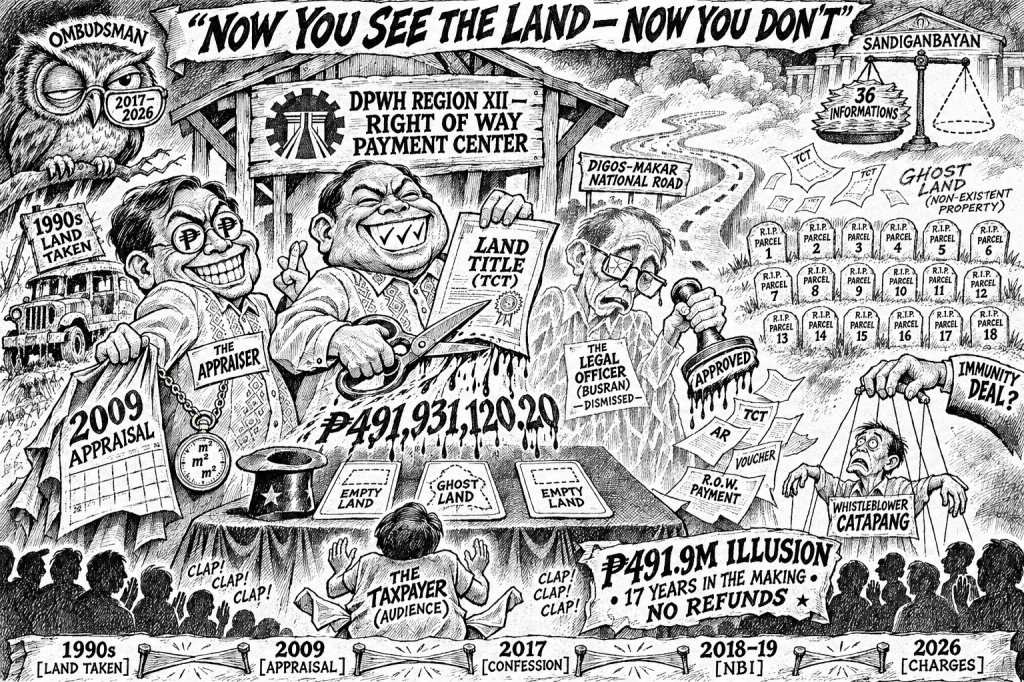
Inside the seventeen-year paper trail: a 2009 appraisal, a 2017 confession, 2019 NBI reports, and a 2026 reckoning
By Louis ‘Barok‘ C. Biraogo — November 4, 2026
Walk me through this, slowly, as if I were a taxpayer. The Ombudsman just wheeled two dozen trolleys of documents into the Sandiganbayan to charge six former Department of Public Works and Highways (DPWH) Region XII officials and seven private individuals over a ₱491.93-million right-of-way scam. The alleged scheme? Fabricating land titles for properties supposedly taken in the early 1990s, then applying a 2009 appraisal rate of ₱3,500 per square meter to inflate the payout. The technical working group approved the disbursement. The claimants presented falsified documents. And somehow, nearly half a billion pesos walked out the door.
This is not a scandal. This is a magic trick. And the Philippine government was the willing audience.
The Chronology of Incompetence
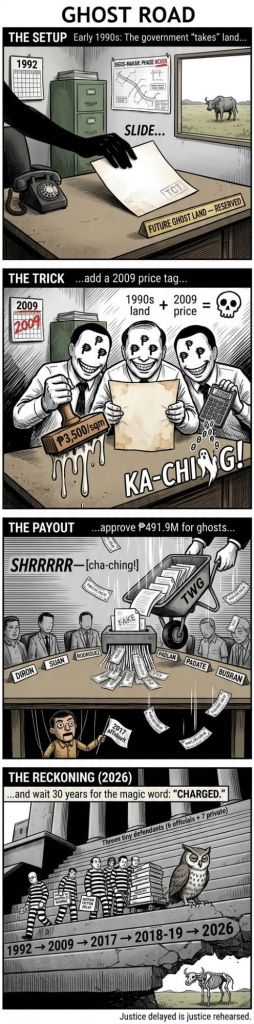
Let us appreciate the timeline, because it is a thing of grotesque beauty. The properties were allegedly taken in the early 1990s. The appraisal used to value them was from 2009. The whistleblower, Roberto Catapang Jr., executed his affidavit in 2017. The National Bureau of Investigation (NBI) submitted its investigation reports in 2018 and 2019. The Ombudsman filed charges in October 2026.
That is a seventeen-year gap between the alleged taking and the appraisal, a nine-year gap between the whistleblower’s confession and the filing, and a thirty-plus-year gap between the original land acquisition and any semblance of accountability. If you are keeping score at home, the fraud allegedly happened before some of the accused officials even held their positions.
The Ombudsman’s press release is a masterclass in understatement: “Investigators also uncovered the alleged unlawful use of a 2009 appraisal value of P3,500 per square meter to determine compensation for properties taken by the government in the early 1990s, resulting in inflated right-of-way claims.” “Inflated” is doing a lot of heavy lifting there. Applying a 2009 valuation to a 1990s taking is not a clerical error. It is not a “mistake.” It is either breathtaking incompetence or deliberate theft, and I am not sure which is worse.
The Architecture of the Scam
The mechanics, as alleged, are almost elegant in their simplicity.
- Find a road project.
- Manufacture ownership documents for land the government supposedly needs.
- Apply a valuation rate from a different geological era.
- Get the technical working group to approve it.
- Profit.
The whistleblower, Catapang, allegedly admitted that “the group… in collusion with respondent public officers, collected money from the government purportedly as payments for the acquisitions, by fabricating and submitting fake documents.” The key phrase is “in collusion with respondent public officers.” Without the public officers, the private claimants are just criminals with bad paperwork. With them, you have a syndicate operating inside the government’s own disbursement machinery.
And what a machinery it was. The DPWH Region XII technical working group approved the release of ₱491,931,120.20. Not one peso less. Not one peso more. The precision of that figure suggests a level of bookkeeping that would be admirable if it were not allegedly criminal.
The Convenient Amnesia of Institutional Controls
Here is what I want to know: where were the checks? The balances? The mandatory verifications that are supposed to prevent exactly this kind of thing? Right-of-way acquisition is not supposed to be a honor-system transaction. There are titles to verify. There are registry records to check. There are appraisals to scrutinize. There are legal officers to sign off.
Oh, wait. The legal officer, Ansare Mariga Busran, was separately dismissed from service by the Ombudsman. So at least one person paid an administrative price. But the criminal cases suggest that the dismissal was not the end of the story.
The Ombudsman’s resolution found “prima facie evidence with reasonable certainty of conviction.” That is a carefully hedged phrase. It means the Ombudsman believes the evidence is strong enough to drag thirteen people into court. It does not mean the evidence is strong enough to convict. That distinction matters, and the defense will exploit it.
The Defense Playbook Writes Itself
I can already hear the motions being drafted. The whistleblower, Catapang, is a self-confessed participant in the alleged scheme. His credibility will be shredded on cross-examination. Did he receive immunity? Was he promised leniency? Did he name names to save his own skin? These are not unfair questions. They are the questions any competent defense lawyer will ask, and they are the questions the prosecution must answer with corroborating evidence, not just Catapang’s word.
Then there is the jurisdictional question. DPWH Regional Directors typically hold Salary Grade 26, and there is jurisprudence suggesting the Sandiganbayan may lack jurisdiction over officials below Salary Grade 27. The Ombudsman filed the cases anyway. Either the Ombudsman believes the position classification puts Diron within the court’s jurisdiction, or there is a jurisdictional fight brewing that could derail the entire prosecution before it begins.
And then there is the valuation issue. The defense will argue that the 2009 appraisal was a legitimate administrative determination, not a criminal act. They will point to the complexity of right-of-way acquisitions, the passage of time, the possibility of negotiated settlements, and the absence of proof that any individual official personally pocketed a single peso. Proving “manifest partiality” or “evident bad faith” under Section 3(e) of Republic Act No. 3019 (Anti-Graft and Corrupt Practices Act) requires more than showing that the government paid too much. It requires showing that someone knew the claims were fraudulent and approved them anyway.
The Pattern That Cannot Be Ignored
Here is the part that should make taxpayers furious. This is not the first time DPWH Region XII has been in the dock for right-of-way anomalies. In March 2026, the Sandiganbayan convicted former DPWH-Soccsksargen officials Tomas Rodriguez and David Padlan for graft and falsification over anomalous ROW payments from 2007 to 2015. The court found they “acted with gross inexcusable negligence” when they recommended approval of IROW resolutions despite “manifest irregularities.”
Rodriguez and Padlan are among the six officials charged in the current case. Let me repeat that. Two men previously convicted of right-of-way corruption are now facing new charges for right-of-way corruption. If that is not a systemic failure of supervision, I do not know what is.
The Ombudsman is not prosecuting a one-off fraud. The Ombudsman is prosecuting a franchise.
What the Ombudsman Got Right (Yes, Really)
Credit where it is due: the Ombudsman did its job. It investigated. It found evidence. It filed charges. It administratively dismissed a legal officer. It is now pursuing criminal accountability. That is precisely what the Ombudsman is supposed to do.
The problem is not the Ombudsman. The problem is the system that made the alleged scam possible in the first place. The problem is the DPWH’s internal controls, which apparently could not distinguish between a legitimate landowner and a fabricated claim. The problem is the technical working group that approved nearly half a billion pesos in disbursements without, allegedly, noticing that the documents were fake. The problem is the seventeen-year gap between the alleged taking and the appraisal, and the nine-year gap between the whistleblower’s confession and the filing of charges.
The Ombudsman can only prosecute what it can prove. The institution cannot retroactively install the safeguards that should have existed. It cannot un-pay the ₱491.93 million. It cannot restore the public’s trust with a press release.
The Unanswered Questions
The Informations have been filed. The cases have been raffled to seven divisions. The accused will have their day in court. But the public deserves answers to questions that the charging documents alone cannot provide.
Who actually owned the 18 parcels of land? Were they genuinely taken by the government in the early 1990s, or is that part of the fabrication? If they were taken, was just compensation ever paid to the actual owners? If not, are there legitimate landowners who were defrauded twice—once by the government’s failure to compensate them, and again by the syndicate’s theft of the compensation that was meant for them?
Where did the ₱491.93 million go? The Ombudsman’s press release does not say. The news reports do not say. The whistleblower allegedly knows, but his credibility is contested. The money trail is the prosecution’s best hope and its biggest vulnerability. If the government cannot trace the funds to the accused, the conspiracy case weakens.
Why did it take until 2026 to file charges based on a 2017 affidavit and 2018-2019 NBI reports? The Ombudsman under Jesus Crispin Remulla, who assumed office in October 2026, may be more aggressive than his predecessor. But the delay raises questions about whether the case was sitting dormant, waiting for a change in leadership, or whether the evidence simply took years to assemble. The public deserves to know which.
The Bottom Line
The ₱491.93-million right-of-way scam is not a story about thirteen individuals. It is a story about a system that allowed thirteen individuals to allegedly extract nearly half a billion pesos from the public treasury by submitting documents that should have been verified and were not. It is a story about a technical working group that approved disbursements without, allegedly, noticing that the claims were fabricated. It is a story about a legal officer who was dismissed administratively while the officials above him face criminal charges. It is a story about a road project in General Santos City that may have paid for land that did not exist, owned by people who did not exist, at prices that made no sense.
The Sandiganbayan will decide the criminal cases on the evidence. That is as it should be. But the court of public opinion has already rendered its verdict on the system that made the scam possible. And that verdict is: never again. Or at least, never again until the next scandal.
Key Citations
A. Legal & Official Sources
- Republic Act No. 3019. An Act Establishing the Anti-Graft and Corrupt Practices Act. 17 Aug. 1960, http://www.officialgazette.gov.ph/1960/08/17/republic-act-no-3019/.
- Office of the Ombudsman. “Ombudsman Charges DPWH Personnel for Alleged Involvement in P491-M ‘Road Right of Way Scam.’” Office of the Ombudsman, 25 Oct. 2026, http://www.ombudsman.gov.ph/?p=134990.
B. News Reports
- Galvez, Daphne. “DPWH Execs Face Graft for P491.9 Million Right-of-Way Scam.” Philstar.com, 4 Nov. 2026, http://www.philstar.com/headlines/2026/11/04/2567732/dpwh-execs-face-graft-p4919-million-right-way-scam.
- GMA Network. “Ombudsman Charges 6 DPWH Personnel over P491.9-M Right-of-Way ‘Scam.’” GMA Network, 25 Oct. 2026, http://www.gmanetwork.com/news/topstories/nation/1007088/ombudsman-charges-7-dpwh-personnel-over-p491-9-m-right-of-way-scam/story/.
- GMA Network. “Ombudsman Files Charges vs 6 DPWH Personnel over Alleged P491.9-M Right-of-Way ‘Scam.’” GMA Network, 3 Nov. 2026, http://www.gmanetwork.com/news/topstories/nation/1008089/ombudsman-files-charges-vs-6-dpwh-personnel-over-alleged-p491-9-m-right-of-way-scam/story/.
- Laqui, Ian. “Ombudsman Charges 6 DPWH Personnel, 7 Others over Alleged GenSan Right-of-Way Scam.” Philstar.com, 25 Oct. 2026, http://www.philstar.com/headlines/2026/10/25/2565627/ombudsman-charges-6-dpwh-personnel-7-others-over-alleged-gensan-right-way-scam.
- Ong, Ghio. “P491 Million ROW Scam: Ombudsman Sues 6 DPWH Execs.” Philstar.com, 26 Oct. 2026, http://www.philstar.com/headlines/2026/10/26/2565684/p491-million-row-scam-ombudsman-sues-6-dpwh-execs.
- Pineda, Bernadette Nicole. “Ombudsman Files Charges vs 6 DPWH Execs over P491-M ‘Right-of-Way’ Scam.” Inquirer.net, 3 Nov. 2026, newsinfo.inquirer.net/2335438/fwd-ombudsman-files-charges-vs-6-dpwh-officials-over-p491m-road-rightway-scam/amp.
- Rappler. “Ex-DPWH Officials Convicted of Corruption over Right-of-Way Anomalies in South Cotabato.” Rappler, 31 Mar. 2026, http://www.rappler.com/philippines/mindanao/dpwh-officials-convicted-corruption-right-of-way-anomalies-south-cotabato/.
- The Manila Times. “Ombudsman Files Graft Raps vs 6 DPWH Personnel, 7 Others.” The Manila Times, 3 Nov. 2026, http://www.manilatimes.net/2026/11/03/news/ombudsman-files-graft-raps-vs-6-dpwh-personnel-7-others/2460224.
- ABS-CBN News. “13 DPWH-Soccsksargen Execs, Private Individuals Face Graft, Malversation Cases over ‘Road Right of Way Scam.’” ABS-CBN News, 3 Nov. 2026, http://www.abs-cbn.com/news/nation/2026/11/3/13-dpwh-soccsksargen-execs-individuals-face-graft-malversation-cases-over-road-right-of-way-scam-1310.
- ₱9 Billion in ‘Savings’? DILG’s Fire Truck Deal Smells Like Smoke

- ₱8B BBM Pork: CCTV for Every Captain’s Kumpare?

- ₱8.9 Billion, 331 Ghost Police Stations: The TIKAS Scandal Explained

- ₱8.4 Billion, 42,000 Barangays, 1 Election: The “Bawat Barangay Makikinabang” Vote-Buying Masterclass

- ₱75 Million Heist: Cops Gone Full Bandit

- ₱63 to the Dollar: The Only Thing Falling Faster Than the Peso Is the Government’s Credibility

- ₱6.77B Ghost Haunts Duterte: RTC Dismisses Mans Carpio’s Desperate Plea
- ₱6.77 Billion and Zero Cash: The Sara Duterte SALN Math That Doesn’t Add Up

- ₱6.7-Trillion Temptation: The Great Pork Zombie Revival and the “Collegial” Vote-Buying Circus

- ₱58.53B, Zero Receipts: The LGSF Pork Barrel Nobody Wants to Name
- ₱53 Million Man Tells ₱695-a-Day Workers to Stop Being ‘Mayabang’: The Audacity of BSP’s Remolona
- ₱491-M Right-of-Way Scam: DPWH Paid for Ghost Land, Ombudsman Finally Notices




Leave a Reply