Certification-only liquidations, phantom supplies, and the art of declaring ‘savings’ you never needed to save
By Louis ‘Barok’ C Biraogo — November 4, 2025
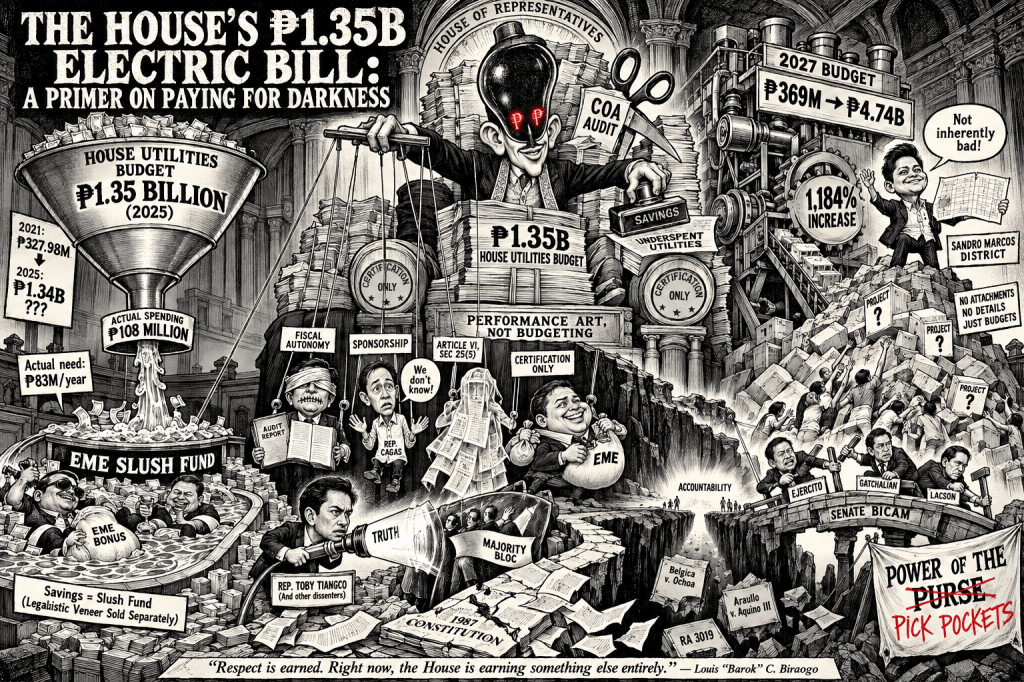
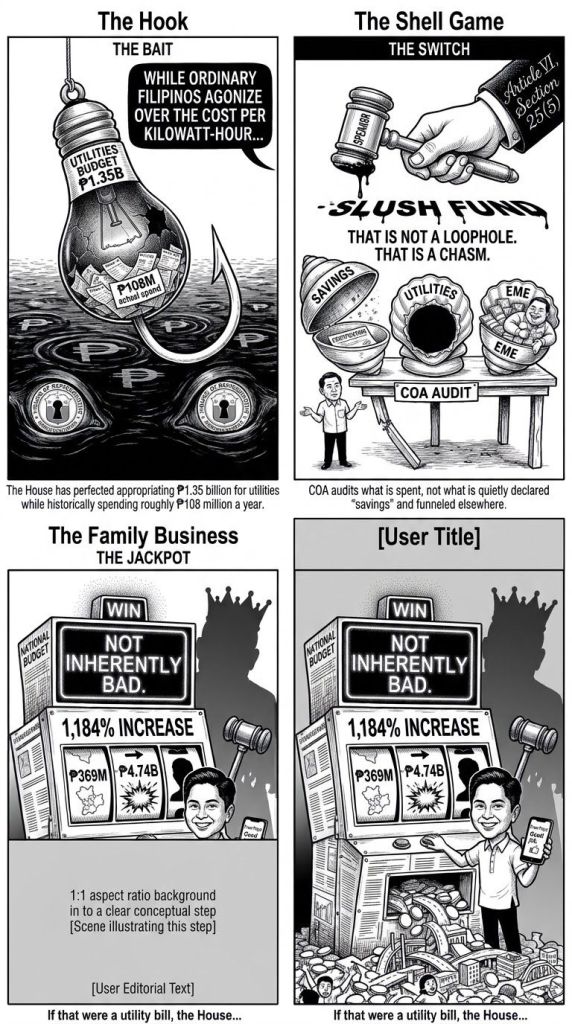
A MOMENT of appreciation is in order. The House of Representatives has turned the humble electric bill into a constitutional mystery. While ordinary Filipinos agonize over the cost per kilowatt-hour, the House has perfected appropriating ₱1.35 billion for utilities while historically spending roughly ₱108 million a year. That is not budgeting. That is performance art.
The Utilities and Supplies Puzzle
The Rappler investigation exposes a pattern so glaring it strains credulity. The House’s supplies budget ballooned from ₱327.98 million in 2021 to ₱1.34 billion in 2025, even though actual spending averaged ₱83 million annually.
If you or I managed a household budget this way, we would be diagnosed with a spending disorder. In the House, it is called “fiscal autonomy.”
Where Did the Savings Go?
Here is the punchline: when asked where the savings go, the Commission on Audit (COA)‘s own budget sponsor in the House, Representative John Tracy Cagas, reportedly admitted that COA “doesn’t know where the savings went.” The constitutional body tasked with auditing every peso has been reduced to a spectator.
COA audits what is spent, under the Government Auditing Code, not what is quietly declared “savings” and funneled elsewhere. That is not a loophole. That is a chasm.
The Suspicion Over Extraordinary and Miscellaneous Expenses
The suspicion, articulated by Navotas Representative Toby Tiangco, is that utility and supply “savings” are being realigned into Extraordinary and Miscellaneous Expenses (EME). And how are EME liquidated? Through certification. No receipts required, per a 2011 concurrent resolution.
Budget expert Zyza Suzara told Rappler these savings “are typically used to provide hefty bonuses for congressional staff.” One wonders what “hefty” means in the House’s lexicon. Perhaps the same adjective used to describe the ₱3.74 billion in EME overspending reported in 2025.
The Constitutional Architecture of “Savings”
The constitutional architecture is elegant in its evasiveness. Article VI, Section 25(5) of the 1987 Constitution permits the Speaker to augment items from “savings.” But the FY 2025 General Appropriations Act (GAA) defines savings as balances free from obligation because of completion, discontinuance, or improved efficiency—not because an agency deliberately over-appropriated and sat on the money.
If the House asks for twelve times what it needs, the resulting balance is not “savings.” It is a slush fund with a legalistic veneer.
The 2027 Budget Insertions
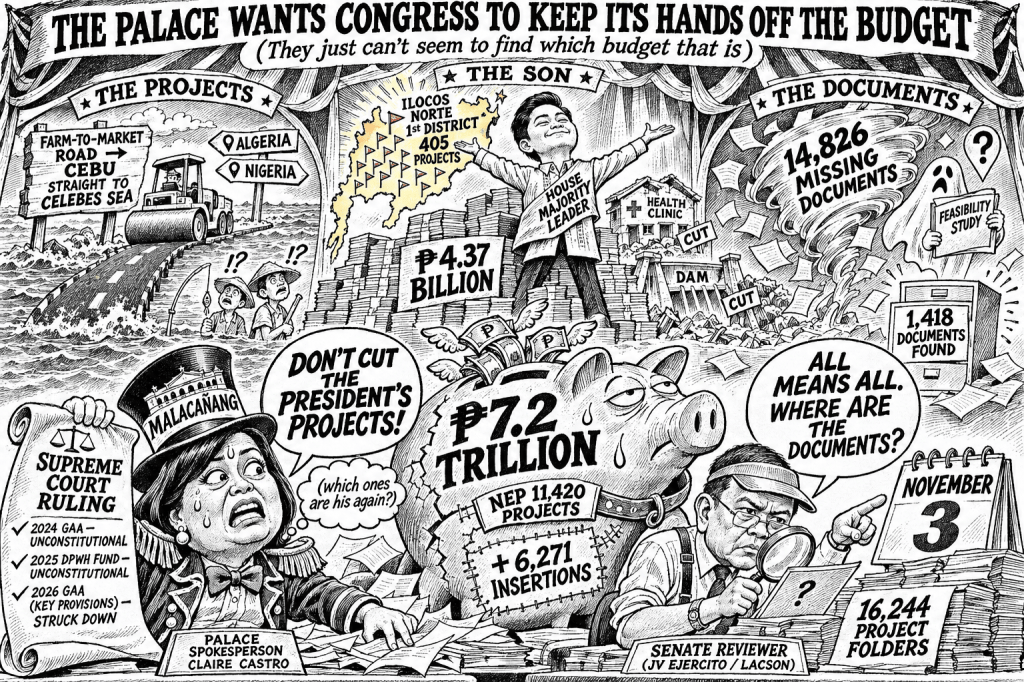
Then we arrive at the 2027 budget insertions, where the numbers become almost comical. The People’s Budget Coalition and BetterGov.ph flagged nearly 7,000 public works projects worth ₱190 billion without published attachments in the House-approved 2027 budget.
The district of House Majority Leader Sandro Marcos—the President’s son, because of course it is—saw its Department of Public Works and Highways (DPWH) allocation leap from ₱369 million in the executive proposal to ₱4.74 billion, an increase of ₱4.38 billion. That is a 1,184 percent increase. If that were a utility bill, the House would have appropriated ₱50 billion for it.
Malacañang’s Defense
Malacañang’s defense, delivered with a straight face, is that insertions are “not inherently bad” as long as funds are used properly and projects benefit the public. This is the political equivalent of saying a bridge is not inherently dangerous as long as it does not collapse.
The question is not whether infrastructure is good. The question is why nearly 7,000 projects lack published attachments, why the largest single increase lands in the district of the Majority Leader and presidential scion, and why the House believes the public should accept assurances in lieu of documents.
Voices Breaking Ranks
To his credit, Tiangco has broken ranks, declaring independence from the majority to pursue budget transparency. Kamanggagawa Party-list Representative Eli San Fernando has taken up the disclosure challenge, noting his party-list sought zero infrastructure allocations and therefore has nothing to hide.
The fact that “nothing to hide” is treated as a novel position speaks volumes. The Daily Tribune has likewise carried the call for louder demands on House disclosure.
What the Law Says
The legal framework is not ambiguous. Belgica v. Ochoa struck down the Priority Development Assistance Fund (PDAF) precisely because it permitted post-enactment legislative control over project selection and implementation. Araullo v. Aquino III held that savings cannot be manufactured through premature declarations or arbitrary abandonments.
The House’s pattern—inflate the budget, underspend, declare savings, realign to EME, approve a new budget with even larger insertions—is a textbook evasion of these doctrines. Whether it crosses into criminal liability under Republic Act (RA) 3019, the Anti-graft and Corrupt Practices Act, is a question for the Ombudsman. Whether it crosses into constitutional violation is a question for the Supreme Court. Whether it is politically sustainable is a question for the voters.
The Burden of Proof
Let us be precise, because precision is what the House’s defenders lack. An inflated appropriation is not automatically illegal. A budget insertion is not automatically a kickback. A certification-based liquidation is not automatically falsified.
But when all these practices converge, the burden of proof shifts. The House cannot demand accountability from the executive while refusing to explain its own financial decisions. It cannot invoke fiscal autonomy as a shield against audit while treating that autonomy as a license for discretion.
A System Designed to Evade Accountability
The most damning indictment is not that the House may have broken a specific law. It is that the system is designed to make accountability nearly impossible. COA audits retrospectively. The Ombudsman investigates individual misconduct. The Supreme Court resolves justiciable controversies.
None can easily penetrate a fiscal-autonomous chamber that controls its own savings, liquidates through certification, and approves its own budget without meaningful external scrutiny.
The Senate’s Moment
The Senate now has the House’s 2027 budget bill. The bicameral conference committee will reconcile the chambers’ versions. Senator JV Ejercito, Senate President Sherwin Gatchalian, and Senator Panfilo Lacson have all signaled openness to the watchdogs’ findings.
This is the moment for the Senate to demonstrate that at least one chamber of Congress understands that “power of the purse” does not mean “power to pick pockets.”
Motives Versus Documents
The ultimate irony is that the House’s defenders will accuse critics of playing politics. Tiangco, they will say, is positioning himself. The watchdogs, they will say, are grandstanding.
Perhaps. But the documents—or the absence of documents—do not care about motives. The ₱1.35 billion utility appropriation does not become reasonable because Tiangco has political ambitions. The ₱4.38 billion insertion in Sandro Marcos’s district does not become transparent because the Palace says it will be well-executed.
Respect Is Earned
The House of Representatives has spent years insisting it is a co-equal branch, entitled to fiscal autonomy and institutional respect. Respect is earned. Right now, the House is earning something else entirely.
Key Citations
A. Laws, Cases, and Official Documents
- Araullo v. Aquino III. G.R. No. 209287, 1 July 2014. Lawphil Project, Arellano Law Foundation, lawphil.net/judjuris/juri2014/jul2014/gr_209287_2014.html.
- Belgica v. Ochoa. G.R. Nos. 208566, 208493, and 209251, 19 Nov. 2013. Supreme Court E-Library, elibrary.judiciary.gov.ph/thebookshelf/showdocs/1/56517.
- Commission on Audit. Presidential Decree No. 1445: Government Auditing Code of the Philippines. 11 June 1978. Lawphil Project, Arellano Law Foundation, lawphil.net/statutes/presdecs/pd1978/pd_1445_1978.html.
- Department of Budget and Management. General Appropriations Act, Fiscal Year 2025: General Provisions. Republic Act No. 12116, 30 Dec. 2024, www.dbm.gov.ph/wp-content/uploads/GAA/GAA2025/VolumeIB/GENPRO/GENPRO.pdf.
- Republic of the Philippines. 1987 Constitution of the Republic of the Philippines. Official Gazette, officialgazette.gov.ph/constitutions/1987-constitution/.
- Republic of the Philippines. Republic Act No. 3019: Anti-Graft and Corrupt Practices Act. 17 Aug. 1960. Supreme Court E-Library, elibrary.judiciary.gov.ph/thebookshelf/showdocs/2/22050.
B. News Articles
- Flores, Helen. “Palace Defends Budget Insertions for Sandro.” The Philippine Star, 28 Oct. 2026, www.philstar.com/headlines/2026/10/28/2566234/palace-defends-budget-insertions-sandro.
- Orcullo, Jerod. “Call Louder over House Disclosure.” Daily Tribune, 3 Nov. 2026, tribune.net.ph/2026/11/02/call-louder-over-house-disclosure.
- POLITIKO. “Sandro Marcos’ District Tops P4.37-B DPWH Insertions as Watchdogs Flag P1-T Budget ‘Pork.’” POLITIKO, 26 Oct. 2026, politiko.com.ph/sandro-marcos-district-tops-p4-37-b-dpwh-insertions-as-watchdogs-flag-p1-t-budget-pork/.
- Rappler. “House Increases DPWH Budget for Sandro Marcos’ District by P4.3B – Watchdog.” Rappler, 25 Oct. 2026, www.rappler.com/philippines/dpwh-budget-sandro-marcos-district-jumps-billions-house-bill-2027-watchdog/.
- Rappler. “House Spends P100M a Year on Utilities. Why Ask for P1B?” Rappler, 1 Nov. 2026, www.rappler.com/philippines/house-increases-utilities-funding-billion-despite-repeated-underspending/.
- Senate of the Philippines. “eClips Senate News Updates: Palace Defends Budget Insertions for Sandro.” Senate of the Philippines, 27 Oct. 2026, eclips.senate.gov.ph/malacanang/palace-defends-budget-insertions-for-sandro.
- Tribune. “San Fernando Backs Calls to Disclose 2027 Budget Insertions.” Daily Tribune, 2 Nov. 2026, tribune.net.ph/2026/11/02/san-fernando-backs-calls-to-disclose-2027-budget-insertions.
C. Official Websites
- Commission on Audit. Commission on Audit, Republic of the Philippines, www.coa.gov.ph.

- “Ang Hirap Maging Mahirap”: The PAO Scandal That Proves Government Contempt Is Nothing New
- “Far-Off” My Axx: Malacañang’s Claire Castro Drowns in Her Own Legal Gaslighting
- “Forthwith” to Farce: How the Senate is Killing Impeachment—And Why Enrile’s Right (Even If You Can’t Trust Him)
- “HINDI AKO NAG-RESIGN!”

- “I Know Nothing”: Baste Duterte’s Amnesia Defense Meets ₱33M in GenCorp Contracts
- “I’m calling you from my new Globe SIM. Send load!”

- “Mahiya Naman Kayo!” Marcos’ Anti-Corruption Vow Faces a Flood of Doubt

- “Manageable” Debt, Unmanageable Lies: DBM’s ₱21 Trillion Fairy Tale
- “Meow, I’m calling you from my new Globe SIM!”

- “Natrabaho”: One Word, One Ombudsman, and a Judiciary on Trial
- “No Special Jail for Crooks!” Boying Remulla Slams VIP Perks for Flood Scammers
- “Philippine-Controlled” or Yankee Gas Station? The Davao Fuel Depot Farce Exposed




Leave a Reply