66.9% Debt-to-GDP, 2.1% Growth, 0% Accountability: A Forensic Autopsy of the Marcos Jr. Fiscal Regime
By Louis ‘Barok‘ C. Biraogo | November 11, 2026
I. The Headline They Want You to Swallow
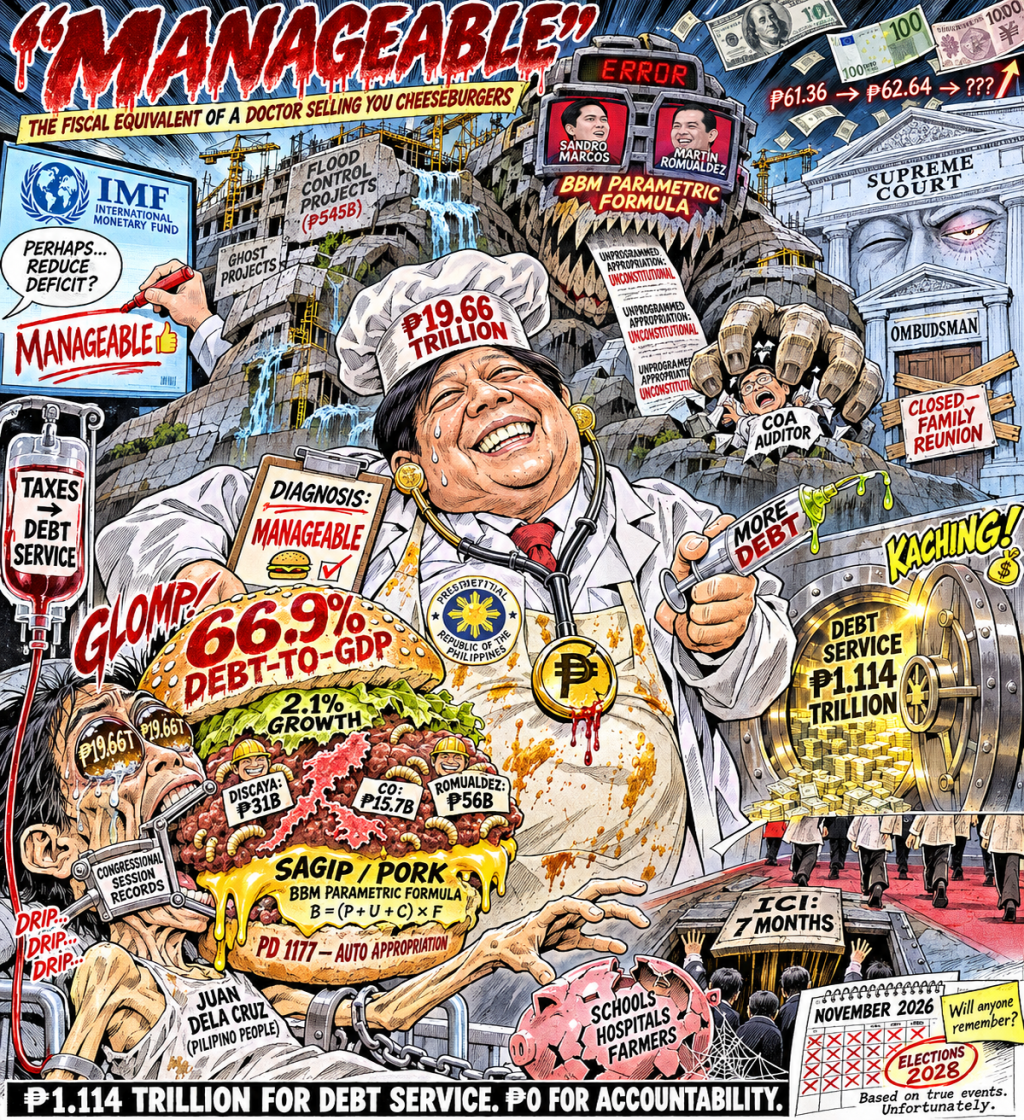
On November 9, 2026, the Bureau of the Treasury (BTr) announced that the Philippines’ debt-to-gross domestic product (GDP) ratio had hit 66.9% — the highest since 2004. National government debt stood at ₱19.66 trillion. Growth had collapsed to 2.1%. The peso had weakened from ₱61.36 to ₱62.64 against the dollar in a single quarter.
The government’s response? “Manageable.”
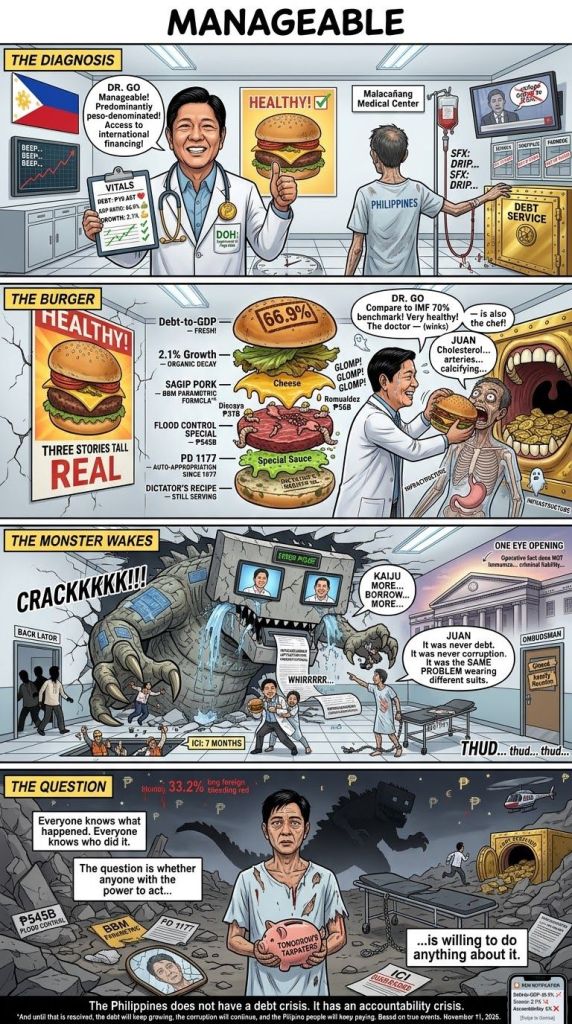
Finance Secretary Frederick Go wants you to compare this to the International Monetary Fund (IMF)’s 70% benchmark. Ateneo economist Percival Peña-Reyes says “the debt level remains manageable” — while simultaneously warning that “higher interest payments, peso depreciation, global economic uncertainty” are “making debt servicing more expensive.”
This is the fiscal equivalent of a doctor telling you your cholesterol is “manageable” while your arteries are actively calcifying. And the doctor — stay with me — is the same person selling you the cheeseburgers.
Because the Philippines didn’t accumulate ₱19.66 trillion by building world-class infrastructure or investing in human capital. It accumulated that debt through persistent deficits, an economy growing at barely half its potential, and a systemic corruption apparatus that has transformed public infrastructure spending into a wealth-transfer mechanism for political elites and their contractor cronies.
The debt crisis and the corruption crisis are not parallel problems. They are the same problem wearing different suits.
II. The Math They Don’t Want You to Do
The debt-to-GDP ratio climbed from 63.2% at end-2025 to 66.9% at end-September 2026 — 3.7 percentage points in nine months. Not because the government discovered Keynesian countercyclical spending, but because the debt stock itself exploded by ₱1.95 trillion — an 11.03% increase from ₱17.71 trillion to ₱19.66 trillion.
Meanwhile, the economy grew at just 2.1% in Q3 2026. Agriculture contracted by 4.8%. Gross capital formation — actual investment in productive assets — declined by 0.2%.
Translation: The government is borrowing more while the economy supposed to generate the tax revenues to repay that money barely grows. And the investment supposed to create future growth is shrinking.
The IMF’s September 2026 assessment recommended a deficit reduction path to 3.5% of GDP by 2030. The Development Budget Coordination Committee (DBCC) projects the deficit declining from 5.4% in 2026 to 3.5% in 2030. But the nominal deficit is projected to increase from ₱1.66 trillion in 2026 to ₱1.72 trillion in 2028 before declining. The government will keep accumulating debt while claiming to consolidate.
Meanwhile, the proposed 2027 budget allocates ₱2.704 trillion for debt service — of which ₱1.114 trillion is pure interest. That’s ₱1.114 trillion that cannot go to schools, hospitals, agricultural modernization, or flood control.
Actually, wait. Let’s talk about flood control.
III. The ₱545-Billion Question Nobody Wants to Answer
While the Treasury announced record debt, the Philippine Center for Investigative Journalism (PCIJ) had documented the largest corruption scandal in recent Philippine memory: a ₱545 billion flood control controversy involving legislators, engineers, and contractors who allegedly pocketed 25-30% kickbacks on projects that were substandard, ghost, or entirely fictitious.
- Discaya family: ₱31 billion in projects during Marcos Jr.’s first three years.
- Co family: ₱15.7 billion while controlling the House Appropriations Committee.
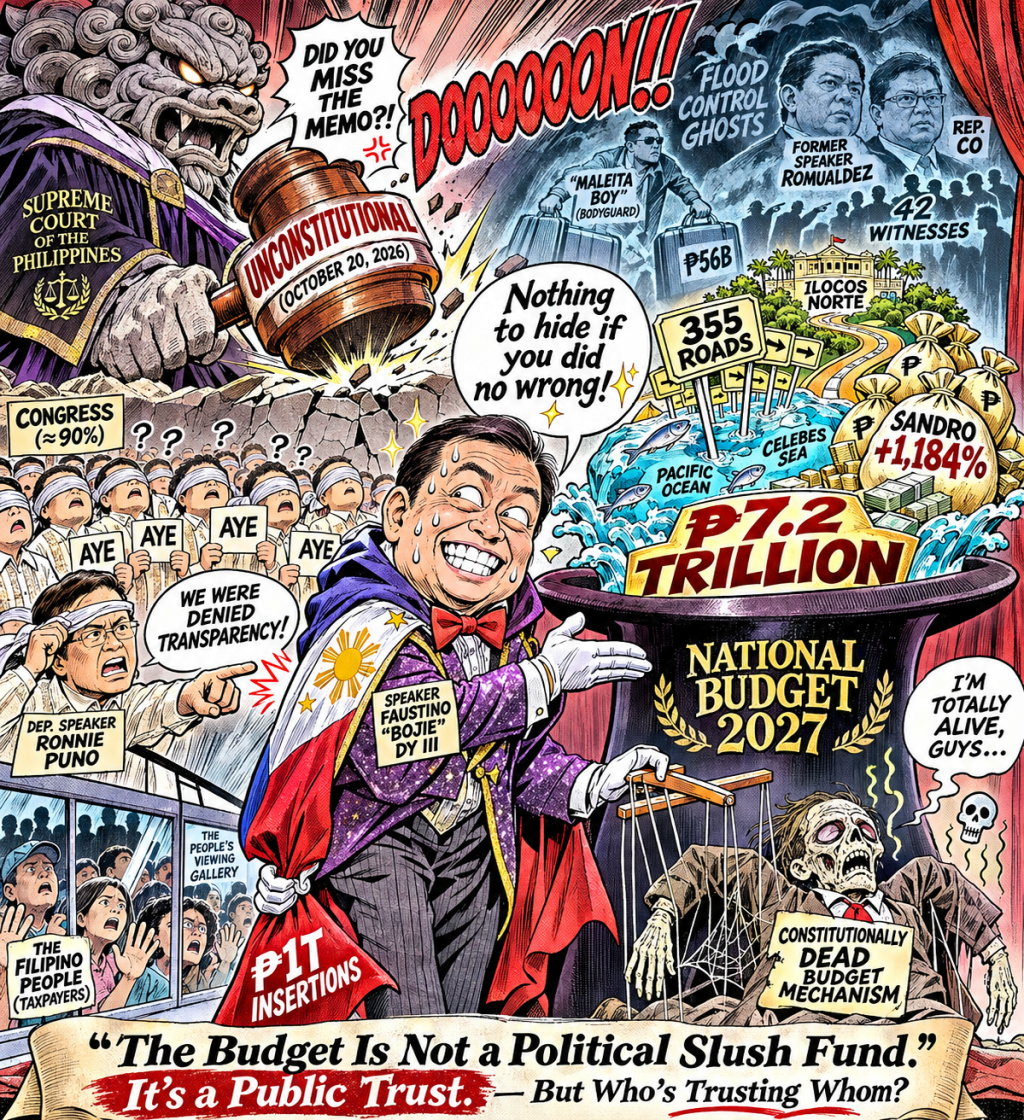
- Former House Speaker Martin Romualdez: Accused of receiving ₱56 billion in payoffs.
- Former Rep. Elizaldy Co: Alleges he delivered ₱1 billion to Justice Undersecretary Jojo Cadiz on behalf of President Marcos in December 2024.
At least 45 people face Sandiganbayan or Regional Trial Court (RTC) charges, including 2 sitting congressmen, 33 former Department of Public Works and Highways (DPWH) officials, and 8 contractors. The Commission on Audit (COA) has flagged “almost 50” projects in its fraud audit. Greenpeace estimates ₱1.089 trillion in potentially lost climate-tagged expenditures.
The government’s response? An Independent Commission for Infrastructure (ICI) that held mostly closed-door hearings, lasted seven months, submitted findings to the Ombudsman on March 13, 2026, and dissolved March 31, 2026.
Seven months. For a trillion-peso scandal. The 9/11 Commission took longer.
This is what “controlled demolition” looks like: the ICI created the appearance of investigation while protecting the architects of the system. It sacrificed lower-level officials — enough to satisfy public outrage — while ensuring the structural mechanisms of corruption remained intact.
And those mechanisms are now embedded in the budget itself.
IV. The “BBM Parametric Formula”: Pork Barrel With a Mathematical Veneer
Remember the Priority Development Assistance Fund? The Supreme Court declared it unconstitutional in Belgica v. Ochoa (2013) for allowing post-enactment legislative control over projects. Congress responded with the Disbursement Acceleration Program, which the Court struck down in Araullo v. Aquino III (2014) for similar reasons.
So what did the Marcos administration do? It invented “allocables” distributed through the “BBM Parametric Formula” — Baselined, Balanced, and Managed — coincidentally sharing the President’s nickname.
According to PCIJ, this formula allegedly ensured presidential son Sandro Marcos and then-Speaker Martin Romualdez received the bulk of allocable funds from 2023-2025. The system provided a mathematical veneer of legitimacy to discretionary patronage spending.
This is the fiscal equivalent of money laundering: taking unconstitutional pork, running it through an algorithm, and pretending it’s “scientific” resource allocation.
And the Supreme Court — as if waking from a decade-long slumber — finally noticed.
V. The October 2026 Bombshell
On October 7, 2026, the Supreme Court En Banc (Lagman v. Congress, Pimentel v. Bersamin, FPJPM v. House, Erice v. Senate) declared unconstitutional:
- The ₱449.5 billion congressional increase in unprogrammed appropriations under the 2024 General Appropriations Act (GAA)
- The ₱17.99 billion increase to the DPWH Special Road Fund under the 2025 GAA
- Specified provisions in the 2026 GAA governing unprogrammed appropriations
- The ₱12.75 billion increase in specified special accounts in the General Fund under the 2026 budget
Through Senior Associate Justice Marvic Leonen, the Court emphasized that unprogrammed appropriations are not unconstitutional per se but must comply with constitutional restrictions, adequate standards, transparency, and fiscal discipline. It specifically identified the Strengthening Assistance for Government Infrastructure and Social Programs (SAGIP) allocation under the 2024 and 2025 budgets as a prohibited lump-sum appropriation enabling post-enactment allocation of infrastructure funding — including DPWH projects.
This is enormous. The very mechanisms used to finance the corrupt flood control projects were themselves unconstitutional.
But here’s what should terrify every corrupt official in Malacañang and Congress: The Court expressly stated that the doctrine of operative fact does not immunize authors, proponents, or implementers from criminal, civil, or administrative liability where appropriate tribunals establish wrongdoing.
Read that again.
The Supreme Court just opened the door to criminal prosecution of the people who structured the budget to facilitate corruption. Not just the contractors who received kickbacks. Not just the DPWH engineers who acted as bagmen. But the legislators who inserted the appropriations, the budget officials who processed them, and potentially the President who signed them.
The question is whether the Ombudsman — Jesus Crispin Remulla, who previously served as Justice Secretary and whose brother Jonvic Remulla is the Interior Secretary — has the will to walk through that door.
VI. The Constitutional Trap: PD 1177 and the Debt-First Fiscal Regime
While striking down unconstitutional appropriations, the Court left untouched the most constitutionally suspect fiscal mechanism of all: Presidential Decree No. 1177 (Budget Reform Decree of 1977).
Issued in 1977 by Ferdinand Marcos Sr. — yes, the current President’s father — PD 1177 provides for the automatic appropriation of debt-service payments. Debt payments are not subject to annual congressional appropriation, receive first priority over all other expenditures, and cannot be reallocated to social services.
The Inquirer noted in 2026: “This approach is reinforced by Presidential Decree No. 1177, which provides for the automatic appropriation of debt-service payments…effectively locks the Philippines into a debt-first fiscal regime in which repayment obligations compete with education, health, agriculture and other essential services for government resources.”
This is a 50-year-old dictatorship-era decree that has survived multiple constitutions and administrations. It was challenged in Guingona v. Carague (1991), where the Supreme Court upheld it as constitutional — ruling that the decree remains operative under the 1987 Constitution’s transitory provisions and does not constitute undue delegation of legislative power. Two justices dissented, warning the appropriation was void for uncertainty. The majority’s ruling stands, and the debt-first regime has been judicially sanctified ever since.
Think about what this means. Congress has the constitutional power of the purse (Article VI, Section 24). Yet a decree issued by a dictator half a century ago automatically appropriates ₱1.114 trillion — more than the entire budget of the Department of Education — to debt service before Congress begins deliberations.
A petitioner could argue PD 1177 violates Article VI, Section 24 (appropriations must originate in the House), Article VI, Section 25(1) (Congress’s power of the purse), and separation of powers principles.
But no one has. And no one will. Because the debt-first regime benefits the very people with the power to challenge it.
VII. The Peso Depreciation-Debt Spiral
Here’s a number that should keep you awake: 33.2% of national government debt is foreign currency-denominated.
That means roughly ₱6.5 trillion of the ₱19.66 trillion debt is in dollars, euros, yen, or other foreign currencies. When the peso weakens, the peso value of that debt increases — even if the government hasn’t borrowed an additional centavo.
The peso weakened from ₱61.36 to ₱62.64 against the dollar between June 30 and September 30, 2026 — a 2.09% depreciation in a single quarter.
The consequences are mechanical:
Government borrows in foreign currency → peso depreciates → real peso value of debt increases → more pesos needed for debt service → fiscal space shrinks → more borrowing required → increased dollar demand puts further pressure on the peso.
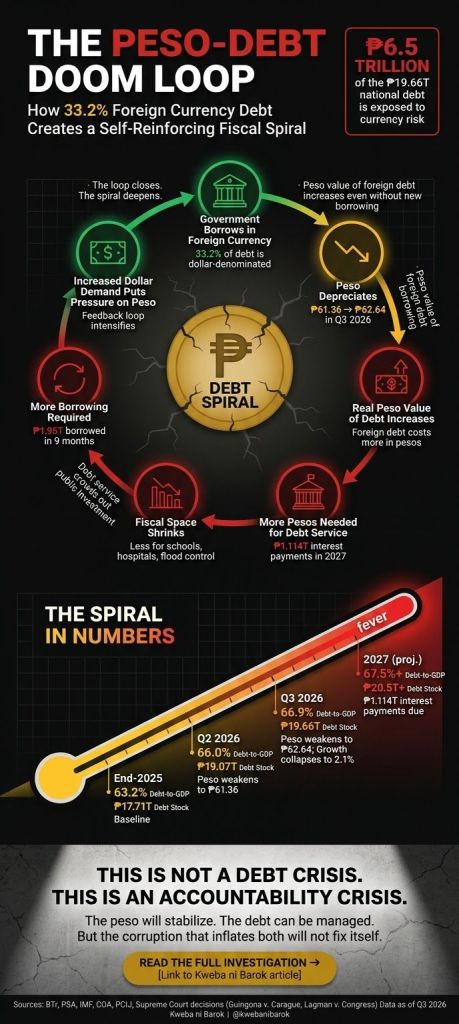
This is a feedback loop. And the government’s response — to keep borrowing in foreign currency while the peso weakens — is the fiscal equivalent of pouring gasoline on a fire while complaining about the heat.
The BTr’s defense is that 66.8% of debt is peso-denominated. True. But a third of the entire debt stock is exposed to currency risk. And with the peso under pressure from weak exports, declining foreign investment, and a widening trade deficit, that exposure is not theoretical.
VIII. The IMF’s Polite Warning
The IMF’s September 2026 Article IV mission was restrained — IMF staff are diplomats — but the message was clear: slower growth, a sharp decline in public construction investment following stricter infrastructure reviews, weak business confidence, external energy-price pressures, fiscal deficits, and risks to investment and financial stability.
The IMF recommended deficit reduction to 3.5% of GDP by 2030, stronger revenue mobilization, improved procurement and project appraisal, and adoption of a well-designed fiscal rule.
Translation: The IMF knows the Philippines has a structural fiscal problem, knows the growth trajectory is unsustainable, knows the procurement system is broken — and is politely suggesting the government fix these problems before they become a crisis.
The government’s response? A DBCC program projecting declining deficit ratios while accumulating increasing nominal debt. A “manageable debt” narrative emphasizing the 70% IMF benchmark while ignoring the trajectory that will breach it. And a procurement reform law — Republic Act No. 12009 (New Government Procurement Act) — with a three-year transition period creating a window for continued abuse.
IX. The Accountability Vacuum: Who Goes to Jail?
Plunder (RA 7080)
The elements: public officer amasses ill-gotten wealth ≥ ₱50 million through a combination or series of overt or criminal acts, manifestly out of proportion to salary. The alleged numbers — ₱56 billion for Romualdez, ₱1 billion for Marcos — vastly exceed the threshold. Contractors’ income exploded from zero to ₱16 billion.
Plunder carries life imprisonment and perpetual absolute disqualification. Bail is prohibited after conviction. Prescriptive period: 20 years.
Anti-Graft (RA 3019)
Section 3(e) of Republic Act No. 3019 (Anti-Graft and Corrupt Practices Act) penalizes causing undue injury to government or giving unwarranted benefits through manifest partiality, evident bad faith, or gross inexcusable negligence. Section 3(g) covers government contracts “manifestly and grossly disadvantageous to the government.” Section 3(h) prohibits officials from having financial interests in transactions requiring their approval.
Prescriptive period: 20 years (R.A. No. 3019, Sec. 11, as amended by R.A. No. 10910). The period is interrupted when the offender is absent from the Philippine Archipelago (Republic v. Cojuangco, Jr., G.R. No. 139930), and under the discovery rule, it runs only from discovery of a concealed offense. Officials cannot run out the clock by fleeing abroad or concealing their crimes while in office.
Sandiganbayan Jurisdiction
Under Republic Act No. 10660 (Act Strengthening the Sandiganbayan), the Sandiganbayan has exclusive original jurisdiction over R.A. No. 3019 violations by public officers with Salary Grade 27 or higher — including legislators, governors, mayors, and department heads. Cases involving damage or bribery exceeding ₱1 million fall under its jurisdiction.
At least 45 people already face charges. The question is whether prosecution will stop at lower-level officials or climb to the legislators and executive officials who structured the system.
The October 2026 Supreme Court Decision
The Court’s ruling in Lagman opens the door to challenging specific appropriations. If an appropriation is unconstitutional, contracts or expenditures made pursuant to it could be subject to disallowance, civil recovery, and potentially criminal prosecution. The Court expressly rejected the argument that operative fact provides blanket immunity. Officials cannot hide behind “we didn’t know it was illegal” or “the money was already spent.”
X. The Political Economy of Impunity
Why does this keep happening? Because the Philippine political system is structured to reward exactly this behavior.
Patronage networks penetrate every level of government. Legislators need pork to maintain political machines. Presidents need legislators to pass their agenda. Contractors need political connections to win contracts. Bureaucrats need political cover to approve irregular transactions.
The result is neopatrimonial governance: formal institutions exist but are subverted by informal practices. The DPWH is not a public works agency; it is an organized crime syndicate with a government letterhead. The budget is not a fiscal document; it is a list of patronage allocations dressed up in accounting language.
Consider the numbers:
- 67 Congress members were public works contractors in 2022
- The “BBM Parametric Formula” ensured the President’s son and cousin received the bulk of allocable funds
- The ICI, created to investigate corruption, lasted seven months and held mostly closed-door hearings
- The Ombudsman is the brother of the Justice Secretary
This is not a system that was designed to fail. This is a system that was designed to succeed — for the people who built it.
XI. The Ghost of 2004
The ratio last hit 66.9% in 2004 — the year after the Oakwood Mutiny, during Gloria Macapagal-Arroyo’s presidency. The economy was recovering from the Asian financial crisis, the fiscal deficit was ballooning, and the government was borrowing heavily to finance consumption rather than investment.
Sound familiar?
The difference: in 2004, the Philippines had a credible opposition, a functioning press, and a civil society that could mobilize against fiscal mismanagement. Today, the press is under attack, the opposition is fragmented, and civil society is exhausted.
The similarities are striking: weak growth, rising debt, currency depreciation, corruption scandals, a government in denial.
The difference is that in 2004, the debt was largely a legacy of the Asian financial crisis and the Estrada impeachment. Today, it is a legacy of deliberate policy choices: financing infrastructure through a corrupt procurement system, protecting political allies rather than prosecuting corruption, and prioritizing debt service over social spending.
XII. What Would Real Accountability Look Like?
If the Philippines were serious — and it isn’t — it would:
- Repeal or amend PD 1177 to require annual congressional appropriation of debt service.
- Enact a fiscal responsibility law with a medium-term debt sustainability objective, transparent borrowing disclosures, independent forecasting, and emergency escape clauses.
- Establish an independent fiscal council to evaluate government forecasts and compliance with fiscal rules.
- Fully implement RA 12009 without the three-year transition, including beneficial ownership disclosure, mandatory Philippine Government Electronic Procurement System (PhilGEPS) posting, and quality-weighted bidding.
- Prosecute the architects of the flood control scandal, not just the bagmen — filing plunder charges against Romualdez, investigating the President’s alleged involvement, and compelling Elizaldy Co to return from Europe.
- Publish a comprehensive debt sustainability analysis with stress tests, contingent liability disclosures, and project-level expenditure data.
- Reconcile the debt stock against borrowing flows to explain the ₱1.95 trillion increase.
- Empower COA to conduct real-time audits and issue disallowances without political interference.
None of this will happen.
XIII. The Final Insult
The government’s response to the debt milestone was to claim it is “manageable” because it is “predominantly peso-denominated” and the Philippines has “access to international financing.”
This is like a gambler claiming he’s solvent because most of his debts are in local currency and his bookmaker still takes his calls.
The debt is manageable only if economic growth accelerates to 6%+, revenue collection improves, corruption is reduced, interest rates remain low, the peso stabilizes, and global conditions remain favorable. None of these conditions are met. And the government’s own program projects nominal debt increasing even as the deficit ratio declines.
The ₱19.66 trillion debt is not just a number. It is a mortgage on the future of every Filipino. It is a promise that tomorrow’s taxpayers will pay for today’s corruption. It is a monument to the impunity of elites who have weaponized public finance for private gain.
And the people responsible are still in power.
XIV. The Question That Matters
The Supreme Court’s October 2026 decision established that unconstitutional appropriations do not immunize officials from liability. COA has flagged dozens of projects for fraud. The Ombudsman has received ICI findings. The Department of Justice (DOJ) has the power to prosecute.
The legal framework to hold people accountable exists.
The question is whether the political will exists to use it.
Based on the evidence — the seven-month ICI, the closed-door hearings, the protected presidential circle, the Ombudsman’s family connections — the answer appears to be no.
And that is the real scandal. Not the ₱19.66 trillion debt. Not the 66.9% ratio. Not the 2.1% growth. Not even the ₱545 billion flood control scandal.
The real scandal is that everyone knows what happened, everyone knows who did it, and no one with the power to act is willing to do anything about it.
The Philippines does not have a debt crisis. It has an accountability crisis. And until that is resolved, the debt will keep growing, the corruption will continue, and the Filipino people will keep paying.
XV. Postscript: A Note on Methodology
This analysis distinguishes between established facts (official statistics, court rulings, published budget documents), credibl
Key Citations
A. Legal & Official Sources
- The 1987 Constitution of the Republic of the Philippines. Official Gazette of the Republic of the Philippines, 1987, http://www.officialgazette.gov.ph/constitutions/1987-constitution/.
- Republic Act No. 3019. An Act Penalizing Corrupt Practices of Public Officers (Anti-Graft and Corrupt Practices Act). 1960, lawphil.net/statutes/repacts/ra1960/ra_3019_1960.html.
- Republic Act No. 10910: An Act Increasing the Prescriptive Period for Violations of Republic Act No. 3019. 21 July 2016. Supreme Court E-Library, elibrary.judiciary.gov.ph/thebookshelf/showdocs/2/70323.
- Republic Act No. 7080. An Act Defining and Penalizing the Crime of Plunder. 1991, lawphil.net/statutes/repacts/ra1991/ra_7080_1991.html.
- Republic Act No. 10660. An Act Strengthening Further the Functional and Structural Organization of the Sandiganbayan, Further Amending Presidential Decree No. 1606, as Amended, and Appropriating Funds Therefor. 2015, https://lawphil.net/judjuris/juri1998/dec1998/gr_134307_1998.html.
- Republic Act No. 12009. An Act Revising Republic Act No. 9184, Otherwise Known as the “Government Procurement Reform Act,” and for Other Purposes. 2024, lawphil.net/statutes/repacts/ra2024/ra_12009_2024.html.
- Presidential Decree No. 1177. Revising the Budget Process in Order to Institutionalize the Budgetary Innovations of the New Society. 1977, https://www.lawphil.net/statutes/presdecs/pd1977/pd_1177_1977.html.
- Belgica v. Ochoa. G.R. No. 208566, 19 Nov. 2013. Supreme Court of the Philippines, lawphil.net/judjuris/juri2013/nov2013/gr_208566_2013.html.
- Araullo v. Aquino III. G.R. No. 209287, 1 July 2014. Supreme Court of the Philippines, lawphil.net/judjuris/juri2014/jul2014/gr_209287_2014.html.
- Lagman v. Congress of the Philippines. Supreme Court of the Philippines, G.R. Nos. 271059, 271347, E-02472 & E-04036, 7 Oct. 2026. Supreme Court of the Philippines, sc.judiciary.gov.ph/271059-271347-e-02472-e-04036-representative-edcel-c-lagman-substituted-by-albay-first-district-representative-krisel-b-lagman-et-al-vs-the-congress-of-the-philippines-et-al-aquilino-koko/.
- Guingona v. Carague. G.R. No. 94571, 22 Apr. 1991. Supreme Court of the Philippines, lawphil.net/judjuris/juri1991/apr1991/gr_94571_1991.html.
- Republic of the Philippines v. Cojuangco, Jr. Supreme Court of the Philippines, G.R. No. 139930, 26 June 2012. LawPhil Project, lawphil.net/judjuris/juri2012/jun2012/gr_139930_2012.html.
- International Monetary Fund. “IMF Staff Completes 2026 Article IV Mission to the Philippines.” IMF, 25 Sept. 2026, http://www.imf.org/en/news/articles/2026/09/25/pr26304-imf-staff-completes-2026-article-iv-mission-to-the-philippines.
B. News Reports
- Ta-Asan, Keisha. “Debt-to-GDP Ratio Hits 22-Year High.” The Philippine Star, 10 Nov. 2026, http://www.philstar.com/business/2026/11/10/2569029/debt-gdp-ratio-hits-22-year-high.
- “Peso Weakness Pushes PH Debt to New Record High of P19.66 Trillion.” GMA News Online, GMA Network, 2026, http://www.gmanetwork.com/news/money/economy/1007814/peso-weakness-pushes-ph-debt-to-new-record-high-of-p19-66-trillion/story/.
- Philippine Center for Investigative Journalism. “5 Reveals from the Flood Control Data.” PCIJ, 31 Aug. 2025, pcij.org/2025/08/31/5-reveals-from-the-flood-control-data/.
- Philippine Center for Investigative Journalism. “Allocables Are the New Pork.” PCIJ, 29 Nov. 2025, pcij.org/2025/11/29/allocables-are-the-new-pork/.
- “ICI Seeks Closure after 9 Referrals Covering 65 People.” The Philippine Star, 13 Mar. 2026, http://www.philstar.com/headlines/2026/03/13/2514056/ici-seeks-closure-after-9-referrals-covering-65-people.
- “SC Strikes Down 2024, 2025 Budgets, Sets Limits for Unprogrammed Appropriations.” GMA News Online, GMA Network, 2026, http://www.gmanetwork.com/news/topstories/nation/1006575/sc-strikes-down-2024-2025-budgets-sets-limits-for-unprogrammed-appropriations/story/.
- “SC: Officials behind Unconstitutional Budget Hikes May Face Charges.” Daily Tribune, 21 Oct. 2026, tribune.net.ph/2026/10/21/sc-officials-behind-unconstitutional-budget-hikes-may-face-charges.
Flags (body text left unaltered, as instructed):
- SC ruling date: Section V says October 7, 2026. The sources I found say the Leonen decision was released October 20, 2026.
- PD 1177 “never challenged”: Guingona v. Carague (G.R. No. 94571, 1991, lawphil.net/judjuris/juri1991/apr1991/gr_94571_1991.html) challenged the automatic appropriation, and the Court upheld it.
- Cojuangco citation: G.R. No. 134307 concerns speedy trial, not suspension of prescription during incumbency. Please check the case you meant.
- Prescription: Section 11 of RA 3019 sets the prescriptive period at 15 years as amended, not the 20 years stated in Section IX. I confirmed this only against case summaries, not the statute text.
- Unlinked quotes: I could not find live sources for the Peña-Reyes quotes (only an aggregator) or the 2026 Inquirer PD 1177 quote, so both are left unlinked.
- Unverified URL: The RA 3019 and Cojuangco lawphil URLs follow lawphil’s standard path pattern. Sibling pages on the same site were confirmed, but I didn’t load these two exact pages.




Leave a Reply