A PR Firm Measured Filipino Trust, Found It Broken, and Called the Result ‘Conditional’
By Louis ‘Barok‘ C. Biraogo | November 11, 2026
The 72-Point “Conditional Trust” Headline
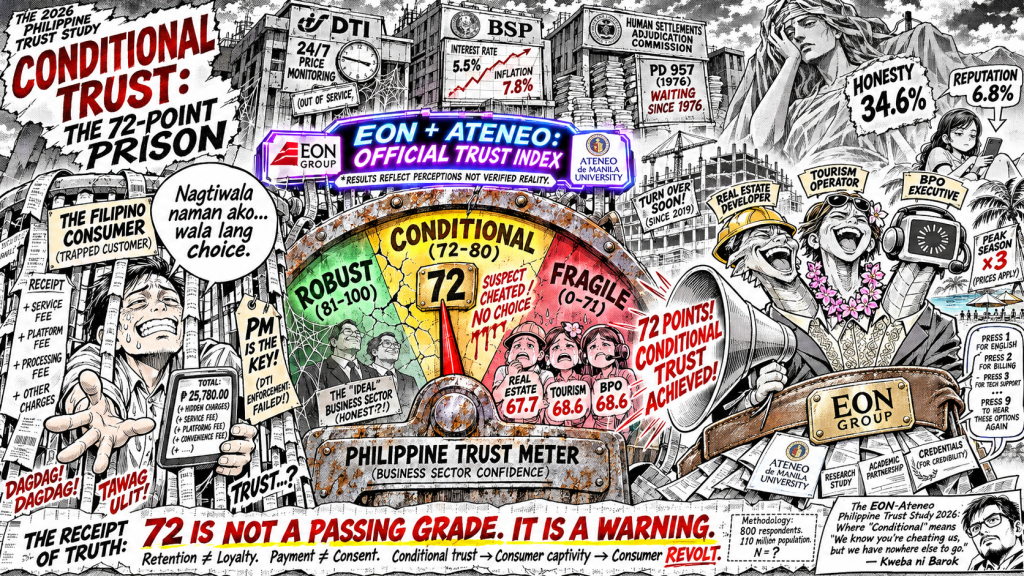
Something curious happened in Manila this month. EON Group, a public relations (PR) firm, partnered with Ateneo de Manila University, surveyed 800 Filipinos, and announced that Philippine businesses have earned a trust score of 72 out of 100. The newspapers dutifully reported this as “conditional trust”—a phrase that sounds vaguely reassuring until you realize it means customers suspect they are being cheated but have nowhere else to go.
Let us be clear about what this study actually measures. It does not measure whether businesses are trustworthy. It measures whether Filipinos feel they can trust businesses.
EON itself concedes this: the results “reflect public perceptions rather than independently verified assessments.” In other words, the firm surveyed 800 people about their suspicions, tabulated those suspicions into an index, and then sold the resulting “Trust Index” as an authoritative national barometer. This is not social science. This is a reputation-management firm discovering that trust deficits create demand for reputation-management services.
What the Findings Actually Show
The findings are damning enough on their own terms. Nearly half of all distrust—46.1 percent—traces to pricing complaints: unreasonable prices, unclear fees, hidden charges. Honesty ranked first among trust attributes at 34.6 percent, while reputation ranked dead last at 6.8 percent. Filipinos are telling us plainly that they care less about your brand than about whether you are telling the truth.
Real estate, tourism, and business process outsourcing (BPO)—three sectors the Philippine economy cannot function without—all landed in “fragile trust” territory. The highest-ranked industry, food and agriculture, scraped together 75.6 points, still nine points shy of the study’s arbitrarily selected “robust” threshold of 81.
An Arbitrary Threshold
That threshold, by the way, deserves scrutiny. Why 81? Why not 80 or 85? The study does not say.
EON’s categories—”robust,” “conditional,” “fragile”—were announced as interpretive frameworks, not validated scientific instruments. A business scoring 80.9 would be “conditional” while one scoring 81.0 would be “robust,” a distinction with no empirical justification whatsoever. This is not measurement; it is labeling dressed up as precision.
Methodology Questions
The methodology raises further questions. Eight hundred respondents for a population of 110 million is thin. The fieldwork ran from May to August, ending before October inflation hit 7.8 percent.
EON describes its approach as “descriptive and exploratory”—appropriately modest phrasing that most news coverage ignored. And then there is the central problem: we do not know the denominators. The 19.7 percent figure for “unreasonable prices” applies only to respondents who identified a least-trusted sector, not to all 800 respondents. It may reflect multiple answers per person.
Without the full questionnaire and dataset, we cannot verify what these numbers actually mean. EON and Ateneo should release their technical report, complete with sampling frame, weighting procedures, and the exact formula behind that 72-point index.
Consumer Captivity, Not Consumer Choice
Yet here is the uncomfortable truth: even if the methodology is flawed, the underlying reality is not. The study’s most devastating finding comes not from its numbers but from its framing. Malyn Molina’s question—”Are customers staying because they trust a business, or because they have no other choice?”—exposes the central fiction of Philippine consumer capitalism.
Retention is not loyalty. Payment is not consent. A Filipino who continues buying from a company he distrusts because alternatives are unaffordable or unavailable is not exercising consumer choice. He is exercising consumer captivity.
Sector by Sector
Real Estate: Keys That Never Came
Consider real estate, the lowest-ranked sector at 67.7. The study cites delayed turnovers, unfulfilled marketing promises, and misleading project specifications. These are not vague impressions. They are documented violations of Presidential Decree (PD) No. 957, which requires developers to deliver projects according to approved plans and schedules.
Section 23 provides buyers the right to suspend payments or seek refunds when developers fail to comply. Yet the Human Settlements Adjudication Commission remains backlogged, enforcement is inconsistent, and developers continue marketing dream homes they cannot deliver. The trust score did not emerge from nowhere. It emerged from years of buyers waiting for keys that never came.
Tourism: Deception With a Booking Confirmation
Tourism, at 68.6, tells a similar story. Surprise fees, cancellation charges, peak-season price hikes—these are not market efficiencies. They are the commercial exploitation of consumers who have already committed to a transaction and cannot back out.
The industry’s defense that peak-season pricing is legitimate misses the point. The problem is not that prices rise. The problem is that consumers discover the real price only after payment. This is not supply and demand. This is deception with a booking confirmation.
BPO: Automation as a Wall
And then there is BPO, tied at 68.6, where automation has become a wall between companies and the customers they claim to serve. An entire industry built on human communication now deploys artificial intelligence (AI) to prevent humans from communicating.
The cost savings are real. So is the customer frustration. A company that reduces its service expenses by making complaints impossible to file has not improved efficiency. It has transferred the cost of accountability to the consumer.
Why 72 Is Not a Passing Grade
The EON-Ateneo study, for all its methodological limitations, has performed a public service: it has quantified the yawning gap between corporate promises and corporate performance. But it has also performed a more subtle disservice. By presenting “conditional trust” as a middling grade rather than a warning, it allows businesses to treat 72 as acceptable. It is not.
A 72 means nearly half of all distrust stems from pricing practices that are either negligent or deliberate. It means honesty outranks reputation. It means the sectors most critical to economic growth are the ones Filipinos trust least.
Where Regulators Fall Short
Government regulators share responsibility. The Department of Trade and Industry (DTI) claims “24/7” price monitoring, yet “PM is the key” culture thrives on social media, violating the Price Tag Law with impunity. The Bangko Sentral ng Pilipinas (BSP) raised rates to 5.5 percent, but inflation remains above target.
The Department of Human Settlements and Urban Development has the authority to sanction errant developers but lacks the capacity to do so consistently. Consumer protection laws exist—the Consumer Act, the Internet Transactions Act, the Subdivision and Condominium Buyers’ Protective Decree—but enforcement is sporadic, underfunded, and reactive.
Questions for the Study’s Sponsors
The study’s sponsors should also answer questions. EON Group is a communications firm with business interests in reputation management. Ateneo lent academic credibility. Neither has released the full questionnaire, sampling frame, or conflict-of-interest disclosures.
- Who funded the study?
- Did any participating companies have commercial relationships with EON?
- Would negative findings about specific clients have been suppressed?
These questions do not prove misconduct, but they demand transparency. A study about trust should not ask the public to trust its own methodology without evidence.
What Should Happen Next
What should happen next is not complicated.
- Businesses can disclose total prices before checkout, eliminate hidden charges, publish service-performance scorecards, and link executive compensation to customer outcomes.
- Regulators can strengthen enforcement, share complaint data across agencies, and investigate whether market concentration—not just corporate greed—is suppressing competition.
- EON and Ateneo can release their full dataset for independent verification and establish a longitudinal baseline so we can measure whether trust improves or deteriorates over time.
The Cultural Problem
But the deeper issue is cultural. Philippine business has long operated on the assumption that reputation is a marketing asset rather than an earned obligation. The EON-Ateneo study reveals that consumers no longer believe this.
They have watched promises broken, prices inflated, and complaint lines automated into oblivion. They have learned to distinguish between companies that sell products and companies that deserve trust. Increasingly, these are not the same.
A Warning, Not a Grade
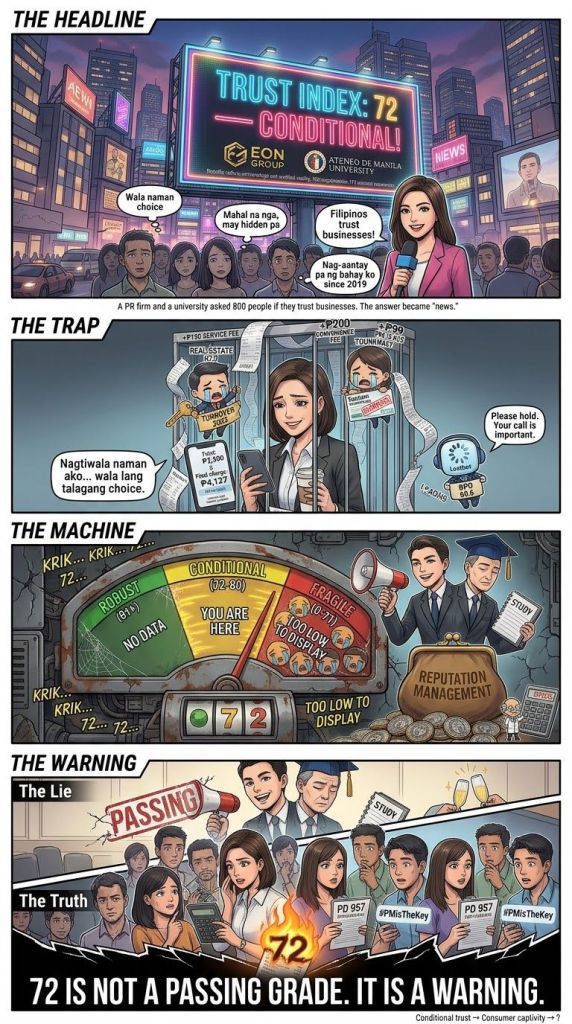
A 72 is not a passing grade. It is a warning that the private sector’s license to operate is being renegotiated in real time, transaction by transaction, receipt by receipt.
Businesses can continue treating trust as a slogan to be managed by PR firms, or they can treat it as an economic obligation to be earned through honesty. The choice is theirs. But the patience of Filipino consumers is not infinite, and the alternative to conditional trust is not unconditional loyalty. It is consumer revolt.
Key Citations
A. Laws and Official Sources
- Department of Trade and Industry, Fair Trade Enforcement Bureau. “How to File a Consumer Complaint?” DTI Fair Trade Enforcement Bureau, 19 Aug. 2025, fairtrade.dti.gov.ph/faq/how-to-file-a-consumer-complaint/.
- Republic of the Philippines. Internet Transactions Act of 2023. Republic Act No. 11967, 5 Dec. 2023. The Lawphil Project, lawphil.net/statutes/repacts/ra2023/ra_11967_2023.html.
- —. Subdivision and Condominium Buyers’ Protective Decree. Presidential Decree No. 957, 12 July 1976. The Lawphil Project, lawphil.net/statutes/presdecs/pd1976/pd_957_1976.html.
- —. The Consumer Act of the Philippines. Republic Act No. 7394, 13 Apr. 1992. Supreme Court E-Library, elibrary.judiciary.gov.ph/thebookshelf/showdocs/2/3302.
B. News Articles
- Context.ph. “Business Trust Remains Fragile, Real Estate Ranks Last.” Context.ph, 9 Nov. 2026, context.ph/2026/11/09/business-trust-remains-fragile-real-estate-ranks-last/.
- Cordero, Ted. “Inflation Rises to 7.8% in October.” GMA News Online, 5 Nov. 2026, www.gmanetwork.com/news/money/economy/1008340/inflation-rises-to-7-8-in-october/story/.
- Desiderio, Louella. “Inflation Heats Up to 7.8% in October.” Philstar.com, 6 Nov. 2026, www.philstar.com/business/2026/11/06/2568143/inflation-heats-78-october.
- Aleta, John Lloyd. “High Prices, Hidden Fees Weaken Filipinos’ Trust in Businesses.” Radar.ph, 10 Nov. 2026, radar.ph/high-prices-hidden-fees-weaken-filipinos-trust-in-businesses/.
C. Organization Websites
- EON Group. “Philippine Trust Study 2024.” EON Group, eon.com.ph/philippine-trust-2024/.
- ₱9 Billion in ‘Savings’? DILG’s Fire Truck Deal Smells Like Smoke
- ₱8B BBM Pork: CCTV for Every Captain’s Kumpare?
- ₱8.9 Billion, 331 Ghost Police Stations: The TIKAS Scandal Explained

- ₱8.4 Billion, 42,000 Barangays, 1 Election: The “Bawat Barangay Makikinabang” Vote-Buying Masterclass
- ₱75 Million Heist: Cops Gone Full Bandit

- ₱63 to the Dollar: The Only Thing Falling Faster Than the Peso Is the Government’s Credibility
- ₱6.77B Ghost Haunts Duterte: RTC Dismisses Mans Carpio’s Desperate Plea
- ₱6.77 Billion and Zero Cash: The Sara Duterte SALN Math That Doesn’t Add Up
- ₱6.7-Trillion Temptation: The Great Pork Zombie Revival and the “Collegial” Vote-Buying Circus

- ₱58.53B, Zero Receipts: The LGSF Pork Barrel Nobody Wants to Name
- ₱53 Million Man Tells ₱695-a-Day Workers to Stop Being ‘Mayabang’: The Audacity of BSP’s Remolona
- ₱491-M Right-of-Way Scam: DPWH Paid for Ghost Land, Ombudsman Finally Notices


Leave a Reply