
The prosecution says the bank records will do the talking. Unfortunately, nobody’s taught the Senate how to read a spreadsheet.
By Louis ‘Barok’ C. Biraogo |October 5, 2026
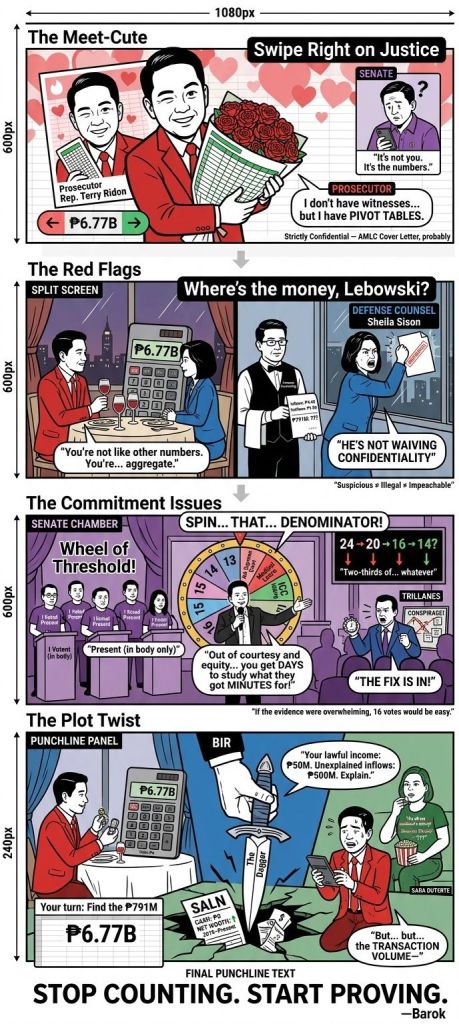
LET me tell you something about the Philippine impeachment circus that should terrify anyone who actually cares about forensic evidence: the prosecution has spent weeks waving around a number — ₱6.77 billion — like it’s a magic wand that will make Vice President Sara Duterte disappear from public life. And yet, as of this writing, nobody has actually explained what that number means. Welcome to the document-heavy phase of Article II, where the House prosecution panel is betting the farm on a paper trail that they insist will “pin down” the Vice President on unexplained wealth charges. House prosecutor Terry Ridon put it this way: “Sometimes the incontrovertible evidence comes from documents and not from alleged (polluted) eyewitnesses.”
Translation: We don’t have a smoking gun witness, so we’re hoping you’ll be impressed by Excel.
The AMLC Telenovela
Anti-Money Laundering Council (AMLC) Executive Director Ronel Buenaventura was supposed to testify last Thursday, but that got pushed to Monday after the defense complained they received the AMLC summaries that morning — and oh, by the way, every single page was stamped “strictly confidential.” Defense counsel Sheila Sison wasn’t wrong to raise this. The AMLC cover letter explicitly stated the agency was “not waiving the confidentiality of AMLC records.” So the prosecution is essentially arguing that the impeachment court can subpoena documents that the agency itself says shouldn’t be publicly disclosed, and then use those documents to convict someone.
That’s… creative.
Presiding Officer Chiz Escudero granted the defense additional time “out of courtesy and equity.” Former Senator Trillanes immediately accused Escudero of sabotage, noting that the prosecution got minutes to study documents in another instance while the defense got days. Whether that’s fair or not, the optics are terrible. But let’s be honest: the AMLC confidentiality fight is a sideshow. The real issue is whether anyone can actually explain what those 630 covered transaction reports and 33 suspicious transaction reports (STRs) actually prove.
Suspicious ≠ Illegal ≠ Impeachable
Here’s the part where I’m going to make some people angry: a “suspicious transaction report” is not evidence of a crime. It’s evidence that a bank employee checked a box. That’s it. That’s the whole thing.
Under Republic Act No. 9160 (Anti-Money Laundering Act of 2001), covered institutions are required to file STRs when they detect transactions that might be suspicious. It’s a regulatory reporting mechanism, not a judicial finding. The prosecution knows this, which is why they’re now pivoting to the “documents will speak for themselves” strategy.
But documents don’t speak. Documents sit there while lawyers argue about what they mean. And what ₱6.77 billion in “aggregate transactions” over 19 years might mean is that the same money moved around a lot. A lawyer who receives ₱10 million in fees, pays ₱9 million in expenses, and transfers ₱1 million between accounts could generate ₱20 million in “transactions” while netting only ₱1 million. That’s not a scandal. That’s basic accounting.
The prosecution has already acknowledged the breakdown: ₱3.77 billion attributed to Duterte, ₱2.99 billion to Carpio, ₱4.4 billion in inflows, ₱1.5 billion in outflows. Notice what’s missing? A clear statement of net wealth acquired. The outflows don’t match the inflows. There’s roughly ₱791 million unaccounted for in these figures. That’s not a rounding error. That’s a forensic accounting problem.
The Corona Precedent Is Not Your Friend
The prosecution keeps invoking the 2012 Corona impeachment, where bank records and Statement of Assets, Liabilities, and Net Worth (SALN) discrepancies led to conviction. But here’s what they conveniently forget: Corona was convicted primarily on Article II — failure to disclose assets — not on the more dramatic charges. The Senate didn’t need to prove he was a billionaire. They only needed to establish that he lied on his SALN.
So the real question isn’t whether Sara Duterte has ₱6.77 billion. It’s whether her SALNs are accurate. And here’s where the prosecution might actually have a case.
Reports indicate Duterte’s SALNs showed zero cash from 2019 onward, while her declared net worth somehow increased. If you’re declaring zero cash and zero bank deposits but your net worth is going up, you either have a very generous income stream that isn’t showing up in your bank accounts (impossible), or your SALN is incomplete (impeachable), or you’re a financial wizard who doesn’t understand how numbers work.
The defense needs to explain this. And “it’s all my husband’s money” isn’t going to cut it when Republic Act No. 1379 (Forfeiture of Unlawfully Acquired Property) and Section 8 of Republic Act No. 3019 (Anti-Graft and Corrupt Practices Act) expressly allow consideration of spousal property.
The Threshold Games
In a move that has nothing to do with evidence and everything to do with politics, the Senate impeachment court voted 13-1 to change the conviction threshold from 16 votes (two-thirds of 24 senators) to whatever two-thirds of the available senators happens to be. With four senators effectively excluded — Estrada and Marcoleta detained, Dela Rosa in hiding from the International Criminal Court (ICC), Legarda on medical leave — that means 14 votes could convict.
Six senators — Alan Peter Cayetano, Pia Cayetano, Bong Go, Imee Marcos, Robin Padilla, and Camille Villar — didn’t even participate in the vote. They wanted the Supreme Court to decide. That’s not an unreasonable position, but it’s also a convenient way to avoid taking a stand.
Here’s the thing about lowering the threshold: it tells the public that the Senate is worried about getting 16 votes. If the evidence were overwhelming, 16 votes would be easy. The fact that they’re gaming the denominator suggests they know this is a close call.
What the Defense Should Be Terrified About
The defense’s core argument — that ₱6.77 billion represents transaction volume, not wealth — is legally sound but practically insufficient. Here’s why:
If the bank records show that, after eliminating duplicate transfers, internal movements, legitimate business receipts, loans, and spousal transactions, there remains a residual amount that cannot be reconciled with declared income and assets, the defense’s “it’s just transaction volume” argument collapses. The prosecution doesn’t need to prove all ₱6.77 billion was ill-gotten. They just need to prove a material, unexplained residual that constitutes betrayal of public trust.
And the Bureau of Internal Revenue (BIR) records could be the dagger. If the BIR establishes that Duterte’s lawful taxable income over the relevant period was, say, ₱50 million, but the bank records show ₱500 million in unexplained inflows, the gap becomes the prosecution’s case. The defense needs to explain where every significant peso came from — not just argue that the aggregate number is misleading.
The Bottom Line
The prosecution is currently in the process of presenting bank and insurance representatives to authenticate records. This is necessary but boring. It’s also where the case will be won or lost. Every account needs to be traced to its owner. Every transaction needs a source. Every asset needs to be matched against a SALN.
If the prosecution can do this — truly, forensically, with spreadsheets that add up — Sara Duterte is in serious trouble. If they can’t, then ₱6.77 billion becomes just another number in a political trial that never should have been about numbers in the first place.
The Senate impeachment court has already ruled that bank records are admissible under the impeachment exception to Republic Act No. 1405 (Bank Secrecy Law). The Supreme Court has said impeachment requires “clear and convincing evidence.” That’s the standard. Not “probably” and not “beyond reasonable doubt.” Clear and convincing.
So here’s my challenge to the prosecution: Stop talking about ₱6.77 billion. Show me the residual. Show me the pesos that have no lawful source. Show me the assets that exist but aren’t on the SALN.
Because if you can’t, then you’re not prosecuting corruption. You’re just counting.
Key Citations
A. Legal & Official Sources
- The 1987 Constitution of the Republic of the Philippines. Art. XI, sec. 3. Official Gazette of the Republic of the Philippines, 1987, http://www.officialgazette.gov.ph/constitutions/the-1987-constitution-of-the-republic-of-the-philippines/the-1987-constitution-of-the-republic-of-the-philippines-article-xi/.
- Republic Act No. 1379. An Act Declaring Forfeiture in Favor of the State Any Property Found to Have Been Unlawfully Acquired by Any Public Officer or Employee and Providing for the Proceedings Therefor. LawPhil Project, 18 June 1955, lawphil.net/statutes/repacts/ra1955/ra_1379_1955.html.
- Republic Act No. 1405. An Act Prohibiting Disclosure of or Inquiry into, Deposits with Any Banking Institution and Providing Penalty Therefore. Official Gazette of the Republic of the Philippines, 9 Sept. 1955, http://www.officialgazette.gov.ph/1955/09/09/republic-act-no-1405/.
- Republic Act No. 3019. Anti-Graft and Corrupt Practices Act. Official Gazette of the Republic of the Philippines, 17 Aug. 1960, http://www.officialgazette.gov.ph/1960/08/17/republic-act-no-3019/.
- Republic Act No. 6713. Code of Conduct and Ethical Standards for Public Officials and Employees. Official Gazette of the Republic of the Philippines, 20 Feb. 1989, http://www.officialgazette.gov.ph/1989/02/20/republic-act-no-6713/.
- Republic Act No. 9160. Anti-Money Laundering Act of 2001. Official Gazette of the Republic of the Philippines, 29 Sept. 2001, http://www.officialgazette.gov.ph/2001/09/29/republic-act-no-9160/.
- Duterte v. House of Representatives. G.R. No. 278353, Supreme Court of the Philippines, 25 July 2025, sc.judiciary.gov.ph/sc-house-impeachment-complaint-vs-vp-duterte-barred-by-1-year-rule-due-process-or-fairness-applies-during-all-stages-of-impeachment-process/.
B. News Reports
- Porcalla, Delon. “Bank Records Will Pin Down VP Sara – Prosecution.” Philstar.com, 5 Oct. 2026, http://www.philstar.com/headlines/2026/10/05/2561054/bank-records-will-pin-down-vp-sara-prosecution.
- “House Prosecution Confident AMLC Confidentiality Not Absolute, Exec Will Finally Testify Monday.” House of Representatives, 2 Oct. 2026, http://www.congress.gov.ph/media/press-releases/10285.
- “House Prosecution Seeks Bank, Insurance Records Witnesses in VP Sara Trial.” House of Representatives, 30 Sept. 2026, http://www.congress.gov.ph/media/press-releases/10272.
- Bacelonia, Wilnard. “Senate Court Drops Fixed 16-Vote Threshold in VP Trial.” Philippine News Agency, 23 Sept. 2026, http://www.pna.gov.ph/articles/1284670.
- “Mark Villar Breaks with Minority on Sara Conviction Threshold; Imee Cites Pressure.” Daily Tribune, 23 Sept. 2026, tribune.net.ph/2026/09/23/mark-villar-breaks-with-minority-on-sara-conviction-threshold-imee-cites-pressure.
- “VP Trial Day 33: ‘Explosive’ Witnesses Up Next, Bribery Claim May Be Dropped – Prosecutor.” ABS-CBN News, 5 Oct. 2026, http://www.abs-cbn.com/news/nation/2026/10/5/vp-trial-day-33-explosive-witnesses-up-next-bribery-claim-may-be-dropped-prosecutor-0941.
- “Prosec Piecing Together Evidence on VP’s Alleged Unexplained Wealth – Ridon.” Inquirer.net, 4 Oct. 2026, newsinfo.inquirer.net/2316781/prosec-piecing-together-evidence-on-vps-alleged-unexplained-wealth-ridon.

- ₱9 Billion in ‘Savings’? DILG’s Fire Truck Deal Smells Like Smoke

- ₱8B BBM Pork: CCTV for Every Captain’s Kumpare?

- ₱8.9 Billion, 331 Ghost Police Stations: The TIKAS Scandal Explained

- ₱8.4 Billion, 42,000 Barangays, 1 Election: The “Bawat Barangay Makikinabang” Vote-Buying Masterclass

- ₱75 Million Heist: Cops Gone Full Bandit

- ₱63 to the Dollar: The Only Thing Falling Faster Than the Peso Is the Government’s Credibility

- ₱6.77B Ghost Haunts Duterte: RTC Dismisses Mans Carpio’s Desperate Plea

- ₱6.77 Billion and Zero Cash: The Sara Duterte SALN Math That Doesn’t Add Up

- ₱6.7-Trillion Temptation: The Great Pork Zombie Revival and the “Collegial” Vote-Buying Circus

- ₱58.53B, Zero Receipts: The LGSF Pork Barrel Nobody Wants to Name

- ₱53 Million Man Tells ₱695-a-Day Workers to Stop Being ‘Mayabang’: The Audacity of BSP’s Remolona

- ₱4.4 Billion and a Witness Who Can’t Explain It: The Duterte Impeachment’s Most Expensive Non-Answer









Leave a Reply