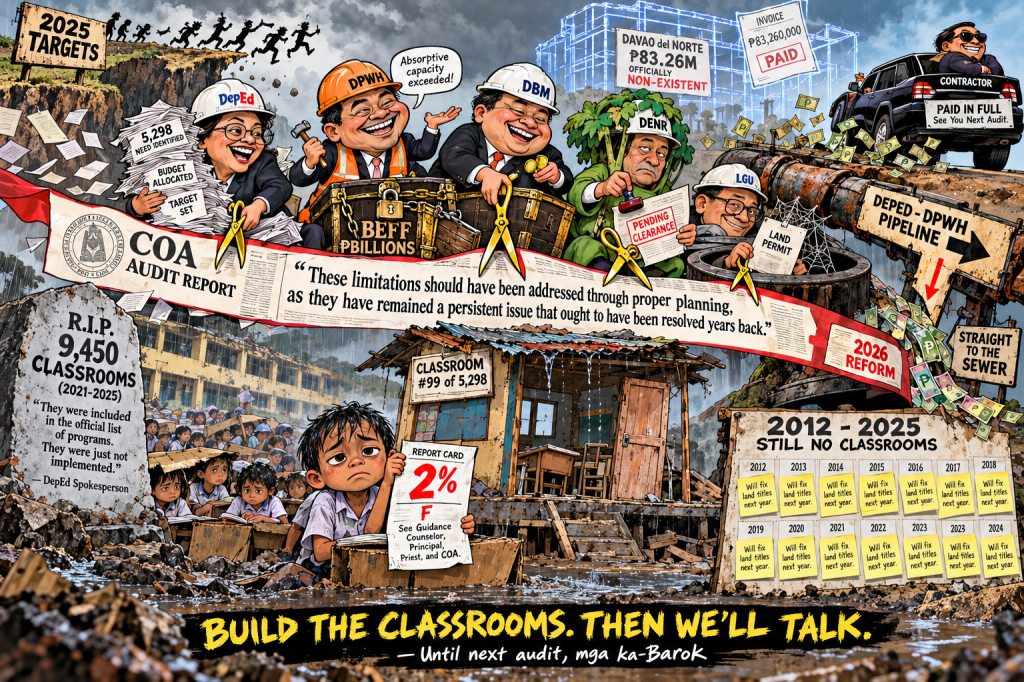
99 Classrooms Built Out of 5,298 Targets—And the Government Calls That a Success
By Louis ‘Barok‘ C. Biraogo — October 4, 2026
WELCOME back to the cave, mga ka-kweba. Today we’re going to talk about a government program that has achieved a level of incompetence so pure, so crystalline, that it almost loops back around to being impressive.
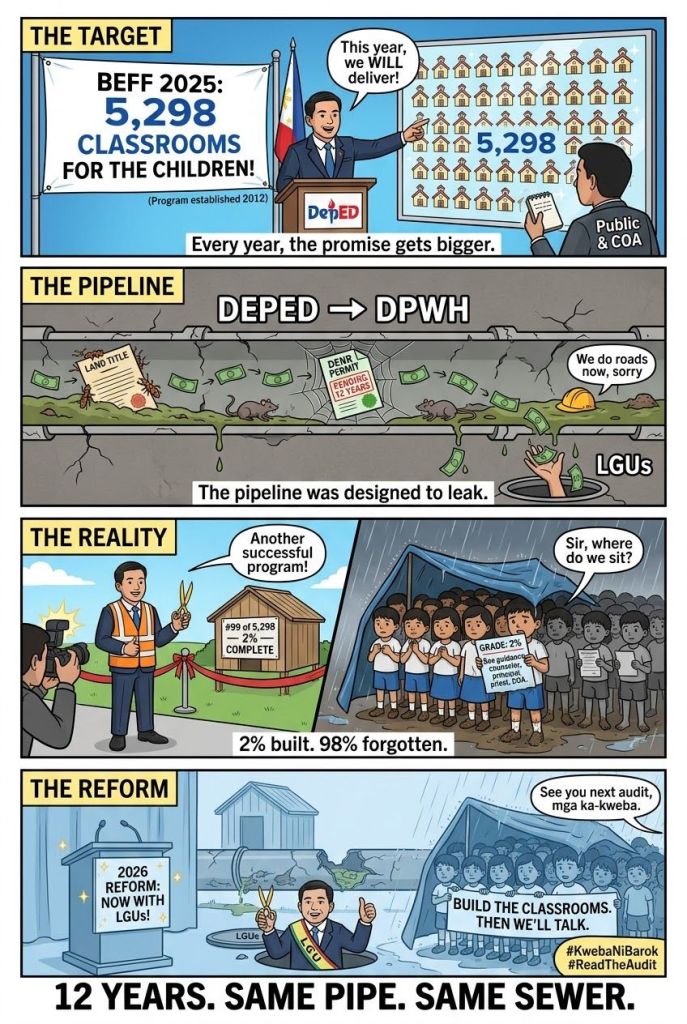
The Commission on Audit (COA) has released its 2025 findings on the Basic Education Facilities Fund (BEFF), and the headline number is this: Out of 5,298 classrooms targeted for construction in 2025, the government completed 99. That is 2 percent.
Two percent.
If you were a student and you got 2 percent on an exam, you wouldn’t just fail. You would be asked to explain yourself to a guidance counselor, a principal, and possibly a priest. The government, however, gets to call this a “program.”
But here’s the thing: the 2 percent is just the flashy part. The real scandal—the systemic, multi-year, inter-agency, budget-design, procurement-pipeline scandal—is buried deeper. And because I am a suspicious, cynical, investigative blogger who reads audit reports for fun, I am going to drag it out into the light.
The Numbers That Should End Careers
Let’s start with the multi-year picture, because the 2025 disaster is not an anomaly. It is the logical endpoint of a system that has been broken since at least 2012.
From 2021 to 2025, the government targeted 14,267 classrooms under the BEFF. It completed 4,817. That’s 34 percent. Which means 9,450 classrooms—66 percent of the entire five-year portfolio—were never built.
Now let’s break that down by year, because the trend is not “bad year, good year, bad year.” The trend is “consistently catastrophic.”
- 2021: 40 out of 50 completed
- 2022: 160 out of 160 completed (a miracle!)
- 2023: 1,703 out of 2,362
- 2024: 2,815 out of 6,397
- 2025: 99 out of 5,298
Notice something? The target in 2025 was more than double the 2024 target. And the completion rate collapsed from 44 percent to 2 percent. That is not a linear decline. That is a cliff. That is a government agency running full speed off a cliff and then acting surprised when it hits the ground.
The COA report notes that 4,984 of the 2025 classrooms had not even started construction as of the audit cutoff. Not “under construction.” Not “in procurement.” Not started. As in, the money was allocated, the targets were published, the press releases were written, and then nothing happened.
The Excuses, Ranked by Level of Audacity
The Department of Education (DepEd) and the Department of Public Works and Highways (DPWH) have offered a variety of explanations for this. Let’s review them, shall we?
Excuse #1: “Site-related issues.”
COA identified the “common contributing factor” as site-related constraints: pending demolition and building permits, unresolved Department of Environment and Natural Resources (DENR) clearances, right-of-way disputes, untitled school sites, and design revisions due to unforeseen site conditions.
Now, I want you to sit with that for a moment. The program has existed since 2012. That is more than a decade. And in 2025, the government was still discovering that school sites had no land titles? That right-of-way had not been negotiated? That environmental clearances had not been secured?
COA itself said it best: “These limitations should have been addressed through proper planning, as they have remained a persistent issue that ought to have been resolved years back.”
Translation: You’ve had twelve years to figure out where the classrooms go and whether you actually own the land. You did not. This is not an excuse. This is an indictment.
Excuse #2: “Compressed validation timelines.”
The DPWH claims it needs at least six months for site validation, and that the 2025 targets were compressed.
Okay. Fine. Site validation takes six months. Here’s a question: Why was the budget structured as though validation was instantaneous?
If you know a process takes six months, and you are planning a fiscal-year program, you have two options: (a) start validation six months before the fiscal year begins, or (b) admit that you cannot execute this many projects in one year and adjust the target.
What you do not do is appropriate money for 5,298 classrooms, publish that target, and then discover in December that you only validated enough sites for 99.
That is not a “compressed timeline.” That is a planning failure dressed up as an excuse.
Excuse #3: “DPWH deprioritized classrooms.”
COA observed that school building construction was “deprioritized” under DPWH, evidenced by the low completion rate.
The DPWH, for its part, has essentially argued that it was overwhelmed. It was handling roads, bridges, flood control, and thousands of classrooms simultaneously. Its “absorptive capacity” was exceeded.
This is a credible institutional explanation. It is also a devastating one. Because if the DPWH did not have the capacity to build the classrooms, then the government’s decision to assign the classrooms to the DPWH—and to keep assigning them year after year—was itself the failure.
The DPWH’s defense is not “We did nothing wrong.” It is “We were given an impossible job.” Which begs the question: Who gave them the impossible job, and why did they keep doing it?
The Accountability Void: Everyone Is Responsible, So Nobody Is
Here is the structural problem that COA’s report exposes, and that the government’s response has carefully avoided confronting.
The BEFF implementation model creates a chain of responsibility that is deliberately diffuse:
- DepEd identifies the need and owns the budget.
- DPWH implements the construction.
- Department of Budget and Management (DBM) controls the release of funds.
- DENR controls environmental clearances.
- Local Government Units (LGUs) control local permits and site information.
- Contractors do the actual work.
And COA audits the whole mess after the fact. Under Article IX-D, Section 2(1) of the 1987 Constitution of the Republic of the Philippines, COA has the power not just to audit financial records but to investigate “acts or omissions… improper or inefficient” and to recommend corrective measures. Presidential Decree No. 1445 (Government Auditing Code of the Philippines) establishes the fundamental principles of government auditing, including the requirement that government funds be spent pursuant to appropriation and solely for public purposes. The Performance Audit Office, under PD 1445, is specifically tasked with audits of the legality of government expenditures.
This is what political scientists call a “multiple-principal” problem. Everyone has some authority. No one has full accountability. When something goes wrong, each agency can point to another agency and say, “That part wasn’t my job.”
COA itself identified this: “Had both parties faithfully complied with the provisions of the Memorandum of Agreement (MoA), the construction delays may have been significantly reduced.”
The MOA—the Memorandum of Agreement between DepEd and DPWH—contemplated joint validation, monitoring, and coordination. Those mechanisms existed on paper. They did not function in practice.
So when DepEd says “DPWH was the builder,” and DPWH says “DepEd selected the projects,” both are telling a partial truth. The full truth is that the system was designed to fail, because it gave no single agency both the authority and the incentive to ensure delivery.
The Ghost Projects in Davao: A Preview of What’s Coming
If you think the 2 percent completion rate is the worst of it, allow me to introduce you to the Davao del Norte situation.
COA flagged approximately ₱83.26 million in school infrastructure projects in Davao del Norte that auditors characterized as non-existent or materially incomplete despite payments having been made.
Three DepEd division officials were placed under preventive suspension. The projects included a school building at Camingawan Elementary School that was not implemented, and the Dulyan Integrated School project that was only partially completed.
DepEd’s spokesperson offered a classic non-denial: “That’s why I said not to immediately describe it as a ghost project because they were included in the official list of programs, they were just not implemented.”
“They were included in the official list of programs, they were just not implemented.”
That is a sentence that should make every Filipino taxpayer’s blood pressure spike. It is the bureaucratic equivalent of saying, “I didn’t steal your money. I just put it in my pocket and didn’t give it back.”
The Davao case matters for two reasons. First, it suggests that the underperformance is not purely a matter of slow construction—it may involve payment for work that was never done. Second, it illustrates why audit findings require careful parsing. “Ghost project at the time of audit” and “ghost project forever” are not the same thing. Some projects may have been completed after the audit date. But the burden of proof is on the government to demonstrate that.
The Corruption Question: Follow the Money, But Don’t Assume the Conclusion
Now we come to the part of the analysis where I must be careful, because the evidence for systemic corruption in the classroom program is suggestive but not conclusive.
The Makabayan bloc in the House of Representatives has filed a resolution demanding an investigation into the slow pace of classroom construction, explicitly asking: “Are classrooms being sidelined in favor of more ‘corruption-prone’ projects?”
The resolution cites the disparity between the government’s education infrastructure spending and its flood control spending. The Ateneo School of Government has made a similar argument: the DPWH budget has surpassed the education budget, and flood control projects (which constitute 22 percent of the DPWH budget) may be receiving preferential treatment because they offer larger opportunities for kickbacks.
And then there is the Densing affair.
Former DepEd Undersecretary Epimaco Densing III was accused during a House hearing of soliciting 18 percent kickbacks from lawmakers in exchange for approving school building projects. Rep. Johnny Pimentel alleged that Densing halted bidding for ₱170 million worth of projects in his district after he refused to pay. Densing has denied the allegations, calling them “a blatant lie.”
The Densing case is not proof that the entire classroom backlog was caused by corruption. It is one set of allegations against one official. But it is a data point that suggests the school building program is vulnerable to corruption, and that the incentive structures may favor delay and manipulation over delivery.
Under Republic Act No. 3019 (Anti-Graft and Corrupt Practices Act), Section 3(e) penalizes causing undue injury to the government or giving a private party unwarranted benefit through manifest partiality, evident bad faith, or gross inexcusable negligence. Section 3(f) specifically covers “neglecting or refusing, after due demand or request, without sufficient justification, to act within a reasonable time on any matter pending before him for the purpose of obtaining… some pecuniary or material benefit.” If the Densing allegations are proven—that bidding was halted to extract kickbacks—then RA 3019 becomes directly relevant.
The honest conclusion is this: The evidence strongly establishes systemic implementation failure. It does not yet establish systemic corruption. But the two are not mutually exclusive, and the burden is on the government to demonstrate that the money that was spent actually produced the results it was supposed to produce.
The Planning Realism Problem: Budgeting as Fantasy
Here is the deepest problem, and the one that COA identified most sharply.
The government’s budgeting process treats appropriation as the beginning of a solution. A certain amount of money is allocated, a certain number of classrooms is targeted, and then everyone acts surprised when the classrooms don’t materialize.
But a classroom is not an appropriation. A classroom is the end product of a long chain:
Need identified → site validated → land titled → environmental clearance secured → design completed → permits obtained → procurement conducted → contract awarded → construction performed → inspection passed → classroom occupied.
If any link in that chain fails, the classroom does not exist.
COA’s criticism is that the government scheduled the classroom targets before completing the prerequisites. It put projects into the pipeline before the sites were ready, before the designs were final, before the clearances were secured, before the procurement arrangements were settled.
This is not a construction delay. This is a planning failure. The government planned to fail.
And the consequences are not abstract. Every year a classroom remains unbuilt, the cost of building it increases. Labor and materials inflation means that the ₱2 million classroom of 2021 becomes the ₱3 million classroom of 2025. COA noted that the delays “resulted to increased construction cost and consequently deprived the general public of timely access to educational facilities.”
The government is not just failing to deliver. It is making the eventual delivery more expensive.
The 2026 “Reform”: Is It Real, or Is It PR?
In February 2026, President Marcos signed a Memorandum of Agreement with city local government units to shift classroom construction from the DPWH to LGUs. The President’s speech was characteristically optimistic: “We are shifting from centralized implementation of classroom construction to faster, and more responsive execution on the ground.”
Under the new model, LGUs will handle procurement and construction, while DepEd sets standards and validates compliance. Funding is released in three tranches, with trust accounts and mandatory reporting.
Is this a genuine structural reform, or is it a political deflection?
Arguments for genuine reform:
The DPWH’s absorptive capacity was clearly exceeded. Decentralizing to LGUs—who know local sites, can coordinate local permits, and may procure faster—addresses a real bottleneck. The three-tranche release system and validation requirements create accountability mechanisms that the old model lacked.
Arguments for skepticism:
Decentralization is not a magic bullet. LGUs vary enormously in capacity. Some will procure efficiently and build well. Others will be captured by local political interests, award contracts to favored contractors, and produce substandard buildings. The risk of fragmentation, inconsistent standards, and local patronage networks is real.
Moreover, the 2026 reform does not address the fundamental planning problem COA identified. If LGUs also receive targets before their sites are validated and their permits secured, they will fail in exactly the same way. The reform changes who builds, but not when the prerequisites are completed.
The real test of the 2026 reform is not whether it produces press releases. It is whether it produces classrooms. And we will not know that for at least another year.
What COA Actually Proved (And What It Didn’t)
Let me be precise here, because precision matters in a controversy like this.
What COA proved:
- The classroom program has severely underperformed for years. Only 4,817 of 14,267 classrooms were completed from 2021 to 2025. The 2025 completion rate was 2 percent.
- Site readiness was a recurring bottleneck. DepEd and DPWH both acknowledge this.
- The problem was inter-agency. The MOA between DepEd and DPWH contemplated joint monitoring and coordination. Those mechanisms did not prevent the failure.
- Planning realism is a legitimate issue. The program repeatedly set targets that could not be met given the unresolved prerequisites.
What COA did not prove:
- That 9,450 classrooms represent 9,450 classrooms’ worth of wasted money. Some projects are delayed, not abandoned. Some are under construction. Some may be completed later.
- That every delay was caused by negligence. Some delays may be attributable to weather, contractor failure, or genuinely unforeseeable events.
- That corruption caused the backlog. The Densing allegations are serious, but they are allegations. The systemic evidence points to planning failure, not proven corruption.
- That DPWH deliberately sabotaged classroom construction. “Deprioritization” is a causal inference that COA drew from low performance. It is plausible, but it is not the same as proof of intent.
The Real Question: Why Does This Keep Happening?
The classroom shortage is not a new problem. The program has existed since 2012. The same site-related issues—land titles, permits, clearances, right-of-way—have appeared year after year. COA itself noted that these problems “ought to have been resolved years back.”
So why weren’t they?
The answer, I suspect, is that no one is rewarded for solving the boring problems. Politicians get credit for announcing targets and appropriating money. They do not get credit for ensuring that a site has a clean land title, that an environmental clearance is secured six months before bidding, or that a right-of-way dispute is resolved before construction begins.
The boring prerequisites are invisible. The ribbon-cutting is visible. So the government optimizes for the visible and neglects the invisible. And then everyone acts surprised when the visible never materializes.
COA’s audit is valuable precisely because it makes the invisible visible. It documents the gap between the appropriation and the outcome. It names the bottlenecks. It asks the questions that the implementing agencies would prefer not to answer.
But an audit is not a solution. It is a diagnosis. The cure—if there is one—requires the government to change how it plans, budgets, and executes infrastructure projects. It requires site-readiness gates. It requires realistic targets. It requires clear accountability. It requires someone to lose their job when 98 percent of the target is missed.
Until that happens, we will be back here next year, reading another COA report, and writing another column about another 2 percent.
Bottom Line
COA’s finding is devastating, but the most devastating part is not the 2 percent. It is the twelve years.
Twelve years of a program that has consistently failed to deliver, consistently blamed external factors, and consistently been allowed to continue without consequence. The 2025 figure is just the most extreme data point in a long, depressing trend line.
The government’s response—shifting to LGUs—is an admission that the old model was broken. Whether the new model works remains to be seen. But the burden of proof is on the government, not the auditors, not the critics, not the bloggers.
Build the classrooms. Then we’ll talk.
Until next time, mga ka-Barok: Follow the money. Read the audit. And never trust a ribbon-cutting photo until you’ve seen the deed.
Key Citations
A. Legal & Official Sources
- The 1987 Constitution of the Republic of the Philippines, Article IX-D. Official Gazette of the Republic of the Philippines, 1987, https://www.officialgazette.gov.ph/constitutions/the-1987-constitution-of-the-republic-of-the-philippines/the-1987-constitution-of-the-republic-of-the-philippines-article-ix/.
- Presidential Decree No. 1445. Ordaining and Instituting a Government Auditing Code of the Philippines. 11 June 1978, https://www.officialgazette.gov.ph/1978/06/11/presidential-decree-no-1445-s-1978/.
- Republic Act No. 3019. Anti-Graft and Corrupt Practices Act. 17 Aug. 1960, https://www.officialgazette.gov.ph/1960/08/17/republic-act-no-3019/.
B. News Reports
- “COA Faults DPWH, DepEd amid School Building Backlog.” Tribune.net.ph, Daily Tribune, 27 Sept. 2026, https://tribune.net.ph/2026/09/27/coa-faults-dpwh-deped-amid-school-building-backlog.
- Mantaring, Jelo Ritzhie. “COA Flags Ghost, Incomplete School Projects in Davao del Norte.” Rappler, 28 Sept. 2026, https://www.rappler.com/philippines/deped-school-projects-davao-del-norte-coa-audit-report-2025/.
- “COA Flags P83.26 Million in Ghost and Unfinished School Projects in Davao del Norte.” ASTIG.ph, 29 Sept. 2026, https://astig.ph/coa-davao-del-norte-ghost-school-projects-83-26-million-2026/.
- “Makabayan Seeks Investigation into Slow Classroom Construction.” Inquirer.net, Philippine Daily Inquirer, 5 Nov. 2025, https://newsinfo.inquirer.net/2134048/makabayan-seeks-investigation-into-slow-classroom-construction.
- “Flood Control, ‘Ayuda’ Eating into Budgets for Food, Health, Jobs – Ateneo.” Philstar.com, The Philippine Star, 23 Sept. 2025, https://www.philstar.com/headlines/2025/09/23/2474873/flood-control-ayuda-eating-budgets-food-health-jobs-ateneo.
- Lalu, Gabriel Pabico. “Rep. Pimentel Claims Ex-DepEd Exec Densing Seeks Kickbacks.” Inquirer.net, Philippine Daily Inquirer, 17 Oct. 2024, https://newsinfo.inquirer.net/1993721/rep-pimentel-claims-ex-deped-exec-densing-seeks-kickbacks.
- Presidential Communications Office. “President Marcos Administration Accelerates Nationwide Classroom Construction through DepEd–LGU Partnership.” Presidential Communications Office, 23 Feb. 2026, https://pco.gov.ph/news_releases/president-marcos-administration-accelerates-nationwide-classroom-construction-through-deped-lgu-partnership/.





Leave a comment