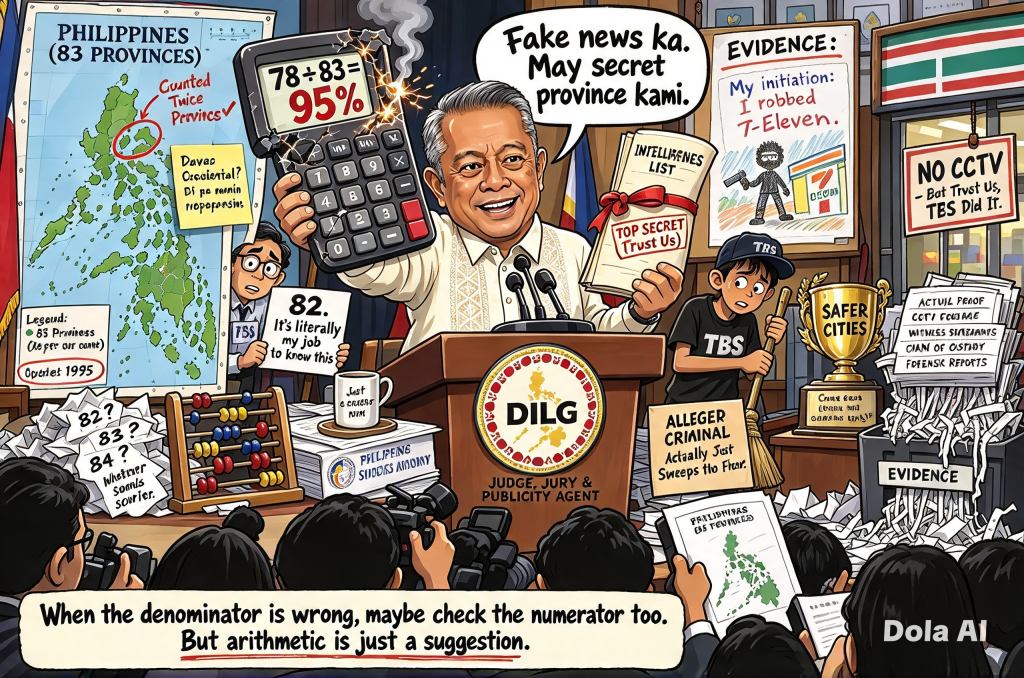
When the Government Can’t Count Provinces, Why Should We Trust It to Count Criminals?
By Louis ‘Barok‘ C. Biraogo | October 2, 2026
THE Philippine government has found its new public enemy number one: a street gang with a name so aggressively bland it sounds like a paint swatch at a hardware store. True Brown Style (TBS). The gang that allegedly spans 78 of the country’s 83 provinces, recruits children as young as 14, and initiates members by forcing them to rob convenience stores at gunpoint.
There’s just one small problem with this narrative. The Philippines doesn’t have 83 provinces. It has 82.
This isn’t a nitpick. It’s a tell. And in the grand tradition of Philippine government crackdowns, the TBS saga is shaping up to be a masterclass in evidence-free governance, where arithmetic is optional, due process is a suggestion, and the Interior Secretary has apparently appointed himself judge, jury, and publicity agent.
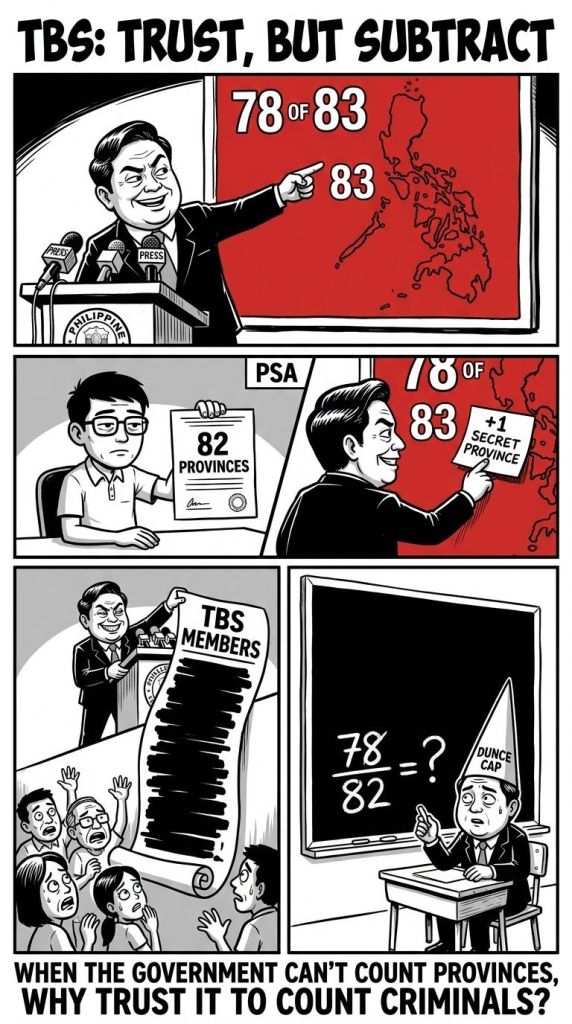
The Arithmetic of Fear
Interior Secretary Jonvic Remulla has repeated the “78 of 83 provinces” claim with the confident cadence of a man who knows his audience isn’t checking. The Philippine Statistics Authority (PSA) current geographic code lists 82 provinces. Not 83. This is not obscure knowledge. It’s in the PSA’s own database, publicly available, updated as of June 30, 2026.
So either:
- Remulla’s intelligence apparatus is working from a map of the Philippines circa 1995, when there were indeed 83 provinces (before the creation of Davao Occidental in 2013 reduced the count);
- Someone in the Department of the Interior and Local Government (DILG) counted a province twice;
- The number was simply invented for rhetorical effect.
Option three deserves serious consideration. “78 of 83” sounds precise. It sounds terrifying. It conjures images of a nationwide criminal octopus with tentacles in every barangay. But when the denominator itself is wrong, the numerator deserves equal skepticism. If the DILG can’t count provinces, why should we trust it can count gang members?
Using the actual PSA figure, 78 of 82 still represents 95% of the country. That’s an extraordinary claim. Extraordinary claims require extraordinary evidence. What we’ve received instead is a press conference, a command conference, and the promise of a list “at the proper time.”
Intelligence vs. Evidence: A Distinction That Matters
Remulla has been careful with his language. He says authorities have an “intelligence list” of TBS members. He says they “know who they are.” He says they will “make public” the names.
Notice what’s missing: specific crimes, specific evidence, specific accused individuals.
Intelligence is not evidence. Intelligence is the raw material from which evidence may be developed. Police intelligence can legitimately identify suspects, map networks, and develop probable cause. But an intelligence assessment is not a judicial finding of guilt. Article III, Section 2 of the 1987 Constitution requires probable cause determined by a judge before warrants of arrest issue.
The chain should look like this:
Intelligence → Investigation → Evidence → Complaint → Probable Cause → Prosecution → Trial → Judgment
What Remulla has proposed looks more like:
Intelligence → Government Names Person → Public Assumes Person Is Criminal
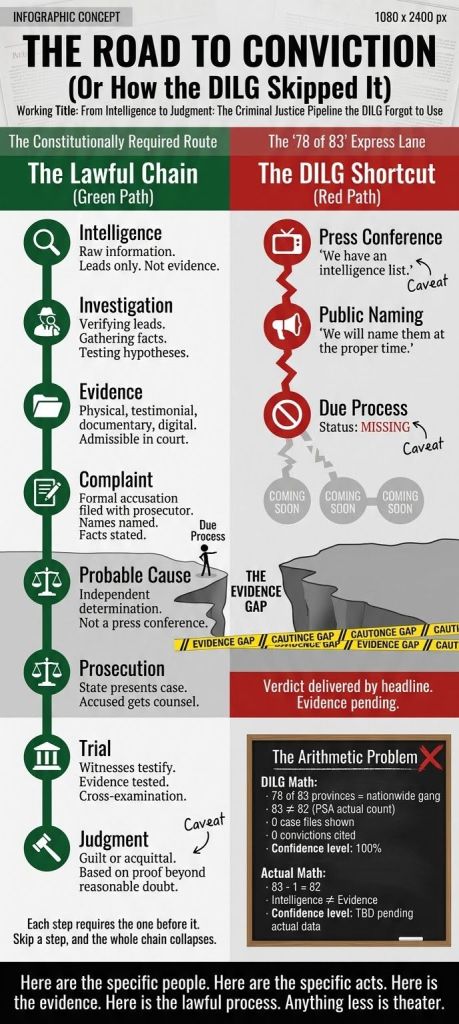
That’s not law enforcement. That’s public branding. And it’s especially dangerous when the alleged “members” include teenagers.
The Convenience Store Initiation: A Testable Claim
To be fair, Remulla has made one unusually specific allegation: that TBS initiates recruits by forcing them to rob convenience stores at gunpoint. This is the kind of claim that should produce verifiable evidence. Closed-circuit television (CCTV) footage. Robbery reports. Timestamps. Geographic clustering. Modus operandi patterns.
If “all robbery cases” were truly “traced to TBS,” where is the data? How many robberies? Over what period? In what areas? How many have been solved? How many have resulted in arrests, complaints, prosecutions, convictions?
Remulla’s claim that robbery increased while other crimes fell under “Safer Cities” and was therefore attributable to TBS is a classic correlation-causation fallacy. A crime category rising while others fall does not prove a single organization caused the rise. It proves you need better data.
The Charitable Defense and the False Binary
TBS has responded with a statement that reads like it was drafted by a law school clinic: “Not everyone using the TBS name, colors or affiliation is a criminal. Many of our members are professionals, workers, parents, business owners, and ordinary law-abiding citizens.”
Remulla’s response was refreshingly blunt: “That’s their version of the truth but we have our mission.” He compared TBS’s community work to Atong Ang distributing rice during the pandemic — good deeds that don’t erase bad acts.
Fair point. Charitable activity does not immunize anyone from prosecution. But the converse matters too: an allegation of criminal conduct against some TBS members does not automatically erase evidence that others are law-abiding.
The legal unit of analysis must be the individual act and individual participation, not the moral reputation of a group. If the DILG’s list collapses “member,” “suspect,” “accused,” and “convicted” into a single category, it will have created a blacklist masquerading as a prosecution strategy.
The Children: Victims or Criminals?
The crackdown’s central justification is child protection. TBS allegedly grooms 14- and 15-year-olds into criminal activity. If true, this is serious. Republic Act No. 7610 (Special Protection of Children Against Abuse, Exploitation and Discrimination Act) provides strong legal tools against child exploitation. Republic Act No. 9344 (Juvenile Justice and Welfare Act of 2006) establishes special protections for children in conflict with the law.
But here’s the conceptual trap: a child recruited into a gang is both a potential victim and a potential offender. RA 9344 recognizes this. Children 15 and younger are exempt from criminal liability. Those 15-18 are generally exempt unless they acted with discernment.
The strategic target should be the adult recruiters. If a 15-year-old is coerced into robbing a convenience store, prosecuting the child without prosecuting the adult who sent them is not child protection. It’s scapegoating.
The List: A Weapon Without a Safety
Remulla has promised to publish the names “at the proper time.” Two TBS members, known only as “Lady Og” and “Adviser,” have already expressed fear for their safety.
This creates a perverse incentive structure. If the government wants cooperation — if it wants members to identify recruiters, testify, provide intelligence — it must offer some assurance that cooperators won’t be exposed to retaliation. Threatening to publish a list of “members” without case-linked evidence destroys that possibility.
What, exactly, would a published list achieve? If it names convicted offenders, that’s public record. If it names wanted persons, that’s lawful procedure. If it names intelligence subjects — people merely suspected, not charged — that’s state-sanctioned defamation with potentially lethal consequences.
The Real Question
The TBS controversy contains two propositions that can both be true:
First: If adults are systematically recruiting minors into robbery and violence, the state has a strong and legitimate basis to intervene aggressively.
Second: Being identified with TBS, wearing TBS colors, or appearing on an intelligence list does not by itself establish criminal liability.
The strongest version of the government’s case is not “TBS is criminal.” It is: “Here are the specific people, here are the specific acts, here is the evidence connecting each person to each act, and here is the lawful process through which each case will be pursued.”
That’s the standard that turns a dramatic crackdown into a sustainable criminal justice operation. Anything less is just theater — with real people’s lives as the props.
And if the government can’t even get the number of provinces right, we should be very careful about trusting its count of criminals.
Key Citations
A. Legal & Official Sources
- The 1987 Constitution of the Republic of the Philippines. Official Gazette of the Republic of the Philippines, 1987, http://www.officialgazette.gov.ph/constitutions/1987-constitution/.
- Republic Act No. 7610. An Act Providing for Stronger Deterrence and Special Protection Against Child Abuse, Exploitation and Discrimination, and for Other Purposes. Official Gazette of the Republic of the Philippines, 17 June 1992, http://www.officialgazette.gov.ph/1992/06/17/republic-act-no-7610/.
- Republic Act No. 9344. An Act Establishing a Comprehensive Juvenile Justice and Welfare System, Creating the Juvenile Justice and Welfare Council under the Department of Justice, Appropriating Funds Therefor and for Other Purposes. Official Gazette of the Republic of the Philippines, 28 Apr. 2006, http://www.officialgazette.gov.ph/2006/04/28/republic-act-no-9344/.
- Republic Act No. 10360. An Act Creating the Province of Davao Occidental. Official Gazette of the Republic of the Philippines, 14 Jan. 2013, http://www.officialgazette.gov.ph/2013/01/14/republic-act-no-10360/.
- Philippine Statistics Authority. Philippine Standard Geographic Code. Philippine Statistics Authority, updated 30 June 2026, psa.gov.ph/classification/psgc.
B. News Reports
- Villamente, Jing. “TBS Presence Reported in 78 Provinces, All Metro Manila LGUs.” Daily Tribune, 30 Sept. 2026, tribune.net.ph/2026/09/30/tbs-presence-reported-in-78-provinces-all-metro-manila-lgus.
- Tupas, Emmanuel. “Jonvic Orders PNP Crackdown on TBS.” Philstar.com, 1 Oct. 2026, http://www.philstar.com/nation/2026/10/01/2560194/jonvic-orders-pnp-crackdown-tbs.
- Tupas, Emmanuel. “DILG to Identify TBS Members Soon.” Philstar.com, 2 Oct. 2026, http://www.philstar.com/nation/2026/10/02/2560334/dilg-identify-tbs-members-soon.
- Recuenco, Aaron. “DILG Finalizing List of Recruiters Luring Minors into Illegal Activities.” Manila Bulletin, 1 Oct. 2026, mb.com.ph/2026/10/01/dilg-finalizing-list-of-recruiters-luring-minors-into-illegal-activities.

- “Ang Hirap Maging Mahirap”: The PAO Scandal That Proves Government Contempt Is Nothing New
- “Far-Off” My Axx: Malacañang’s Claire Castro Drowns in Her Own Legal Gaslighting
- “Forthwith” to Farce: How the Senate is Killing Impeachment—And Why Enrile’s Right (Even If You Can’t Trust Him)
- “HINDI AKO NAG-RESIGN!”

- “I Know Nothing”: Baste Duterte’s Amnesia Defense Meets ₱33M in GenCorp Contracts

- “I’m calling you from my new Globe SIM. Send load!”

- “Mahiya Naman Kayo!” Marcos’ Anti-Corruption Vow Faces a Flood of Doubt

- “Manageable” Debt, Unmanageable Lies: DBM’s ₱21 Trillion Fairy Tale
- “Meow, I’m calling you from my new Globe SIM!”

- “Natrabaho”: One Word, One Ombudsman, and a Judiciary on Trial
- “No Special Jail for Crooks!” Boying Remulla Slams VIP Perks for Flood Scammers
- “Philippine-Controlled” or Yankee Gas Station? The Davao Fuel Depot Farce Exposed





Leave a Reply