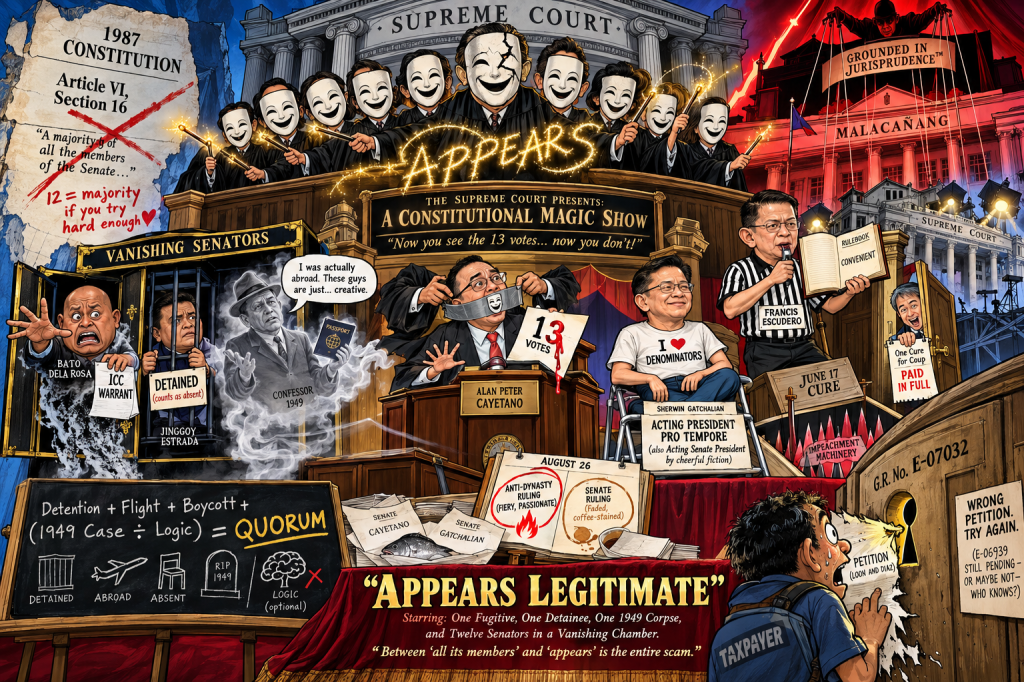
How the Supreme Court blessed the June 3 rump session, ducked Cayetano’s real case, and left the Senate’s arithmetic looking like a magic trick.
By Louis “Barok” C. Biraogo — October 2, 2026
LET me get this straight, because the Supreme Court clearly did not.
On October 1, the country was handed an August 26 resolution in G.R. No. E-07032, the petition of lawyers Valeriano Loon and Zigfred Diaz, and told that the June 3 Senate session which vacated Alan Peter Cayetano’s presidency and parked Sherwin Gatchalian in the chair as President Pro Tempore — and, by the chamber’s own cheerful fiction, Acting Senate President — was not grave abuse of discretion. On the contrary, the Court said, that session “appear[s] to be in accord with the facts and applicable law and jurisprudence.”
Appear. Not “is.” Appear. A co-equal branch was rearranged on the strength of a verb that would not survive a first-year pleading.
“He who cannot elect a Senate President cannot remove one — unless the Court is in a forgiving mood and the petitioners are the wrong lawyers.”
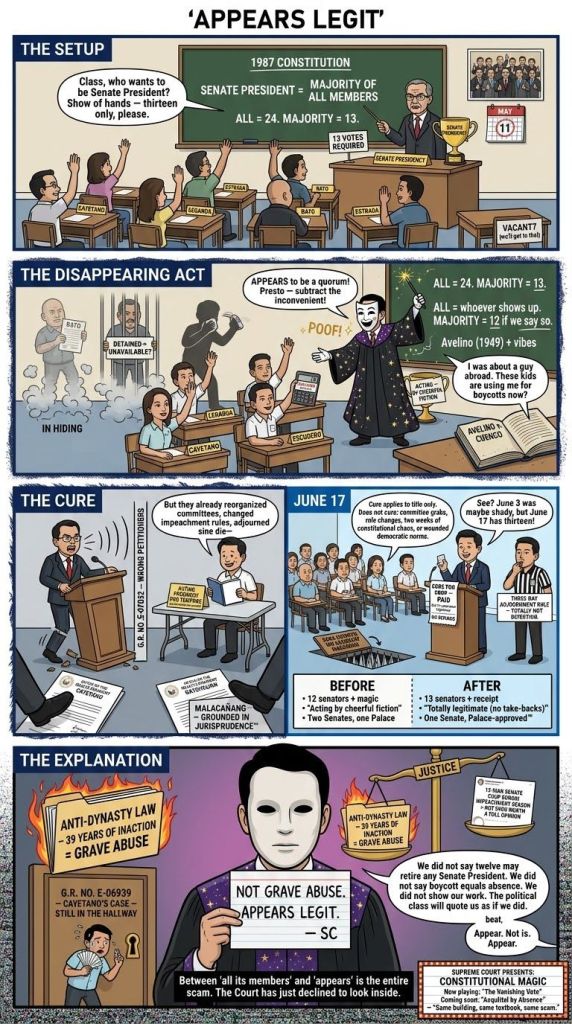
When the Constitution says “13” but the Court hears “12 if you squint.”
The Wrong Petition, on Purpose
Start with the trick. Loon and Diaz sued as taxpayers, officers of the court, and concerned citizens. Useful costumes. They are not the man who was elected on May 11 with thirteen votes, not Loren Legarda, not the Senate Secretary whose office was declared vacant by people who had not yet acquired the votes to fill it. Cayetano’s own case, G.R. No. E-06939, filed around June 16 and 17 with his allies, is a different docket. The Court has not told us what it thinks of that one. It junked the spectators and left the players in the hallway.
That is not restraint. That is stage management. Rule 65 of the 1997 Rules of Civil Procedure (Rules of Court) already demands a showing of capricious, whimsical, despotic judgment amounting to evasion of a positive duty. File the soft petition, lose on the soft petition, and the headline writes itself: Supreme Court upholds the session. The harder questions — whether twelve can declare vacant an office the Constitution says is filled by a majority of all the members, whether a Pro Tempore election is “other officers” under Article VI, Section 16(1) or a backdoor to the presidency — stay politely unbriefed.
Avelino, Dragged Out of 1949 and Made to Do a New Job
The doctrine they are hiding behind is Avelino v. Cuenco, G.R. No. L-2821 (March 4, 1949). In 1949, Tomas Confesor was outside the country. Twelve senators out of an effective twenty-three were held to be a quorum, because “the House” does not mean “all the members,” and a chamber that cannot function is not a constitutional ornament. The Senate repeated the trick in 2015, when Franklin Drilon counted twelve present after subtracting colleagues who were abroad or in detention.
So the Gatchalian bloc did the subtraction.
- Jinggoy Estrada: detained.
- Ronald “Bato” dela Rosa: in hiding from an International Criminal Court (ICC) warrant, the same man whose thirteenth vote installed Cayetano on May 11, then evaporated.
- Effective membership, twenty-two. Majority, twelve. Francis Escudero walks in. Quorum. Vacancies. Committees. Impeachment rules. Sine die. Curtain.
Cute. Also not the same case. Confesor was beyond coercive reach by geography. Dela Rosa is beyond coercive reach because he chose a cave over a warrant, after the Senate he helped lead could not, or would not, produce him. Estrada’s detention has a 2015 cousin. A political boycott does not. Cayetano’s bloc stayed away on June 1 and 2 on purpose, calling it institutional protest over Senate independence. If deliberate absence can be laundered into “unavailability,” then every future minority with eleven friends and a press release owns a veto, and every future majority with a creative denominator owns a coup. The Constitution did not pick a side. The Court just did, and called it Avelino.
The Thirteen-Vote Problem They Pretended to Respect
Article VI, Section 16(2) of the 1987 Constitution of the Republic of the Philippines (1987 Constitution) gives you a quorum to do business: a majority of each House. Section 16(1) gives you a Senate President: a majority vote of all its respective members. Senate Rule II, Section 2 repeats the second rule. Rule XV, Section 44 even carves officer elections out of the ordinary quorum provision. Legarda said the quiet part out loud: twelve cannot appoint the Pro Tempore, the Secretary, and the Sergeant-at-Arms if those offices are elected by all the members.
The June 3 bloc knew this. That is why Gatchalian was not crowned Senate President that afternoon. He was elected Pro Tempore and treated as acting president, on the theory that Cayetano had been removed, or had become incapacitated, or had resigned by sulking. He had done none of those things. Rule IV contemplates the Pro Tempore as acting president upon resignation, removal, death, or absolute incapacity. Protest is not incapacity. A boycott is not a funeral.
Cayetano’s best line remains the one the resolution never answers: he who cannot elect a Senate President cannot remove one, because removal without an election sets a constitutional command in motion and leaves it unanswered. Declaring the office vacant is not a lesser included offense of an election. It is the election, performed with the lights off.
June 17, the Escape Hatch
Then Joel Villanueva appeared at the June 17 special session, thirteen senators sat, and all thirteen voted Gatchalian in as Senate President proper. Suddenly the coup had a receipt. Even if June 3 was a rump, the argument goes, the later election cured the title. Maybe it cured the title. It did not cure the committee reorganizations, the impeachment-rule amendments, the sine die adjournment, or the two weeks in which the Republic had two Senates, two letterheads, and one Palace that had already picked a dance partner. Malacañang recognized the acting leadership almost immediately, “grounded in jurisprudence.” The Executive does not get to designate the presiding officer of a co-equal chamber and call it administrative convenience. That is how you launder a preference.
Escudero’s alibi is the three-day adjournment rule: he was not defecting, he was preventing a constitutional violation. Possible. Also convenient. He now sits at the center of the Sara Duterte impeachment machinery. Article XI, Section 3(6) still demands two-thirds of all the members to convict, and Gatchalian has said the quorum theory does not shrink that number. Believe that when the denominator stops moving. This is the same building that has already experimented with subtraction. Acquittal by absence and conviction by subtraction are cousins. They share a textbook.
What the Court Actually Did
Read the sentence again. Failure to show grave abuse. Session appears in accord with facts, law, and jurisprudence. That is a Rule 65 shrug, not a constitutional treatise. Santiago v. Guingona, Jr., G.R. No. 134577 (November 18, 1998), tells courts to stay out of the Senate’s internal furniture unless a real legal norm is broken. Neri v. Senate Committee of the Whole, G.R. No. 180643 (March 25, 2008), and the other half of Avelino say the shield stops at the Constitution. The August 26 resolution picks the shield and does not show its work.
Same date, different face. On August 26 the Court also told Congress that thirty-nine years of not passing an anti-dynasty law was grave abuse, and that “shall” means move. Inaction by the bigger chamber: justiciable. A twelve-man reorganization of the smaller one, in the middle of an impeachment season: not even worth a full opinion the public can read, released six weeks later through a senator’s social media post. If that is separation of powers, it is separation with a favorite child.
The ruling does not hold that any twelve senators may retire any Senate President. It does not dispose of E-06939. It does not say detention, flight, official travel, and a tactical boycott are the same legal object. It says these petitioners, on these papers, did not clear an extraordinary bar. The political class will quote it as if it said the other thing. It always does.
The Precedent Nobody Wants to Own
Two poisons, one bottle. If eleven senators can freeze the chamber by staying home, the quorum clause becomes a hostage note. If twelve can shrink the Senate by defining their enemies as unavailable, the quorum clause becomes a weapon, and the thirteen-vote rule for the presidency becomes a suggestion. The Court was asked which poison it preferred. It answered that the second one did not look like grave abuse, then left the building.
A Senate that needs a 1949 case, a 2015 journal, a fugitive’s empty chair, and a late defection to decide who bangs the gavel is not a Senate in control of its rules. It is a cave with better lighting. The 1987 Constitution still says all its members. The resolution says appear. Between those two words is the entire scam, and the Court has just declined to look inside.
Louis “Barok” C. Biraogo is the author of the Kweba ni Barok blog.
Key Citations
A. Legal & Official Sources
- The 1987 Constitution of the Republic of the Philippines, art. VI, sec. 16. Official Gazette of the Republic of the Philippines, 1987, http://www.officialgazette.gov.ph/constitutions/the-1987-constitution-of-the-republic-of-the-philippines/the-1987-constitution-of-the-republic-of-the-philippines-article-vi/.
- The 1987 Constitution of the Republic of the Philippines, art. VIII, sec. 1. Official Gazette of the Republic of the Philippines, 1987, http://www.officialgazette.gov.ph/constitutions/the-1987-constitution-of-the-republic-of-the-philippines/the-1987-constitution-of-the-republic-of-the-philippines-article-viii/.
- The 1987 Constitution of the Republic of the Philippines, art. XI, sec. 3. Official Gazette of the Republic of the Philippines, 1987, http://www.officialgazette.gov.ph/constitutions/the-1987-constitution-of-the-republic-of-the-philippines/the-1987-constitution-of-the-republic-of-the-philippines-article-xi/.
- 1997 Rules of Civil Procedure, Rule 65. Supreme Court of the Philippines, lawphil.net/courts/rules/rc_1-71_civil.html.
- Rules of the Senate. Senate of the Philippines, legacy.senate.gov.ph/about/rules.asp.
- Avelino v. Cuenco, G.R. No. L-2821, 4 Mar. 1949. Supreme Court of the Philippines, lawphil.net/judjuris/juri1949/mar1949/gr_l-2821_1949.html.
- Santiago v. Guingona, Jr., G.R. No. 134577, 18 Nov. 1998. Supreme Court of the Philippines, lawphil.net/judjuris/juri1998/nov1998/gr_134577_1998.html.
- Neri v. Senate Committee of the Whole, G.R. No. 180643, 25 Mar. 2008. Supreme Court of the Philippines, lawphil.net/judjuris/juri2008/mar2008/gr_180643_2008.html.
- Rome Statute of the International Criminal Court. International Criminal Court, 1998, http://www.icc-cpi.int/.
B. News Reports
- Bolledo, Jairo. “SC Junks Petition Questioning Session That Ousted Cayetano as Senate President.” Rappler, 1 Oct. 2026, http://www.rappler.com/philippines/supreme-court-decision-dismiss-petition-oust-alan-cayetano-senate-president/.
- Macababbad, EJ. “SC Settles Quorum Question on Senate Shakeup.” The Philippine Star, 2 Oct. 2026, http://www.philstar.com/headlines/2026/10/02/2560384/sc-settles-quorum-question-senate-shakeup.
- GMA News. “SC Tells Congress: Enact Anti-Political Dynasty Law.” GMA News Online, GMA Network, 26 Aug. 2026, http://www.gmanetwork.com/news/topstories/nation/1002555/sc-tells-congress-enact-anti-political-dynasty-law/story/.
- “Ang Hirap Maging Mahirap”: The PAO Scandal That Proves Government Contempt Is Nothing New

- “Far-Off” My Axx: Malacañang’s Claire Castro Drowns in Her Own Legal Gaslighting

- “Forthwith” to Farce: How the Senate is Killing Impeachment—And Why Enrile’s Right (Even If You Can’t Trust Him)
- “HINDI AKO NAG-RESIGN!”

- “I Know Nothing”: Baste Duterte’s Amnesia Defense Meets ₱33M in GenCorp Contracts

- “I’m calling you from my new Globe SIM. Send load!”

- “Mahiya Naman Kayo!” Marcos’ Anti-Corruption Vow Faces a Flood of Doubt

- “Manageable” Debt, Unmanageable Lies: DBM’s ₱21 Trillion Fairy Tale
- “Meow, I’m calling you from my new Globe SIM!”

- “Natrabaho”: One Word, One Ombudsman, and a Judiciary on Trial
- “No Special Jail for Crooks!” Boying Remulla Slams VIP Perks for Flood Scammers

- “Philippine-Controlled” or Yankee Gas Station? The Davao Fuel Depot Farce Exposed






Leave a comment