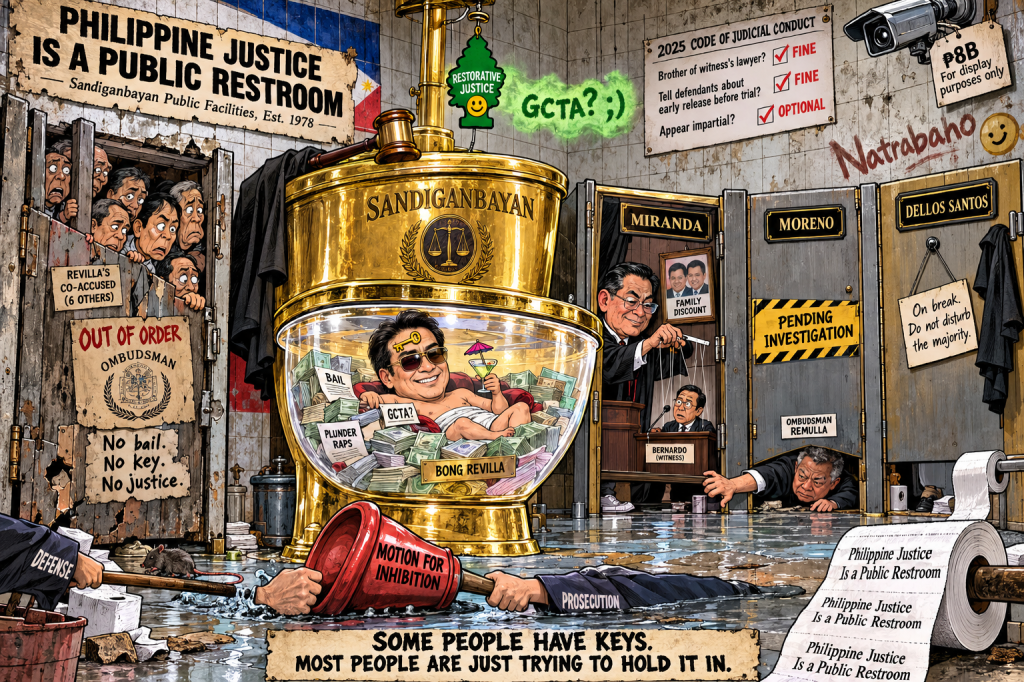
Revilla Walks, Bernardo Talks, Miranda Stays, and Moreno Waits: A Sandiganbayan Story Where Everyone Gets What They Paid For
By Louis ‘Barok’ C. Biraogo — October 1, 2026
LET me tell you something about the Philippine justice system, dear readers. It’s not broken. It’s working exactly as designed—for the people who designed it.
The Sandiganbayan Third Division’s September 24 resolution denying former Senator Ramon “Bong” Revilla Jr.’s second attempt to remove Associate Justice Karl Miranda from his P92.8-million malversation case is, depending on who you ask, either a textbook application of judicial restraint or a masterclass in pretending that structural conflicts of interest don’t exist if you squint hard enough at the rulebook.
I’ve spent enough time in the Kweba to know that when both sides are screaming about “appearance of impropriety” while simultaneously engaging in the exact same tactical maneuver, you’re not watching a search for truth. You’re watching a chess match where the pieces are human beings and the board is the public’s dwindling faith in institutions.
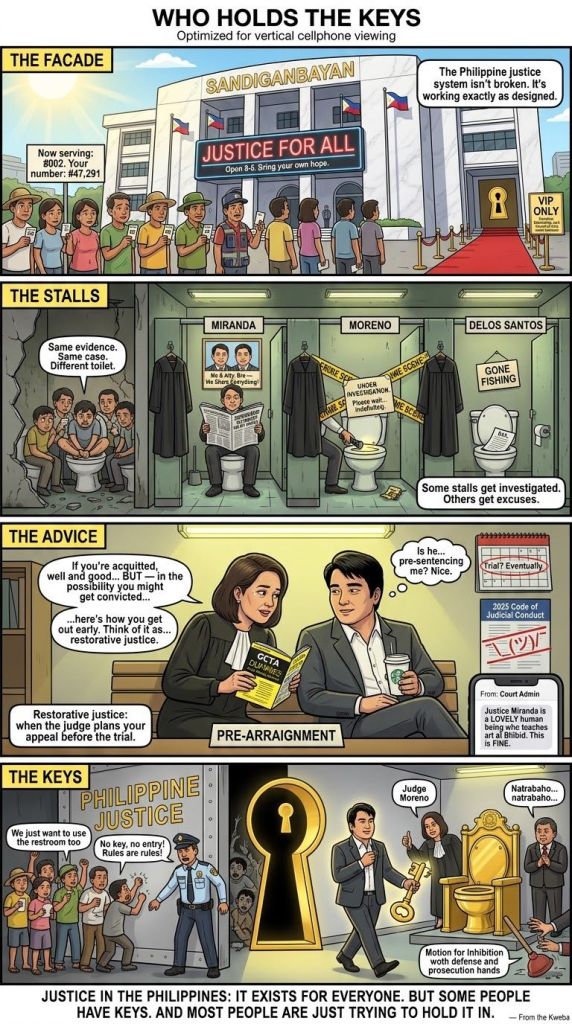
The Anatomy of a Legal Mirage
Here’s what the court wants you to believe: Justice Miranda’s brother, Atty. Buenaventura Miranda, represented state witness Roberto Bernardo during Senate hearings. That’s not a conflict because Bernardo is “merely a witness,” not a party, and Atty. Miranda isn’t counsel of record in the actual criminal case.
Technically correct. The best kind of correct, as they say.
But let’s strip away the legal formalism and look at what’s actually happening. Bernardo is not some random bystander who happened to see something. He is, according to prosecutors, the evidentiary bridge connecting Revilla to the alleged ghost flood control project. His testimony is the glue holding the conspiracy theory together.
And Justice Miranda—the same justice who voted to deny Revilla bail—is the brother of the man who represented this critical witness. The court says this doesn’t matter because the prosecution, not Atty. Miranda, presented Bernardo in court. As if the identity of the person who physically walks the witness to the stand is what matters, rather than the relationship between the judge and the witness’s legal counsel.
The Sandiganbayan even noted that “the list of grounds for mandatory inhibition provided under Section 11, Canon III of the 2025 Code of Judicial Conduct and Accountability does not include the relationship of the judge with the counsel of a party’s witness”.
Fascinating. The 2025 Code—the shiny new ethics framework that supposedly modernized Philippine judicial standards—apparently didn’t think to address this particular scenario. What an inconvenient oversight.
The court also helpfully pointed out that Justice Miranda is “not related to Mucho by consanguinity or affinity,” referring to another lawyer from the CMA Law firm who attended hearings. So the judge isn’t related to every lawyer at the firm representing the prosecution’s star witness. Only to one of them. The one who actually represented the witness. That’s fine then.
The GCTA Remarks: Restorative Justice or Premature Sentencing?
Then there’s the matter of Justice Miranda allegedly approaching the accused before arraignment and encouraging them to look into Good Conduct Time Allowance (GCTA) benefits under Republic Act (R.A.) No. 10592.
Revilla’s camp called this prejudgment. The court called it “restorative justice advocacy,” noting Miranda’s “long history as a staunch advocate for prison reform” and his work teaching at the New Bilibid Prison and organizing art auctions for persons deprived of liberty.
I’m sure Justice Miranda is a lovely human being with a genuine passion for prison reform. But there’s a time and place for everything. Approaching criminal defendants before they’ve even been arraigned—before the prosecution has presented its full evidence, before any conviction exists—and discussing the mechanics of sentence reduction is not “informing them of their rights.” It’s telling them what you expect to happen.
The court’s contextualization is creative. Miranda allegedly prefaced his remarks with “If you are acquitted, well and good… but in the possibility that you might get convicted…”. Conditional language! The court pounced on this as proof that Miranda wasn’t prejudging anything.
Let me translate: “I’m not saying you’re definitely going to prison. I’m just saying that if you do, here’s how you might get out earlier.” That’s not a neutral statement. That’s a judge telling defendants that he’s already thinking about their post-conviction future. Before trial. Before evidence. Before anything.
The court’s defense—that this reflects Miranda’s “restorative justice philosophy”—is actually more troubling than the original remark. If a judge’s personal philosophy about prison reform leads him to advise defendants on sentence reduction before they’ve been tried, that’s not a philosophy. That’s a problem.
The Asymmetry Problem: When Both Sides Cry Bias
Here’s where the story gets deliciously, depressingly symmetrical.
While the court was busy denying Revilla’s motion against Miranda, the Office of the Ombudsman prosecutors filed their own motion seeking the voluntary inhibition of Justice Ronald Moreno—one of the two justices who voted to grant Revilla bail. Their 69-page motion alleged “unwarranted conduct,” “active advocacy,” and unfair treatment of prosecution witnesses.
So let’s tally this up:
- Revilla wants the justice who voted against him removed.
- The prosecution wants the justice who voted for him removed.
Both sides are using the same legal mechanism, citing the same general principles about “appearance of impropriety,” to try to shape the panel that will decide the case.
The court resolved the motion against Miranda (the dissenter) while leaving the motion against Moreno (a bail-granting justice) pending. This creates a rather glaring appearance of selective dispatch. The justice who hurts Revilla stays. The justice who hurts the prosecution? Still waiting.
The Supreme Court has repeatedly warned about the dangers of forum-shopping through inhibition motions. In Pagoda Philippines v. Universal Canning, the Court noted that automatically granting such motions would enable litigants to manipulate panel composition. The Sandiganbayan cited this concern in denying Revilla’s motion.
But here’s the thing about citing forum-shopping concerns: they apply equally to both sides. If Revilla’s serial motions are forum-shopping, what exactly is the Ombudsman’s motion against Moreno? A principled stand for judicial ethics? Or strategic retaliation dressed in ethical clothing?
The court’s failure to address both motions with equal urgency is not just an optics problem. It’s a substantive signal about whose bias claims are being taken seriously.
Ombudsman Remulla and the “Natrabaho” Bombshell
Let’s not forget the context that preceded all of this. When Revilla posted his P1-million bail on July 31, Ombudsman Jesus Crispin Remulla didn’t just express disappointment. He suggested the outcome had been “natrabaho”—that someone had worked to secure it.
“We predicted this to happen,” Remulla said. “Meron talaga mangyayari na mukhang natrabaho, na magkaroon ng grant of bail”.
That’s not a subtle critique of judicial reasoning. That’s an insinuation of impropriety. And Remulla is not some random commentator. He’s the government’s chief prosecutor, publicly suggesting that the court’s bail ruling was the product of behind-the-scenes manipulation.
No evidence was offered. No specific allegations were made. Just a public insinuation that the justices who granted bail did so because someone “worked” on them.
And then, remarkably, the Ombudsman filed a motion seeking Moreno’s inhibition. The justice who voted for bail. One of the two justices whose decision Remulla had just publicly insinuated was “natrabaho.”
If you’re keeping score at home: the prosecution accused the court of being improperly influenced, then moved to remove one of the justices who ruled against them, while the court was simultaneously denying the defense’s motion to remove the justice who ruled for them.
This is not how a justice system builds public confidence. This is how it burns it to the ground.
The Bail Ruling: Evidence or Exoneration?
The underlying bail decision deserves its own scrutiny. The 2-1 majority—Justices Moreno and Delos Santos—found that the prosecution failed to establish strong evidence of Revilla’s guilt.
Their reasoning, as summarized in the defense’s public statements, was that:
- Revilla’s position as Senate Public Works Committee chairman didn’t give him authority to insert projects into the budget
- Witnesses couldn’t produce a specific request from Revilla for the Pandi project
- Bernardo’s claims about kickbacks weren’t independently corroborated
- The alleged advance kickbacks came from private contractors before any government disbursement, meaning public funds—an essential element of malversation—didn’t exist yet
These are not frivolous arguments. They’re actually quite serious legal points. The malversation charge requires proof that public funds were misappropriated. If the alleged “kickback” happened before any public money existed, what exactly was malversed?
But here’s the uncomfortable question: if the evidence against Revilla was so weak, why did Justice Miranda find it “strong”? Why did he conclude that Revilla played an “indispensable” role in the alleged scheme?
The answer, according to Miranda’s dissent, is conspiracy. Even if Revilla wasn’t the accountable public officer, he could still be liable for malversation through conspiracy with those who were. The advance kickbacks, viewed in context, could be evidence of his participation in the larger scheme.
This is a legitimate legal theory. It’s also a theory that requires proof. And the majority concluded that the proof wasn’t strong enough—at least not for bail purposes.
The 2-1 split isn’t evidence of corruption. It’s evidence of a genuinely difficult evidentiary question. But in the hothouse of Philippine political prosecutions, genuine evidentiary disagreements get weaponized as proof of bias.
The Ocular Inspection That Proved Nothing and Everything
Remember the April 2026 ocular inspection? Department of Public Works and Highways (DPWH) officials testified that the Pandi flood control project—the one that supposedly cost P92.8 million—was, in the words of one official, “no seen accomplishment”.
A government project that was paid for but never built. On a vacant lot. With certification of completion despite the absence of a construction-materials testing report.
If you’re wondering whether something fraudulent happened with the project itself, the answer appears to be: obviously yes. Someone certified completion of a project that doesn’t exist. Someone approved disbursements for a ghost.
But here’s the crucial distinction the court recognized: Was there a ghost project? and Did Revilla knowingly participate in the fraud? are two different questions.
The ocular inspection strongly supports an affirmative answer to the first. It does nothing, by itself, to answer the second. That’s not a legal technicality. That’s the fundamental requirement of criminal liability: personal, knowing participation.
The prosecution’s case against Revilla rests on Bernardo’s testimony—the testimony of a witness whose lawyer is the judge’s brother. And that, dear readers, is why the inhibition motion mattered in the first place.
What the Court Actually Decided (Versus What It Said)
The Sandiganbayan’s resolution is a masterclass in legal formalism. It correctly states the doctrine: adverse rulings don’t prove bias; mere relationship with a witness’s counsel isn’t mandatory disqualification; clear and convincing evidence is required for voluntary inhibition.
All of this is true. The court applied the law correctly. If this were a law school exam, the answer would get full marks.
But law is not a multiple-choice test. It’s a system designed to produce just outcomes through fair procedures. And the procedures here, while technically correct, produced an outcome that strains credulity.
A judge whose brother represented the prosecution’s star witness will continue to sit on the case. A judge who told defendants to look into early release benefits before they were tried will continue to preside. The court says this is fine because the rulebook doesn’t explicitly prohibit it.
The 2025 Code of Judicial Conduct says judges must “appear impartial to a reasonable, fair-minded and informed observer.” The Sandiganbayan’s ruling asks us to believe that a reasonable observer would look at Justice Miranda’s situation—brother representing the key witness, dissenting opinion crediting that witness, pre-arraignment GCTA advice—and conclude that everything is above board.
I am, allegedly, a reasonable observer. I am not persuaded.
The Bottom Line: A System That Works for Those Who Know How to Work It
Here’s what the Sandiganbayan’s ruling actually tells us, stripped of legal jargon:
If you’re powerful enough, sophisticated enough, and well-lawyered enough, you can:
- Get bail despite facing non-bailable charges
- File serial motions to remove judges who rule against you
- Have those motions denied on technical grounds while the same technical grounds are used to threaten removal of judges who ruled in your favor
- Continue to enjoy provisional liberty while your co-accused rot in jail
Revilla’s six co-accused remain detained. They didn’t get bail. They didn’t get the benefit of the doubt about “weak evidence.” They didn’t have the resources or the political capital to mount a multi-front legal and public relations campaign.
The system isn’t broken. It’s calibrated. And it’s calibrated to produce different outcomes for different people.
The September 24 resolution isn’t the end of this story. The Ombudsman’s motion against Moreno is still pending. The trial continues. Appeals will follow convictions or acquittals. The Supreme Court of the Philippines may eventually weigh in.
But whatever happens next, this much is clear: the Sandiganbayan has now established that a judge’s brother representing the prosecution’s key witness is not enough to warrant recusal. That’s a precedent. And precedents, like the people who make them, have consequences.
In the Kweba, we’ve always said that justice in the Philippines is like a public restroom: it exists, theoretically, for everyone. But some people have keys, and most people are just trying to hold it in.
The Sandiganbayan just showed us who’s holding the keys. And it’s not the people in jail.
Key Citations
A. Reports & Studies
- Senate of the Philippines. Senator Ramon “Bong” Revilla Jr. Official Biography. Senate of the Philippines, legacy.senate.gov.ph/senators/sen_bio/revilla_bio.asp.
B. News Articles
- Inquirer.net Staff. “Sandiganbayan Rejects Revilla’s Recusal Motion Against Justice Miranda.” Inquirer.net, 25 Sept. 2026, newsinfo.inquirer.net/1968814/sandiganbayan-denies-revilla-motion-to-recuse-justice-miranda.
- Philstar.com Legal Desk. “Ombudsman Questions Bail Grant in Revilla Malversation Case.” The Philippine Star, 1 Aug. 2026, www.philstar.com/headlines/2026/08/01/revilla-bail-ombudsman-remulla.
C. Legal & Official Sources
- Republic of the Philippines. Republic Act No. 10592: An Act Amending Articles 29, 94, 97, 98 and 99 of Act No. 3815, as Amended, Otherwise Known as the Revised Penal Code. Official Gazette, 29 May 2013, www.officialgazette.gov.ph/2013/05/29/republic-act-no-10592.
- Supreme Court of the Philippines. 2025 Code of Judicial Conduct and Accountability. Supreme Court Public Information Office, 2025, sc.judiciary.gov.ph/code-of-judicial-conduct.
- Supreme Court of the Philippines. Pagoda Philippines, Inc. v. Universal Canning, Inc. G.R. No. 160538, 21 Mar. 2006. Lawphil Project, lawphil.net/judjuris/juri2006/mar2006/gr_160538_2006.html.
- ₱8B BBM Pork: CCTV for Every Captain’s Kumpare?

- ₱8.9 Billion, 331 Ghost Police Stations: The TIKAS Scandal Explained

- ₱8.4 Billion, 42,000 Barangays, 1 Election: The “Bawat Barangay Makikinabang” Vote-Buying Masterclass

- ₱75 Million Heist: Cops Gone Full Bandit

- ₱6.77B Ghost Haunts Duterte: RTC Dismisses Mans Carpio’s Desperate Plea

- ₱6.7-Trillion Temptation: The Great Pork Zombie Revival and the “Collegial” Vote-Buying Circus

- ₱53 Million Man Tells ₱695-a-Day Workers to Stop Being ‘Mayabang’: The Audacity of BSP’s Remolona
- ₱3.06 Billion for Evacuation Centers—But Nobody Knows Where They’ll Stand (Or If They’ll Exist)
- ₱10B Ghost in New Clark City: Matibag’s Haunted Séance for Cayetano

- ₱1.9 Billion for 382 Units and a Rooftop Pool: Poverty Solved, Next Problem Please

- ₱1.35 Trillion for Education: Bigger Budget, Same Old Thieves’ Banquet

- ₱1 Billion Congressional Seat? Sorry, Sold Out Na Raw — Si Bello Raw Ang Hindi Bumili







Leave a comment