A Dismissed Cop, a Grudge, and a Polygraph That Proved Nothing: Inside the Impeachment Witness No One Wants to Vouch For
By Louis ‘Barok’ C. Biraogo — September 30, 2026
HOLD my balikbayan box.
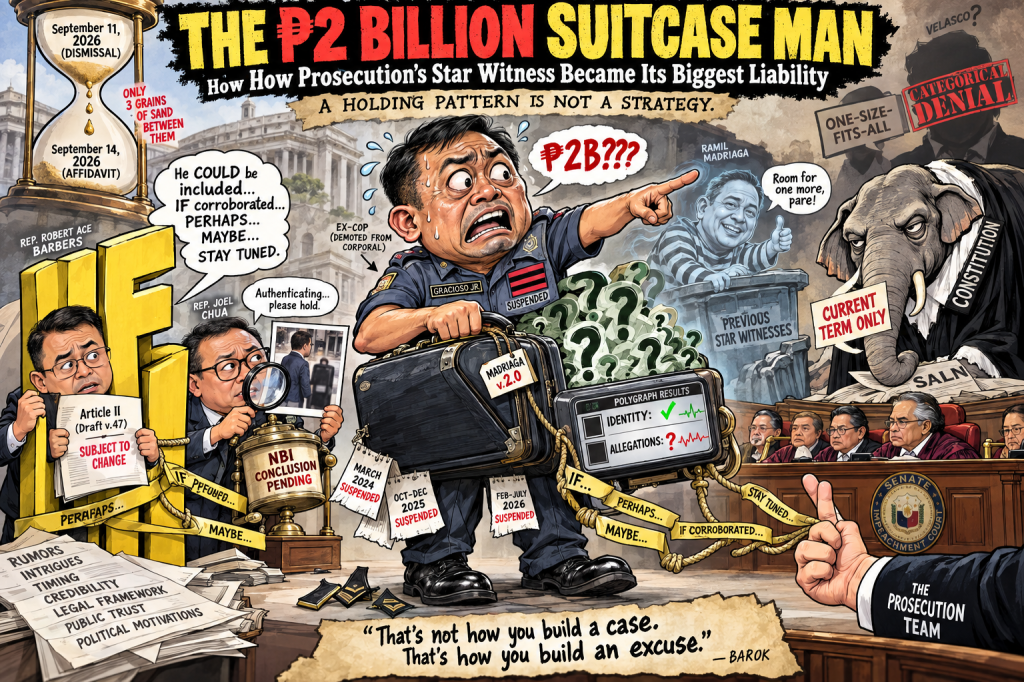
The House prosecution team wants to put a dismissed cop on the witness stand—a man who claims he personally schlepped more than ₱2 billion in cash-stuffed suitcases to the Vice President of the Philippines over roughly twenty separate occasions—and the best they can muster is: “Maybe. If someone else confirms it. Perhaps. We’ll see. Stay tuned.”
If that doesn’t scream “we have absolutely no idea what we’re doing, but we’re hoping this works out,” I don’t know what does.
Rodulfo Gracioso Jr. is the latest entrant in the growing cottage industry of Duterte-family accusers, following in the hallowed footsteps of Ramil Madriaga, whose own bagman narrative collapsed under the weight of its own contradictions and the inconvenient fact that the man supposedly running Office of the Vice President (OVP) security had never heard of him. Now we have Gracioso, a former police corporal who served as security aide to former Speaker Lord Allan Velasco, claiming he delivered cash in denominations so large that the logistics alone should have triggered every anti-money laundering flag in Southeast Asia.
And the prosecution’s response? Robert Ace Barbers, the House prosecution panel’s spokesman, says Gracioso’s testimony “could be included” in Article II—but only if backed by corroborative evidence. They’re “waiting for the National Bureau of Investigation (NBI) conclusion.” They’re being “cautious.”
That’s not a prosecution strategy. That’s a prayer.

THE ART OF THE NON-COMMITTAL VOUCH
Let’s give credit where it’s due: Barbers’ conditional language is legally sound. It’s ethically defensible. It’s precisely the kind of measured prosecutorial caution that would make any law school professor proud. It also happens to be a spectacular admission that the underlying evidence is, at present, thinner than the paper it’s printed on.
The Manila Times reported that Barbers framed Gracioso’s potential testimony as contingent on corroboration—a position echoed by Rep. Joel Chua, who said the prosecution would authenticate photographs and examine corroborative evidence before deciding whether to use it. This is prudent. It is also, politically speaking, the equivalent of announcing that your star witness might be a star witness, or might be a liability, and you’ll let the NBI decide which.
The NBI, for its part, is doing its best impression of an agency that wants nothing to do with any of this. Director Melvin Matibag confirmed that Gracioso passed a polygraph test—then immediately clarified that the test covered only his identity and relationships with the people he mentioned, not the substantive allegations. In other words: yes, we confirmed he is who he says he is, and yes, we confirmed he knows the people he claims to know. We have not confirmed that any of the cash-delivery story is true.
That’s not corroboration. That’s a background check.
THE TIMING: A COINCIDENCE, SURELY
Gracioso’s dismissal from the Philippine National Police (PNP) took effect on September 11, 2026. His affidavit was submitted to the NBI on September 14. Three days. That’s the gap between unemployment and whistleblowing.
The dismissal order cited three counts of “less grave misconduct” (some reports say “grave misconduct”; the official records say less grave—let’s not let precision get in the way of a good narrative). His service record reveals a pattern that would make any defense attorney salivate: three prior suspensions, a demotion from corporal to patrolman in 2025 for grave threat and conduct unbecoming, and two separate detentions in 2024 and 2025.
Father Flaviano Villanueva, the anti-drug-war priest who facilitated Gracioso’s approach to the NBI, told reporters that what “appeared to be the trigger” was Gracioso’s failure to secure financial support—allegedly ₱150,000 or a guarantee letter—for his ailing father, who died in 2024.
So let’s reconstruct the timeline:
- Gracioso allegedly delivered ₱2 billion in cash between 2018 and 2022.
- He told no one about this during his years of service.
- In 2024, his father gets sick. He asks for financial help. He allegedly doesn’t get it.
- His father dies.
- In 2026, he gets dismissed from the PNP amid disciplinary proceedings.
- Three days after his dismissal, he submits an affidavit claiming he delivered billions in cash to the Duterte family.
The defense will call this retaliation. The prosecution will call it a conscience finally stirred. The rest of us will call it what it looks like: a man with a grudge, a dismissal, and nothing left to lose.
Vice President Sara Duterte, predictably, has already previewed her strategy: “Once we are done dismantling the lies contained in his testimony, it will end up in the trash bin—just like the one from Ramil Madriaga.” It’s not subtle, but it’s effective. The Madriaga precedent looms large over this entire affair, a cautionary tale about what happens when you build an impeachment case on the word of a man whose own security chief says he never met him.
THE PHOTOGRAPHS: A PICTURE IS WORTH A THOUSAND QUESTIONS
Gracioso claims to have photographs and videos that substantiate his allegations. When asked directly whether these showed the alleged money deliveries or the cash itself, he said: “Yes.”
That’s reassuring. Except for one small problem: these photographs and videos were not included in his sworn affidavit. They are being “authenticated” by the NBI. Authentication, in the legal sense, means proving that a document or image is what it purports to be—not proving what it depicts. A genuine photograph of Gracioso standing next to a suitcase proves that Gracioso stood next to a suitcase. It does not prove the suitcase contained ₱50 million. It does not prove the suitcase was handed to Sara Duterte. It does not prove the money came from government projects, or that anyone knew it was there.
The NBI’s own director has acknowledged this limitation. The polygraph didn’t cover the substantive allegations. The photographs are being authenticated, not substantiated. And the financial records that would actually prove or disprove the cash deliveries—bank withdrawals, property acquisitions, corporate transactions—remain conspicuously absent from the public record.
If Gracioso really delivered ₱2 billion in cash across twenty-plus transactions, where is the money trail? The burden of proof falls on the prosecution, but the burden of plausibility falls on the story. And right now, the story is running a deficit.
THE VELASCO PROBLEM
Gracioso’s allegations necessarily implicate Lord Allan Velasco, the former Speaker who allegedly directed the cash deliveries. Velasco’s camp has responded with the kind of categorical denial that suggests they’ve been preparing for this moment: “The former Speaker’s record of service is untainted with corruption and his wife’s benevolence is widely known, leaving no basis for the illegal allegations now being suggested.”
Translation: We have no idea what this man is talking about, and we would appreciate it if everyone would move along.
But here’s the thing: if Gracioso was Velasco’s security aide, and if he was present during meetings with Duterte, and if he was tasked with transporting cash—then Velasco is either the source of the money, the conduit for the money, or the victim of a spectacularly detailed fabrication. There is no fourth option.
Velasco’s defense team has already flagged what they call the “one-size-fits-all” nature of Gracioso’s narrative—an allegation designed to attack as many targets as possible while remaining conveniently unfalsifiable. They point to inconsistencies with verifiable events: the COVID-19 pandemic, Velasco’s actual period of service as Speaker, basic logistical realities.
These are the kinds of attacks that will define the cross-examination. And they are precisely the attacks that the prosecution seems unprepared to answer, which is why Barbers is hedging with “if” and “maybe” and “wait for the NBI.”
THE CONSTITUTIONAL ELEPHANT
There is a more fundamental problem, one that Barbers’ conditional framework conveniently sidesteps: much of the alleged conduct occurred between 2018 and 2021, when Sara Duterte was Mayor of Davao City, not Vice President. The Supreme Court’s 2025 decision in Sara Duterte v. House of Representatives emphasized that impeachable offenses must be connected to the officer’s current term and office.
The prosecution will argue that the alleged historical transactions are evidence of present unexplained wealth—that money received in 2018 remains part of assets that should have been disclosed later, or explains presently unaccounted-for wealth. That is a colorable argument. It is not a slam dunk.
The defense will argue that a person cannot convert an alleged 2018 act into a current-term impeachment offense simply by relabeling it “wealth.” That, too, is a colorable argument. And it has the added virtue of being grounded in the Supreme Court’s own language about the temporal scope of impeachment.
If the Senate impeachment court takes its constitutional role seriously—and the 2025 decision suggests the judiciary expects it to—then the Gracioso evidence may be procedurally admissible but substantively irrelevant. The prosecution would need to establish not just that cash was delivered, but that the cash’s absence from Statements of Assets, Liabilities, and Net Worth (SALNs) or its transformation into assets constitutes a present-term impeachable offense. That’s a chain of inference long enough to hang a defense motion on.
THE MADRIAGA GHOST
We have been here before. Ramil Madriaga, the previous “bagman,” claimed to have delivered cash for the Duterte family, claimed to have bank accounts opened in his name, claimed to have been a trusted operative. His credibility collapsed when Army Col. Raymund Dante Lachica, the former chief of the Vice Presidential Security and Protection Group (VPSPG), stated under oath that he had never met, worked with, or coordinated with Madriaga—and that Madriaga was never part of the Armed Forces of the Philippines (AFP), the VPSPG, or any unit under his command.
Madriaga had a criminal record. He was in detention on kidnap-for-ransom charges. He was angling for witness protection. His testimony was, in the words of the Vice President’s camp, the “weakest link” in the impeachment case.
Gracioso is not Madriaga. He has a different background, a different story, a different set of corroborating circumstances—most notably, the PNP’s confirmation that he was, in fact, detailed to Velasco’s security team. That confirmation establishes opportunity and relationship. It does not establish cash deliveries. It does not establish that Sara Duterte received anything. It does not establish that the money came from government projects.
What it establishes is that Gracioso had access. Access is not corruption. Proximity is not proof.
THE PROSECUTION’S DILEMMA
Barbers and his colleagues face an unenviable choice. They can:
- Option A: Go all in on Gracioso. Put him on the stand, let him tell his story, hope the photographs and videos carry the day. Risk: he collapses under cross-examination, the photographs prove nothing, and the prosecution’s credibility suffers a body blow from which Article II may not recover.
- Option B: Use him peripherally. Mention him in passing, introduce his affidavit as one piece of a larger puzzle, never call him as a witness. Risk: the defense demands the right to confront accusers, and the Senate impeachment court—mindful of due process requirements—may compel his appearance anyway.
- Option C: Drop him entirely. Acknowledge that his allegations are uncorroborated and move on. Risk: admitting that the prosecution’s most dramatic new evidence is worthless.
Barbers has chosen a fourth path: the conditional non-commitment. Gracioso “could be included” if corroborated. The NBI is still investigating. The prosecution is waiting.
This is not a strategy. It is a holding pattern. And it suggests that the prosecution knows, at some level, that Gracioso is a gamble they cannot afford to lose—but also cannot afford to take.
THE BOTTOM LINE
Rodulfo Gracioso Jr. may be telling the truth. Stranger things have happened in Philippine politics. But the burden of proof does not rest on the plausibility of the improbable. It rests on evidence. And right now, the evidence is:
- A dismissed cop with a disciplinary record and an admitted grudge.
- Photographs that are being authenticated but have not been substantiated.
- A polygraph that covered identity, not allegations.
- A timeline that begins three days after his termination.
- And a prosecution team that is hedging every bet.
If this is the best the House can do, then Article II is in trouble. If this is a preview of what’s to come, then the Senate impeachment court is in for a long, messy, credibility-testing spectacle.
Sara Duterte said Gracioso’s testimony will end up in the trash bin. She may be right. Or she may be wrong. But the prosecution’s refusal to commit—their insistence on “if” and “maybe” and “wait for the NBI”—suggests that even they aren’t sure which way the wind is blowing.
That’s not how you build a case. That’s how you build an excuse.
And in the end, the only thing more dangerous than a prosecution that overreaches is a prosecution that doesn’t know what it has.
Louis ‘Barok’ C. Biraogo is the author of the Kweba ni Barok blog, where he writes about law, politics, and the occasional constitutional crisis. He has been described as “suspiciously well-informed” and “probably has too much time on his hands.” Both descriptions are accurate.
Key Citations
A. Legal & Official Sources
- The 1987 Constitution of the Republic of the Philippines. Official Gazette of the Republic of the Philippines, 1987, http://www.officialgazette.gov.ph/constitutions/1987-constitution/.
- The 1987 Constitution of the Republic of the Philippines, art. III (Bill of Rights). Official Gazette of the Republic of the Philippines, http://www.officialgazette.gov.ph/constitutions/the-1987-constitution-of-the-republic-of-the-philippines/the-1987-constitution-of-the-republic-of-the-philippines-article-iii/.
- The 1987 Constitution of the Republic of the Philippines, art. XI (Accountability of Public Officers). Official Gazette of the Republic of the Philippines, http://www.officialgazette.gov.ph/constitutions/the-1987-constitution-of-the-republic-of-the-philippines/the-1987-constitution-of-the-republic-of-the-philippines-article-xi/.
- Republic Act No. 6713. An Act Establishing a Code of Conduct and Ethical Standards for Public Officials and Employees. 20 Feb. 1989, http://www.officialgazette.gov.ph/1989/02/20/republic-act-no-06713/.
- Republic Act No. 9160. Anti-Money Laundering Act of 2001. 29 Sept. 2001, http://www.officialgazette.gov.ph/2001/09/29/republic-act-no-9160/.
- Sara Z. Duterte v. House of Representatives, et al. G.R. Nos. 278353 and 278359, Supreme Court of the Philippines, 25 July 2025, sc.judiciary.gov.ph/278353-278359-sara-z-duterte-in-her-capacity-as-the-vice-president-of-the-philippines-vs-house-of-representatives-represented-by-ferdinand-martin-g-romualdez-et-al-atty-israelito-p-torreon-e/.
- Official Gazette of the Republic of the Philippines. “The Basics: Statement of Assets, Liabilities, and Net Worth.” http://www.officialgazette.gov.ph/saln/.
B. News Reports
- Maralit, Kristina. “Gracioso’s Claim That He Delivered Suitcases Full of Cash to VP Sara May Be Included in Impeachment Trial – Barbers.” The Manila Times, 28 Sept. 2026, https://www.manilatimes.net/2026/09/28/news/graciosos-claim-that-he-delivered-suitcases-full-of-cash-to-vp-sara-may-be-included-in-impeachment-trial-barbers/2433805.
- Pulta, Benjamin. “NBI to Evaluate Cash Delivery Claims of Velasco’s Ex-Aide.” Philippine News Agency, 28 Sept. 2026, https://www.pna.gov.ph/index.php/articles/1285009.
- Rita, Joviland, and Darlene Cay. “PNP: Ex-Cop Gracioso Suspended, Demoted, Dismissed; Was Velasco Security Detail.” GMA News Online, 28 Sept. 2026, https://www.gmanetwork.com/news/topstories/nation/1003933/gracioso-was-demoted-suspended-at-least-thrice-before-dismissal-napolcom-records-show/story/.
- Danio, James Daniel. “Sara Duterte Denies Receiving P2B in Cash from Alleged Bagman.” The Manila Times, 26 Sept. 2026, http://www.manilatimes.net/2026/09/26/news/national/sara-duterte-denies-receiving-p2b-in-cash-from-alleged-bagman/2433362.
- GMA Integrated News. “Ex-Security Aide Claims He Delivered over P2B in Cash to Sara Duterte.” GMA News Online, 25 Sept. 2026, http://www.gmanetwork.com/news/topstories/nation/1003720/ex-security-aide-claims-he-delivered-over-p2b-in-cash-to-sara-duterte/story/.
- GMA News. “Who Is Ramil Madriaga?” GMA News Online, 14 Apr. 2026, http://www.gmanetwork.com/news/topstories/nation/983808/who-is-ramil-madriaga/story/.
- GMA News. “Prosecution Drops Madriaga, Lachica, Nolasco as Witnesses in Impeachment Trial.” GMA News Online, 4 Sept. 2026, http://www.gmanetwork.com/news/topstories/nation/1001215/prosecution-drops-madriaga-lachica-nolasco-as-witnesses-in-impeachment-trial/story/.
- Mayuga, Jonathan L. “NBI Testing Gracioso’s Credibility.” BusinessMirror, 28 Sept. 2026, businessmirror.com.ph/2026/09/28/nbi-testing-graciosos-credibility/.
- Philippine Star. “PNP Confirms Sara Accuser Was Detailed as Velasco Aide.” 29 Sept. 2026, http://www.philstar.com/headlines/2026/09/29/2559731/pnp-confirms-sara-accuser-was-detailed-velasco-aide.
- “Ang Hirap Maging Mahirap”: The PAO Scandal That Proves Government Contempt Is Nothing New
- “Far-Off” My Axx: Malacañang’s Claire Castro Drowns in Her Own Legal Gaslighting
- “Forthwith” to Farce: How the Senate is Killing Impeachment—And Why Enrile’s Right (Even If You Can’t Trust Him)
- “HINDI AKO NAG-RESIGN!”

- “I Know Nothing”: Baste Duterte’s Amnesia Defense Meets ₱33M in GenCorp Contracts
- “I’m calling you from my new Globe SIM. Send load!”

- “Mahiya Naman Kayo!” Marcos’ Anti-Corruption Vow Faces a Flood of Doubt

- “Manageable” Debt, Unmanageable Lies: DBM’s ₱21 Trillion Fairy Tale
- “Meow, I’m calling you from my new Globe SIM!”

- “Natrabaho”: One Word, One Ombudsman, and a Judiciary on Trial
- “No Special Jail for Crooks!” Boying Remulla Slams VIP Perks for Flood Scammers
- “Philippine-Controlled” or Yankee Gas Station? The Davao Fuel Depot Farce Exposed




Leave a comment