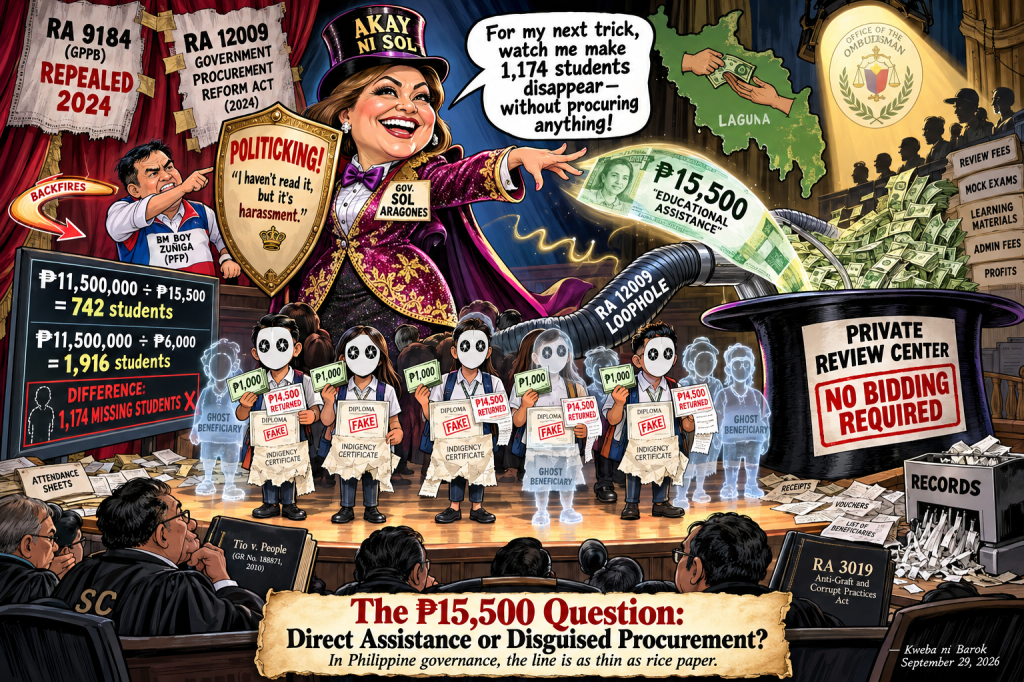
Or: How to Spend ₱11.5 Million on “Educational Assistance” Without Actually Procuring Anything
By Louis ‘Barok‘ C. Biraogo — September 29, 2026
MAKE no mistake: I don’t know if Sol Aragones is guilty. I don’t know if she’s innocent. What I do know is that someone in Laguna decided that the best way to help civil service exam takers was to hand them ₱15,500 each, watch them pose for photos with the cash, and then—allegedly—tell them to give it all back to a single private review center.
And somehow, this wasn’t procurement.
If you’re confused, welcome to Philippine governance, where the line between “direct assistance” and “disguised procurement” is apparently as thin as the rice paper used to print fake diplomas.
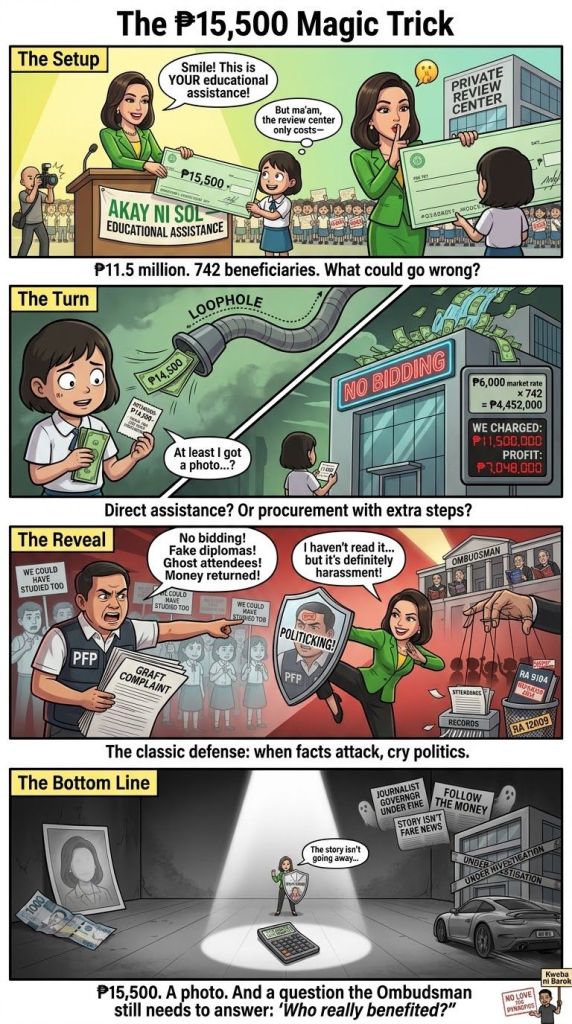
The Setup
On September 28, 2026, Board Member Lorenzo “Boy” Zuñiga Jr. and friends filed a graft complaint against Governor Aragones before the Ombudsman. The allegations are, to put it mildly, spicy:
- No public bidding for a ₱11.5 million program
- ₱15,500 per beneficiary versus ₱6,000 market rate
- Fake diplomas submitted by beneficiaries
- Ghost attendees who never showed up to review classes
- Instruction to return the ₱15,500 to a predetermined review center
Aragones’ response? The classic political jiu-jitsu: “This is politicking.”
Translation: “I haven’t read the complaint yet, but I’m already calling it harassment.”
The Legal Sleight of Hand
Here’s where it gets interesting. The complainants cite Republic Act No. 9184 (Government Procurement Reform Act). Problem: RA 9184 was repealed by Republic Act No. 12009 (New Government Procurement Act), which took effect in August 2024.
Minor detail, right? Like citing the 1935 Constitution in a 2026 case.
But the plot twist is this: The Implementing Rules and Regulations of RA 12009 apparently says that direct assistance to beneficiaries is not procurement. So if Laguna genuinely gave cash assistance to students who independently chose their review center, then the absence of bidding might not be fatal.
But if the beneficiaries were merely conduits—warm bodies holding cash for a photo op before the money flowed to a single private entity—then we’re not talking about assistance anymore. We’re talking about procurement with extra steps.
The distinction isn’t academic. It’s the difference between “technically legal” and “technically legal but please explain the ₱14,500 that didn’t make it to the student’s pocket.”
The Math Problem
Let’s do some simple arithmetic. The program budget was ₱11.5 million. At ₱15,500 per beneficiary, that’s roughly 742 students.
At ₱6,000 per student (the market rate cited by complainants), that same budget could have served 1,916 students.
That’s a difference of 1,174 students who could have been reviewing for the civil service exam instead of… not.
Now, maybe the ₱15,500 package included extras: meals, materials, mock exams, therapy for the anxiety of knowing your governor is under investigation. But when one review center gets all 742 slots without competitive bidding, and that center charges more than twice the going rate, you have to ask: Who benefits?
The answer, presumably, is not the students who allegedly received ₱1,000 and a photo op.
The Fake Diploma Problem
Let’s set aside the procurement issue for a moment. The allegation that beneficiaries submitted fake diplomas and indigency certificates is a different beast entirely.
Under Act No. 3815 (Revised Penal Code), falsification by private individuals and use of falsified documents are criminal offenses. If beneficiaries knowingly submitted fabricated documents, they’re liable. If provincial officials knew about the fabrication and approved payments anyway, that’s gross inexcusable negligence at minimum, and potentially evident bad faith—two of the three magic words that trigger Section 3(e) of Republic Act No. 3019 (Anti-Graft and Corrupt Practices Act).
The Supreme Court has been clear: “Gross inexcusable negligence” means want of even the slightest care, with conscious indifference to consequences. If someone in the Provincial Social Welfare Office was supposed to verify diplomas and didn’t, that’s not a paperwork error. That’s a systemic failure that enabled fraud.
And if the scheme was organized—if documents were manufactured to create the appearance of eligibility—then we’re looking at malversation through falsification of public documents.
The “I Didn’t Know” Defense
Aragones’ most plausible defense is the classic executive dodge: “I delegated this to subordinates.”
But the Supreme Court has repeatedly held that approving officials can be liable for violations of Section 3(e) of RA 3019 even if they didn’t personally handle every transaction. In Tio v. People, a municipal accountant was convicted for certifying disbursements despite irregularities she should have caught. The Court said: “Public officers make certifications that the expense is necessary and lawful, [which] signifies that he or she had checked all the supporting documents before affixing his or her signature.”
If Aragones signed off on ₱11.5 million without ensuring the program complied with procurement rules, verified beneficiaries, and actually delivered services, she can’t just shrug and say “not my department.”
The Political Context (Because Of Course)
Let’s address the elephant in the room: Zuñiga is from Partido Federal ng Pilipinas (PFP), while Aragones ran under Akay ni Sol, her own party. She defeated Ruth Mariano-Hernandez—wife of former Governor Ramil Hernandez—in 2025, ending a political dynasty’s hold on the province.
Is the complaint politically motivated? Possibly. Probably. But as any good prosecutor will tell you: A complaint can be both politically motivated AND factually accurate. The two aren’t mutually exclusive.
The Ombudsman’s job isn’t to determine who’s playing politics. It’s to follow the money.
The Money Trail (Or: Where Did It Go?)
Here’s the investigative framework I’d love to see:
| Stage | Question | What It Reveals |
|---|---|---|
| Selection | Who chose the review center? | Predetermination or beneficiary choice |
| Disbursement | Did beneficiaries actually receive ₱15,500? | Conduit vs. genuine assistance |
| Return | Who got the money back? | Ultimate beneficiary |
| Service | Did anyone actually attend classes? | Ghost beneficiaries |
| Verification | Who checked the diplomas? | Accountability chain |
If investigators can answer these five questions with contemporaneous documents—vouchers, receipts, attendance sheets, bank records—the entire controversy resolves itself. Either the money went to students who used it for review classes, or it didn’t.
The fact that this is even a question suggests the program’s record-keeping was, shall we say, aspirational.
The Bottom Line
Sol Aragones spent years as a broadcast journalist covering health and community issues. She knows how to tell a story. The problem is that the story she’s telling now—about educational assistance and political harassment—doesn’t match the numbers.
₱15,500 per student. No bidding. Fake diplomas. Money allegedly returned.
Either this is the most incompetent educational assistance program in Philippine history, or it’s something else entirely.
The Ombudsman should find out which. And if the answer is “something else,” then Aragones’ journalist instincts should tell her what comes next: The story isn’t going away just because you call it fake news.
Louis “Barok” C. Biraogo is the author of Kweba ni Barok. He has no love for either political dynasty in Laguna, which makes him uniquely qualified to criticize both.
Key Citations
A. Legal & Official Sources
- Republic Act No. 9184. An Act Providing for the Modernization, Standardization and Regulation of the Procurement Activities of the Government and for Other Purposes. 2003, lawphil.net/statutes/repacts/ra2003/ra_9184_2003.html.
- Republic Act No. 12009. An Act Revising Republic Act No. 9184, Otherwise Known as the “Government Procurement Reform Act,” and for Other Purposes. Official Gazette of the Republic of the Philippines, 20 July 2024, http://www.officialgazette.gov.ph/2024/07/20/republic-act-no-12009/.
- The Implementing Rules and Regulations of Republic Act No. 12009 or The New Government Procurement Act. Official Gazette of the Republic of the Philippines, 10 Feb. 2025, http://www.officialgazette.gov.ph/2025/02/10/the-implementing-rules-and-regulations-of-republic-act-no-12009-or-the-new-government-procurement-act/.
- Republic Act No. 3019. Anti-Graft and Corrupt Practices Act. 17 Aug. 1960, lawphil.net/statutes/repacts/ra1960/ra_3019_1960.html.
- Act No. 3815. The Revised Penal Code of the Philippines. 1930, lawphil.net/statutes/acts/act1930/act_3815_1930.html.
- The 1935 Constitution of the Philippines. Official Gazette of the Republic of the Philippines, http://www.officialgazette.gov.ph/constitutions/the-1935-constitution/.
- Tio v. People. G.R. Nos. 230132 and 230252, Supreme Court of the Philippines, 19 Jan. 2021, lawphil.net/judjuris/juri2021/jan2021/gr_230132_2021.html.
- Uriarte v. People. G.R. No. 169251, Supreme Court of the Philippines, 20 Dec. 2006, lawphil.net/judjuris/juri2006/dec2006/gr_169251_2006.html.
B. News Reports
- Amoroso, Ed. “Gov. Aragones, Laguna Officials Kinasuhan ng Graft sa Ombudsman.” Pilipino Star Ngayon, Philippine Star, 29 Sept. 2026, http://www.philstar.com/pilipino-star-ngayon/probinsiya/2026/09/29/2559709/gov-aragones-laguna-officials-kinasuhan-ng-graft-sa-ombudsman.
- “Complaint First, Copy Later: Sol Aragones Tags Early Politicking in P11.5M Graft Case.” Politiko, 28 Sept. 2026, politiko.com.ph/2026/09/28/complaint-first-copy-later-sol-aragones-tags-early-politicking-in-p11-5m-graft-case/politiko-lokal/.
- Datu, Dennis. “Sol Aragones Wins Laguna Gubernatorial Race on Second Try.” ABS-CBN News, 13 May 2025, abs-cbn.com/news/regions/2025/5/13/former-broadcaster-wins-laguna-gubernatorial-race-on-second-try-1735.

- “Ang Hirap Maging Mahirap”: The PAO Scandal That Proves Government Contempt Is Nothing New

- “Far-Off” My Axx: Malacañang’s Claire Castro Drowns in Her Own Legal Gaslighting
- “Forthwith” to Farce: How the Senate is Killing Impeachment—And Why Enrile’s Right (Even If You Can’t Trust Him)

- “HINDI AKO NAG-RESIGN!”

- “I Know Nothing”: Baste Duterte’s Amnesia Defense Meets ₱33M in GenCorp Contracts

- “I’m calling you from my new Globe SIM. Send load!”

- “Mahiya Naman Kayo!” Marcos’ Anti-Corruption Vow Faces a Flood of Doubt

- “Manageable” Debt, Unmanageable Lies: DBM’s ₱21 Trillion Fairy Tale
- “Meow, I’m calling you from my new Globe SIM!”

- “Natrabaho”: One Word, One Ombudsman, and a Judiciary on Trial

- “No Special Jail for Crooks!” Boying Remulla Slams VIP Perks for Flood Scammers

- “Philippine-Controlled” or Yankee Gas Station? The Davao Fuel Depot Farce Exposed





Leave a comment