They Didn’t Kill the 2026 Barangay Elections. They Just Renamed the Murder ‘Term-Setting’—And the Supreme Court Might Let Them Get Away With It
Louis ‘Barok’ C. Biraogo | September 28, 2026
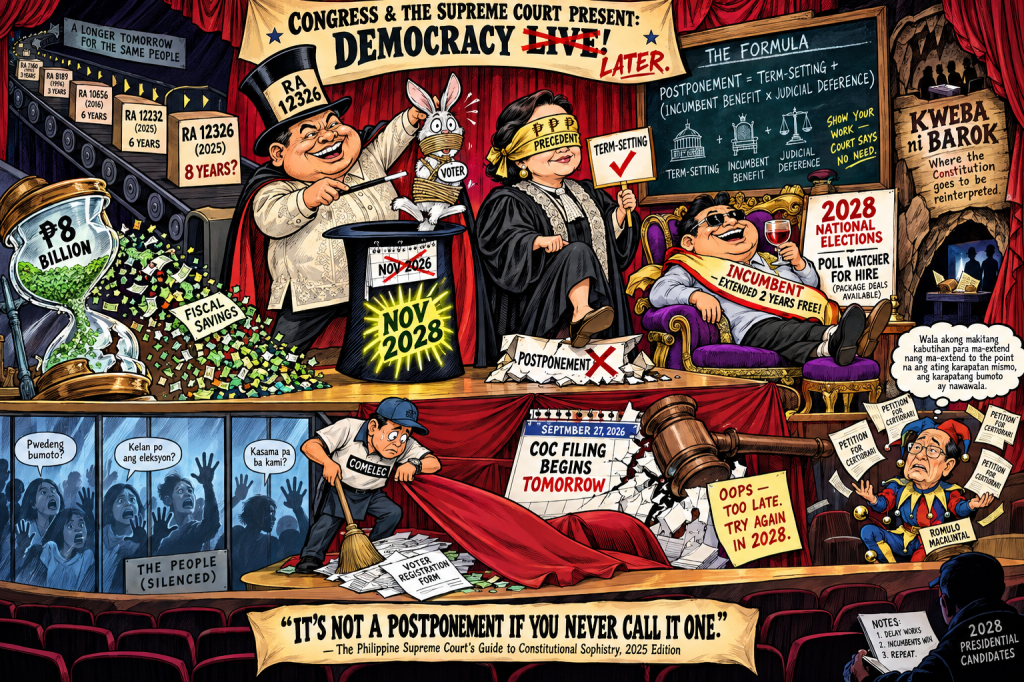
LET’S start with a simple question: What do you call a law that extends the terms of sitting officials, moves an election two years later, gets signed three days before the filing of certificates of candidacy (COC), and takes effect immediately upon publication in the Official Gazette?
If you answered “a term-setting law,” congratulations. You have passed the Philippine Supreme Court’s bar exam for constitutional sophistry, and you are now qualified to serve as a legal consultant to anyone who wants to delay an election without technically calling it a postponement.
If you answered “a postponement,” you are either (a) an election lawyer with an actual conscience, (b) a civil society group that still believes in the quaint notion that elections should happen when they’re supposed to, or (c) someone who read the text of Republic Act No. 12326 (An Act Fixing the Term of Office of Barangay Officials and Members of the Sangguniang Kabataan to Five (5) Years) and noticed that it moves the November 2, 2026 barangay and Sangguniang Kabataan (SK) elections to November 13, 2028.
That’s a two-year delay. That’s not “incidental.” That’s not a mere “change in interval.” That’s the kind of gap that, if you squint really hard, starts to look less like “term-setting” and more like “we really don’t want to face the voters right now.”
But I’m getting ahead of myself. Let’s do this the Above the Law way: with footnotes, condescension, and a healthy dose of cynicism.
The Setup: A Constitutional Loophole You Could Drive a Truck Through
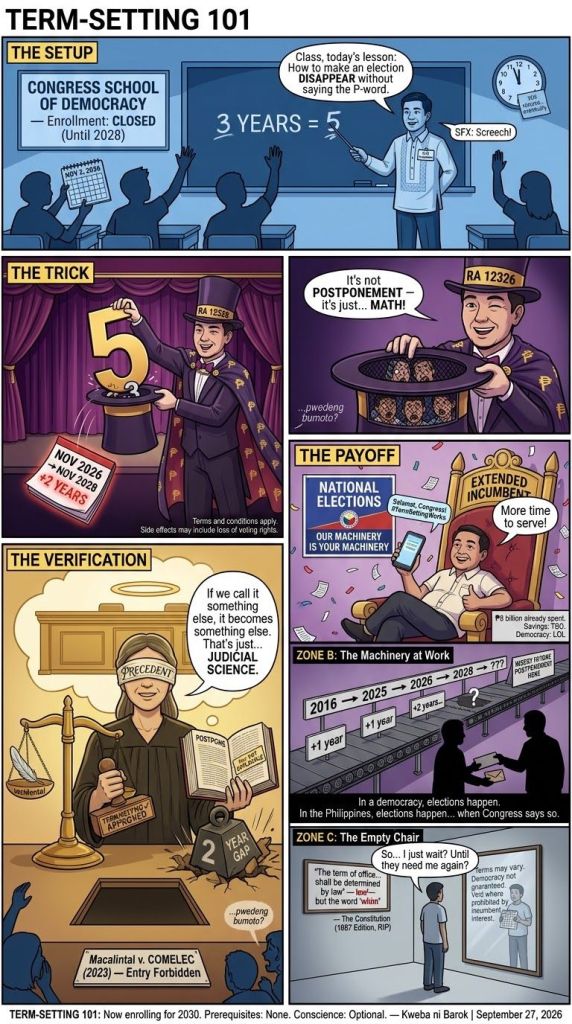
Here’s the deal. Article X, Section 8 of the 1987 Constitution says that the term of office for elective local officials—except barangay officials—shall be three years. For barangay officials, the Constitution says their term “shall be determined by law.”
That parenthetical is doing a lot of work. It’s the constitutional equivalent of saying “we don’t really want to think about barangay officials, so Congress can do whatever it wants.”
And Congress has done whatever it wants. Repeatedly.
Since 2016, the synchronized barangay and SK elections have been postponed five times. Five. That’s not a typo. That’s a pattern. Under Duterte, three postponements. Under Marcos Jr., three postponements (with some overlap in the counting, because even the postponement tallying is a mess). The August Twenty-One Movement put it bluntly: “Marcos and Duterte normalized this with three postponements each during their respective terms. But let it be put on record that this is not normal in a democracy.”
In a democracy, elections happen. In the Philippines, elections happen when Congress says they happen, and Congress keeps saying “later.”
The Intellectual Architecture of Evasion
Now, here’s where it gets interesting. In November 2025, the Supreme Court upheld Republic Act No. 12232 (An Act Setting the Term of Office of Barangay Officials and Members of the Sangguniang Kabataan, and for Other Purposes), a law that extended barangay terms from three to four years and moved the December 2025 elections to November 2026. The Court, speaking through Justice Jhosep Lopez, held that RA 12232 was fundamentally a term-setting law, not a postponement law. The rescheduling of the election was “merely incidental.”
This was the legal equivalent of saying: “It’s not a postponement if we change the term length and the election date changes as a consequence. It’s just math.”
Justice Lopez’s majority opinion emphasized that Article X, Section 8 gives Congress the authority to determine barangay terms, and that this authority “includes the power to decide when the new term begins.” Elections remain “regular, periodic, and certain.” Voters “know when the next election will take place.” Accountability is preserved at “fixed intervals.”
There’s just one problem with this reasoning: it’s a tautology dressed in a judicial robe.
If Congress can set any term length it wants, and if changing the term length necessarily changes the election date, and if the Court will always defer to Congress’s characterization of the law as “term-setting,” then Congress can postpone an election indefinitely by simply extending the term in increments. Three years becomes four. Four becomes five. Five becomes six. And each time, the Court says: “Well, it’s a term-setting law. The postponement is incidental.”
This is not constitutional interpretation. This is an invitation to legislate without limits.
RA 12326: The Test Case for Judicial Credulity
Which brings us to RA 12326. The new law does several things:
- It fixes barangay and SK terms at five years.
- It moves the next Barangay and Sangguniang Kabataan Elections (BSKE) to November 2028.
- It keeps incumbents in office until then.
- It reduces the term limit from three consecutive terms to two.
- It maintains the one-term limit for SK officials.
The fiscal justification is that the Commission on Elections (COMELEC) had already spent ₱8 billion of its ₱19 billion budget preparing for the 2026 elections, and postponement would supposedly save money. House leaders said the extension gives officials “more time to serve.”
But let’s look at the timing. RA 12326 was signed on September 24, 2026. It was published on September 25. COC filing was supposed to begin on September 28. The law was literally enacted three days before the electoral process was set to begin.
Romulo Macalintal, the election lawyer who has made a career out of challenging these laws, called it “strategic” and “engineered to beat the Monday, Sept. 28, deadline for filing Certificates of Candidacy.” He’s not wrong. The speed with which this bill moved through Congress—Senate approval on September 14, House adoption on September 16, presidential signature on September 24—suggests a level of legislative efficiency that is, frankly, uncharacteristic for the Philippine Congress. They can’t pass a budget on time, but they can postpone an election in ten days flat when incumbents need protection.
The “Term-Setting” Fiction and Its Limits
The government’s defense of RA 12326 rests on the 2025 precedent. If the Court said RA 12232 was a term-setting law, why can’t RA 12326 be one too?
Here’s why: RA 12232 involved a one-year extension. RA 12326 involves a two-year extension. The interval between the originally scheduled 2026 election and the new 2028 date is not “incidental.” It’s the entire point.
The Macalintal guidelines from 2023—the ones the 2025 majority said didn’t apply to term-setting laws—established that any election postponement must be justified by “sufficiently important, substantial, or compelling reasons.” Election fatigue, divisiveness, and shortness of term were explicitly rejected as sufficient justifications. Those guidelines were laid down in Macalintal v. Commission on Elections (G.R. Nos. 263590 and 263673, June 27, 2023).
What’s the compelling reason for RA 12326? The government says “more time to serve” and “fiscal savings.” But the fiscal argument is weak. COMELEC has already spent ₱8 billion. That money is gone. Postponement doesn’t recover it. It just delays the next expenditure while adding new costs for storage, preservation, and re-preparation.
And “more time to serve” is not a compelling government interest. It’s a benefit to incumbents. The Supreme Court in 2023 was explicit that postponement cannot be justified by reasons that primarily benefit those already in power.
The Political Elephant in the Room
Let’s be honest about what’s happening here. The 2028 barangay elections are scheduled for November—six months after the May 2028 presidential and national elections.
Barangay officials are the grassroots machinery of Philippine politics. They are the poll watchers, the vote deliverers, the people who know every household in their community. Keeping incumbents in office through the 2028 national elections means keeping existing political networks intact during the most critical electoral period in the country’s six-year cycle.
Roland Simbulan of the Center for People Empowerment in Governance (CenPEG) noted that “keeping the present barangay political configuration in place longer could give the administration additional time to consolidate relationships and political machinery at the grassroots.”
This is not a conspiracy theory. It’s political physics. Incumbents who owe their extended tenure to the administration are more likely to be cooperative during the national campaign. It’s not proof of a quid pro quo, but it’s a pretty clear alignment of incentives.
The Dissent That Should Have Been the Majority
The 2025 decision was 8-5-2. The dissenters—Leonen, Caguioa, Inting, Kho, and Singh—argued that RA 12232 was essentially a postponement regardless of its label.
Justice Singh’s concurrence in the 2023 case made the point that election postponements should be subject to strict scrutiny, not mere rational basis review. The right to vote is “preservative of all rights.” When the government delays an election, it infringes on the most fundamental democratic right there is.
If strict scrutiny applied to RA 12326, the government would have to show that the two-year delay is narrowly tailored to achieve a compelling interest. “More time to serve” doesn’t cut it. “Fiscal savings” doesn’t cut it, especially when you’ve already spent ₱8 billion. There is no compelling interest here—except the political interest of incumbents in staying in power.
The Operative Fact Problem
Even if the Supreme Court strikes down RA 12326, we may not get a 2026 election. The operative fact doctrine, applied in the 2023 Macalintal decision, allows the Court to recognize the practical consequences of a law even after declaring it unconstitutional.
COMELEC has already halted all preparations. It has cancelled COC filing. It has stored the ballots and materials. It has reopened voter registration for 2028. Reinstating the 2026 election would require restarting the entire electoral machinery with less than two months’ notice.
The Court may find itself in the position of saying: “This law was unconstitutional, but we can’t fix it in time for the election to proceed.” Which is, of course, exactly what the law’s drafters were counting on.
What Comes Next?
Macalintal has said he will file a petition for certiorari before the Supreme Court. The National Citizens’ Movement for Free Elections (NAMFREL) has said it will join the challenge.
The Court will have to decide whether RA 12326 is meaningfully different from RA 12232. The government will argue that it’s just another term-setting law, and that the 2025 precedent controls. The petitioners will argue that a two-year delay is qualitatively different from a one-year delay, and that the Court’s “term-setting” doctrine cannot be stretched to cover what is essentially a legislative decision to keep incumbents in office through a national election cycle.
The most constitutionally sound outcome would be for the Court to uphold the five-year term prospectively—meaning it applies to officials elected in 2026—while striking down the provision that extends the terms of current incumbents and delays the 2026 election. This would achieve Congress’s stated goal of a longer term without depriving voters of their right to vote in 2026.
But that would require the Court to distinguish between term-setting and postponement in a way that the 2025 majority explicitly refused to do. It would require the Court to say that the “incidental” postponement doctrine has limits—that you can’t use it to delay an election by two years, three days before the electoral process begins, primarily for the benefit of incumbents.
I’m not optimistic. The 2025 decision gave Congress a roadmap for circumventing the Macalintal guidelines. RA 12326 is the test of whether the Court will actually enforce those guidelines or whether “term-setting” has become a magic word that immunizes any electoral manipulation from judicial review.
The Bottom Line
RA 12326 is not a complex legal puzzle. It’s a straightforward political power grab dressed in constitutional language. Congress extended the terms of sitting officials, moved an election two years later, and did it so quickly that no one could challenge it in time to stop the electoral train from leaving the station.
The legal question is whether the Supreme Court will call this what it is or whether it will hide behind the “term-setting” fiction it created in 2025.
The political question is whether Filipino voters will notice that their right to choose their local officials has been deferred—again—by the same people who benefit from that deferral.
And the philosophical question—the one that really matters—is whether a democracy that keeps postponing elections can still call itself a democracy.
I’ll leave you with the words of Romulo Macalintal, who has been fighting these battles longer than most of us have been paying attention: “Wala akong makitang kabutihan para ma-extend nang ma-extend to the point na ang ating karapatan mismo, ang karapatang bumoto ay nawawala.”
“I see no good in extending and extending to the point that our very right, the right to vote, is lost.”
The Supreme Court will have the final word. But the Court’s credibility—and the country’s democracy—are on the line.
Louis ‘Barok’ C. Biraogo is a non-lawyer who nonetheless insists on reading the Constitution, following the jurisprudence, and asking inconvenient questions. He writes about law, politics, and the places where they intersect with the least possible amount of dignity. He blogs at Kweba ni Barok.
Key Citations
A. Legal & Official Sources
- The 1987 Constitution of the Republic of the Philippines. Official Gazette of the Republic of the Philippines, 1987, http://www.officialgazette.gov.ph/constitutions/1987-constitution/.
- “Article X, Local Government.” The 1987 Constitution of the Republic of the Philippines, Official Gazette of the Republic of the Philippines, http://www.officialgazette.gov.ph/constitutions/the-1987-constitution-of-the-republic-of-the-philippines/the-1987-constitution-of-the-republic-of-the-philippines-article-x/.
- Republic Act No. 12232. An Act Setting the Term of Office of Barangay Officials and Members of the Sangguniang Kabataan, and for Other Purposes. 13 Aug. 2025, lawphil.net/statutes/repacts/ra2025/ra_12232_2025.html.
- Republic Act No. 12326. An Act Fixing the Term of Office of Barangay Officials and Members of the Sangguniang Kabataan to Five (5) Years, Amending Republic Act No. 12232. 24 Sept. 2026, http://www.officialgazette.gov.ph/2026/09/24/republic-act-no-12326/.
- Macalintal v. Commission on Elections, G.R. Nos. 263590 and 263673, 27 June 2023. The Lawphil Project, lawphil.net/judjuris/juri2023/jun2023/gr_263590_2023.html.
- “SC Declares Unconstitutional Law Postponing Barangay and Sangguniang Kabataan Elections… Issues Guidelines for Validity of Rules Postponing Elections.” Supreme Court of the Philippines, 27 June 2023, sc.judiciary.gov.ph/sc-declares-unconstitutional-law-postponing-barangay-and-sangguniang-kabataan-elections-orders-the-conduct-of-elections-in-october-2023-issues-guidelines-for-validity-of-rules-postponing-elections/.
- “PRESS BRIEFER November 11, 2025.” Supreme Court of the Philippines, 11 Nov. 2025, sc.judiciary.gov.ph/press-briefer-november-11-2025/.
B. News Reports
- “PBBM Signs Law Fixing the Terms of Barangay and SK Officials.” Presidential Communications Office, 25 Sept. 2026, pco.gov.ph/news_releases/pbbm-signs-law-fixing-the-terms-of-barangay-and-sk-officials/.
- Gita-Carlos, Ruth Abbey. “Marcos Postpones BSKE.” Philippine News Agency, 25 Sept. 2026, http://www.pna.gov.ph/articles/1284830.
- Medenilla, Samuel P. “Law Extending Bgy, SK Terms, Moving BSKE to 2028 Signed.” BusinessMirror, 25 Sept. 2026, businessmirror.com.ph/2026/09/25/law-extending-bgy-sk-terms-moving-bske-to-2028-signed/.
- Geducos, Argyll Cyrus. “Barangay, SK Polls Reset to 2028.” Manila Bulletin, 25 Sept. 2026, mb.com.ph/2026/09/25/barangay-sk-polls-reset-to-2028.
- Apacible, Lisa Marie, and Alvin Murcia. “Polls Freeze Draws Fire: SC Petition Eyed.” Daily Tribune, 26 Sept. 2026, tribune.net.ph/2026/09/26/polls-freeze-draws-fire-sc-petition-eyed.
- “Opposition Lawmakers Oppose BSKE Postponement.” OneNews.PH, 27 Sept. 2026, http://www.onenews.ph/articles/opposition-lawmakers-oppose-bske-postponement.
- “Ang Hirap Maging Mahirap”: The PAO Scandal That Proves Government Contempt Is Nothing New
- “Far-Off” My Axx: Malacañang’s Claire Castro Drowns in Her Own Legal Gaslighting
- “Forthwith” to Farce: How the Senate is Killing Impeachment—And Why Enrile’s Right (Even If You Can’t Trust Him)
- “HINDI AKO NAG-RESIGN!”

- “I Know Nothing”: Baste Duterte’s Amnesia Defense Meets ₱33M in GenCorp Contracts

- “I’m calling you from my new Globe SIM. Send load!”

- “Mahiya Naman Kayo!” Marcos’ Anti-Corruption Vow Faces a Flood of Doubt

- “Manageable” Debt, Unmanageable Lies: DBM’s ₱21 Trillion Fairy Tale
- “Meow, I’m calling you from my new Globe SIM!”

- “Natrabaho”: One Word, One Ombudsman, and a Judiciary on Trial

- “No Special Jail for Crooks!” Boying Remulla Slams VIP Perks for Flood Scammers

- “Philippine-Controlled” or Yankee Gas Station? The Davao Fuel Depot Farce Exposed





Leave a Reply