
Google Funds the Cure for the Scams Its Own Platforms Spread
By Louis ‘Barok’ C. Biraogo | October 18, 2026
LET’S start with a number that should make every Filipino’s blood run cold: 84%.
That’s the share of Filipino adults who encountered a scam attempt in the past year, according to the Global Anti-Scam Alliance’s 2026 report. Not 84% of internet users. Not 84% of people who answered their phones. 84% of the surveyed adult population of the Philippines.
But here’s the kicker that reveals the true depth of the rot: 60% of those exposed actually interacted with a scammer. And 15% lost money or personal information that led to financial loss.
Translation: The Philippines isn’t just a country where scams exist. It’s a country where scams work.
And yet, on October 12, 2026, the ASEAN Foundation and Bangko Sentral ng Pilipinas (BSP) gathered in Manila to celebrate the launch of the “Scam Ready ASEAN Program” — a well-funded, publicly branded, Google-backed initiative that will teach Filipinos how to recognize scams.
Because apparently, the solution to a criminal industry that has embedded itself in our financial system, our immigration apparatus, and our real estate sector is… a game.
The Master Trainer Math That Doesn’t Add Up
Dr. Piti Srisangnam, Executive Director of the ASEAN Foundation, deserves credit for his academic pedigree — a Ph.D. in Economics from the University of Melbourne and years of teaching ASEAN studies at Chulalongkorn University. He’s not some fly-by-night operator.
But his program’s numbers tell a story that the press release conveniently omits.
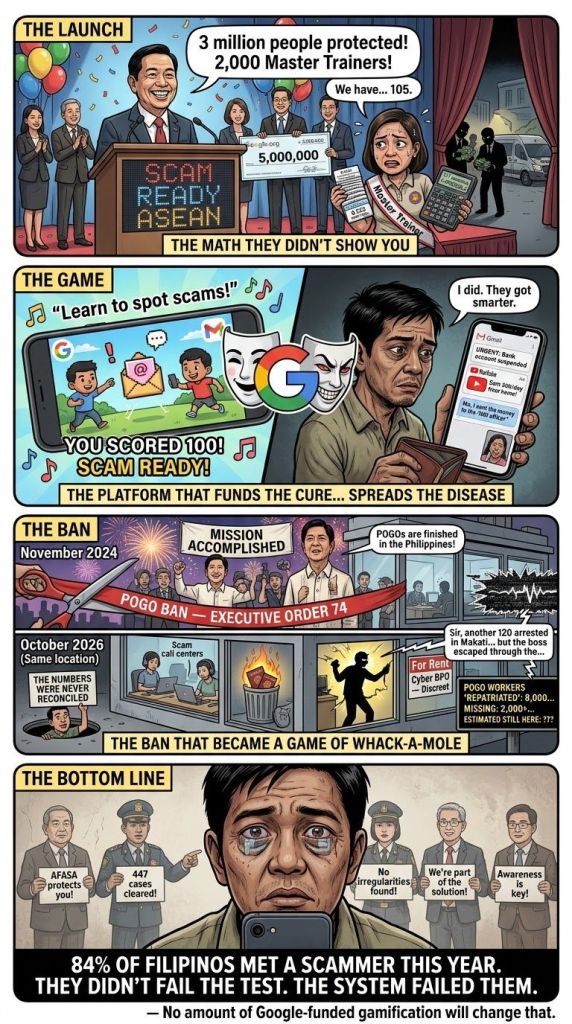
The Scam Ready ASEAN initiative aims to reach 3 million people across Southeast Asia through 2,000 Master Trainers, with support from a US$5 million commitment from Google.org.
As of the October 2026 launch in the Philippines, how many Master Trainers had been recruited? 105.
That’s 5.25% of the target, with a Philippine rollout of the localized “Be Scam Ready” game scheduled for December 2026 to January 2027 — a window of two to three months for a program meant to reach 1 million Filipinos.
Let me do the math that the ASEAN Foundation apparently didn’t want you to do.
To reach 1 million beneficiaries with 105 trainers, each trainer would need to personally reach roughly 9,523 people. If each training session lasts one hour and reaches 30 participants, that’s 317 sessions per trainer. Working 8 hours a day, 7 days a week, that’s roughly 40 days of nonstop training.
Doable on paper. Laughable in practice.
And this assumes the localized game — the primary pedagogical tool — will be ready on time. It won’t. December 2026 is when the program launches. The Philippine school year ends in March. The math simply doesn’t work.
The Google Money Question
Let’s talk about the elephant in the room: Google.org.
The Scam Ready ASEAN program is backed by US$5 million from Google.org, plus another US$5 million for AI Ready ASEAN, plus US$1.5 million for digital literacy initiatives.
Why is Google so generous?
Because Google’s platforms — Gmail, YouTube, Android’s default messaging apps, Google Ads — are primary vectors for scams. The company that profits from the digital infrastructure through which scams flow is now funding the program that teaches people how to avoid the scams flowing through its infrastructure.
This isn’t corporate social responsibility. This is regulatory risk mitigation.
The ASEAN Foundation gets funding. Google gets to position itself as part of the solution rather than the problem. The public gets a game.
What could possibly go wrong?
The POGO Ban Was a Lie
The narrative pushed by the Marcos administration is simple: The Philippines banned Philippine Offshore Gaming Operators (POGOs) in November 2024 through Executive Order No. 74, and now we’re cleaning up the mess.
The reality, as documented by the Asia/Pacific Group on Money Laundering (APG) and reported by the Manila Bulletin in July 2026, is that criminal syndicates simply decentralized and relocated.
The APG found that scam operations “broke up large-scale operations into smaller, mobile units” that operate from “hotel rooms, private homes, vacation rentals, or even entire floors of commercial buildings”. They’re in Clark, Bamban, Cebu, and regulatory grey zones where enforcement is weak.
Winston Casio, former deputy operations director of the Presidential Anti-Organized Crime Commission (PAOCC), dropped a bombshell in an SCMP investigation: Before the 2024 ban, at least 10,000 foreign POGO workers were granted permits to stay beyond the grace period. But only 8,000 actually left.
At one point, up to 400,000 overseas POGO workers were estimated to be in the country.
“So there’s a discrepancy in the numbers, and those numbers were never reconciled after the ban took effect,” Casio said.
Translation: We don’t know how many POGO workers stayed. We don’t know how many simply transitioned into guerrilla-style scam operations. We don’t know because we never bothered to find out.
And the September 2026 National Bureau of Investigation (NBI) raid in Makati — arresting over 120 Chinese nationals in a call center-style facility — suggests the problem is as alive as ever.
The AFASA Mirage
The BSP’s solution to this crisis is the Anti-Financial Account Scamming Act (AFASA), or Republic Act No. 12010, signed in July 2024.
Under AFASA, the BSP can examine financial accounts suspected of being used in scams without first securing a court order. This is a radical departure from the Bank Secrecy Law that has governed Philippine banking since 1955.
The BSP’s Consumer Account Protection Office (CAPO) has signed information-sharing agreements with the NBI, Cybercrime Investigation and Coordinating Center (CICC), Securities and Exchange Commission (SEC), Department of Justice (DOJ), and Philippine National Police (PNP).
The numbers cited by BSP General Counsel Roberto Figueroa are impressive: 527 AFASA-related cases recorded by the PNP Anti-Cybercrime Group in 2025, with 447 solved or cleared.
But here’s what the BSP doesn’t want you to notice: 447 cases “solved or cleared” doesn’t mean 447 convictions. It doesn’t mean 447 scam networks dismantled. It means 447 cases where police finished their paperwork.
Meanwhile, the GASA report shows only 4% of scam victims report to authorities. The 527 cases are a rounding error compared to the actual scale of victimization.
And the BSP’s much-touted AFASA powers? They apply to financial accounts in the Philippines. They do nothing about the scam compounds operating from Myanmar, Cambodia, or the dozens of smaller “guerrilla” hubs now scattered across Metro Manila and the provinces.
The Trafficking Victims Nobody Wants to Name
The scam industry doesn’t just steal money. It steals people.
The United Nations Office on Drugs and Crime (UNODC) has documented that POGO compounds were converted into scam operations, with the PAOCC liberating 5,949 people including 3,483 foreigners. These are not willing criminals. They are trafficking victims — lured by fake job offers, their passports confiscated, subjected to physical abuse and electric shocks if they don’t meet scam quotas.
The Anti-Trafficking in Persons Act (RA 9208, as amended by RA 11862) carries penalties of 20 years imprisonment and PHP 1-2 million fines. But the law only works if authorities bother to distinguish between organizers and coerced workers.
Too often, they don’t. Raids produce arrests, not rescues. Deportations, not prosecutions of the real masterminds.
The Real Question Srisangnam Won’t Answer
Dr. Srisangnam’s assertions are carefully calibrated. He says the Philippines is “among the hotspots.” He says “nearly 80%” are exposed. He says scam centers have “spread” from Cambodia, Thailand, and Vietnam.
But he doesn’t say who is funding the migration. He doesn’t say which Philippine officials are facilitating the operations. He doesn’t say why the POGO ban produced decentralization rather than elimination.
Because those questions would implicate governments, including the one hosting his program launch.
The Scam Ready ASEAN Program is a public relations exercise dressed as public health. It teaches individuals to protect themselves from a systemic problem. It puts the burden on potential victims rather than on the institutions — banks, regulators, law enforcement, immigration — that enabled the fraud ecosystem to flourish.
It’s cheaper to hand out a game than to prosecute a syndicate. It’s easier to teach people to spot a phishing text than to dismantle the financial infrastructure that launders scam proceeds.
The Bottom Line
The Philippines is not a “hotspot for cyber fraud” because Filipinos are gullible. It’s a hotspot because the entire ecosystem — from corrupt immigration officials to complicit bank officers to underfunded law enforcement — allows fraud to operate with near-total impunity.
The 84% exposure rate isn’t a failure of Filipino education. It’s a failure of Filipino governance.
And no amount of Google-funded gamification will change that.
Louis ‘Barok’ C Biraogo is the author of the Kweba ni Barok blog. He has no Google.org funding, no ASEAN Foundation grants, and no interest in pretending that awareness campaigns are a substitute for accountability.
Key Citations
A. Reports & Studies
- Global Anti-Scam Alliance. “State of Scams in the Philippines 2026.” GASA, 8 Oct. 2026, gasa.org/knowledge-base/reports/state-of-scams-in-the-philippines-2026.
- Asia/Pacific Group on Money Laundering. “Money Laundering and Terrorist Financing Risk Assessment Report.” APG, July 2026, as reported in Manila Bulletin.
- United Nations Office on Drugs and Crime. “Scam no more: how the Philippines is cracking down on online fraud centres with UNODC support.” UNODC, 27 Apr. 2026, unodc.org/roseap/en/philippines/2026/04/scam-no-more/story.html.
B. News Articles
- BusinessWorld. “Philippines still among hotspots for cyber fraud in Southeast Asia.” BusinessWorld, 12 Oct. 2026, bworldonline.com/top-stories/2026/10/12/786391/philippines-still-among-hotspots-for-cyber-fraud-in-southeast-asia/.
- Philippine Star. “Filipinos lost P121.8 billion to scams in past year — study.” Philstar, 10 Oct. 2026, philstar.com/headlines/2026/10/10/2562116/online-scams-cost-filipinos-p1218-billion-one-year.
- Manila Bulletin. “Cyber scams evolve as syndicates outmaneuver Marcos POGO ban.” Manila Bulletin, 17 July 2026, mb.com.ph/2026/07/17/cyber-scams-evolve-as-syndicates-outmaneuver-marcos-pogo-ban.
- South China Morning Post. “Philippines thought Pogos were gone. Corruption and AI still power them.” SCMP, 9 Oct. 2026, scmp.com/week-asia/politics/article/3370281/philippines-thought-pogos-were-gone-corruption-and-ai-still-power-them.
- Inquirer. “Over 120 Chinese involved in ‘lust scam’ nabbed in Makati.” Inquirer, 1 Oct. 2026, globalnation.inquirer.net/340086/over-120-chinese-involved-in-lust-scam-nabbed-in-makati.
C. Legal & Official Sources
- Republic of the Philippines. “Republic Act No. 12010: Anti-Financial Account Scamming Act.” Supreme Court E-Library, 2024, elibrary.judiciary.gov.ph/thebookshelf/showdocs/2/97690.
- Republic of the Philippines. “Republic Act No. 11862: Expanded Anti-Trafficking in Persons Act.” Lawphil, 2022, lawphil.net/statutes/repacts/ra2022/ra_11862_2022.html.
- Republic of the Philippines. “Republic Act No. 1405: Bank Secrecy Law.” Lawphil, 1955, lawphil.net/statutes/repacts/ra1955/ra_1405_1955.html.
- Google.org. “AI Ready ASEAN.” Google.org, 2026, google.org and aseanfoundation.org/learning-platforms/ai-ready-asean/.
- ASEAN Foundation. “Scam Ready ASEAN Launched in Kuala Lumpur.” ASEAN Foundation, 28 Apr. 2026, aseanfoundation.org/scam-ready-asean-launched-in-kuala-lumpur/.
D. Official Websites
- Bangko Sentral ng Pilipinas. “Consumer Account Protection Office.” BSP, 2026, bsp.gov.ph.
- Presidential Anti-Organized Crime Commission. “Official Website.” PAOCC, 2026, paocc.gov.ph.
- National Bureau of Investigation. “Official Website.” NBI, 2026, nbi.gov.ph.
- Department of Justice. “Office of Cybercrime.” DOJ, 2026, doj.gov.ph/cybercrime.html.
- Cybercrime Investigation and Coordinating Center. “Official Website.” CICC, 2026, cicc.gov.ph.
- Securities and Exchange Commission. “Official Website.” SEC, 2026, sec.gov.ph.
- Philippine National Police. “Anti-Cybercrime Group.” PNP, 2026, pnp.gov.ph.








Leave a Reply