Why ‘Central Figures Never Front Themselves’ Is Not a Rule of Evidence
By Louis “Barok” C. Biraogo — November 26, 2026
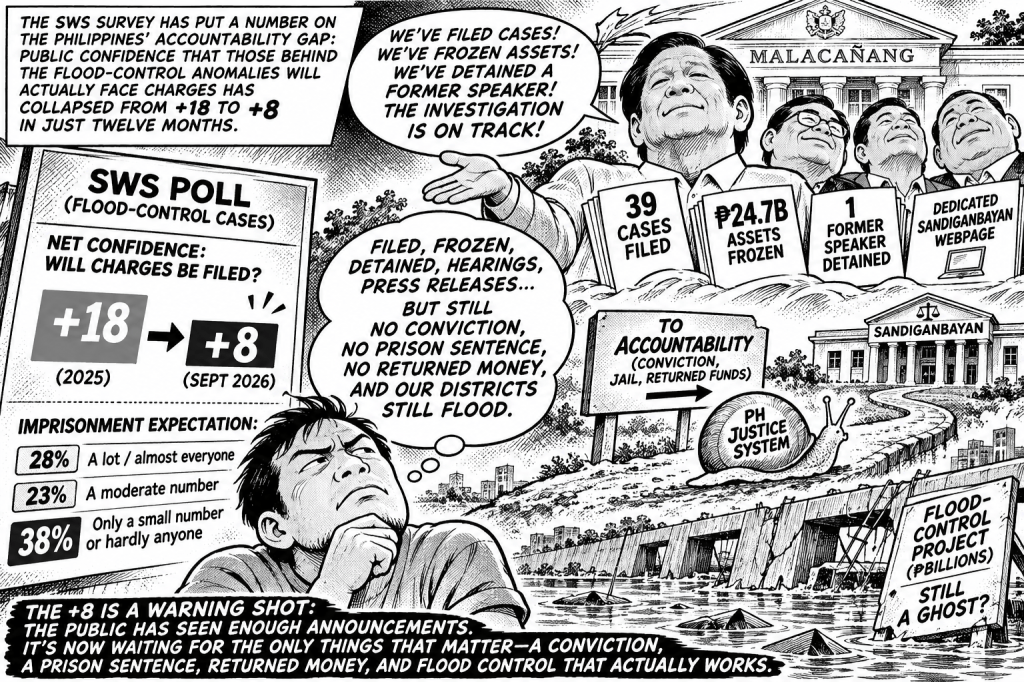
THERE is a particular kind of legal performance that deserves our attention this week, and it comes to us courtesy of the Office of the Ombudsman, by way of Assistant Special Prosecutor Joshua Tan. The performance is not a confession, nor is it a conviction. It is something far more delicate: the sound of a prosecutor explaining, under oath, that the “central figure” of a multibillion-peso kickback scheme is central precisely because no one can find him at the center of anything.
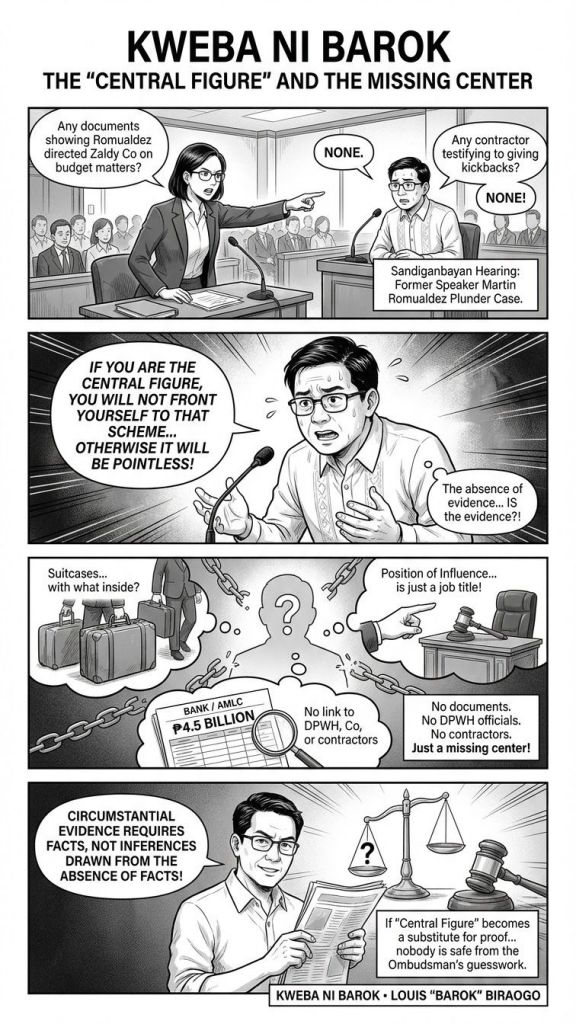
Let us review the transcript of reality. Tan testified before the Sandiganbayan’s Third Division in the bail hearing of former Speaker Martin Romualdez, who stands accused of plunder to the tune of ₱7.44 billion. Under cross-examination by defense counsel Rashel Ann Pomoy, Tan was asked whether there were documents showing that Romualdez directed Zaldy Co on budget matters. “None,” Tan replied. Asked whether the prosecution’s theory of Romualdez influencing Co was based on inference, Tan said “Yes”. Asked whether any contractor or Department of Public Works and Highways (DPWH) official had testified to giving Romualdez kickbacks, the answer was, once again, “None”.
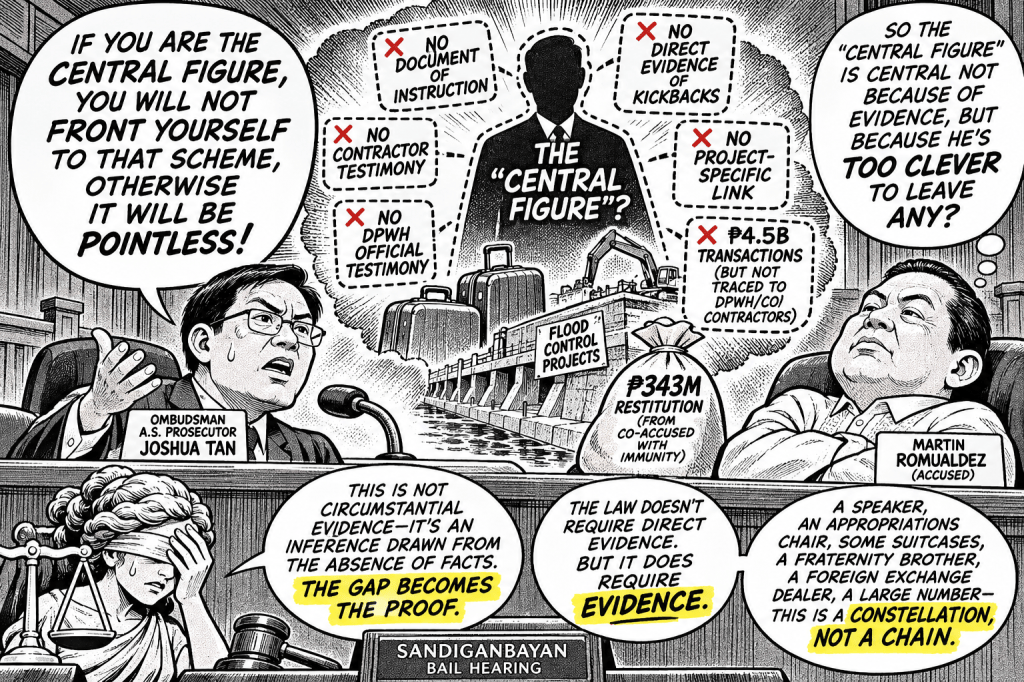
And then came the line that will be studied in law schools for decades, not as a principle of evidence but as a specimen of circular reasoning preserved in amber: “If you are the central figure, you will not front yourself to that scheme, otherwise it will be pointless“.
Read that again. Slowly.
The prosecution has no direct evidence that Romualdez gave instructions. It has no direct evidence that he received money from contractors or DPWH officials. It has no document linking him to a specific substandard flood control project. But it maintains he is the central figure because a central figure would be too clever to leave direct evidence. The absence of evidence becomes the evidence of cleverness. The gap becomes the proof.
This is not circumstantial evidence. Circumstantial evidence requires proven facts from which inferences are drawn. This is an inference drawn from the absence of facts, which is a different animal entirely—one that belongs in a political rally, not a criminal courtroom.
The Three Clusters and the One Missing Link
Tan helpfully identified “three clusters” of evidence supporting the central-figure theory: the alleged suitcase deliveries, Romualdez’s influence as Speaker, and his appointment of Co as appropriations chair.
Let us examine the first cluster with the care it deserves. In October, GMA reported that witnesses testified to seeing suitcase deliveries but one witness explicitly said he did not see money inside the suitcases. By November, the prosecution was describing “cash-filled suitcases” delivered to a property associated with Romualdez, based on statements from Co’s former security aides . This is a meaningful evidentiary upgrade in the retelling, even if the underlying observations have not changed.
The second cluster—Romualdez’s “influence” as Speaker—is not evidence of a crime. It is a description of a job title. The Speaker of the House has influence over the House. This is not a revelation; it is a civics lesson. The question is whether that influence was exercised to facilitate a criminal scheme, and on that question Tan offered inference, not evidence.
The third cluster—Co’s appointment—is similarly a fact that proves nothing on its own. Speakers appoint committee chairs. Some of those chairs may commit crimes. The appointment is not the conspiracy.
What is striking is not that the prosecution lacks a smoking gun. Sophisticated corruption rarely leaves one. What is striking is that the prosecution’s own witness, under oath, conceded the absence of the basic connective tissue that would distinguish a political relationship from a criminal enterprise. No document. No contractor. No DPWH official. No project-specific link .
And yet: “central figure.”
The Financial Evidence: A Number in Search of a Narrative
The prosecution has also deployed the Anti-Money Laundering Council (AMLC) witness, who testified to ₱4.5 billion in transactions linked to Romualdez during his speakership . This number has been repeated with the solemnity of a verdict. But a transaction volume is not a crime. It is a statistic.
More telling is what the same AMLC witness reportedly conceded: that the funds flowing into Romualdez’s accounts could not be traced to the DPWH, to project contractors, or to Zaldy Co . The prosecution’s own financial investigator, in other words, established that the money in the bank accounts did not come from the sources the prosecution alleges. The ₱4.5 billion figure, upon inspection, is not a trail. It is a headline.
Then there is the Guevarra restitution. Felicito Guevarra, president of Samchan Foreign Exchange, has returned ₱343 million in alleged earnings from transactions involving Romualdez, coursed through Joselyn Serenio, described as Romualdez’s former aide. Guevarra is now cooperating and is expected to testify.
This is potentially the prosecution’s most concrete offering. But it arrives with its own problems. Guevarra is a co-accused who has been granted conditional immunity . His restitution is not an admission of Romualdez’s guilt; it is a transaction between Guevarra and the state. What Guevarra actually knows, and whether his testimony can bridge the gap between Serenio’s alleged deliveries and Romualdez’s knowledge, remains to be seen. The defense has already objected to the timing of his introduction, noting that he was substituted for former DPWH Secretary Manuel Bonoan on the final day of the bail hearing.
The substitution is itself a tell. If Bonoan had evidence linking Romualdez to the flood control projects, one might expect the prosecution to call him. Instead, the prosecution swapped him for a co-accused with a restitution check and an immunity deal. This is not necessarily improper. But it is not the stuff of which “strong evidence of guilt” is conventionally made.
What the Defense Sees, and Why It Matters
Romualdez’s camp has been blunt. “Despite numerous Senate and House inquiries and other official investigations, no former or incumbent DPWH official has ever identified Rep. Romualdez as having participated in the planning, procurement, implementation, inspection, payment, or release of funds for any alleged ghost project,” said spokesperson Elaine Atienza. The Speaker, she noted, has no authority over project bidding, contract awards, implementation, or fund release. Those are executive functions.
This is not a denial of corruption in the flood control program. It is a denial of a specific causal chain: that Romualdez’s position as Speaker gave him operational control over the projects that were allegedly corrupted. The prosecution’s theory requires that chain. Without it, the “central figure” is merely a prominent figure.
The defense has also pointed out what Tan conceded: that Romualdez is not a stockholder in the Golden Pheasant and Brightnews corporations used by Jose Raulito Paras to purchase the Forbes Park properties. The prosecution’s nominee theory—that Paras was a front for Romualdez—may be true. But “may be true” is not the standard for denying bail in a plunder case. The standard is “strong evidence of guilt.” Beneficial ownership must be proven, not inferred from fraternity membership and income tax returns.
The Law Does Not Require Direct Evidence. It Requires Evidence.
Let us be fair to the prosecution. Philippine law does not require direct proof. Rule 133, Section 4 permits conviction on circumstantial evidence, provided there are multiple circumstances, the facts from which inferences are drawn are proven, and the combination produces conviction beyond reasonable doubt. Republic Act No. 7080 (Plunder Law), Section 4 explicitly states that it is not necessary to prove every criminal act if a pattern of overt acts indicative of the overall unlawful scheme is established .
The Estrada plunder cases, which the prosecution will surely invoke, confirm this framework. But they also confirm something else: that the pattern must be established with evidence, not assertion. The Supreme Court in Enrile v. People, while addressing the sufficiency of the Information, emphasized that the predicate acts must be stated with particularity so that the accused can prepare a defense. The same logic applies at the bail stage: the evidence of the pattern must be particular enough to be tested, not merely gestured toward.
The prosecution’s problem is not that it relies on circumstantial evidence. It is that its circumstances do not yet form a chain. They form a constellation: a Speaker, an appropriations chair, some suitcases, a fraternity brother, a foreign exchange dealer, a large number. Constellations are patterns in the sky. Chains are what bind.
The Bail Hearing Is Not the Trial. But It Is Not Nothing.
The Sandiganbayan is not being asked to convict Romualdez. It is being asked to determine whether the evidence of guilt is strong enough to justify continued detention without bail. This is a lower standard than proof beyond reasonable doubt, but it is not a rubber stamp. The prosecution bears the burden of demonstrating that its evidence is strong. If its own witness concedes that the key links are missing, the court is entitled to ask whether the evidence is strong or merely loud.
The Ombudsman’s institutional credibility is also on the line. This is an agency that has pursued powerful figures before, sometimes successfully, sometimes not. But the pursuit of Romualdez has proceeded on a narrative arc that has outpaced its evidentiary foundation. The “central figure” label was deployed before the evidence was assembled. The ₱4.5 billion figure was publicized before it was traced. The suitcase witnesses were characterized as seeing cash before it was clarified that some saw only luggage.
None of this means Romualdez is innocent. It means the prosecution has not yet demonstrated that he is guilty in the way that matters legally: through evidence that survives cross-examination and connects the dots without requiring the court to fill in the blanks with faith.
The Uncomfortable Question Nobody Wants to Ask
The most intriguing possibility is not that the prosecution has no case. It is that the prosecution has a case against someone, and has not yet decided, or has not yet been able, to tell the court who that someone is.
Zaldy Co is the figure who, according to Tan’s own testimony, identified projects, made insertions, and sought percentages. Co is the one who allegedly dealt with Bernardo. Co is the one whose security aides allegedly delivered the suitcases. Co is abroad. Co has not testified.
If the evidence establishes Co’s misconduct but not Romualdez’s knowing participation, the prosecution has a problem: it has charged the wrong man at the top, or it has charged the right man without the evidence to prove it. The “central figure” theory may be an attempt to solve that problem by inference—to reason backward from the structure of the alleged scheme to the identity of its architect. But architecture is not a crime. Conspiracy is. And conspiracy must be proven, not deduced from organizational charts.
The Sandiganbayan will decide, in the coming weeks or months, whether the evidence is strong. If bail is granted, the prosecution will continue, and may yet find the missing links. If bail is denied, Romualdez will remain detained on a theory that his own accusers have described as inferential.
Either way, the public should watch closely. Not because Romualdez is sympathetic—he is not—but because the standard being applied to him will be applied to others. If “central figure” reasoning is enough to detain a former Speaker, it will be enough to detain anyone the Ombudsman decides is central. The absence of evidence should not become a feature of the prosecution’s case. It should be a warning.
In the meantime, the phrase ‘central figures are never the front’ will echo. It is a clever line—and hardly a frivolous one. Sophisticated schemes are built precisely to insulate their architects, and Philippine law has never required direct evidence where circumstantial proof is sound. The law does not require the guilty to stand at the front. It requires the prosecution to show, through the full evidentiary picture, that they were there at all—and that case has not yet been fully heard.
Key Citations
A. Legal & Official Sources
- Enrile v. People. G.R. No. 213455, 11 Aug. 2015. LawPhil Project, lawphil.net/judjuris/juri2015/aug2015/gr_213455_2015.html.
- Estrada v. Sandiganbayan. G.R. No. 148560, 19 Nov. 2001. LawPhil Project, lawphil.net/judjuris/juri2001/nov2001/gr_148560_2001.html.
- Estrada v. Sandiganbayan. G.R. No. 148965, 26 Feb. 2002. LawPhil Project, lawphil.net/judjuris/juri2002/feb2002/gr_148965_2002.html.
- Philippines. Republic Act No. 7080. An Act Defining and Penalizing the Crime of Plunder. 12 July 1991. LawPhil Project, lawphil.net/statutes/repacts/ra1991/ra_7080_1991.html.
- Supreme Court of the Philippines. 2019 Revised Rules on Evidence. A.M. No. 19-08-15-SC, 2019. LawPhil Project, lawphil.net/courts/supreme/am/am_19-08-15-sc_2019.html.
B. News Reports
- ABS-CBN News. “ANC: Rep. Romualdez Co-Accused Returns Alleged P343-M Kickbacks.” ABS-CBN News, 23 Nov. 2026, http://www.abs-cbn.com/news/nation/2026/11/23/anc-rep-romualdez-co-accused-returns-alleged-p343-m-kickbacks-2223.
- ABS-CBN News. “Romualdez Co-Accused Restitutes P343 Million.” ABS-CBN News, 23 Nov. 2026, http://www.abs-cbn.com/news/nation/2026/11/23/romualdez-co-accused-returns-alleged-p343-million-kickbacks-1205.
- GMA News. “Romualdez Camp Denies Ombudsman’s Allegations, Claims No Evidence Exists.” GMA News Online, GMA Network, 1 July 2026, http://www.gmanetwork.com/news_duplicate/topstories/nation/993559/romualdez-camp-denies-ombudman-s-allegations-claims-no-evidence-exists/story/.
- Inquirer.net. “No Proof of Romualdez Influencing Co in Alleged Infra Kickbacks – Witness.” Inquirer.net, 23 Nov. 2026, newsinfo.inquirer.net/2346279/no-proof-of-romualdez-influencing-co-in-alleged-infra-kickbacks-witness/.
- Inquirer.net. “Witness: No Direct Proof Linking Romualdez to Kickbacks Scheme but…” Inquirer.net, 24 Nov. 2026, newsinfo.inquirer.net/2346570/witness-no-direct-proof-linking-romualdez-to-kickbacks-scheme-but.
- Inquirer.net. “Witness: Romualdez Cash Inflows Not Traceable to DPWH, Co, Contractors.” Inquirer.net, 12 Nov. 2026, newsinfo.inquirer.net/2340545/witness-romualdez-cash-inflows-not-traceable-to-dpwh-co-contractors.
- Ong, Ghio. “Romualdez: No Link to Flood Control Kickbacks.” The Philippine Star, 25 Nov. 2026, qa.philstar.com/headlines/2026/11/25/2572485/romualdez-no-link-flood-control-kickbacks.
- Panti, Llanesca T. “Ombudsman Prosecutor: No Document Shows Romualdez Directed Co on Budget Matters.” GMA News Online, GMA Network, 24 Nov. 2026, http://www.gmanetwork.com/news_duplicate/topstories/nation/1010572/ombudsman-prosecutor-no-document-shows-romualdez-directed-co-on-budget-matters/story/.
- Panti, Llanesca T. “Witnesses on Romualdez Plunder Case: We Saw Suitcase Deliveries, Not the Money.” GMA News Online, 18 Oct. 2026, http://www.gmanetwork.com/news/topstories/nation/1006368/witness-on-romualdez-plunder-case-i-saw-suitcase-deliveries-not-the-money/story/ .
- “Ang Hirap Maging Mahirap”: The PAO Scandal That Proves Government Contempt Is Nothing New

- “Far-Off” My Axx: Malacañang’s Claire Castro Drowns in Her Own Legal Gaslighting
- “Forthwith” to Farce: How the Senate is Killing Impeachment—And Why Enrile’s Right (Even If You Can’t Trust Him)

- “HINDI AKO NAG-RESIGN!”

- “I Have No Reason to Doubt”: Teodoro’s MDT Fairy Tale

- “I Know Nothing”: Baste Duterte’s Amnesia Defense Meets ₱33M in GenCorp Contracts

- “I’m calling you from my new Globe SIM. Send load!”

- “Mahiya Naman Kayo!” Marcos’ Anti-Corruption Vow Faces a Flood of Doubt

- “Manageable” Debt, Unmanageable Corruption: The ₱19.66-Trillion Lie

- “Manageable” Debt, Unmanageable Lies: DBM’s ₱21 Trillion Fairy Tale

- “Meow, I’m calling you from my new Globe SIM!”

- “Natrabaho”: One Word, One Ombudsman, and a Judiciary on Trial



Leave a Reply