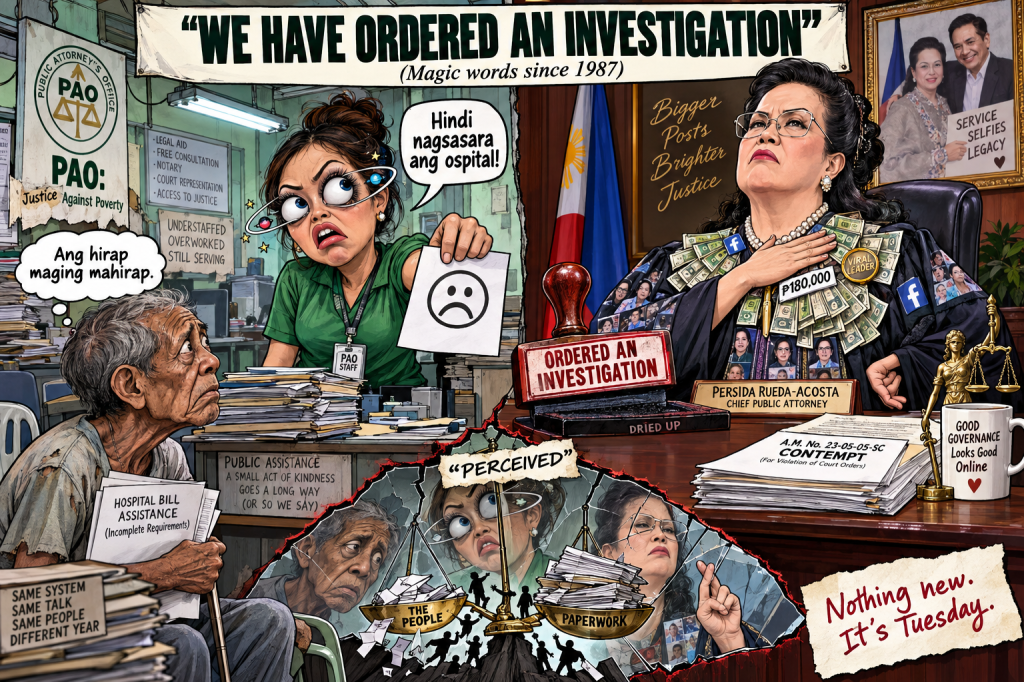
A viral video, an eye-rolling staffer, and the ₱180,000 question: Why is Acosta’s PAO lecturing anyone about dignity?
By Louis ‘Barok‘ C. Biraogo — September 19, 2026
LET me tell you about the most predictable sentence in Philippine governance.
“We have ordered an investigation.”
Something embarrassing goes viral. An agency spokesperson emerges. The magic words are uttered. And then—if history is any guide—nothing of consequence happens.
The Public Attorney’s Office (PAO) just gave us a masterclass in this ritual.

The Facts
A video surfaced showing an elderly man being treated with textbook bureaucratic contempt by a PAO staff member at the Meycauayan, Bulacan district office. According to the viral post by “Inday Panadera Gelyn,” a female employee in a green dress—holding a paper with a frowning face—demanded: “Asaan medical niyo!?”
When the man explained he left blanks because the hospital was closed, she allegedly snapped: “Hindi nagsasara ang ospital at walang ospital dun!” before turning away with an eye roll visible from orbit.
The post ended with: “Ang hirap maging mahirap.”
Translation: It’s hard to be poor.
The Institutional Response
Deputy Chief Public Attorney Ana Lisa Soriano announced that Chief Persida Rueda-Acosta had “immediately ordered an investigation.” The Legal Research Service issued notices to explain. Personnel—including the office head—were given 72 hours. Due process would be respected. Sanctions would follow if liability were established.
Soriano said Rueda-Acosta “deeply regrets that a client experienced or perceived inappropriate treatment.”
Perceived.
That word is doing an awful lot of heavy lifting.
A government employee was caught on video treating an elderly indigent client—the exact constituency PAO exists to serve—with mockery. And the official response includes language subtly questioning whether the misconduct was real or just a matter of perception.
This is accountability theater.
The Credibility Problem You Can’t Investigate Away
Here’s the thing about PAO’s leadership lecturing anyone about professionalism: the Chief Public Attorney herself was fined ₱180,000 by the Supreme Court in A.M. No. 23-05-05-SC (the Acosta contempt Decision) in February 2024 for indirect contempt and “grossly undignified conduct.”
Acosta’s offense? Launching a public campaign—using PAO lawyers, staff, and clients—against the Supreme Court’s A.M. No. 22-09-01-SC (Code of Professional Responsibility and Accountability) provision on conflict of interest. She posted Facebook videos. She insinuated the Court was trying to “destroy” the justice system.
The Supreme Court’s language was devastating: “Instead of being at the forefront of upholding the Court’s dignity and independence, Atty. Acosta sowed hate and disrespect against the Court.”
This is the same person now ordering investigations into subordinates for disrespectful conduct.
The irony is so thick you could serve it at a wake.
Can an agency credibly discipline frontline staff for rudeness when its own chief has a documented history of grossly undignified conduct? That’s not rhetorical. That’s the institutional credibility deficit PAO operates with.
The “We Investigated Ourselves” Problem
Soriano’s statements suggest commitment to process. Not prejudging. Giving a chance to explain. Conditioning sanctions on findings. All procedurally proper.
But here’s what’s missing: any indication PAO is investigating itself with the same rigor.
Did this elderly client actually receive legal assistance? Reports don’t say. Did he return? Was he eventually served? Or did he walk out humiliated and empty-handed?
Is this isolated or a pattern? The Meycauayan office has apparently had prior complaints. One anonymous Reddit post from years ago described a similar experience—unverified, but suggestive. Is PAO tracking complaints? Or do they only become visible when someone films them?
What systemic conditions produced this? PAO offices are notoriously overworked. Was this a bad employee in a broken system—or did the system make her this way?
Did the office head know? The supervisor was included in the investigation. But what does that mean? Did previous complaints go unaddressed? Was there a culture of tolerating rudeness because “that’s just how it is”?
These aren’t gotcha questions. They’re what a genuine accountability process would ask.
The PAO Client Problem Nobody Wants to Talk About
PAO exists because poor Filipinos cannot afford lawyers.
Every person walking into a PAO office has already exhausted their options. They’re often elderly, confused, intimidated by legal processes, carrying the accumulated trauma of navigating systems not designed for them.
When a staff member rolls her eyes at such a person, she isn’t just being rude. She’s reinforcing that the poor should be grateful for whatever scraps they receive. That their confusion is an inconvenience. That their poverty is a personal failing.
The viral post ended with: “This kind of behavior from government employees is nothing new to us.”
Nothing new.
That’s the most damning line in the story. For the people PAO serves, this treatment is expected. It’s Tuesday. It’s just how things work.
If that perception is even partially accurate, PAO doesn’t have a rudeness problem. It has a culture problem. And culture problems don’t get fixed by investigating one employee.
What Real Accountability Would Look Like
I’m not suggesting summary firing based on a viral video. Due process matters, and Soriano is right to respect it.
But here’s what PAO leadership could do to prove this isn’t reputation management:
- First, complete the factual investigation transparently. Not “we investigated and found the controversy exaggerated,” but a genuine account: What happened? Was the video accurate? Was the client served? What rule was violated? What sanction was imposed?
- Second, address the client’s experience directly. If the elderly man was denied or delayed assistance, PAO should ensure he receives it. If he walked away without help, that’s not just a discipline issue—it’s a failure of PAO’s core mandate.
- Third, investigate the system, not just the individual. Was this a bad actor or a bad system producing bad behavior? PAO needs to examine intake procedures, staffing, training, and complaint mechanisms. The Supreme Court has emphasized PAO’s “primordial responsibility” is providing legal assistance to indigent persons. That includes treating them as human beings.
- Fourth, acknowledge the credibility gap. If PAO wants the public to believe it takes rudeness seriously, it needs to explain how its own leadership’s history—including the Chief’s Supreme Court sanctions—fits into the accountability picture. Uncomfortable. Also unavoidable.
The Bottom Line
The PAO Meycauayan incident is small in the grand scheme. One employee, one elderly client, one viral video.
But it’s a window into something larger: how government institutions that serve the poor often treat the poor as burdens rather than citizens deserving dignity.
PAO’s mandate is “justice against poverty.” But justice delivered with contempt isn’t justice. It’s charity with an attitude problem.
The investigation will run its course. Notices will be explained. Findings will be made. Sanctions may or may not be imposed.
The real test is whether anything changes.
Will PAO train staff to recognize that an elderly person with an incomplete form isn’t being difficult—they’re navigating a system that failed them before they walked through the door?
Will supervisors be held accountable for cultures where rudeness is tolerated?
Will PAO leadership recognize that the credibility of its accountability mechanisms depends on its own conduct?
Or will this be another case of “we investigated ourselves, found nothing systemic, and moved on”?
The cameras will stop rolling. The viral posts will fade. The news cycle will move on.
What remains is whether the next elderly Filipino who walks into a PAO office is treated with dignity—or with another eye roll.
Given the track record, I’m not holding my breath.
Key Citations
A. Legal & Official Sources
- The 1987 Constitution of the Republic of the Philippines. Official Gazette of the Republic of the Philippines, 1987, http://www.officialgazette.gov.ph/constitutions/the-1987-constitution-of-the-republic-of-the-philippines/the-1987-constitution-of-the-republic-of-the-philippines-article-iii/.
- Republic Act No. 9406. An Act Reorganizing and Strengthening the Public Attorney’s Office (PAO), Amending for the Purpose Pertinent Provisions of Executive Order No. 292, Otherwise Known as the “Administrative Code of 1987”, as Amended, Granting Special Allowance to PAO Officials and Lawyers, and Providing Funds Therefor. 23 Mar. 2007, http://www.officialgazette.gov.ph/2007/03/23/republic-act-no-9406/.
- Executive Order No. 292. Administrative Code of 1987, Book IV, Title III, Chapter 5 (Public Attorney’s Office). 25 July 1987, http://www.officialgazette.gov.ph/1987/07/25/executive-order-no-292-book-ivtitle-iiichapter-5-public-attorneys-office/.
- A.M. No. 22-09-01-SC. Code of Professional Responsibility and Accountability. Supreme Court of the Philippines, 11 Apr. 2023, sc.judiciary.gov.ph/wp-content/uploads/2023/05/22-09-01-SC.pdf.
- A.M. No. 23-05-05-SC. Request of the Public Attorney’s Office to Delete Section 22, Canon III of the Proposed Code of Professional Responsibility and Accountability. Supreme Court of the Philippines, 27 Feb. 2024, sc.judiciary.gov.ph/wp-content/uploads/2024/06/23-05-05-SC.pdf.
B. News Reports
- Calalo, Arlie O. “PAO Lawyers in Bulacan Office under Fire over Viral Video Post.” The Manila Times, 18 Sept. 2026, http://www.manilatimes.net/2026/09/18/news/pao-lawyers-in-bulacan-office-under-fire-over-viral-video-post/2428050.
- Untalan, Sherylin. “SC Fines PAO Chief Acosta P180K for Indirect Contempt.” GMA News Online, GMA Network, 27 Feb. 2024, http://www.gmanetwork.com/news/topstories/nation/898815/sc-fines-pao-chief-acosta-p180k-for-indirect-contempt/story/.
- Pulta, Benjamin. “SC Fines PAO Chief for Indirect Contempt, ‘Undignified Conduct.’” Philippine News Agency, 27 Feb. 2024, http://www.pna.gov.ph/articles/1219692.
- ₱8B BBM Pork: CCTV for Every Captain’s Kumpare?
- ₱8.9 Billion, 331 Ghost Police Stations: The TIKAS Scandal Explained

- ₱8.4 Billion, 42,000 Barangays, 1 Election: The “Bawat Barangay Makikinabang” Vote-Buying Masterclass

- ₱75 Million Heist: Cops Gone Full Bandit

- ₱6.77B Ghost Haunts Duterte: RTC Dismisses Mans Carpio’s Desperate Plea

- ₱6.77 Billion and Zero Cash: The Sara Duterte SALN Math That Doesn’t Add Up

- ₱6.7-Trillion Temptation: The Great Pork Zombie Revival and the “Collegial” Vote-Buying Circus

- ₱58.53B, Zero Receipts: The LGSF Pork Barrel Nobody Wants to Name
- ₱53 Million Man Tells ₱695-a-Day Workers to Stop Being ‘Mayabang’: The Audacity of BSP’s Remolona
- ₱4.4 Billion and a Witness Who Can’t Explain It: The Duterte Impeachment’s Most Expensive Non-Answer
- ₱3.06 Billion for Evacuation Centers—But Nobody Knows Where They’ll Stand (Or If They’ll Exist)
- ₱16 Billion, 280 Accounts, 8 Helicopters: Boying Remulla’s Case Against the Yaps Is Not a Drill



Leave a comment