When Suspicious Transaction Reports Are Just Headlines With a Filing Number
By Louis ‘Barok’ C. Biraogo — October 8, 2026
ALLOW me to summarize this for the folks in the back, because the AMLC just handed us comedy gold.
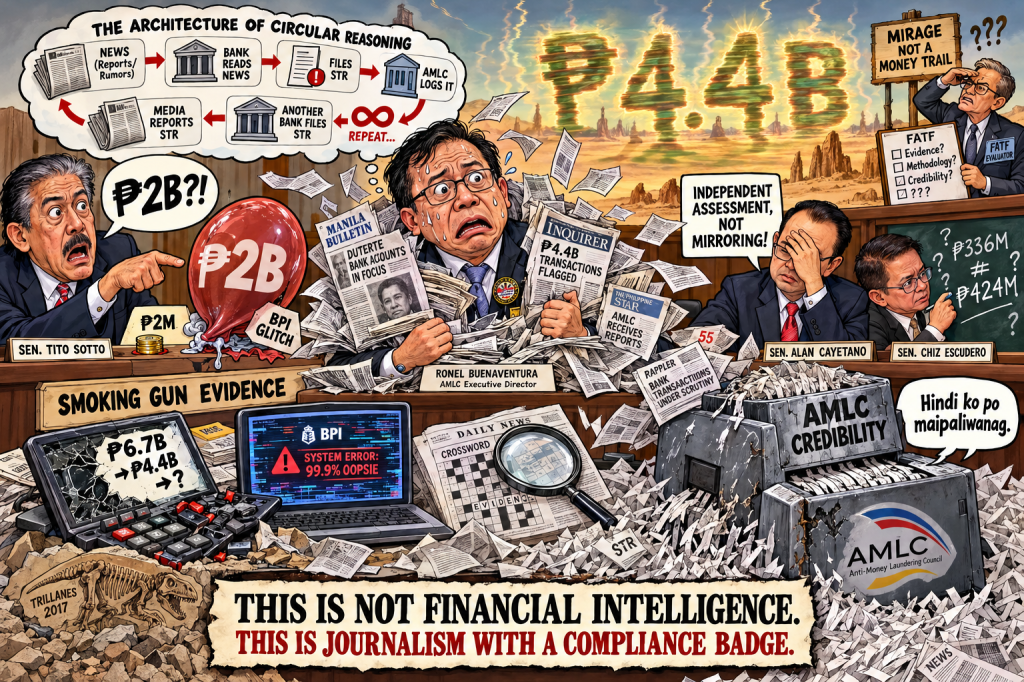
The Anti-Money Laundering Council (AMLC)—the Philippines’ premier financial intelligence unit, the agency that exists to catch dirty money—went to the Senate Impeachment Court on Day 33 and essentially admitted that some of its “suspicious transaction reports” (STRs) against Vice President Sara Duterte and her husband were triggered not by sophisticated forensic analysis, not by sophisticated pattern recognition, not by the kind of financial detective work that would make a Financial Crimes Enforcement Network (FinCEN) analyst proud.
They were triggered by newspaper articles.
You read that correctly.
AMLC Executive Director Ronel Buenaventura testified, under oath, that a 2019 STR involving premium payments to Mercantile Insurance Company was filed because “several news outlets recently released a list of individuals and corporations identified as being involved in the Department of Public Works and Highways (DPWH) flood control issue.”
The “reason” listed in the report? “Graft and corrupt practices.”
The actual financial connection between the transaction and the alleged flood control scam?
Nowhere to be found in the record.
This is not financial intelligence. This is journalism with a compliance badge.
The Architecture of Circular Reasoning
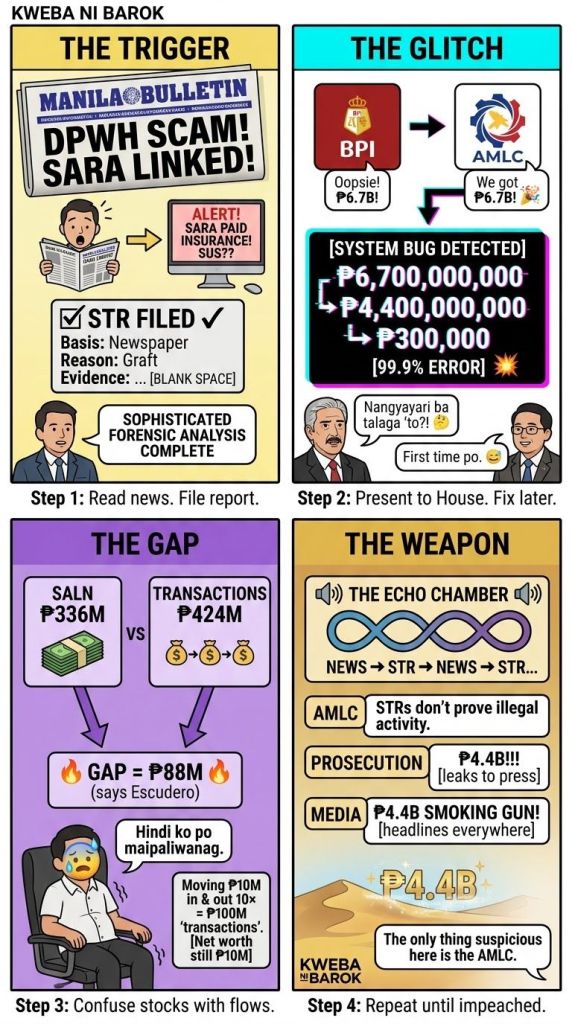
Let me walk you through the evidentiary chain that prosecutors are asking the Senate—and the Filipino public—to accept as proof of impeachable conduct:
- News outlets publish allegations about the DPWH flood control controversy.
- A bank or insurance company reads the news.
- The institution notices that a customer—Sara Duterte—made a transaction.
- The institution files a Suspicious Transaction Report citing the news report as the basis for suspicion.
- The AMLC receives the STR and logs it.
- The prosecution presents the STR to the impeachment court as evidence of potential graft.
- Media reports on the STR testimony, creating more news reports.
- Another institution reads the news and files another STR.
This is not a money trail. This is an echo chamber with a filing system.
Senator Alan Cayetano apparently recognized this absurdity, slamming the AMLC’s verification process and arguing that banks should conduct independent assessments rather than merely “mirroring newspaper reports.”
He’s right.
If a high school student submitted this as a research paper—citing newspaper articles as the primary basis for financial suspicion—they would fail. Yet the AMLC is presenting it as evidence in the impeachment trial of the second-highest official in the land.
The ₱4.4 Billion Mirage
Let’s talk about the headline number, because the prosecution certainly wants you to.
₱4.4 billion.
That’s the aggregate figure from 666 Covered Transaction Reports and 55 Suspicious Transaction Reports involving Duterte and Carpio from 2007 to 2025.
Sounds damning, doesn’t it?
Except here’s what the prosecutors conveniently omit from their press releases:
A CTR is not evidence of wrongdoing. A Covered Transaction Report (CTR) is triggered simply because a transaction exceeds ₱500,000 in a single banking day under Republic Act No. 9160 (Anti-Money Laundering Act of 2001). That’s it. A politician selling a piece of property worth ₱600,000 would generate a CTR. A legitimate business owner depositing receipts from a good week would generate a CTR. The threshold is not “this is dirty money”—the threshold is “this is a large transaction.”
The ₱4.4 billion includes both inflows and outflows. Of the total, only ₱1.63 billion was inflows and ₱1.31 billion was outflows, with about ₱1.46 billion that the AMLC could not even classify as either.
The number was revised DOWN from ₱6.7 billion. Why? Because the Bank of the Philippine Islands (BPI) admitted to a “system bug” that inflated transactions linked to Carpio by over ₱2 billion. An amount initially reported at around ₱269 million was corrected to ₱300,000. That’s not a rounding error—that’s a 99.9% mistake. And BPI asked the AMLC to delete the erroneous records.
So the prosecution’s timeline is: present ₱6.7 billion to the House, get headlines, then quietly correct it to ₱4.4 billion when the bank notices its own software was hallucinating numbers.
But wait—there’s more.
The “Gap” That Proves Nothing
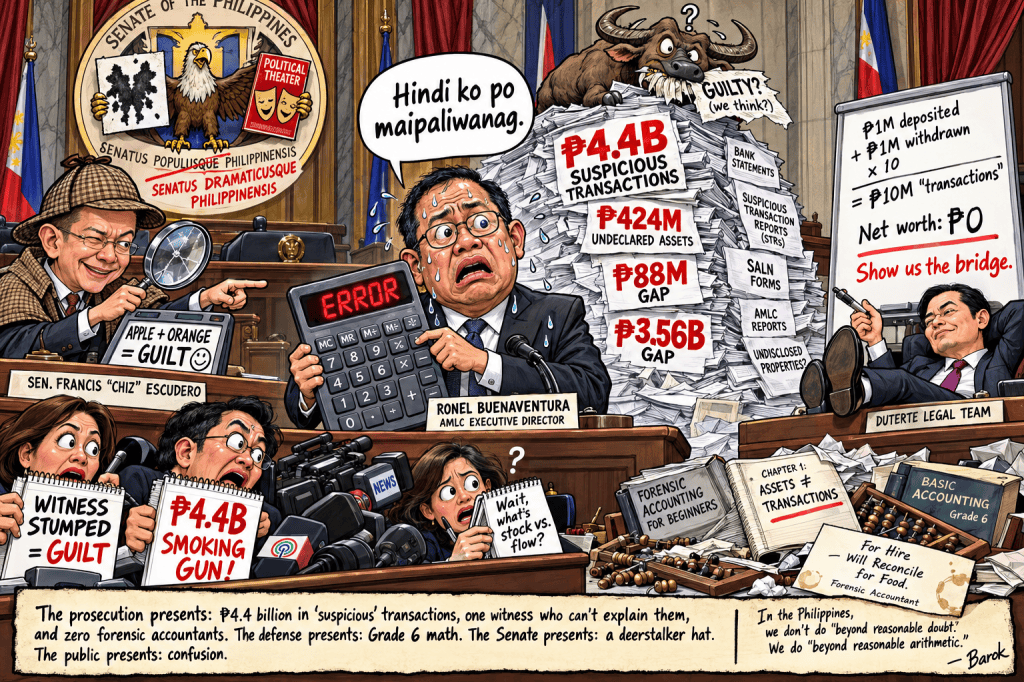
Presiding Officer Chiz Escudero, clearly enjoying his role as amateur forensic accountant, pointed out that Duterte and Carpio’s Statement of Assets, Liabilities, and Net Worth (SALN) net worth from 2022 to 2025 totaled ₱336 million, while their combined inflow and outflow transactions hit ₱424 million—a “gap” of ₱88 million.
Escudero asked Buenaventura to explain.
Buenaventura’s answer: “Hindi ko po maipaliwanag.” (I cannot explain.)
Here’s what Escudero didn’t seem to grasp, and what the prosecution certainly hopes you don’t either:
Transactions are flows. SALN records net worth at a specific date. They are not the same thing.
If I have ₱10 million in my account on January 1, move it out and back in ten times over the course of a year, I’ve generated ₱100 million in “transactions” while my net worth at year-end might still be ₱10 million.
A person can have a high volume of transactions with a modest net worth. That’s called normal financial activity. Businesses do it every day. Wealthy individuals do it every day. Politicians receiving campaign contributions and disbursing campaign expenses do it every election cycle.
The prosecution’s SALN comparison is not forensic evidence. It’s a category error dressed up as a smoking gun.
“Drug Trafficking” Based on a 2017 Complaint That Led Nowhere
One of the STRs, dated August 1, 2024, flagged Carpio’s Philippine Savings Bank (PSBank) accounts for alleged links to “drug trafficking and related offenses.”
The basis?
A criminal complaint filed by former Senator Antonio Trillanes IV in 2017—seven years earlier—naming Carpio among the accused in the ₱6.4-billion shabu smuggling case.
The STR narrative, according to Buenaventura, literally states: “Per checking today, 01 August 2024, in Manila Bulletin News Website, Davao City Rep. Pulong Duterte, VP Sara’s husband Carpio, 8 others charged in P6.4B shabu importation in 2017.”
So the “suspicious” trigger was: someone read a 2024 news article about a 2017 complaint that had not resulted in charges, let alone conviction, against Carpio.
Let me repeat that for emphasis.
The STR was not triggered by a pattern of drug-related financial activity. It was not triggered by deposits matching known drug-trafficking typologies. It was not triggered by intelligence from law enforcement.
It was triggered by a Manila Bulletin article about a Trillanes complaint.
If this is the standard for filing an STR, then every Filipino named in any criminal complaint ever filed should have their bank accounts flagged as suspicious. That’s not financial intelligence. That’s weaponized compliance.
The China Money: Fact, Speculation, and a Senator’s Homework Assignment
The most intriguing thread involves Cale88 Foods Corporation, a company where Carpio is a shareholder, which received ₱319.33 million in remittances from China and Hong Kong.
Senator Risa Hontiveros, doing the work the AMLC apparently should have done, examined the Chinese companies that sent the money and found that several appeared to be state-owned enterprises, including China National Township Enterprises, which she said was directly under China’s Ministry of Agriculture.
This is genuinely interesting. Potentially alarming, even.
But here’s what the AMLC admitted under cross-examination:
The AMLC has no record showing that China or the Chinese government funneled funds to Cale88. Buenaventura explicitly testified: “As far as I recall and based on the record, there is no showing.”
So we have:
- Remittances from Chinese companies to a company linked to Carpio
- Some of those companies appear to have state links
- No evidence in AMLC records that the Chinese government was involved
- No evidence in AMLC records that the companies were illegitimate
The AMLC flagged the transactions because they allegedly lacked “underlying legal or trade obligation, purpose or economic justification.”
But Cale88 Foods is a food manufacturing company. China is a major exporter of food products and agricultural goods. Remittances from Chinese food import/export companies to a Philippine food company would seem… normal?
Unless the AMLC has evidence that these specific transactions were shams—that no goods moved, no legitimate business occurred—then the “suspicion” appears to be based on the identity of the recipient (Carpio-linked) rather than the nature of the transaction.
That’s not suspicious activity detection. That’s guilt by association.
The Confidential Funds STR: The One That Might Actually Matter
If there’s one STR that has genuine evidentiary weight, it’s the December 5, 2024 report citing “malversation of public funds” and referencing the Commission on Audit (COA)’s disallowance of ₱73 million in confidential funds from the Office of the Vice President.
Unlike the news-based STRs, this one cites a governmental finding—an audit disallowance by the COA.
That’s a real document. COA is a constitutional body. Its findings carry weight.
But even here, a critical distinction must be maintained:
COA disallowance is not criminal malversation.
A disallowance means an expenditure failed to meet legal, accounting, or documentary requirements. It does not automatically mean funds were stolen, misappropriated, or converted to personal use. It means the paperwork was deficient or the expenditure was unauthorized.
To prove malversation under Article 217 of Act No. 3815 (Revised Penal Code), prosecutors must establish the statutory elements of the offense: that public funds were taken, misappropriated, or lost through negligence by an accountable officer.
The COA finding is evidence that requires explanation. It is not proof of crime.
The prosecution knows this. They’re hoping the Senate and the public don’t.
The Institutional Damage
Here’s what troubles me most about this entire spectacle.
The AMLC is supposed to be a credible financial intelligence unit. Its STRs feed into investigations by the National Bureau of Investigation (NBI), the Ombudsman, the Department of Justice (DOJ). Its assessments influence the Financial Action Task Force (FATF) evaluation of the Philippines’ anti-money laundering regime.
If the AMLC files STRs based on newspaper articles…
If the AMLC presents aggregate figures that include a ₱2 billion bank error…
If the AMLC’s Executive Director cannot explain the most basic distinction between transaction flows and net worth…
…then what confidence can anyone have in the agency’s work?
Buenaventura himself acknowledged under cross-examination that “a suspicious transaction report alone does not establish that money laundering or another illegal activity occurred.”
He’s right.
An STR is a starting point. It’s a flag that says “look closer.” It is not a conclusion. It is not proof. And it is certainly not grounds for impeachment.
But in the hands of prosecutors eager for a conviction, an STR becomes a political weapon—a document that sounds official, that carries the imprimatur of a government agency, that can be leaked and sensationalized and used to destroy reputations before any adjudication occurs.
The Bottom Line
The AMLC’s testimony establishes the following:
- There were many large financial transactions involving Duterte and Carpio over nearly two decades.
- Some of those transactions were flagged as suspicious by banks and other covered institutions.
- Several of those STRs were based on news reports rather than independent financial analysis.
- One bank admitted its own system error inflated the numbers by over ₱2 billion.
- The AMLC cannot explain the gap between transaction flows and SALN net worth.
- The AMLC has no evidence linking Chinese government funds to Carpio’s company.
What the AMLC testimony does not establish:
- That Duterte or Carpio committed graft.
- That they received drug money.
- That they malversed public funds.
- That the ₱4.4 billion represents ill-gotten wealth.
- That any predicate crime occurred.
The prosecution’s case, at this stage, rests on a simple proposition: “Look at all these transactions.”
But the law does not criminalize having money move through your bank account.
If it did, every businessman in the Philippines would be in jail.
The Senate Impeachment Court should demand more than news reports dressed up as financial intelligence. It should demand actual evidence—transaction-level, source-to-destination, verifiable proof.
Because if this is the best the prosecution can do, then the ₱4.4 billion is not a smoking gun.
It’s a mirage.
And the only thing suspicious here is how the AMLC allowed itself to become a conduit for political warfare rather than a guardian of financial integrity.
Louis ‘Barok’ C. Biraogo is the founder of Kweba ni Barok, where he writes about politics, law, and the absurdities of Philippine public life.
Key Citations
A. Legal & Official Sources
- The 1987 Constitution of the Republic of the Philippines. Article XI. Official Gazette of the Republic of the Philippines, 1987, http://www.officialgazette.gov.ph/constitutions/the-1987-constitution-of-the-republic-of-the-philippines/the-1987-constitution-of-the-republic-of-the-philippines-article-xi/.
- The 1987 Constitution of the Republic of the Philippines. Article IX-D. Official Gazette of the Republic of the Philippines, 1987, http://www.officialgazette.gov.ph/constitutions/the-1987-constitution-of-the-republic-of-the-philippines/the-1987-constitution-of-the-republic-of-the-philippines-article-ix-d/.
- Republic Act No. 9160. Anti-Money Laundering Act of 2001. Official Gazette of the Republic of the Philippines, 29 Sept. 2001, http://www.officialgazette.gov.ph/2001/09/29/republic-act-no-9160/.
- Republic Act No. 6713. An Act Establishing a Code of Conduct and Ethical Standards for Public Officials and Employees. Official Gazette of the Republic of the Philippines, 20 Feb. 1989, http://www.officialgazette.gov.ph/1989/02/20/republic-act-no-6713/.
- Act No. 3815. The Revised Penal Code of the Philippines. Article 217. LawPhil, 8 Dec. 1930, lawphil.net/statutes/acts/act1930/act_3815_1930.html.
B. News Reports
- Bernardo, Jaehwa, and Rowegie Abanto. “AMLC Received Reports on P4.4-B Transactions Involving Sara Duterte, Husband.” ABS-CBN News, ABS-CBN, 5 Oct. 2026, http://www.abs-cbn.com/news/nation/2026/10/5/amlc-received-reports-on-p4-4-b-transactions-involving-sara-duterte-husband-1736.
- “AMLC: 666 Covered, 55 Suspicious Duterte-Carpio Transactions Worth P4.4B.” Inquirer.net, Philippine Daily Inquirer, 5 Oct. 2026, newsinfo.inquirer.net/2317385/amlc-666-covered-55-suspicious-duterte-carpio-transactions-worth-p4-4b.
- “Impeachment Court Opens VP Duterte’s P4.4-B Transaction Docs.” Inquirer.net, Philippine Daily Inquirer, 6 Oct. 2026, newsinfo.inquirer.net/2317821/impeach-court-opens-vps-p4-4-b-transaction-docs.
- Yu, Lance Spencer. “Why BPI Asked AMLC to Delete P2-B Worth of Transactions from Duterte-Carpio Records.” Rappler, 5 Oct. 2026, http://www.rappler.com/newsbreak/inside-track/bpi-anti-money-laundering-council-delete-duterte-carpio-records-glitch/.
- Panti, Llanesca T. “Sotto Questions AMLC on Bank Glitch Reducing Mans Carpio’s Transaction from P2B to P2M.” GMA News Online, GMA Network, 6 Oct. 2026, http://www.gmanetwork.com/news/topstories/nation/1004920/sotto-questions-amlc-on-bank-glitch-reducing-mans-carpio-s-transaction-from-p2b-to-p2m/story/.
- “AMLC Exec: Transactions Flagged as ‘Suspicious’ Not Proof of Illegal Activity.” SunStar, 6 Oct. 2026, http://www.sunstar.com.ph/manila/amlc-exec-transactions-flagged-as-suspicious-not-proof-of-illegal-activity.
- “Impeachment Court Rejects VP Sara Bid to Exclude AMLC Exec as Prosecution Witness.” Journal News Online, 5 Oct. 2026, journalnews.com.ph/impeachment-court-rejects-vp-sara-bid-to-exclude-amlc-exec-as-prosecution-witness.

- “Ang Hirap Maging Mahirap”: The PAO Scandal That Proves Government Contempt Is Nothing New

- “Far-Off” My Axx: Malacañang’s Claire Castro Drowns in Her Own Legal Gaslighting
- “Forthwith” to Farce: How the Senate is Killing Impeachment—And Why Enrile’s Right (Even If You Can’t Trust Him)

- “HINDI AKO NAG-RESIGN!”

- “I Know Nothing”: Baste Duterte’s Amnesia Defense Meets ₱33M in GenCorp Contracts

- “I’m calling you from my new Globe SIM. Send load!”

- “Mahiya Naman Kayo!” Marcos’ Anti-Corruption Vow Faces a Flood of Doubt

- “Manageable” Debt, Unmanageable Lies: DBM’s ₱21 Trillion Fairy Tale
- “Meow, I’m calling you from my new Globe SIM!”

- “Natrabaho”: One Word, One Ombudsman, and a Judiciary on Trial

- “No Special Jail for Crooks!” Boying Remulla Slams VIP Perks for Flood Scammers

- “Philippine-Controlled” or Yankee Gas Station? The Davao Fuel Depot Farce Exposed






Leave a comment