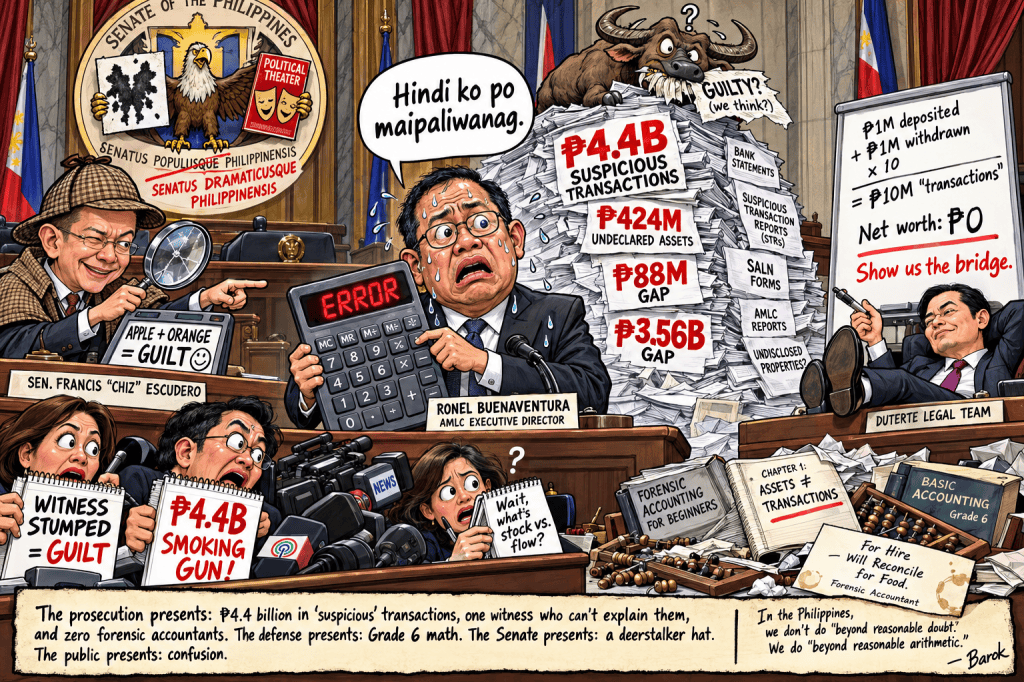
The AMLC’s own executive director admitted he couldn’t reconcile the numbers—and that admission may be the defense’s strongest evidence yet
By Louis ‘Barok’ C Biraogo | October 7, 2026
The Witness Who Knew Too Little
FORGIVE me, I must have skipped the day they taught ‘How to Add Apples and Oranges’ in senator school.
The Anti-Money Laundering Council (AMLC)—the Philippines’ premier financial intelligence agency, the same body armed with subpoena power, transaction monitoring systems, and a statutory mandate to detect dirty money—sent its Executive Director to the Senate impeachment court to explain the most explosive financial evidence in Philippine political history.
And his answer, repeated like a broken prayer, was essentially: “Hindi ko po maipaliwanag.”
Ronel Buenaventura, a career official who presumably passed some examination to run the AMLC Secretariat, stood before the presiding officer of the highest impeachment tribunal in the land and admitted—under oath, no less—that he could not explain why ₱4.4 billion in bank transactions were passing through accounts linked to the Vice President of the Philippines while her sworn Statements of Assets, Liabilities, and Net Worth (SALN) declared a net worth that would barely cover a decent Makati condominium.
This is either the most spectacular institutional failure since the Bureau of Internal Revenue (BIR) lost those Marcos-era tax records, or it’s the most transparent attempt to have a witness testify without actually testifying. Either way, someone should check whether the AMLC’s budget includes a line item for “forensic accountants” or just “people who read raw data aloud.”

The Arithmetic That Would Fail a Remedial Math Class
Here’s where it gets deliciously absurd.
Senator Francis Escudero, playing Sherlock Holmes with a calculator, constructed what he called an “absurd possibility”: add up all of Sara Duterte’s SALN net worth figures from 2022 to 2025—₱336 million—and compare it to the ₱424 million in AMLC-reported transactions for the same period.
The gap: ₱88 million.
For the longer period, 2007 to 2025, the combined SALNs totaled ₱840 million versus ₱4.4 billion in transactions. The gap: ₱3.56 billion.
Gasp. The math is undeniable. Except—and this is the part that would get you failed in Accounting 101—you cannot add stock figures and compare them to flow figures.
Let me explain this like I’m talking to a senator who should know better.
A SALN reports your net worth at a specific moment in time. Think of it as a photograph of your bank account on December 31. A bank transaction is movement—money entering and leaving your account. Think of it as a video of every deposit and withdrawal you made all year.
If I deposit ₱1 million and withdraw it, then deposit it again and withdraw it again, ten times in a year, my bank statement shows ₱10 million in transactions. My net worth is still zero. My SALN correctly reports zero.
Escudero’s “absurd possibility” is not a legal argument. It’s a parlor trick. And the media swallowed it like a hungry carabao at a rice paddy.
The AMLC’s Dirty Little Secret: Suspicious ≠ Illegal
Here’s what the headlines won’t tell you: a Suspicious Transaction Report (STR) is not a finding of criminality. It is a compliance mechanism. Banks file them for countless reasons: transactions disproportionate to a client’s profile, absence of underlying legal obligation, unusual patterns, structuring, or simply because the bank’s algorithm got nervous.
Under Republic Act No. 9160 (Anti-Money Laundering Act of 2001), a transaction can be “suspicious” without being illegal. A lawyer receiving a large retainer? Suspicious. A businessman importing goods from China? Suspicious. A politician’s spouse with a corporate account? Suspicious.
Buenaventura himself admitted this. The AMLC records do not prove money laundering. They prove that banks filed reports. That’s it.
So when the prosecution waves ₱4.4 billion in “suspicious transactions,” what they’re actually waving is a pile of raw data that has not been analyzed, reconciled, or contextualized. It’s like presenting a hospital’s entire inventory of surgical instruments and declaring, “Look at all these knives! Someone must have been stabbed!”
The Stock vs. Flow Disaster: A Forensic Accounting Horror Story
Let’s do the math the prosecution refuses to do.
Between 2022 and 2025, the AMLC reported approximately ₱1.63 billion in inflows and ₱1.31 billion in outflows—a net difference of ₱320 million. But even that net figure is misleading, because the same money can move multiple times.
If ₱50 million enters Account A, moves to Account B, then to Account C, then back to Account A, the gross transaction volume is ₱200 million. The underlying economic asset is still ₱50 million.
This is not a technicality. This is the difference between evidence and innuendo.
The prosecution’s implicit argument is: “Even if Duterte saved every peso of her declared wealth, the numbers don’t match.” But this assumes that all transactions represent income. They don’t. They represent movement—loans, repayments, business receipts, inter-account transfers, asset sales, investment proceeds, and God knows what else.
To prove unexplained wealth under Republic Act No. 1379 (Forfeiture of Unlawfully Acquired Property), the prosecution must establish three things:
- The offender is a public officer.
- They acquired considerable property during incumbency.
- The amount is manifestly out of proportion to their official salary and other lawful income.
Notice what’s missing from the AMLC data: any analysis of lawful income. Any reconciliation of sources and uses. Any determination of beneficial ownership. Any establishment of net position.
Buenaventura admitted he hadn’t seen the SALN. He hadn’t conducted a reconciliation. He hadn’t determined the nature of each transaction. He was testifying purely from raw records—records that, standing alone, prove nothing.
The Cale88 Red Herring
Then there’s Cale88 Foods Corporation, the company reportedly connected to Sara Duterte’s husband, Manases Carpio. The AMLC flagged ₱319.3 million in inward remittances from China and Hong Kong.
The prosecution’s narrative: Chinese money flowing into Duterte-linked accounts.
The reality: A corporation received funds from foreign entities. Corporations are legally distinct from their shareholders. Money entering a corporate account does not automatically become personal income.
Buenaventura himself admitted the AMLC records did not establish how much of Cale88’s transactions personally benefited Duterte or Carpio. The records did not show China, as a country, funneling money to the Vice President.
So what do we have? Foreign-origin transactions. Corporate accounts. Suspicious transaction reports.
What we don’t have: Any proof of illegal purpose. Any evidence of personal benefit. Any connection to the Chinese government.
The defense’s counter-argument is devastatingly simple: “Show us the bridge.” Show us how corporate money became personal wealth. Show us the invoices, the contracts, the bills of lading, the customs records. Show us the dividend declarations, the share transfers, the beneficial ownership structure.
Until then, Cale88 is not evidence of corruption. It’s evidence that a company received money from abroad—which is what import-export businesses do.
The Witness Who Couldn’t Answer: Competence or Caution?
Let me be fair to Buenaventura. Under the Rules of Evidence, a witness can only testify to facts within their personal knowledge. He can authenticate AMLC records. He can explain how transactions were reported. He cannot—and should not—offer legal conclusions about guilt or unexplained wealth.
His repeated “I cannot explain” might actually be appropriate witness discipline, not incompetence.
But here’s the problem: If the AMLC’s own Executive Director cannot explain the evidentiary significance of his agency’s records, why are those records being treated as the centerpiece of an impeachment trial?
The proper witnesses for an unexplained wealth case are not AMLC officials reading raw data. They are forensic accountants who have conducted a reconciliation. They are bank officers who can identify account holders. They are Securities and Exchange Commission (SEC) officials who can trace corporate ownership. They are BIR officials who can verify declared income.
The prosecution’s failure to present such witnesses suggests either incompetence or a deliberate strategy to rely on impressionistic power—the sheer magnitude of ₱4.4 billion—rather than forensic rigor.
The “Others” Explanation: A Defense Worth Taking Seriously
Duterte’s lawyers have argued that cash was included under the SALN’s “others” category rather than explicitly under cash-on-hand or cash-in-bank. Her 2025 SALN reportedly showed ₱16.2 million under “others.”
Is this a valid explanation? Maybe. The SALN form is not a model of clarity. Public officials have long complained about ambiguous categories and inconsistent reporting requirements.
The relevant question is not whether cash was omitted from the SALN. It’s whether the “others” entry can be reconciled with bank records. If ₱16.2 million corresponds to legitimate cash holdings, the defense gains ground. If bank records show tens of millions beyond that amount with no corresponding declaration, the explanation collapses.
This is why forensic reconciliation matters. Without it, we’re left with dueling narratives: the prosecution’s “look at all this money!” versus the defense’s “we reported it under ‘others.’”
Neither is evidence. Both are assertions.
The Political Theater: Everyone Has a Motive
Let’s be honest about the incentives.
The Marcos administration benefits from neutralizing a 2028 rival. The President maintains plausible deniability while his allies in the House and Senate do the heavy lifting.
The House prosecutors want a conviction to establish precedent and demonstrate legislative dominance. A compelling financial narrative—even if technically flawed—serves that goal.
Senator Escudero wants to appear impartial while managing the trial to withstand scrutiny. His “absurd possibility” framing was a media-friendly soundbite, not a forensic conclusion.
The defense wants to create reasonable doubt, expose procedural flaws, and frame the trial as political persecution. Challenging Buenaventura’s competence serves all three objectives.
Buenaventura himself may be motivated by institutional loyalty, personal caution, or subtle resistance to the political use of AMLC data. His repeated refusals to speculate could be read as professional integrity—or as a quiet signal that the evidence doesn’t support the prosecution’s narrative.
Everyone has a motive. Everyone has a strategy. And in the middle of it all, the Filipino public is left trying to decipher financial data that even the experts can’t explain.
The Legal Framework: RA 1379 and the Burden of Proof
Under RA 1379, a prima facie presumption of unlawful acquisition arises when a public officer acquires property manifestly out of proportion to their lawful income. The Supreme Court has consistently held that all three requisites must concur.
But here’s the critical point: the prosecution has not yet established a prima facie case. Comparing cumulative transaction flows to year-end net worth snapshots is not a valid methodology. It’s not even close.
The proper approach requires:
- Establishing total lawful income (salary, business income, inheritance, gifts, investments)
- Comparing it to total accumulated wealth
- Demonstrating that the gap is manifestly disproportionate
None of this has been done. The AMLC data, standing alone, cannot support the inference of unexplained wealth.
Moreover, the defense has raised a constitutional argument: requiring Duterte to explain the gap would improperly shift the burden of proof and violate her right against self-incrimination under Article III, Section 17 of the 1987 Constitution. Under the presumption of innocence, the prosecution must prove guilt—not the accused prove innocence.
This is not a technicality. It’s a fundamental principle of criminal and constitutional law.
The Media’s Complicity: Headlines That Mislead
Let’s talk about the reporting.
The Inquirer: “AMLC exec stumped by gap in Sara Duterte SALN vs bank records.” This headline suggests guilt by confusion—as if Buenaventura’s inability to explain the gap is itself evidence against Duterte.
ABS-CBN: “AMLC director ‘cannot explain’ gap.” Same framing, emphasizing witness helplessness.
Philstar: “Bank Records Show Undeclared Assets.” This is misleading. The records show transactions, not necessarily undeclared assets. An asset is a stock; a transaction is a flow.
The most accurate reporting came from sources that included Buenaventura’s clarification that STRs are not legal conclusions of crime, the distinction between personal and corporate transactions, and the defense’s counter-arguments about business income.
The media’s failure to provide this context is not just sloppy journalism. It’s a disservice to the public, which is being asked to form judgments about an impeachment trial based on headlines that conflate suspicion with guilt.
The Bottom Line: What the Evidence Actually Shows
Let me summarize what we know and what we don’t know.
What we know:
- The AMLC reported ₱4.4 billion in transactions linked to Duterte and Carpio from 2007 to 2025.
- The figure was corrected from an initial ₱6.7 billion after a bank error.
- The transactions include inflows, outflows, and amounts whose direction could not be classified.
- Cale88 Foods Corporation received ₱319.3 million from Chinese and Hong Kong entities.
- Duterte’s SALNs declared net worth figures that appear inconsistent with the transaction volumes.
What we don’t know:
- Whether the transactions represent income, transfers, loans, business receipts, or something else.
- Whether the same money moved multiple times, inflating the gross figure.
- Whether corporate transactions personally benefited Duterte or Carpio.
- Whether the bank balances were actually undeclared assets.
- Whether any of the transactions were illegal.
The prosecution has a legitimate and potentially powerful financial case—but the ₱4.4 billion figure is not itself the proof of unexplained wealth. The strongest argument is narrower: authenticated bank records show identifiable balances materially inconsistent with sworn SALNs, and after accounting for legitimate sources, a substantial residual remains unexplained.
But that argument requires forensic reconciliation. It requires expert testimony. It requires evidence, not innuendo.
The weakest prosecution argument is: “₱4.4 billion transactions > cumulative SALNs, therefore unexplained wealth.” This is mathematically illiterate and legally insufficient.
The strongest defense argument is: “Show us the actual beneficial ownership, actual ending balances, actual sources and uses, eliminate double-counting, separate corporate from personal money, and reconcile the records before calling any residual ‘unexplained wealth.’”
That is the heart of the scandal. Not whether Duterte is guilty or innocent, but whether the prosecution has met its burden of proof.
The Verdict: Not Guilty of Competent Evidence
If I were a senator sitting in judgment, I would not vote to convict based on the evidence presented so far.
Not because Duterte is innocent. Not because the transactions are unremarkable. But because the prosecution has failed to connect the dots. They have presented raw data and asked the Senate to draw inferences that the data cannot support.
The AMLC’s “I cannot explain” is not proof of corruption. It is proof that the prosecution’s evidence is incomplete.
The ₱4.4 billion figure is not a smoking gun. It is a Rorschach test—an ambiguous image onto which both sides project their preferred narratives.
The Cale88 transactions are not evidence of Chinese influence. They are evidence that a company received money from abroad.
The SALN discrepancies are not proof of unexplained wealth. They are proof that the SALN form is confusing and that public officials often fail to report accurately.
None of this means Duterte is clean. It means the prosecution hasn’t proven she’s dirty.
And in a constitutional democracy, that distinction matters. The burden of proof is not a technicality. It is the safeguard that prevents impeachment from becoming a political weapon.
The Senate’s task is not to decide whether the numbers “look bad.” It is to decide whether the prosecution has met the constitutional standard for removal. Based on the evidence presented so far, they have not.
But the trial is not over. The prosecution may yet present the forensic accounting that would transform their raw data into a compelling case. The defense may yet fail to explain transactions that genuinely lack legitimate sources.
Until then, the ₱4.4 billion remains what it has always been: a number in search of a narrative.
And the AMLC’s “I cannot explain” remains what it has always been: an admission that the evidence, standing alone, cannot support the conclusion the prosecution wants the Senate to draw.
Louis ‘Barok’ C Biraogo is the author of Kweba ni Barok, a blog that has been described as “what happens when a lawyer with too much time and too little patience decides to explain Philippine politics to people who should already know better.” He accepts no responsibility for readers who mistake satire for legal advice.
Analysis current as of October 7, 2026. Based on publicly available news reports, legal databases, and official documents. The author has no affiliation with any political party or candidate.
Key Citations
A. Legal & Official Sources
- The 1987 Constitution of the Republic of the Philippines, art. III, secs. 14, 17. Official Gazette of the Republic of the Philippines, 1987, http://www.officialgazette.gov.ph/constitutions/the-1987-constitution-of-the-republic-of-the-philippines/the-1987-constitution-of-the-republic-of-the-philippines-article-iii/.
- Republic Act No. 9160. An Act Defining the Crime of Money Laundering, Providing Penalties Therefor and for Other Purposes (Anti-Money Laundering Act of 2001). Official Gazette of the Republic of the Philippines, 29 Sept. 2001, http://www.officialgazette.gov.ph/2001/09/29/republic-act-no-9160/.
- Republic Act No. 1379. An Act Declaring Forfeiture in Favor of the State Any Property Found to Have Been Unlawfully Acquired by Any Public Officer or Employee and Providing for the Proceedings Therefor. Lawphil Project, 18 June 1955, lawphil.net/statutes/repacts/ra1955/ra_1379_1955.html.
- Republic Act No. 6713. An Act Establishing a Code of Conduct and Ethical Standards for Public Officials and Employees, to Uphold the Time-Honored Principle of Public Office Being a Public Trust, Granting Incentives and Rewards for Exemplary Service, Enumerating Prohibited Acts and Transactions and Providing Penalties for Violations Thereof and for Other Purposes. Lawphil Project, 20 Feb. 1989, lawphil.net/statutes/repacts/ra1989/ra_6713_1989.html.
- Supreme Court of the Philippines. 2019 Amendments to the 1989 Revised Rules on Evidence. A.M. No. 19-08-15-SC, 8 Oct. 2019, https://lawphil.net/courts/rules/am_19-08-15-sc_2019.html.
B. News Reports
- Ager, Maila. “AMLC Exec Stumped by Gap in Sara Duterte SALN vs Bank Records.” INQUIRER.net, 6 Oct. 2026, https://newsinfo.inquirer.net/2318505/amlc-exec-stumped-by-gap-in-sara-duterte-saln-vs-bank-records
- Cahatol, Marilyn. “AMLC Director ‘Cannot Explain’ Gap in Sara Duterte SALNs, Bank Records.” ABS-CBN News, 6 Oct. 2026, https://www.abs-cbn.com/news/nation/2026/10/6/amlc-director-cannot-explain-sara-duterte-saln-amounts-bank-records-1601.
- “Bank Records Show Undeclared VP Assets.” Philstar.com, Philstar Global, 7 Oct. 2026, http://www.philstar.com/headlines/2026/10/07/2561461/bank-records-show-undeclared-vp-assets.
- “Defense: No Proof Sara Duterte, Husband’s Millions Came from Chinese Gov’t.” GMA News Online, GMA Network, 6 Oct. 2026, http://www.gmanetwork.com/news/topstories/nation/1005002/defense-no-proof-sara-duterte-husband-s-millions-came-from-chinese-gov-t/story/.
- Ombay, Giselle. “AMLC: Firm Linked to Sara Duterte’s Husband Got P319M from China, HK.” GMA News Online, GMA Network, 5 Oct. 2026, http://www.gmanetwork.com/news/topstories/nation/1004829/amlc-cale88-received-p319m-from-china-hk/story/.
- Panti, Llanesca T. “AMLC: Sara Duterte, Husband Had P4.4B in Covered, Suspicious Bank Transactions.” GMA News Online, GMA Network, 5 Oct. 2026, http://www.gmanetwork.com/news/topstories/nation/1004801/amlc-sara-duterte-husband-had-p4-4b-in-covered-suspicious-bank-transactions/story/.
- Rita, Joviland. “NSC to Probe Alleged China Money Sent to Sara Duterte-Linked Firm.” GMA News Online, GMA Network, 6 Oct. 2026, http://www.gmanetwork.com/news/topstories/nation/1004904/nsc-to-probe-alleged-china-money-sent-to-sara-duterte-linked-firm/story/.

- ₱9 Billion in ‘Savings’? DILG’s Fire Truck Deal Smells Like Smoke

- ₱8B BBM Pork: CCTV for Every Captain’s Kumpare?

- ₱8.9 Billion, 331 Ghost Police Stations: The TIKAS Scandal Explained

- ₱8.4 Billion, 42,000 Barangays, 1 Election: The “Bawat Barangay Makikinabang” Vote-Buying Masterclass

- ₱75 Million Heist: Cops Gone Full Bandit

- ₱63 to the Dollar: The Only Thing Falling Faster Than the Peso Is the Government’s Credibility

- ₱6.77B Ghost Haunts Duterte: RTC Dismisses Mans Carpio’s Desperate Plea

- ₱6.77 Billion and Zero Cash: The Sara Duterte SALN Math That Doesn’t Add Up

- ₱6.7-Trillion Temptation: The Great Pork Zombie Revival and the “Collegial” Vote-Buying Circus

- ₱58.53B, Zero Receipts: The LGSF Pork Barrel Nobody Wants to Name

- ₱53 Million Man Tells ₱695-a-Day Workers to Stop Being ‘Mayabang’: The Audacity of BSP’s Remolona

- ₱4.4 Billion and a Witness Who Can’t Explain It: The Duterte Impeachment’s Most Expensive Non-Answer







Leave a Reply