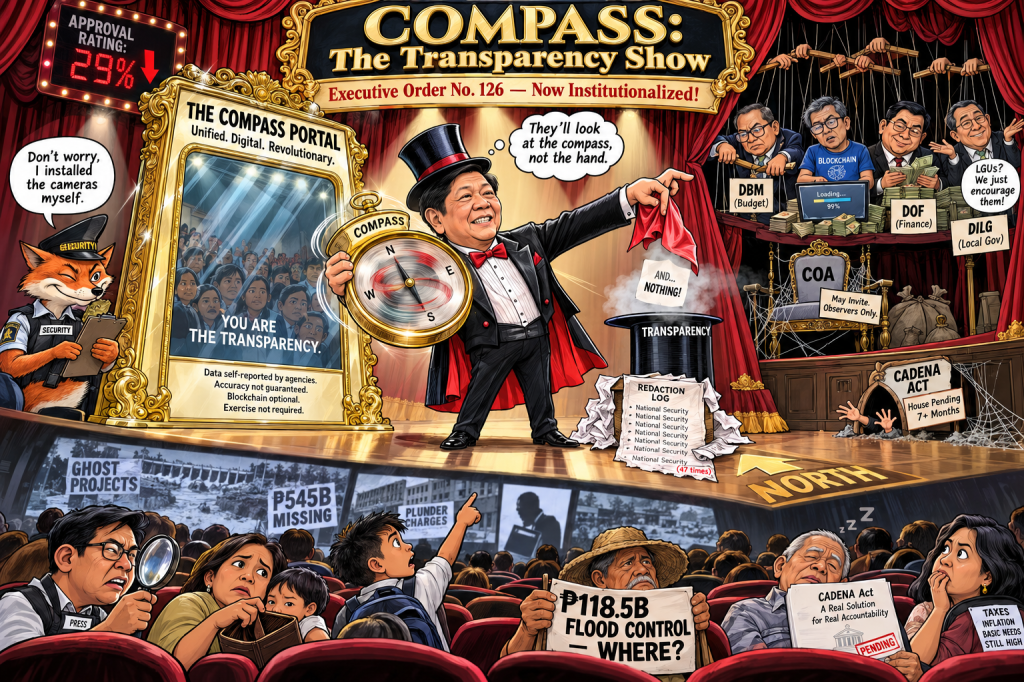
Marcos Institutionalizes a Portal That Sees Everything—And Answers to No One
By Louis ‘Barok‘ C. Biraogo — October 5, 2026
THE Marcos Jr. administration just did something genuinely interesting: it took a glorified spreadsheet and gave it the constitutional weight of an Executive Order.
On September 28, 2026, President Ferdinand Marcos Jr. signed Executive Order No. 126 (EO 126), “institutionalizing” the Department of Budget and Management’s (DBM) Centralized Open Monitoring Platform for Appropriations and Spending Statistics (COMPASS) as the government’s “unified” digital platform for budget transparency. The timing is impeccable. The flood-control scandal has cost the economy an estimated ₱118.5 billion annually from 2023 to 2025. The President’s approval ratings are in freefall—only 29 percent approve of his performance, while 50 percent disapprove. And Congress has been sitting on the Citizen Access and Disclosure of Expenditures for National Accountability (CADENA) Act—a genuine legislative transparency framework—since the Senate passed it 17-0 in December 2025.
So naturally, the Executive branch decided to act alone. With a stroke of a pen. Through an Executive Order that can be undone by the next stroke of a pen.
What EO 126 Actually Does
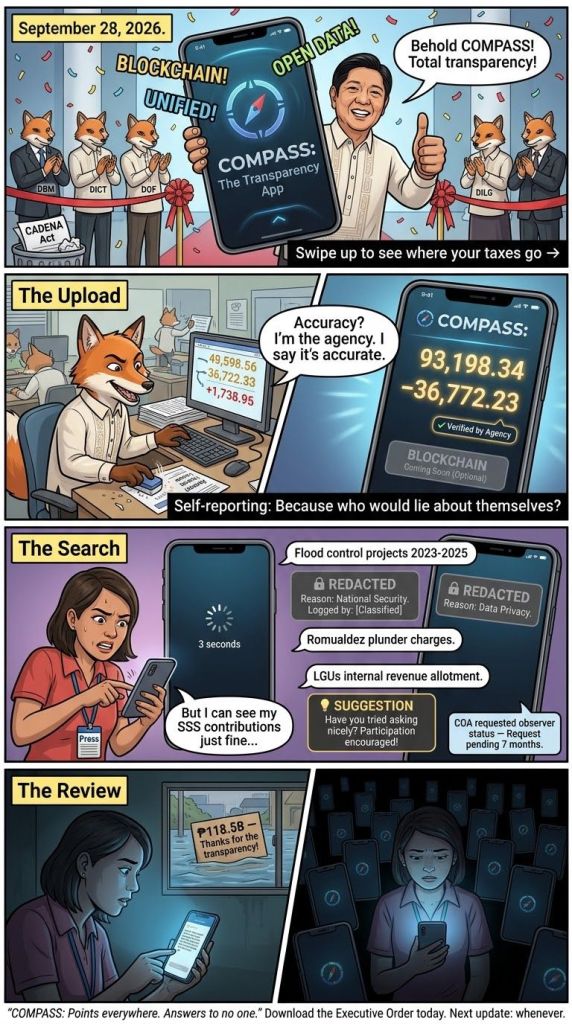
Let’s be clear about what EO 126 actually does. It mandates national agencies, government-owned or -controlled corporations (GOCCs), and government financial institutions (GFIs) to upload data to a portal launched in June 2026. It creates a “COMPASS Council” chaired by the DBM, co-chaired by the Department of Information and Communications Technology (DICT), with the Department of Finance (DOF) and Department of the Interior and Local Government (DILG) as members. It allows the use of blockchain and “distributed ledger technology.” And it “encourages” local government units (LGUs) to participate.
Encourages. LGUs. To participate.
You know, the same LGUs that receive massive internal revenue allotments. The same LGUs that handle a substantial portion of public infrastructure spending. The same LGUs where, if we’re being honest, some of the most creative budget “reallocations” happen. They get a polite suggestion. National agencies get a mandate. That’s not a transparency architecture. That’s a transparency suggestion with a constitutional problem.
Self-Reporting, and Blockchain That Is Only Optional
But wait—it gets better. The EO says agencies “shall be responsible for the accuracy, completeness, and timeliness” of the data they upload. In other words, the DBM is building a platform, but the agencies whose spending we want to track are the ones self-reporting the numbers. This is like asking the fox to install the henhouse security camera. “Garbage in, permanent garbage out”—blockchain just makes the trash immortal.
And speaking of blockchain: the EO permits it, but doesn’t require it. This is the technological equivalent of saying you “may” exercise. It sounds forward-thinking without committing to anything. If the DBM wanted to actually prevent tampering, it would mandate cryptographic verification at the source. Instead, we get a permissive clause that lets the administration claim “innovation” while doing nothing structurally different from uploading PDFs to a server.
A Council That Polices Itself
The COMPASS Council is a masterclass in executive self-policing. The DBM chairs it. DICT co-chairs. DOF and DILG sit on it. The Commission on Audit (COA)—the constitutional body with the actual audit power—is conspicuously absent from the Council’s membership. The EO says the Council “may invite” COA, Congress, the Judiciary, and civil society as “observers or technical advisers.” May. Invite. Observers. This is the constitutional equivalent of being CC’d on an email you can’t respond to.
Meanwhile, the EO explicitly exempts information that could “compromise national defense and security” or “violate Republic Act No. 10173 (Data Privacy Act of 2012).” Both are legitimate categories. Both are also the exact categories that have historically been stretched into meaninglessness by administrations that don’t want to disclose something embarrassing. The EO does require a “redaction log” indicating the legal basis for withholding. That’s a genuine improvement. But a log that says “national security” without any independent verification is just a more bureaucratic way of saying “trust us.”
Formal Transparency, Thin Accountability
Now, to be fair: COMPASS does represent progress. The Philippines ranked #1 in Asia in budget transparency per the 2025 Open Budget Survey, with a score of 76 out of 100. Yet corruption perceptions remain abysmal. The paradox isn’t lost on anyone. A centralized portal that lets citizens trace funds from appropriation to disbursement—if it actually works—could close the gap between formal transparency and actual accountability. The integration with the Philippine Government Electronic Procurement System (PhilGEPS), the Budget and Treasury Management System (BTMS), and the Integrated Financial Management Information System (IFMIS) is technically sound in principle. The interagency coordination is better than nothing.
But here’s the fundamental problem: an Executive Order is not a law. It is a policy directive that the next administration can reverse, modify, or simply ignore. The research materials are right to highlight that CADENA—the actual legislative framework—remains stuck in the House despite passing the Senate unanimously. Why pass a law when you can claim credit for an EO? Why subject yourself to congressional scrutiny when you can create a Council that you control?
CADENA, Still Waiting on the House
Senator Bam Aquino, the principal author of CADENA, has been prodding the House for seven months to act on the measure. He noted that CADENA was previously ranked third among Legislative-Executive Development Advisory Council (LEDAC) priority measures but has since dropped to 41st. The signal is unmistakable: the administration would rather have an executive-controlled transparency mechanism than a legislatively-mandated one with teeth.
Executive Secretary Ralph Recto said “Every peso comes from the people. They should be able to see where it goes.” That’s a lovely sentiment. It’s also the exact same sentiment that every administration since EDSA (the 1986 People Power Revolution) has expressed. The question isn’t whether this administration believes in transparency. The question is whether it believes in binding, irreversible, institutionally-enforced transparency—or whether it believes in transparency that it controls, that it can shape, and that it can quietly starve of resources when the news cycle moves on.
The EO requires implementing guidelines within 60 days. That’s where the real fight will be. Data standards. Timelines. Enforcement mechanisms. Whether the “redaction log” has teeth. Whether agencies that fail to upload get sanctioned or just get a sternly worded memo. Whether the platform actually connects legislative budget revisions—not just the final General Appropriations Act—to the public record. Because if COMPASS only shows us what the executive wants us to see, from the executive’s own systems, verified by the executive’s own Council, then we haven’t built an accountability infrastructure. We’ve built a very sophisticated press release.
The Flood-Control Test
The flood-control scandal is the test. Billions allegedly siphoned through ghost projects and inflated contracts. Former House Speaker Martin Romualdez—the President’s cousin—now faces plunder charges over alleged bribes and anomalous budget insertions totaling ₱7.4 billion. If COMPASS can’t help journalists, auditors, and citizens trace a single questionable flood-control project from appropriation to payment to physical non-existence, then it’s theater. Beautiful, blockchain-enabled, executive-sanctioned theater.
The President said COMPASS “points the way forward.” But a compass doesn’t tell you where to go. It just tells you which way is north. The direction—and whether anyone actually follows it—is a decision. And so far, this administration has decided to point north with one hand while keeping the other hand firmly on the wheel.
Key Citations
A. Legal & Official Sources
- The 1987 Constitution of the Republic of the Philippines, Article IX-D. Official Gazette of the Republic of the Philippines, 1987, http://www.officialgazette.gov.ph/constitutions/the-1987-constitution-of-the-republic-of-the-philippines/the-1987-constitution-of-the-republic-of-the-philippines-article-ix/.
- Executive Order No. 126. Institutionalizing the Centralized Open Monitoring Platform for Appropriations and Spending Statistics (COMPASS) Portal as the Unified Digital Platform for Government Budget and Expenditure Disclosures. Official Gazette of the Republic of the Philippines, 28 Sept. 2026, http://www.officialgazette.gov.ph/2026/09/28/executive-order-no-126-s-2026/.
- Republic Act No. 10173. An Act Protecting Individual Personal Information in Information and Communications Systems in the Government and the Private Sector, Creating for This Purpose a National Privacy Commission, and for Other Purposes (Data Privacy Act of 2012). Official Gazette of the Republic of the Philippines, 15 Aug. 2012, http://www.officialgazette.gov.ph/2012/08/15/republic-act-no-10173/.
- Republic Act No. 7160. An Act Providing for a Local Government Code of 1991. Official Gazette of the Republic of the Philippines, 10 Oct. 1991, http://www.officialgazette.gov.ph/1991/10/10/republic-act-no-7160/.
- Republic Act No. 7640. An Act Constituting the Legislative-Executive Development Advisory Council. 1992, lawphil.net/statutes/repacts/ra1992/ra_7640_1992.html.
- Senate Bill No. 1506. An Act Mandating the Full Disclosure of Government Transactions Through the Establishment of a Digital Budget Portal to Enhance Transparency, Accountability, and Public Participation in the Philippine Budget Process (CADENA Act). Senate of the Philippines, approved on third reading 15 Dec. 2025, legacy.senate.gov.ph.
- “Philippines.” Open Budget Survey 2025. International Budget Partnership, 2025, http://www.internationalbudget.org/open-budget-survey/country-results/2025/philippines.
B. News Reports
- Basilio, Kenneth Christiane L. “Senate Passes Bill Creating Digital Budget Portal to Boost Spending Transparency.” BusinessWorld Online, 15 Dec. 2025, http://www.bworldonline.com/the-nation/2025/12/15/718998/senate-passes-bill-creating-digital-budget-portal-to-boost-spending-transparency/.
- “Lacson: P118.5B Economic Loss from Ghost Flood Projects a Bigger Crime if Culprits Remain Unpunished.” Senate of the Philippines, 3 Sept. 2025, legacy.senate.gov.ph/press_release/2025/0903_lacson1.asp.
- Mateo, Janvic. “More Pinoys Disapprove of, Distrust Marcos – Pulse.” Philstar.com, 21 July 2026, http://www.philstar.com/headlines/2026/07/21/2543522/more-pinoys-disapprove-of-distrust-marcos-pulse.
- “‘7 Months Pending’: Bam Aquino Prods House to Pass CADENA Budget Bill.” Manila Bulletin, 22 Aug. 2026, mb.com.ph/2026/08/22/7-months-pending-bam-aquino-prods-house-to-pass-cadena-budget-bill.
- Balagtas See, Aie. “Marcos Kin Arrested in Philippines Kickbacks Case.” The New York Times, 7 Sept. 2026, http://www.nytimes.com/2026/09/07/world/asia/philippines-romualdez-arrest-kickbacks.html.
- Presidential Communications Office. “President Marcos Institutionalizes COMPASS Portal to Boost Transparency in Gov’t Spending.” 29 Sept. 2026, pco.gov.ph/news_releases/president-marcos-institutionalizes-compass-portal-to-boost-transparency-in-govt-spending/.

- ₱8B BBM Pork: CCTV for Every Captain’s Kumpare?

- ₱8.9 Billion, 331 Ghost Police Stations: The TIKAS Scandal Explained

- ₱8.4 Billion, 42,000 Barangays, 1 Election: The “Bawat Barangay Makikinabang” Vote-Buying Masterclass

- ₱75 Million Heist: Cops Gone Full Bandit

- ₱6.77B Ghost Haunts Duterte: RTC Dismisses Mans Carpio’s Desperate Plea

- ₱6.77 Billion and Zero Cash: The Sara Duterte SALN Math That Doesn’t Add Up

- ₱6.7-Trillion Temptation: The Great Pork Zombie Revival and the “Collegial” Vote-Buying Circus

- ₱58.53B, Zero Receipts: The LGSF Pork Barrel Nobody Wants to Name
- ₱53 Million Man Tells ₱695-a-Day Workers to Stop Being ‘Mayabang’: The Audacity of BSP’s Remolona

- ₱3.06 Billion for Evacuation Centers—But Nobody Knows Where They’ll Stand (Or If They’ll Exist)
- ₱10B Ghost in New Clark City: Matibag’s Haunted Séance for Cayetano

- ₱1.9 Billion for 382 Units and a Rooftop Pool: Poverty Solved, Next Problem Please





Leave a comment