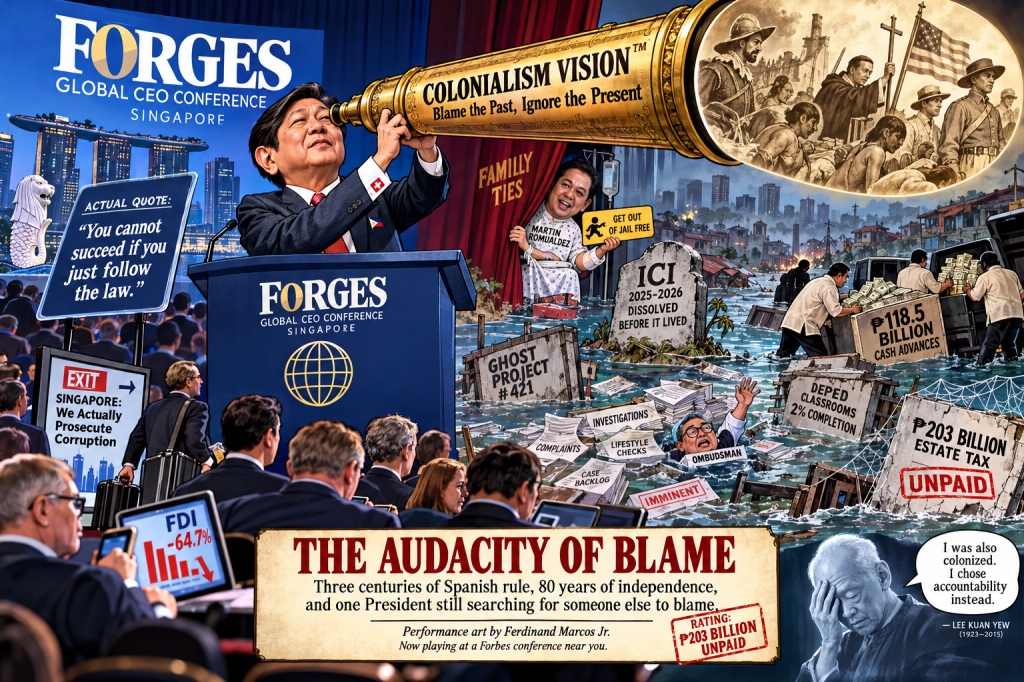
Three centuries of Spanish rule, eighty years of independence, and one President still searching for someone else to blame
By Louis “Barok” C. Biraogo | October 11, 2026
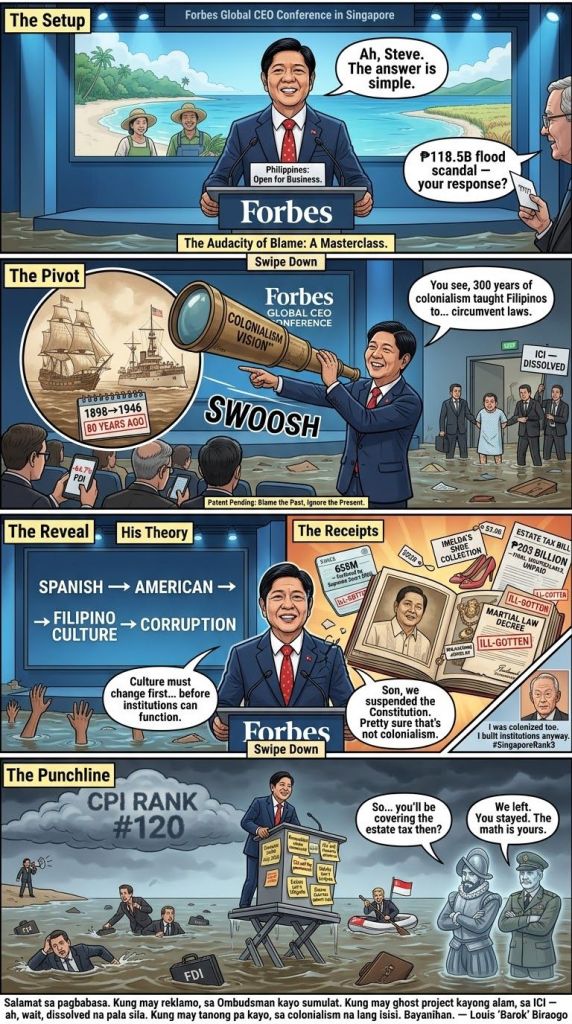
SINGAPORE — President Ferdinand “Bongbong” Marcos Jr. stood before the assembled captains of global capital at the Forbes Global CEO Conference last week and delivered what can only be described as the most breathtaking act of rhetorical jiu-jitsu in recent Philippine political history.
Asked by Steve Forbes about the multi-billion-peso flood control scandal that has submerged his administration in controversy, the President did not talk about accountability. He did not talk about the Ombudsman’s investigations. He did not talk about the 421 ghost projects or the ₱118.5 billion allegedly funneled into nonexistent flood control infrastructure while Filipino communities drowned.
Instead, he blamed the Spanish.
And the Americans. And three centuries of colonialism that apparently taught Filipinos to “find ways to get around the law because you cannot succeed if you just follow the law.”
Let that sink in for a moment.
The son of the man whose 21-year kleptocracy remains the gold standard for post-colonial plunder — a family whose ill-gotten wealth is still the subject of active forfeiture proceedings, whose Swiss deposits were ordered returned to the Philippine government, whose matriarch was convicted (later overturned on appeal) of seven counts of graft — stood before global investors and suggested that colonialism is why corruption persists in the Philippines.
This is not analysis. This is not governance. This is performance art of the highest order, executed with the straight-faced audacity of a man who knows his audience has short memories and his family has good lawyers.
The Colonialism Defense: A Legal and Historical Farce
Let us examine the President’s thesis with the rigor it deserves — which is to say, with the rigor of a first-year law student who actually attended class.
Marcos posits that “300 plus years” as second-class citizens under Spanish and American rule created a cultural predisposition to circumvent the law. The implication is clear: corruption is not a governance failure but a historical inheritance, a national character flaw bequeathed by colonizers and now impossible to shake without a generational cultural transformation.
There are several problems with this argument, any one of which should disqualify it from serious consideration by anyone who has ever read a history book or an audit report.
First, colonialism ended in 1946. That was 80 years ago. In that time, the Philippines has had the opportunity to build institutions, reform procurement systems, strengthen the Ombudsman, and prosecute corrupt officials. It has had multiple constitutions — including one drafted in 1987 explicitly designed to prevent the kind of kleptocracy Marcos Sr. perfected. The persistence of corruption is not a colonial hangover. It is a contemporary political choice, made and remade by each successive administration, including this one.
Second, if colonialism is the root cause, why have other post-colonial states managed to build functional, relatively corruption-free institutions? Singapore — where Marcos delivered these remarks — was also colonized by the British. It is now ranked third in Transparency International’s Corruption Perceptions Index (CPI). Botswana, Rwanda, Georgia — all post-colonial states that have made substantial progress in governance. The colonialism explanation does not explain variance. It explains nothing except the President’s desire to avoid explaining anything.
Third, and most damning, the Marcos family itself is the most spectacular beneficiary of the very system the President now blames on colonialism. Ferdinand Marcos Sr. did not merely “find ways around the law” because he was a second-class citizen. He suspended the Constitution, declared martial law, jailed his opponents, and used state power to expropriate private businesses and funnel billions into accounts in Switzerland, New York, and Panama.
The Supreme Court of the Philippines found that Ferdinand and Imelda Marcos accumulated between $5 billion and $10 billion during their time in power, against a combined lawful income of approximately $304,000. The Supreme Court’s 2003 ruling in Republic of the Philippines v. Sandiganbayan (G.R. No. 152154) ordered the forfeiture of $658 million in Swiss deposits, finding they were “manifestly and grossly disproportionate” to their salaries as public officials. Subsequent rulings ordered the forfeiture of the Arelma assets, the Malacañang jewelry collection, and paintings worth $17 million.
This is the man lecturing global investors about cultural change.
The Flood Control Scandal: A Case Study in Selective Accountability
While the President was in Singapore refining his colonialism thesis, the actual mechanics of the flood control scandal continued their grinding, depressing march through Philippine institutions.
The scale of the alleged fraud is staggering. The Independent Commission for Infrastructure (ICI), created by executive order in September 2025 and unceremoniously dissolved in March 2026, investigated what it could before its sunset clause expired. The Ombudsman has over 200 cases under investigation, with 35 already filed. Senator Panfilo Lacson has identified ₱3.7 billion in questionable flood control projects in Taguig City alone.
And at the center of it all sits former House Speaker Martin Romualdez — the President’s first cousin — who the Ombudsman has described as “the central figure in a scheme built on the diversion of public funds meant for flood control projects.”
The political calculus here is exquisite in its cruelty. Prosecuting Romualdez would demonstrate that no one is above the law, but it would fracture the Marcos family’s political base and expose the dynastic networks that have sustained the administration. Protecting him would confirm what critics have alleged from the start: that accountability in the Philippines is a function of surname and political utility, not evidence and law.
Marcos has said that cases against Romualdez are “imminent.” That was in July 2026. It is now October. The cases remain imminent, in the way that housing for informal settlers remains imminent, in the way that flood control projects remain imminent — as promises perpetually deferred, always just beyond the horizon of accountability.
The arrest warrant was finally served on Romualdez on September 7, 2026, at a hospital in Metro Manila where he had been admitted for a cardiovascular ailment. The timing — two months after Marcos’s State of the Nation Address (SONA) promise, hours after the Ombudsman filed the plunder case — suggests that the wheels of justice move at the speed of political convenience.
Meanwhile, the Palace has been busy redirecting attention to the Duterte administration’s flood control projects, with Press Officer Claire Castro noting that 13,970 projects were reported completed as of March 2022 and deserve scrutiny. This is a legitimate point — corruption did not begin in July 2022. But it is also a transparent deflection, an attempt to reframe the current scandal as a bipartisan failure rather than a continuing crisis that this administration has failed to resolve.
The Investor Confidence Paradox
The setting of Marcos’s remarks — a Forbes conference in Singapore, the financial capital of a country that has made governance its competitive advantage — was not accidental. The President was there to reassure investors that the Philippines is open for business, that the macroeconomic fundamentals are sound, that the regulatory environment is predictable.
The data suggests investors are not convinced.
Foreign direct investment (FDI) net inflows plunged to $210 million in May 2026, a 64.7 percent contraction year-on-year and the lowest monthly level in over 11 years. Total FDI for the first five months of 2026 reached $2.18 billion, down 33.4 percent from the same period in 2025.
The Bangko Sentral ng Pilipinas (BSP) attributes this to lower investments in debt instruments and reduced reinvestment of earnings. But the timing is difficult to ignore. The flood control scandal broke in 2025, metastasized through 2026, and has now become a defining narrative of the Marcos administration. Investors are not merely responding to interest rate differentials; they are pricing in governance risk.
And governance risk, in the Philippines, has a name and a face and a family tree.
When Marcos tells investors that corruption is a cultural problem rooted in colonialism, he is inadvertently confirming their worst fears: that the problem is systemic, that it is deeply embedded, that it will not be solved by a few prosecutions or a new procurement law or a digital dashboard. He is telling them that the Philippines is a country where the rules are optional, where the powerful are protected, where the rot goes all the way to the top.
This is not a reassuring message.
The Ombudsman and the Limits of Institutional Independence
To be fair — and I use that phrase with considerable reluctance — the Ombudsman has been active. Cases have been filed. Investigations continue. The Office of the Ombudsman, under Jesus Crispin Remulla, has shown a willingness to pursue high-profile targets that has occasionally surprised observers.
But institutional independence is not merely about filing cases. It is about filing the right cases, against the right people, with the right evidence, and seeing them through to conclusion regardless of political pressure. The Ombudsman’s record on this front is mixed.
The ICI, for all its promise, was dissolved after six months, having investigated only a fraction of its 10-year mandate. Its commissioners resigned. Its recommendations remain recommendations. And the legislation that would create a permanent, independent anti-corruption body with subpoena powers and contempt authority remains pending in Congress, where it has been pending for years.
This is not institutional reform. This is institutional theater — the appearance of action without the substance of accountability.
The Cultural Argument: A Convenient Excuse
There is a kernel of truth in Marcos’s cultural argument. Corruption in the Philippines is not merely a legal problem; it is a social practice, embedded in patron-client relationships, normalized through everyday interactions, sustained by the expectation that officials will extract rents and citizens will pay them.
But this is not an explanation. It is a description. And it is a description that conveniently absolves those with the power to change the system.
Culture is not immutable. It is shaped by incentives, by enforcement, by the visible consequences of wrongdoing. When officials see their colleagues prosecuted, their assets seized, their careers destroyed, culture changes. When they see their superiors protected, their allies promoted, their crimes forgotten, culture calcifies.
Marcos’s cultural argument inverts the causality. It suggests that culture must change before institutions can function. The reality is the opposite: institutions must function — consistently, impartially, without fear or favor — before culture can change.
Singapore did not become Singapore because its people underwent a cultural transformation. It became Singapore because Lee Kuan Yew built institutions that made corruption costly and competence rewarded. The culture followed.
The Final Assessment: What Marcos Did Not Say
The most revealing aspect of Marcos’s Singapore performance is what he did not say.
He did not say that his cousin, Martin Romualdez, would be prosecuted regardless of family ties.
He did not say that the ICI would be reconstituted with permanent status and genuine independence.
He did not say that the Ombudsman would be given the resources and political cover to pursue cases wherever the evidence leads.
He did not say that his own family’s ill-gotten wealth — the Swiss deposits, the Arelma assets, the jewelry, the paintings — would be returned without further litigation and delay.
He did not say any of the things that would actually reassure investors, because saying them would require doing them, and doing them would threaten the political and familial networks that sustain his administration.
Instead, he offered a history lesson. He blamed colonialism. He talked about changing culture. He invoked “the corrosive effect and influence of corruption” as if it were a natural phenomenon, like typhoons or earthquakes, rather than a set of choices made by identifiable people with identifiable names and identifiable bank accounts.
The estate tax alone — the deficiency assessment against the Marcos estate that the Supreme Court declared final and unappealable in 1997 — amounted to ₱23.29 billion. That figure has since ballooned to over ₱203 billion with interest, surcharges, and penalties. The family has not paid it. The government has not collected it. But the President of the Philippines is worried about cultural transformation.
This is the audacity of the Marcos dynasty: to inherit the fruits of plunder, to preside over its continuation, and then to lecture the world about the cultural roots of corruption.
The Philippines’ corruption ranking fell to 120th out of 182 countries in 2025, its lowest score since the current methodology was adopted in 2012. The ghost flood control projects remain ghost projects. The communities they were meant to protect remain vulnerable. The ₱118.5 billion remains unaccounted for.
And the President of the Philippines, standing before the world’s business elite, has offered the most creative explanation yet for why nothing can be done: the Spanish did it.
Salamat sa pagbabasa. Kung may reklamo, sa Ombudsman kayo sumulat. Kung may ghost project kayong alam, sa ICI — ah, wait, dissolved na pala sila. Kung may tanong pa kayo, sa colonialism na lang isisi. Bayanihan..
Key Citations
A. Reports & Studies
- Transparency International. Corruption Perceptions Index 2025. Transparency International, 2026.
- Transparency International. “Corruption Perceptions Index 2025: Stalling Anti-Corruption Progress.” Transparency.org, 10 Feb. 2026.
- Corrupt Practices Investigation Bureau. “2025 TI CPI: Singapore Maintains Global Third Spot and Top Position in Asia Pacific.” Corrupt Practices Investigation Bureau, 10 Feb. 2026.
- Bangko Sentral ng Pilipinas. Foreign Direct Investments. Bangko Sentral ng Pilipinas, 2026.
B. News Articles
- Romero, Alexis. “Marcos Quizzed on Corruption by Global Investors.” The Philippine Star, 9 Oct. 2026.
- “FDI Inflows Plunge to 11-Year Low in May.” The Philippine Star, 11 Aug. 2026.
- Balagtas See, Aie. “Philippines Lawmaker, Cousin of Marcos, Charged With Taking Kickbacks.” The New York Times, 7 Sept. 2026.
- Galvez, Daphne. “SC Reverses Imelda’s Conviction for Graft.” The Philippine Star, 10 Sept. 2026.
- Mendoza, John Eric. “ICI’s Work on Flood Mess Ends March 31.” Philippine Daily Inquirer, 14 Mar. 2026.
- “Philippines Falls in Corruption Index, among Worst in SEA.” The Philippine Star, 12 Feb. 2026.
C. Legal & Official Sources
- Republic of the Philippines v. Sandiganbayan (Special First Division), Ferdinand E. Marcos, and Imelda Romualdez Marcos. G.R. No. 152154, Supreme Court of the Philippines, 18 Nov. 2003. Lawphil Project, Arellano Law Foundation, https://lawphil.net/judjuris/juri2003/nov2003/gr_152154_2003.html.
- Ferdinand R. Marcos II v. Court of Appeals. G.R. No. 120880. Supreme Court of the Philippines, 5 June 1997.
- “The 1987 Constitution of the Republic of the Philippines.” Official Gazette, 1987.
- Office of the Ombudsman. Official Website. Republic of the Philippines.
- ₱8B BBM Pork: CCTV for Every Captain’s Kumpare?

- ₱8.9 Billion, 331 Ghost Police Stations: The TIKAS Scandal Explained

- ₱8.4 Billion, 42,000 Barangays, 1 Election: The “Bawat Barangay Makikinabang” Vote-Buying Masterclass

- ₱75 Million Heist: Cops Gone Full Bandit

- ₱6.77B Ghost Haunts Duterte: RTC Dismisses Mans Carpio’s Desperate Plea

- ₱6.77 Billion and Zero Cash: The Sara Duterte SALN Math That Doesn’t Add Up

- ₱6.7-Trillion Temptation: The Great Pork Zombie Revival and the “Collegial” Vote-Buying Circus

- ₱58.53B, Zero Receipts: The LGSF Pork Barrel Nobody Wants to Name
- ₱53 Million Man Tells ₱695-a-Day Workers to Stop Being ‘Mayabang’: The Audacity of BSP’s Remolona

- ₱4.4 Billion and a Witness Who Can’t Explain It: The Duterte Impeachment’s Most Expensive Non-Answer
- ₱3.06 Billion for Evacuation Centers—But Nobody Knows Where They’ll Stand (Or If They’ll Exist)
- ₱16 Billion, 280 Accounts, 8 Helicopters: Boying Remulla’s Case Against the Yaps Is Not a Drill




Leave a Reply