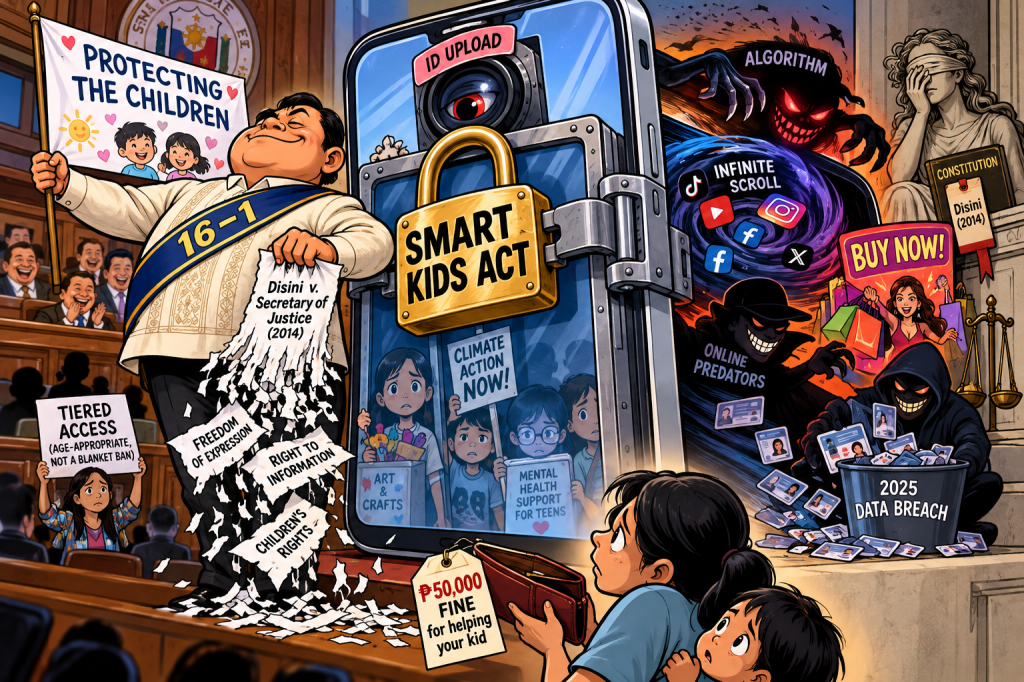
Senate Bill No. 2424, or How the Philippine Senate Decided That the Best Way to Protect Kids Online Was to Do the One Thing the Supreme Court Has Repeatedly Said You Cannot Do
By Louis ‘Barok‘ C. Biraogo — October 10, 2026
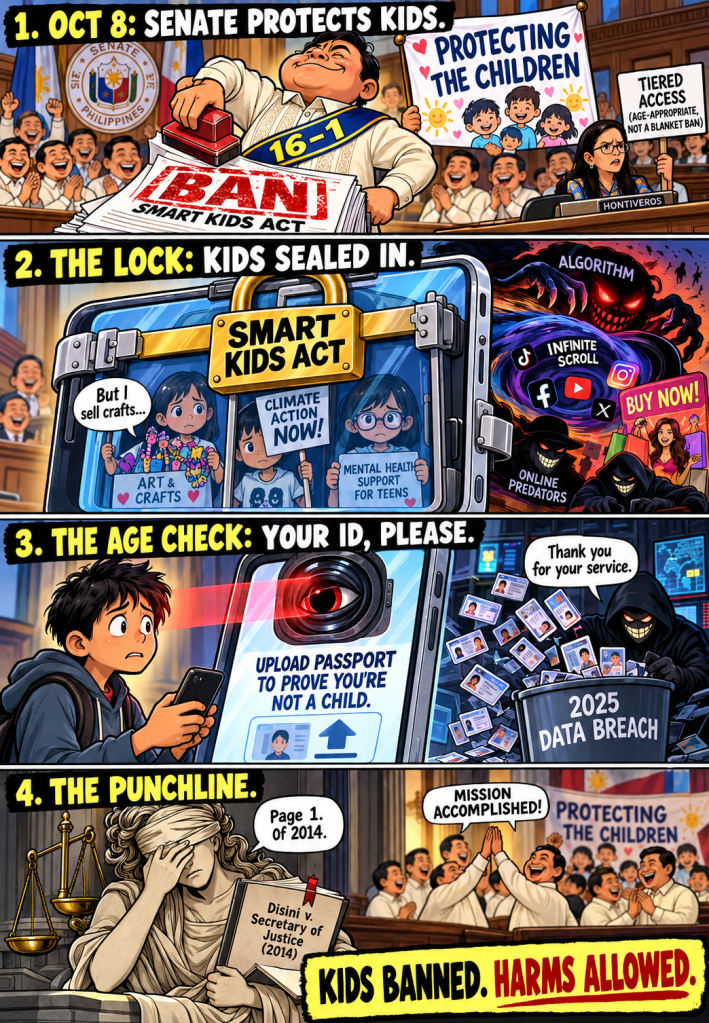
THE Philippine Senate has done it again. In a move that combines the moral clarity of a campaign ad with the constitutional sophistication of a bar exam fail, sixteen senators voted on October 8 to ban everyone under 18 from social media platforms. The bill—the charmingly acronymed Senate Bill No. 2424 (Safe Media Access and Responsible Technology for Kids in Digital Spaces Act, or the SMART KIDS Act)—was sponsored by Senator Robin Padilla, who apparently believes that the same legislative instincts that brought us his constitutional amendment crusades can now solve the youth mental health crisis through the time-honored technique of pretending the internet doesn’t exist.
One senator voted against it. Risa Hontiveros, who has spent her career actually passing child protection laws that work, had the audacity to suggest that maybe—just maybe—a blanket ban on 20 million Filipinos might not be the best approach. For this, she was rewarded with a 16–1 vote and the privilege of watching her colleagues pat themselves on the back for “protecting the children”.
Let’s be clear about what happened here. The Senate didn’t pass a child protection law. It passed a constitutional crisis waiting to happen, wrapped in the warm blanket of parental anxiety.
The Law of Unintended Consequences, Philippine Edition
The bill’s core provisions are simple enough:
- No one under 18 gets a social media account.
- Platforms must implement “effective age-assurance measures.”
- Parents who help their kids circumvent the ban face fines of up to ₱50,000.
- The definition of “high-risk digital services” is left conveniently vague—the better to expand later, my dear.
What could possibly go wrong?
Let’s start with the obvious: the Philippine Supreme Court has already struck down a nearly identical scheme. In Disini v. Secretary of Justice (2014), the Court invalidated Section 19 of Republic Act No. 10175 (Cybercrime Prevention Act of 2012)—the notorious “takedown clause”—because it allowed the government to restrict or block access to computer data without judicial warrant. The Court called it what it was: an unconstitutional prior restraint that “ensures that all computer data will automatically be subject to the control and power of the Department of Justice”.
Sound familiar? The SMART KIDS Act mandates that platforms “suspend, restrict, disable, or remove” accounts “reasonably determined” to belong to minors. No judicial warrant. No notice and hearing. No meaningful appeal mechanism. Just a platform’s algorithmic guess and a government mandate to erase lawful speech.
The Court in Disini was explicit:
“Any law or official that requires some form of permission to be had before publication can be made, commits an infringement of the constitutional right”. And while a social media account is not a newspaper, the principle is the same: you cannot remove a person from a channel of lawful expression without due process.
The Senate apparently didn’t read that part.
The Age Verification Trap: Because Nothing Says “Privacy” Like Uploading Your Face to Mark Zuckerberg
Now let’s talk about the age-assurance measures, which is polite legislative language for “we have no idea how this works but we’re going to mandate it anyway.”
The bill requires platforms to implement “effective age-assurance measures” including—according to the legislative debates—government-issued identification verification. For hundreds of millions of users worldwide, this has meant facial age estimation: you stare into your phone camera, a third-party vendor like Yoti estimates whether you’re over 18, and if the algorithm guesses wrong, you’re locked out until you upload a passport or government ID.
What could possibly go wrong?
Well, for starters, facial age estimation is not the privacy-preserving miracle its vendors claim. A selfie captures not just your face but your surroundings—potentially your bedroom, your school uniform, your location. The data trail extends well beyond the initial scan: logs of who was checked, when, and what method was used can be retained indefinitely for “compliance” purposes. And when you’re a minor who fails the check, you’re pushed toward uploading government ID—which means handing your most sensitive personal information to a private company with unclear security practices.
This isn’t hypothetical. In October 2025, hackers breached a third-party verification vendor and exposed over 70,000 user IDs and personal documents from users who had been flagged as underage and uploaded their IDs on appeal. That’s the future the SMART KIDS Act is building: a nationwide honeypot of children’s identity documents.
The National Privacy Commission (NPC) has issued guidelines on child-oriented transparency, emphasizing data minimization and risk-based assessments. Those guidelines exist precisely because the government knows—or should know—that age verification creates privacy risks. Mandating it for every social media user in the country, without specifying safeguards in the statute itself, is the opposite of responsible regulation.
The Philippine Supreme Court Already Told You This Was Unconstitutional
Let’s return to Disini, because it’s the case the Senate apparently forgot to read.
The Court invalidated the takedown clause not because it was “too harsh” or “inconvenient,” but because it failed basic constitutional requirements: it lacked judicial oversight, defined standards, and procedural safeguards. The Court warned that the provision “hampers the possibility of free speech and expression through the internet” and that the “sheer possibility that the State has the ability to unilaterally decide” what content to remove chills expression.
The SMART KIDS Act does exactly this, but broader. Instead of targeting specific illegal content, it targets an entire class of users—all minors—and mandates their removal from platforms without any individual determination of wrongdoing. A 17-year-old using TikTok to sell handmade crafts? Banned. A 16-year-old activist organizing a school walkout? Banned. A 15-year-old abuse survivor finding support in an online community? Banned, because the algorithm guessed her age correctly.
Chavez v. Gonzales (2008) reinforced this principle: restrictions on expression must survive the clear and present danger test if content-based, or intermediate scrutiny if content-neutral. A blanket ban on an entire age group’s access to communication platforms is neither narrowly tailored nor the least restrictive means. The government has a compelling interest in protecting children—nobody disputes that—but “protecting children” is not a magic phrase that suspends the Bill of Rights.
The Court in Chavez warned that “protected expression is chilled simply by speaking softly while carrying a big stick”. What is the SMART KIDS Act if not a big stick aimed at every Filipino under 18?
What the Senate Could Have Done (But Didn’t)
Here’s the infuriating part: there are actual, evidence-based approaches to child online safety. They just don’t fit on a bumper sticker.
- Age-appropriate design codes. The UK’s Age-Appropriate Design Code requires platforms to default to high privacy settings for minors, disable addictive features, and limit data collection. It doesn’t ban kids; it makes platforms safer for them.
- Tiered access with progressive autonomy. Hontiveros proposed exactly this: stronger protections for younger children, gradually expanding access as adolescents mature. The House version (House Bill No. 11566) takes a similar approach, banning under-13s while requiring parental consent for 13–17s. That’s not a perfect bill, but it’s at least grounded in developmental reality.
- Platform accountability for design harms. Instead of banning users, regulate the algorithms, the infinite scroll, the autoplay, the targeted advertising. Require transparency. Mandate human oversight. Make platforms prove their systems don’t exploit children’s psychology.
- Digital literacy education. The House has proposed integrating digital literacy into the K–12 curriculum, teaching students to recognize misinformation, understand algorithmic manipulation, and navigate online risks. This is the long-term solution that actually builds resilience.
- Targeted enforcement against actual harms. The Philippines already has Republic Act No. 11930 (Anti-Online Sexual Abuse or Exploitation of Children and Anti-Child Sexual Abuse or Exploitation Materials Act), the Cybercrime Prevention Act, and Republic Act No. 7610 (Special Protection of Children Against Abuse, Exploitation and Discrimination Act). If those laws aren’t working, the answer is better enforcement, not a new law that does the opposite of what the Constitution allows.
The Senate chose none of these. It chose the simplest, most headline-friendly option: ban the kids.
The Politics of “Won’t Someone Think of the Children”
Let’s be honest about what’s happening here.
Senator Padilla—an action star turned legislator whose committee assignments include constitutional amendments and mass media regulation—is not known for nuanced tech policy. His sponsorship of the SMART KIDS Act reads less like evidence-based governance and more like a bid for parental approval ratings. “Protecting children” is the ultimate political shield: who can argue against it without seeming heartless?
Senate President Gatchalian, co-sponsor, has presidential ambitions. Child protection is a safe, popular issue. Why risk complexity when you can pass a ban and call it a day?
The sixteen senators who voted yes didn’t need to think about constitutional doctrine, implementation costs, or unintended consequences. They needed to be on record as “pro-child.” The one who actually understood the issue—Hontiveros, who has passed more child protection legislation than the rest of the chamber combined—was the one who voted no.
This is not governance. This is theater.
What Happens Next
The bill now goes to the House, which has its own version with a lower age threshold (under 13 banned; 13–17 with parental consent). If the two chambers can’t reconcile, it dies. If they do, it becomes law—and then the real fun begins.
Tech platforms will face a choice: comply with an unconstitutional mandate that violates their global privacy policies, or challenge it in court. Given the Disini precedent, a facial challenge is almost certain. The Supreme Court, which has shown increasing willingness to scrutinize digital regulations, is unlikely to look kindly on a law that does exactly what it prohibited a decade ago.
But even if the Court strikes it down, the damage will have been done: months of legislative effort wasted, millions of children left in limbo, and the false impression that the Senate actually accomplished something.
Meanwhile, the actual problems—cyberbullying, grooming, exploitation, addictive design—will remain unaddressed. Because banning users doesn’t fix platforms. It just moves the problem somewhere the government can’t see it.
The Bottom Line
The SMART KIDS Act is not a child protection law. It is a constitutional violation dressed in protective clothing. It ignores Supreme Court precedent, creates massive privacy risks, and substitutes prohibition for actual regulation. It will not make children safer; it will make them invisible to the adults who could help them.
The Senate had a choice: do the hard work of regulating platforms, or pass a ban and call it a day. It chose the ban.
The children of the Philippines deserve better. So does the Constitution.
Key Citations
A. Legal & Official Sources
- The 1987 Constitution of the Republic of the Philippines. Official Gazette of the Republic of the Philippines, 1987, http://www.officialgazette.gov.ph/constitutions/1987-constitution/.
- Republic Act No. 7610. An Act Providing for Stronger Deterrence and Special Protection Against Child Abuse, Exploitation and Discrimination. Official Gazette of the Republic of the Philippines, 17 June 1992, http://www.officialgazette.gov.ph/1992/06/17/republic-act-no-7610/.
- Republic Act No. 10175. An Act Defining Cybercrime, Providing for the Prevention, Investigation, Suppression and the Imposition of Penalties Therefor and for Other Purposes. Official Gazette of the Republic of the Philippines, 12 Sept. 2012, http://www.officialgazette.gov.ph/2012/09/12/republic-act-no-10175/.
- Republic Act No. 11930. An Act Punishing Online Sexual Abuse or Exploitation of Children and Penalizing the Production, Distribution, Possession and Access of Child Sexual Abuse or Exploitation Materials. 30 July 2022, lawphil.net/statutes/repacts/ra2022/ra_11930_2022.html.
- Disini v. Secretary of Justice. G.R. No. 203335, Supreme Court of the Philippines, 18 Feb. 2014, lawphil.net/judjuris/juri2014/feb2014/gr_203335_2014.html.
- Chavez v. Gonzales. G.R. No. 168338, Supreme Court of the Philippines, 15 Feb. 2008, lawphil.net/judjuris/juri2008/feb2008/gr_168338_2008.html.
- National Privacy Commission. Advisory No. 2024-03: Guidelines on Child-Oriented Transparency. 17 Dec. 2024, privacy.gov.ph/wp-content/uploads/2024/12/Advisory-2024.12.17-Guidelines-on-Child-Oriented-Transparency-w-SGD.pdf.
- Information Commissioner’s Office. Age Appropriate Design: A Code of Practice for Online Services. United Kingdom, ico.org.uk/for-organisations/uk-gdpr-guidance-and-resources/childrens-information/childrens-code-guidance-and-resources/age-appropriate-design-a-code-of-practice-for-online-services/.
B. News Reports
- Gonzales, Gelo. “Senate OKs Bill Banning Those Below 18 Years Old from Social Media.” Rappler, 8 Oct. 2026, http://www.rappler.com/technology/senate-approves-bill-2424-social-media-ban-18-smart-kids/.
- Pechay, Isabelle. “Senate Approves Bill Restricting Social Media Use by Minors.” Philippine Daily Inquirer, 8 Oct. 2026, newsinfo.inquirer.net/2319819/senate-approves-bill-restricting-social-media-use-by-minors.
- Cayabyab, Marc Jayson. “Senate OKs Bill Restricting Socmed for Under-18s.” The Philippine Star, 9 Oct. 2026, http://www.philstar.com/headlines/2026/10/09/2561963/senate-oks-bill-restricting-socmed-under-18s.
- GMA News. “Senate Approves Bill Barring Minors from ‘High-Risk’ Online Platforms on Final Reading.” GMA News Online, 8 Oct. 2026, http://www.gmanetwork.com/news/topstories/nation/1005231/senate-passes-social-media-ban-for-children-below-16-on-final-reading/story/.
- “House OKs Bill on Children’s Digital Safety on 2nd Reading.” BusinessWorld, 6 Oct. 2026, bworldonline.com/the-nation/2026/10/06/784897/house-oks-bill-on-childrens-digital-safety-on-2nd-reading/.

- ₱8B BBM Pork: CCTV for Every Captain’s Kumpare?

- ₱8.9 Billion, 331 Ghost Police Stations: The TIKAS Scandal Explained

- ₱8.4 Billion, 42,000 Barangays, 1 Election: The “Bawat Barangay Makikinabang” Vote-Buying Masterclass

- ₱75 Million Heist: Cops Gone Full Bandit

- ₱6.77B Ghost Haunts Duterte: RTC Dismisses Mans Carpio’s Desperate Plea

- ₱6.77 Billion and Zero Cash: The Sara Duterte SALN Math That Doesn’t Add Up

- ₱6.7-Trillion Temptation: The Great Pork Zombie Revival and the “Collegial” Vote-Buying Circus

- ₱58.53B, Zero Receipts: The LGSF Pork Barrel Nobody Wants to Name
- ₱53 Million Man Tells ₱695-a-Day Workers to Stop Being ‘Mayabang’: The Audacity of BSP’s Remolona

- ₱4.4 Billion and a Witness Who Can’t Explain It: The Duterte Impeachment’s Most Expensive Non-Answer
- ₱3.06 Billion for Evacuation Centers—But Nobody Knows Where They’ll Stand (Or If They’ll Exist)
- ₱16 Billion, 280 Accounts, 8 Helicopters: Boying Remulla’s Case Against the Yaps Is Not a Drill




Leave a Reply