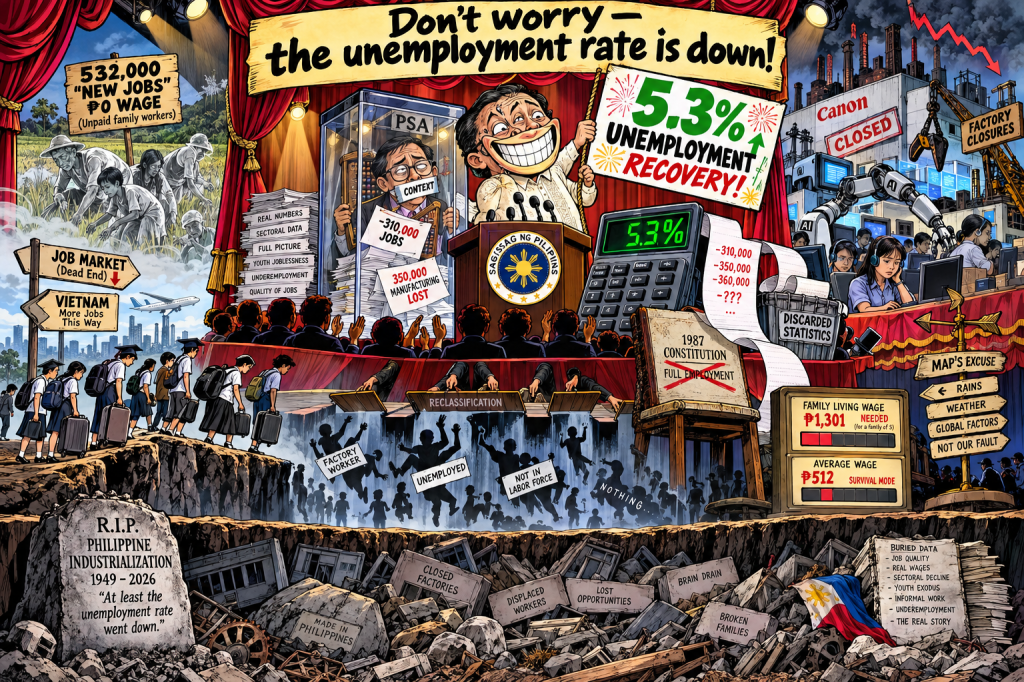
When 310,000 Jobs Disappear but the Press Release Says “Recovery
By Louis ‘Barok’ C. Biraogo — October 10, 2026
MGA ka-kweba, countrymen, and fellow prisoners of the Philippine statistical imagination—welcome back to the Cave.
Let us begin with a confession. When I first saw the headline “Unemployment Falls to 5.3%,” I felt something I rarely experience in this era of perpetual national disappointment: a flicker of hope. A momentary lapse. A weakness.
Then I remembered that the Philippine Statistics Authority (PSA) is not in the business of telling us how many Filipinos are suffering. It is in the business of counting. And counting, my friends, is not the same as caring. Sometimes it is the opposite.
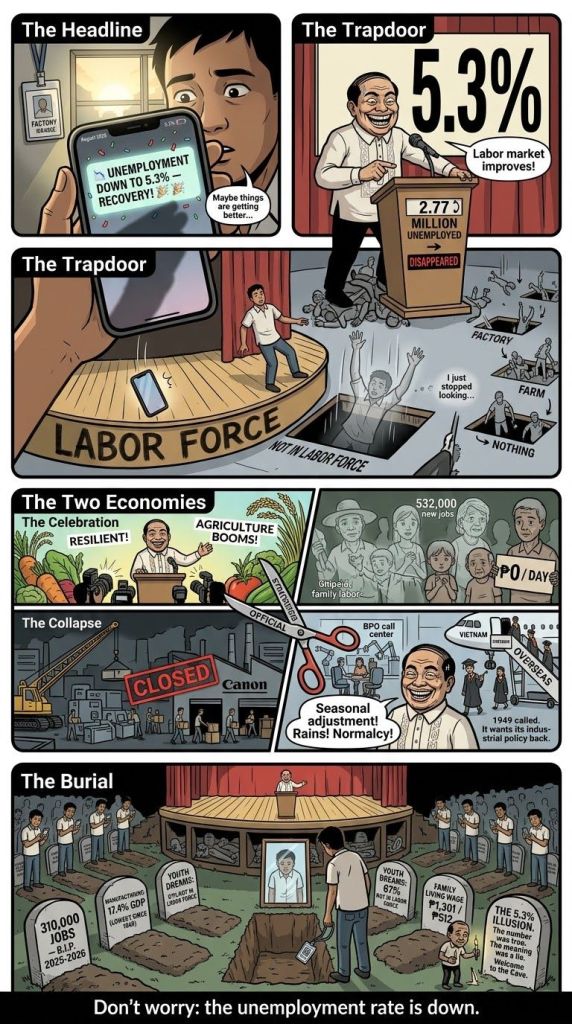
#PSA #LaborForceParticipation #HiddenUnemployment #PHPolitics #EconomicDenial
The Arithmetic of Denial
The August 2026 Labor Force Survey, released last week, tells us that 2.77 million Filipinos are unemployed—down from 3.14 million in July, but up from 2.03 million a year ago. The government’s spin doctors have seized on the monthly improvement with the fervor of a drowning man grabbing a floating peso.
“Labor market improves!” declared the Department of Labor and Employment (DOLE), as if a single month of statistical relief somehow erases a year of structural rot.
But here is the question no one in Malacañang wants to answer: Why did employment fall year-on-year by 310,000 while the working-age population grew?
The answer is not complicated. It is simply inconvenient.
National Statistician Claire Dennis Mapa, a competent technocrat trapped in an impossible job, explained that July saw 1.5 million new labor force entrants due to graduation season, while August saw only 897,000. Of those August entrants, 470,000 found jobs.
The implication is clear: the July spike was temporary, and August represents a return to normalcy.
But normalcy, in the Philippines, is now defined by a 5.3% unemployment rate—higher than the 3.9% recorded in August 2025. The labor force participation rate has fallen from 65.1% to 64.0% year-on-year.
Translation: hundreds of thousands of Filipinos have simply stopped looking for work, their aspirations quietly buried under the weight of repeated rejection. They are not counted as unemployed. They are counted as “not in the labor force.” They are counted as nothing.
This is the statistical sleight of hand that allows officials to celebrate a jobs report in which fewer Filipinos are working than the year before. The math works only if you accept that a shrinking labor force is a sign of health rather than surrender.
The Manufacturing Massacre
While the government trumpets seasonal agricultural hiring—532,000 new farm workers, many of them unpaid family laborers—the industrial backbone of the economy is being quietly dismantled.
Manufacturing shed 350,000 jobs year-on-year. This is not a blip. This is not weather. This is the sound of factories closing, production lines going dark, and the country’s capacity to create stable, productive, value-adding employment evaporating before our eyes.
The data confirms what discerning observers have long suspected: the Philippines is de-industrializing before it ever properly industrialized.
Manufacturing employment has declined for three straight months, from 3.46 million workers in June to 3.16 million in August. Canon closed its final Philippine manufacturing plant in June, eliminating 1,400 jobs.
The S&P Global Philippines Manufacturing Purchasing Managers’ Index (PMI) recorded job shedding in April, the first of the year. The Department of Economy, Planning, and Development (DEPDev) itself has revised its 2026 unemployment forecast upward to 5.8%, tacitly admitting that the situation is worse than the administration’s public optimism suggests.
IBON Foundation, the research group that has consistently been more accurate in its predictions than the government’s own economists, put it bluntly: manufacturing growth averaged just 2.5% from 2023 to 2025—the slowest in over 15 years outside the pandemic lockdown—and manufacturing now accounts for only 17.4% of gross domestic product (GDP), the smallest share since 1949.
Seventy-six years of industrial aspiration, undone by policy neglect and the seductive illusion that services and remittances could substitute for factories.
The Underemployment Trap
The headline unemployment rate, as I have argued before in these pages, is a Rorschach test. What matters is not how many people are officially jobless but how many are working without dignity.
Underemployment—the number of employed Filipinos who want more hours, better jobs, or incomes that can actually feed a family—stands at 5.9 million, or 11.9% of the employed. This is an improvement from July’s 12.9%, but a deterioration from August 2025’s 10.7%.
The average workweek has fallen below 40 hours for the first time since May 2025, with 3.7 million workers attributing their reduced hours to bad weather. Mapa, again doing his best with an impossible job, blamed the rains. But rains happen every August in the Philippines. What is new is the economy’s inability to provide enough work even when the weather cooperates.
IBON estimates that 78% of employed Filipinos are in informal arrangements—self-employed, unpaid family workers, or toiling in informal establishments without benefits, security, or legal protection. These are not “jobs” in any meaningful sense. They are survival strategies dressed up in statistical clothing.
The average daily nominal wage nationwide stands at Php512—just 39% of the Php1,301 family living wage needed for a family of five. Workers are employed, yes. But they are not earning. They are not building. They are not advancing. They are simply persisting.
The Youth Betrayal
Perhaps the most damning indictment of the administration’s economic stewardship is its treatment of the young.
Youth unemployment reached 18.6% in July, more than triple the overall rate. The youth labor force participation rate fell to 32.7% in August from 33.7% the month before.
But here is what that number conceals: it means that two-thirds of young Filipinos have simply withdrawn from the labor market entirely. Some are in school. Many are not. They are neither employed, nor in education, nor in training. They are a lost generation in formation, their potential quietly composting in the corners of a failing economy.
IBON’s Rosario Guzman delivered the verdict with surgical precision: “This goes beyond whether young people are acquiring the right skills to whether the economy is creating decent and productive jobs.”
The skills mismatch narrative, beloved by government officials and foreign consultants alike, is a convenient fiction. You can train all the coders and nurses and technicians you want. If the economy lacks the industrial base to employ them, they will either emigrate or languish.
Ateneo economist Leonardo Lanzona has been sounding the alarm for months. As early as June, he warned that the labor market was struggling to absorb new entrants, with only about one in four additional labor force participants finding employment.
The Business Process Outsourcing (BPO) industry—the country’s largest formal wage-employment generator—has cut its 2028 employment projection from 2.5 million to between 1.85 and 2.14 million, citing Artificial Intelligence (AI) driven automation and intensifying global competition.
The safety valve is closing. The pressure is building. And the government is still debating whether to celebrate a monthly decline in unemployment or acknowledge that the country is drifting toward a structural crisis.
The Political Theater
I have covered Philippine politics long enough to recognize the choreography of denial.
The Marcos administration, facing a 2028 succession battle in which economic performance will be the central battleground, has adopted a strategy of aggressive optimism. Every monthly improvement is amplified. Every year-on-year deterioration is contextualized. The labor market is “resilient.” The economy is “growing.” The Filipino worker, we are told, has never had it so good.
Meanwhile, the 1987 Constitution’s promise of “full employment” and “rising standards of living” sits in the text like a cruel joke. The government’s own economic planners have quietly revised their unemployment forecast upward, acknowledging that the situation is worse than they publicly admit. The Department of Labor and Employment issues press releases celebrating statistical noise while the factories close and the graduates queue for jobs that do not exist.
This is not governance. This is performance art.
The tragedy is that the performers are not entirely dishonest. Claire Dennis Mapa is a competent statistician. The DOLE bureaucrats are not villains. They are cogs in a machine that produces numbers because numbers can be managed, while livelihoods cannot.
What Would Honesty Look Like?
An honest government would acknowledge that 5.3% unemployment is not a success story. It is a warning.
An honest government would treat the loss of 350,000 manufacturing jobs as a national emergency. It would convene its economic managers, summon the country’s industrialists, and ask the question that has gone unasked for decades: Why can Vietnam build factories while we build call centers and condominiums?
An honest government would admit that the decline in labor force participation is a crisis of hope, not a statistical curiosity. It would invest in the kind of industrial policy that creates durable, productive employment—not just jobs, but careers; not just work, but wages sufficient to build a life.
An honest government would stop celebrating the absorption of 470,000 graduates into an economy that cannot employ them meaningfully and start building the productive base that would allow them to stay.
But honest government is not what we have. What we have is a regime that has mastered the art of statistical theater, where every report is a Rorschach test and every crisis is a “challenge” and every failure is a “learning opportunity.”
The Cave’s Verdict
Mga ka-kweba, I am tired of writing the same essay with different numbers. I am tired of watching governments celebrate the absence of catastrophe as if it were the presence of prosperity. I am tired of a political class that treats the Filipino people as variables to be managed rather than citizens to be served.
The August 2026 labor force data tells a simple story: the Philippine economy is not creating enough jobs, and the jobs it does create are increasingly precarious, poorly paid, and concentrated in sectors that cannot sustain national development.
The government’s response tells an even simpler story: it does not want you to know this.
So let us say it plainly, in the language of the Cave: The 5.3 percent is a lie not because the number is false, but because the meaning attached to it is false.
- Unemployment fell because fewer people are looking for work.
- Employment rose because seasonal farm labor increased.
- The economy is “resilient” because the poor have learned to survive on less.
- And the government is “managing the situation” because managing perceptions is easier than managing an economy.
Welcome to the Philippines, 2026. The factories are closing. The graduates are leaving. The farmers are aging. The call centers are automating.
But don’t worry: the unemployment rate is down.
Louis ‘Barok’ C. Biraogo is the founder of Kweba ni Barok, a platform for Filipino discourse and dissent. He writes from Davao City and the University of the Philippines, where he learned that the most dangerous statistics are the ones that make you feel better.
Key Citations
A. Reports & Studies
- Philippine Statistics Authority. “Unemployment Rate Declined to 5.3 Percent in August 2026.” Philippine Statistics Authority, 6 Oct. 2026.
- Department of Labor and Employment. “DOLE Welcomes August Labor Market Improvement, Strengthens Pathways to Sustainable Work.” DOLE, 7 Oct. 2026.
- Department of Economy, Planning, and Development. “2026 Unemployment Could Be Higher, at 5.8%, Says DepDev.” BusinessMirror, 21 Aug. 2026.
- IBON Foundation. “GDP Slowdown: Corruption Is Smokescreen for Bad Economics.” IBON Foundation, 29 Jan. 2026.
- IBON Foundation. “More Youth Seeking Work, but Jobs Fall Short.” IBON Foundation, 9 Sept. 2026.
- S&P Global. “Philippines Manufacturing PMI: Renewed Deterioration in April.” S&P Global, Apr. 2026.
B. News Articles
- Manila Bulletin. “August Unemployment Eases from Post-Pandemic High as Agriculture, Construction Add Jobs.” Manila Bulletin, 7 Oct. 2026.
- BusinessWorld Online. “Unemployment Rate Hits 5.3% in August.” BusinessWorld, 7 Oct. 2026.
- Nikkei Asia. “Canon to Shut Down Philippine Laser Printer Plant as Demand Falls.” Nikkei Asia, 12 May 2026.
- PTV News. “PH Labor Market Remains Resilient amid Inflationary Pressures.” PTV News, 7 Oct. 2026.
- Philippine Canadian Inquirer. “IBON Says Weak Industrial Base Is Leaving Young Filipinos without Stable Jobs.” Philippine Canadian Inquirer, 25 Sept. 2026.
- Outsource Accelerator. “Philippine BPO Calls AI Threat Real but Manageable.” Outsource Accelerator, 27 Aug. 2026.
- Trading Economics. “Philippines Jobless Rate Falls to 5.3%.” Trading Economics, 7 Oct. 2026.
C. Official Websites
- Philippine Statistics Authority. Philippine Statistics Authority, psa.gov.ph.
- Department of Labor and Employment. Department of Labor and Employment, dole.gov.ph.
- IBON Foundation. IBON Foundation, ibon.org.
- Official Gazette of the Republic of the Philippines. “The 1987 Constitution of the Republic of the Philippines.” Official Gazette, officialgazette.gov.ph.
- IT and Business Process Association of the Philippines. IBPAP, ibpap.org.

- ₱8B BBM Pork: CCTV for Every Captain’s Kumpare?

- ₱8.9 Billion, 331 Ghost Police Stations: The TIKAS Scandal Explained

- ₱8.4 Billion, 42,000 Barangays, 1 Election: The “Bawat Barangay Makikinabang” Vote-Buying Masterclass

- ₱75 Million Heist: Cops Gone Full Bandit

- ₱6.77B Ghost Haunts Duterte: RTC Dismisses Mans Carpio’s Desperate Plea

- ₱6.77 Billion and Zero Cash: The Sara Duterte SALN Math That Doesn’t Add Up

- ₱6.7-Trillion Temptation: The Great Pork Zombie Revival and the “Collegial” Vote-Buying Circus

- ₱58.53B, Zero Receipts: The LGSF Pork Barrel Nobody Wants to Name
- ₱53 Million Man Tells ₱695-a-Day Workers to Stop Being ‘Mayabang’: The Audacity of BSP’s Remolona

- ₱4.4 Billion and a Witness Who Can’t Explain It: The Duterte Impeachment’s Most Expensive Non-Answer
- ₱3.06 Billion for Evacuation Centers—But Nobody Knows Where They’ll Stand (Or If They’ll Exist)

- ₱16 Billion, 280 Accounts, 8 Helicopters: Boying Remulla’s Case Against the Yaps Is Not a Drill








Leave a Reply