
The House Always Wins: A Villar Gets the Public Works Keys, a Sister Stays in the Minority, and the Family Keeps Both Doors Open
By Louis ‘Barok’ C. Biraogo — October 9, 2026
The Most Honest Man in the Senate
Let me tell you a story about the most honest man in the Philippine Senate. His name is Mark Villar.
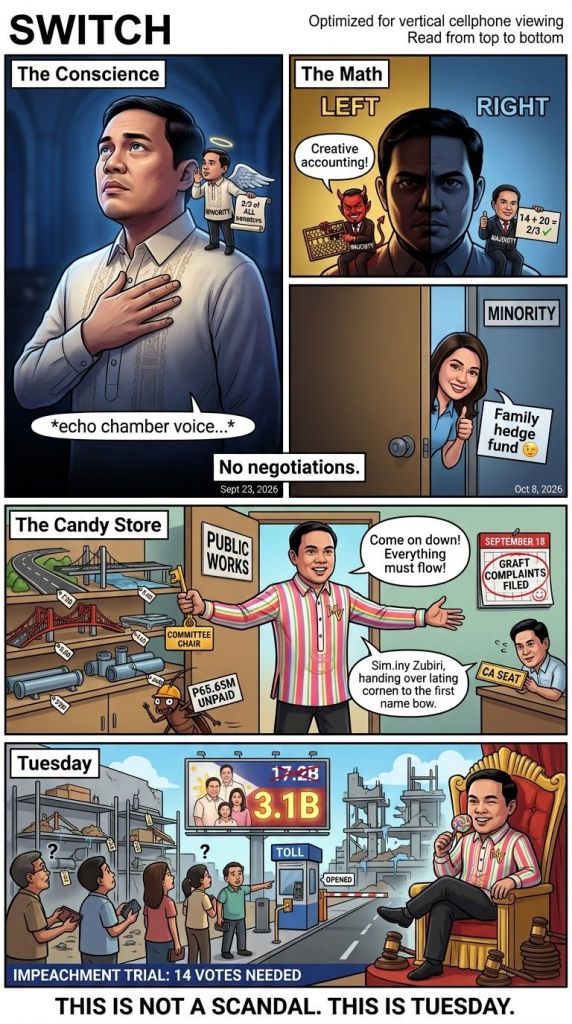
You may remember him as the guy who ran the Department of Public Works and Highways (DPWH) with all the regulatory ferocity of a wet noodle. You may also remember him as the scion of the Villar dynasty, heirs to a fortune Forbes estimates at a cool $3.1 billion (down from $17.2 billion last year, which is the kind of math that makes you wonder if someone forgot to declare a few assets).
But none of that matters now, because on October 8, 2026, Senator Mark Villar did something truly remarkable. He woke up, looked at his minority bloc colleagues, and said—and I’m paraphrasing here—“So long, suckers.” Then he walked across the Senate floor, got himself elected Chairman of the Committee on Public Works, and snagged a seat on the Commission on Appointments (CA), replacing the very man who made the motion to give it to him.
A Timeline That Smells Worse Than the Pasig
Let’s talk about the timing, because in Philippine politics, timing is everything, and this timing smells worse than the Pasig River on a hot day.
September 18, 2026: The Graft Complaints
The Ombudsman files graft complaints against the Villar family—Mark, Camille, Manny, Cynthia, Paolo, and a cast of PrimeWater executives—over “grossly disadvantageous” joint venture agreements (JVAs) with local water districts. The complaints allege violations of the Anti-Graft and Corrupt Practices Act.
The Office of the Government Corporate Counsel (OGCC) found that 75 water districts entered into these deals from 2015 to 2022, with 19 seeking pre-termination. Unpaid obligations: P65.65 million.
September 23, 2026: The “Conscience Vote”
Mark Villar votes with the majority to reinterpret the impeachment conviction threshold, changing the denominator from “all 24 senators” to “senators capable of participating.” This is a procedural vote, we are told. A “conscience vote,” says Majority Leader Zubiri.
October 8, 2026: The Keys to the Candy Store
Villar formally joins the majority, gets Public Works chair, gets CA seat. Zubiri gives up his own CA spot. Sotto hands over Public Works. Everyone is very gracious about it.
Now, I’m just a humble blogger with a laptop and a healthy distrust of billionaires, but let me see if I have the sequence right: Graft complaint on Friday. “Conscience vote” on Wednesday. Committee chairmanship two weeks later. And Zubiri says there were “no negotiations”.
Sure. And I have a bridge in C5 I’d like to sell you.
What the Public Works Committee Actually Does
Let’s be clear about what the Public Works Committee actually does. It oversees infrastructure spending. It reviews the DPWH budget. It can investigate projects.
And Mark Villar, who once ran the DPWH and now chairs the committee that oversees it, has a family business empire that includes Vista Land, PrimeWater, and—according to allegations from a former DPWH undersecretary—a kickback system that funneled 10% of project costs to a cousin “presumably for Sec Mark Villar”.
But wait, there’s more! The Ombudsman has also flagged allegations of a 50% commission from infrastructure projects during Villar’s DPWH tenure. These are allegations, of course. Unproven. But when you put a man under investigation for infrastructure corruption in charge of the committee that oversees infrastructure, the optics aren’t just bad—they’re criminal-adjacent.
A Vote on Who Gets the Job
Now, let’s talk about the CA seat. The Commission on Appointments confirms presidential appointments. Mark Villar now has a vote on whether certain officials get their jobs.
This is the same man facing Ombudsman investigation. The same man whose family business has been described as “grossly disadvantageous” to government water districts. And he gets a constitutional role in vetting government appointees.
Hedging Like a Two-Headed Hydra
The defense, such as it is, goes like this:
- Villar’s move is “legitimate” because senators can switch blocs.
- The appointments were “institutional responsibilities.”
- The graft complaints are just allegations.
- And the fact that his sister Camille remains in the minority? That’s just “institutional independence” or “strategic diversification,” not a family hedging its bets like a two-headed political hydra.
Let me offer a different interpretation. The Villar family is running a masterclass in political risk management. Mark joins the majority to protect family interests from the inside. Camille stays in the minority to maintain influence across the aisle.
If the impeachment trial goes one way, the family has a senator on the winning side. If it goes the other way, they still have someone in the opposition. This isn’t political principle. This is a diversified portfolio.
The Impeachment Math
And the impeachment angle? Let’s do the math. The September 23 reinterpretation means that if 20 senators are capable of participating, 14 votes are needed for conviction—exactly the number the majority now has. Villar’s defection gives the majority the exact supermajority it needs under its own creative constitutional theory.
If one majority senator defects or abstains, the conviction fails. This is not governance. This is hostage-taking with extra steps.
The Supreme Court dismissed petitions against the threshold change on procedural grounds—standing, prematurity—which means the Court didn’t say the interpretation was correct. It just said the challengers didn’t have the right paperwork. The constitutional question remains: what does “two-thirds of all the Members of the Senate” actually mean? The majority’s answer is “whatever we need it to mean to win.” That’s not constitutional interpretation — that’s a fiesta game where the host keeps changing the rules mid-dance.
Let’s not forget the context: the impeachment trial of Vice President Sara Duterte. The majority wants her convicted. The minority wants her acquitted. Mark Villar’s vote on the threshold suggests he’s already aligned with the conviction camp. His committee chairmanship is the reward. His family’s legal troubles are the leverage. The whole thing fits together like a jigsaw puzzle assembled by a particularly cynical political operative.
The Burden of Proof
Now, I am not saying Mark Villar committed a crime. I am not saying the committee chairmanship was explicitly traded for a vote. I am saying that in a country where “trapo” is not just a word but a governing philosophy, the burden of proof falls on the man who just got a promotion two weeks after his family got indicted.
If Villar wants to clear his name, here’s what he should do:
- Explain the realignment publicly.
- Disclose his financial interests.
- Commit to recusing himself from any Public Works matter involving PrimeWater or Vista Land.
- And stop pretending that a “conscience vote” on an impeachment threshold followed by a committee chairmanship is just how the Senate works.
But he won’t do any of that. Because the Villar family didn’t build a $3.1 billion fortune by explaining themselves. They built it by knowing when to switch sides, when to hedge bets, and when to make sure that the committee in charge of infrastructure spending is chaired by someone named Villar.
Procedure Is King
The Senate’s rules are clear: Rule 10, Section 13 allows the majority to elect committee chairs. The Constitution’s CA provision is clear: proportional representation from political parties. Everything Villar did was procedurally valid. And that’s the problem.
In a system where procedure is king, the most corrupt acts are the ones that follow the rules to the letter. Mark Villar didn’t break any laws. He just reminded everyone that in the Philippines, political loyalty is a currency, committee chairs are the change, and the public is the one getting robbed.
This Is Tuesday
The Ombudsman will continue its investigation. The impeachment trial will proceed. The Supreme Court will wait for a proper case. And Mark Villar will sit in his new chair, overseeing the spending of billions, while his family faces graft charges and his sister votes with the opposition.
This is not a scandal. This is Tuesday.
But here’s the thing about Tuesdays: they have a way of turning into Wednesdays, and Wednesdays have a way of turning into elections. The Filipino public may have a short memory, but even the most forgiving voter eventually notices when the man in charge of the roads is the same man who allegedly charged a toll for every kilometer paved.
The real question isn’t whether Mark Villar’s move was legal. It’s whether it was decent. And in Philippine politics, decency is the one commodity that’s always in short supply.
Key Citations
A. Legal & Official Sources
- Republic of the Philippines. “Republic Act No. 3019, Anti-Graft and Corrupt Practices Act.” Lawphil, 17 Aug. 1960.
- Republic of the Philippines. “The 1987 Constitution of the Republic of the Philippines — Article VI.” Official Gazette.
- Republic of the Philippines. “The 1987 Constitution of the Republic of the Philippines — Article XI.” Official Gazette.
B. News Articles
- Ager, Maila. “Mark Villar Joins Senate Majority Bloc.” Inquirer.net, 8 Oct. 2026.
- Chi, Cristina. “Mark Villar Reclaims Public Works Chairship in Switch to Majority Bloc.” Philstar.com, 8 Oct. 2026.
- Valente, Catherine S. “Mark Villar Joins Senate Majority, Leads Public Works Panel.” The Manila Times, 9 Oct. 2026.
- Galvez, Daphne. “Villar Family Faces Graft Complaints over PrimeWater Deals.” Philstar.com, 19 Sept. 2026.
- Ramirez, Renalyn. “Ombudsman Probes Villars, PrimeWater Execs over Water District Deals.” Philstar.com, 18 Sept. 2026.
- Danio, James Daniel. “Ombudsman Files Graft Complaints vs Villars, PrimeWater Officials over ‘Grossly Disadvantageous’ Water Deals.” The Manila Times, 18 Sept. 2026.
- Lalu, Gabriel Pabico, et al. “2/3 Threshold Revisited: Fewer Votes Needed to Convict Sara Duterte.” Cebu Daily News / Inquirer.net, 24 Sept. 2026.
- Buan, Lian. “Mark Villar, Bonoan, Cabral Operated Kickback System in DPWH – Witness.” Rappler, 14 Nov. 2025.
- Mangaluz, Jean. “Villar, Poe, Angara Deny Bernardo’s DPWH Kickback Allegations.” Philstar.com, 14 Nov. 2025.
- Ong, Ghio, and Daphne Galvez. “SC Junks Petitions vs Lower Impeach Vote to Convict.” Philstar.com, 1 Oct. 2026.
- InsiderPH. “PH Rich List Reshuffles as Razon Nears P1 Trillion, Villar Wealth Slumps by P800B.” 11 Mar. 2026. Citing Forbes World’s Billionaires List figures of $17.2 billion in 2025 and $3.1 billion in 2026.
C. Official Websites
- Commission on Appointments. Commission on Appointments. Republic of the Philippines.
- Department of Public Works and Highways. Department of Public Works and Highways. Republic of the Philippines.
- Office of the Government Corporate Counsel. Office of the Government Corporate Counsel. Republic of the Philippines.
- PrimeWater Infrastructure Corp. PrimeWater.
- Vista Land & Lifescapes, Inc. Vista Land.
- Ober Da Bakod: Mark Villar Swaps Conscience Vote for Public Works Candy Store

- The -11 Presidency: How a Survey Exposed the Rot Beneath the Malacañang Marble

- From Import Ban to Import Flood: How the DA Created the Rice Crisis It Now Claims to Solve

- The Barbers Gambit: How “Two and Two” Became a Constitutional Magic Trick

- Padilla and Go to the Rescue: The Only Men Brave Enough to Defend the Constitution They Voted to Ignore

- The ₱4.4 Billion Hallucination: How the AMLC Turned Newspaper Clippings Into Impeachment Evidence

- Billionaire on Bail: Why Leviste’s ₱72K Warrant Is the Cheapest Thing About This Scandal

- The Tangere “Survey” Is Not a Poll—It’s a Political Weapon

- Adik? The ₱66 Million Question Jonvic Remulla Doesn’t Want You to Ask
- ₱4.4 Billion and a Witness Who Can’t Explain It: The Duterte Impeachment’s Most Expensive Non-Answer
- Villar ISP Case Dropped: When “Insufficient Evidence” Means “We Didn’t Really Try”

- The Duterte Succession: A Trial Balloon So Obvious You Can See the Strings From Davao









Leave a comment