
Manchurian Candidates and Manufactured Drama: How the Prosecution Learned to Stop Worrying and Love the Conspiracy Theory
By Louis ‘Barok‘ C. Biraogo — October 9, 2026
MGA ka-kweba, welcome back to the Cave.
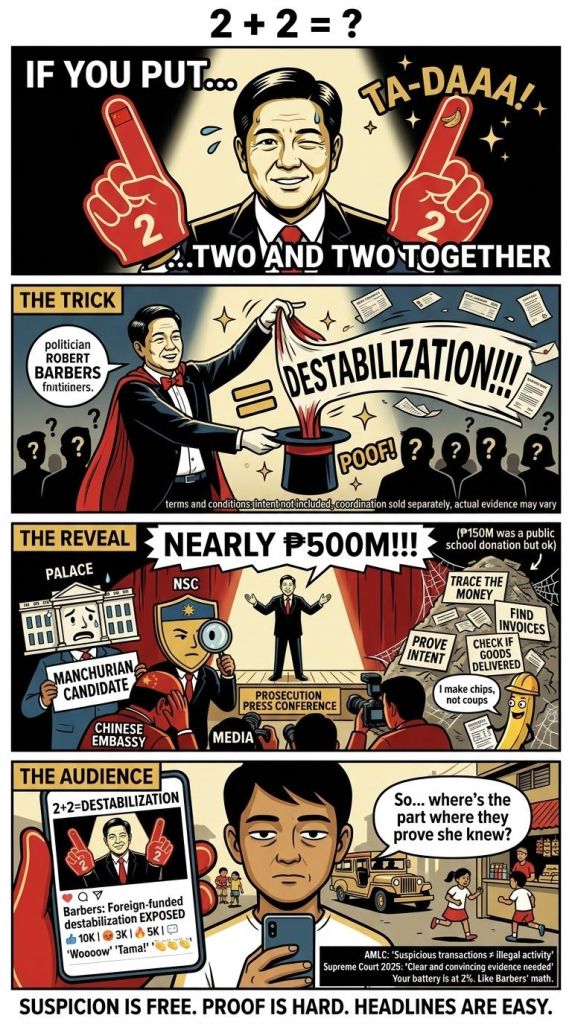
Today we’re going to talk about a phrase that has become the prosecution’s favorite rhetorical crutch in the impeachment trial of Vice President Sara Duterte. It’s a phrase that sounds like algebra but functions like a magic trick. It’s a phrase that transforms suspicion into certainty, bank records into bombshells, and a banana chip company into a geopolitical chessboard.
That phrase is: “If you put two and two together.”
Former Congressman Robert Ace Barbers—now the House prosecution’s spokesperson and impeachment adviser—uttered this verbal sleight-of-hand on October 5, 2026, and the Philippine political establishment has been running with it ever since. The line, “if you put two and two together,” is now doing the work of an argument.
The Palace invoked the “Manchurian candidate.” The National Security Council promised to “assess the implications.” The Chinese Embassy called the whole thing “fabricated” and “malicious.”
And somewhere, a banana chip exporter with an ₱8,000 monthly electricity bill became the central node in a supposed Chinese destabilization plot against the Philippine government.
Let’s be clear about what I’m about to do here. I am not defending Sara Duterte. I am not saying the money is clean. I am not saying the Chinese Communist Party is a benevolent actor in Philippine politics. What I am saying is that “putting two and two together” is not a legal standard, and Robert Ace Barbers knows it.
The Arithmetic of Suspicion
Here is what we actually know, stripped of the rhetorical varnish.
The Anti-Money Laundering Council (AMLC) testified before the Senate impeachment court that Cale88 Foods Corporation received ₱319,326,770.41 in inward remittances from mainland China and Hong Kong. That is a real number. It is confirmed by a government agency, under oath, in a court of law. Barbers is right that this is no longer merely Antonio Trillanes’ press conference allegation.
Senator Risa Hontiveros then identified some of the remitters as Chinese state-owned enterprises, including China National Township Enterprise and entities linked to the Xinjiang Fruit Industry Group. That is also significant. It raises legitimate questions about why state-linked Chinese companies were sending millions of pesos to a small Philippine corporation.
And the AMLC flagged some transactions as suspicious because they had “no underlying legal or trade obligation, purpose or economic justification.”
All of this is serious. All of this warrants investigation. All of this should make any reasonable Filipino pause.
But here is where Barbers’ arithmetic collapses. He wants you to add two numbers: Chinese money plus Duterte connection equals foreign-funded destabilization. And that is not addition. That is speculation dressed in a barong.
The Missing Variables
Let me explain what “putting two and two together” actually requires in this context. It requires at least five separate propositions to be independently proven.
- First, that the money came from China or Hong Kong. This is now well-supported.
- Second, that the recipients were genuinely connected to Manases Carpio and Sara Duterte. This is also supported—Carpio was an incorporator, director, and shareholder of Cale88 from 2021 to 2024, with his stake reaching 47.5%.
- Third, that the transactions lacked a legitimate commercial, charitable, or other lawful purpose. Here the evidence is suggestive but incomplete. AMLC flagged some transactions as lacking economic justification. But the defense argues these could be capital infusion, pre-payment for export orders, or legitimate business investments. The truth is that we don’t yet know, because no one has traced the money to its ultimate purpose.
- Fourth, that the money was intended to influence a Philippine public official or political faction. This is where Barbers’ case gets shaky. A suspicious transaction report is not proof of political intent. AMLC Executive Director Ronel Buenaventura himself testified that suspicious transaction reports do not prove illegal activity. He said Cale88 could be a “candidate” for a money laundering investigation—but that authorities first need to establish a predicate offense.
- Fifth—and this is the big one—that the purpose was specifically destabilization, subversion, or unlawful interference with the Philippine government. This is the proposition that Barbers needs for his “foreign-funded destabilization” narrative to land. And this is the proposition for which there is presently no direct evidence whatsoever.
Barbers is treating the existence of money as proof of motive, and the existence of motive as proof of conspiracy. That is not investigation. That is deduction by assertion.
The Manchurian Candidate Meets the Banana Chip Exporter
The Palace’s invocation of “Manchurian candidate” is a particularly delicious piece of rhetorical theater. It conjures images of sleeper agents and brainwashed operatives, of Cold War paranoia and geopolitical manipulation.
But let’s look at the actual company at the center of this alleged conspiracy. Cale88 Foods Corporation is a banana chip exporter. Its reported sales were ₱20,000 in 2022, ₱23 million in 2023, and ₱150 million in 2024. Its average monthly electricity bill was ₱8,000—a figure that, as Trillanes correctly noted, seems absurdly low for a company handling hundreds of millions in transactions.
Is that suspicious? Absolutely. A company that suddenly receives ₱319 million in foreign remittances while operating out of what appears to be a modest facility deserves scrutiny.
But suspicious and criminal are not synonyms. And “this doesn’t add up” is an invitation to investigate, not a conclusion.
The Tapang at Malasakit Red Herring
Barbers and the prosecution have bundled the ₱319 million Cale88 remittances with a separate ₱150 million donation to the Tapang at Malasakit Foundation, bringing the total to nearly half a billion pesos. This rhetorical aggregation is misleading.
The ₱150 million donation appears to have been publicly documented. Philstar and Philippine News Agency (PNA) reports from 2018 describe a Chinese Embassy donation for the construction of 13 school buildings in Davao City, with a ceremonial groundbreaking attended by then-Chinese Ambassador Zhao Jianhua and then-Mayor Sara Duterte. The project was coordinated with the Department of Education (DepEd) Davao.
Now, there are legitimate questions here. Why was a foreign government financing a project connected to a prominent Philippine politician? Were there political expectations attached? Was the foundation transparent about the arrangement?
But the classroom donation is analytically different from unexplained private-company remittances. Lumping them together allows Barbers to say “nearly half a billion” and let the public imagine a coordinated influence operation. It also invites the defense to argue that the prosecution is treating publicly disclosed charitable assistance as sinister merely because China was the donor.
That is a credibility problem the prosecution does not need.
The Legal Vacuum
Here is the uncomfortable truth that Barbers and his fellow travelers in the prosecution panel would rather not confront: “Foreign-funded destabilization” is not a crime in the Revised Penal Code.
If “destabilization” means an effort to overthrow the government, the relevant offenses are rebellion, coup d’état, or sedition. Each of these requires specific overt acts—violence, intimidation, public and tumultuous rising—that have not been alleged, much less proven.
Treason requires levying war against the Philippines or adhering to its enemies, giving them aid or comfort. It also requires the testimony of two witnesses to the same overt act. Good luck meeting that standard with bank records.
Even “betrayal of public trust,” the broadest impeachment ground, requires more than suspicion. The Supreme Court’s 2025 ruling in Duterte v. House of Representatives emphasized that impeachment decisions must be based on clear charges supported by clear and convincing evidence—not ex parte speculation.
Barbers is not a prosecutor presenting evidence. He is a spokesperson shaping a narrative. And the narrative he is shaping is that money from China, flowing to a company connected to the Vice President’s husband, must mean foreign-funded destabilization because… well, because it’s suspicious.
That is not how the law works. And Barbers, a six-term congressman and former governor, knows it.
The Question That Actually Matters
So what should the prosecution be doing instead of peddling destabilization theories to the press?
They should be tracing the money.
- Who were the ultimate beneficial owners of the Chinese entities that remitted funds?
- Were they actually state-controlled, or were they private companies with incidental government ties?
- What contracts generated the payments?
- Were goods actually delivered? Were services rendered? Were invoices authentic?
- Did Cale88’s books reflect the transactions?
- Did money subsequently leave Cale88, and if so, where did it go?
- Did any of it reach Duterte personally or politically?
Those questions are probative. They are answerable with documents and testimony. And if the answers are damning, they will be far more devastating than Barbers’ rhetorical flourishes.
If the answers are exculpatory—if Cale88 was genuinely engaged in legitimate export business and the money can be traced through invoices and shipping documents—then Barbers’ destabilization theory collapses, and the prosecution is left with egg on its face for overplaying its hand.
The prosecution does not need to prove a Chinese destabilization plot to establish unexplained wealth. It does not need to invoke the Manchurian candidate to raise questions about Sara Duterte’s financial disclosures. The AMLC records alone provide sufficient material for a serious investigation into whether her assets are “manifestly out of proportion” to her lawful income under Republic Act No. 1379 (RA 1379).
But Barbers wants the bigger headline. He wants the geopolitical conspiracy. He wants “foreign-funded destabilization” because it sounds more dramatic than “discrepancies in Statement of Assets, Liabilities, and Net Worth (SALN) filings.”
And that is precisely why his assertion is analytically weak. It overreaches. It conflates suspicion with proof. It asks the Senate and the public to fill in the blanks with imagination rather than evidence.
The China Factor
Let me address the elephant in the kweba: China.
Is it plausible that Beijing would seek to influence Philippine politics? Absolutely. China has a long history of “elite capture” strategies across Southeast Asia and beyond. It has economic leverage, diplomatic channels, and intelligence capabilities. The West Philippine Sea dispute gives it strong incentives to cultivate friendly voices in Manila.
But plausibility is not proof. And the fact that China could have financed destabilization does not mean it did in this specific case.
The Chinese Embassy has denied the allegations, calling them “fabricated” and “malicious.” That denial is not dispositive—embassies deny things. But it does mean the allegation remains contested at the highest diplomatic level.
What is missing is any evidence of instructions, communications, or expectations connecting the money to political outcomes. Barbers has given us a money trail and an inference. He has not given us a smoking gun.
The Game Being Played
So what is Robert Ace Barbers actually doing?
He is doing what political spokespersons do: he is shaping the narrative. He is taking a complex, ambiguous financial story and giving it a simple, dramatic frame. “Chinese money” plus “Duterte connection” equals “foreign-funded destabilization.” It’s memorable. It’s alarming. It plays into pre-existing anxieties about China and about the Duterte family.
It also accomplishes several political objectives simultaneously. It ties the impeachment case to national security, making it harder for Duterte’s defenders to dismiss it as a purely political vendetta. It puts the Duterte camp on the defensive about China, forcing them to either denounce Beijing (alienating their base) or defend their Chinese connections (confirming suspicions). And it shifts the narrative from “Did Sara Duterte accurately report her wealth?” to “Is Sara Duterte a Chinese asset?”
That is a much more dangerous question for the Vice President. And Barbers knows it.
The Standard We Should Demand
Mga ka-kweba, here is my challenge to the prosecution and to Robert Ace Barbers specifically:
If you have evidence that Chinese money financed destabilization, present it. If you have documents showing a quid pro quo, file them. If you have witnesses who can testify to instructions from Beijing, bring them to the stand.
But do not ask the Filipino people to “put two and two together” and call it proof. Do not dress up speculation as evidence. Do not use the gravity of national security to shield a weak case from scrutiny.
The impeachment trial is not a press conference. It is a constitutional proceeding with real consequences for the Vice President, for the institution she holds, and for the country. The prosecution owes the Senate and the public evidence, not arithmetic.
And if Barbers cannot do better than “if you put two and two together,” then perhaps he should leave the math to the accountants and the investigation to the investigators.
Because right now, the only thing he has definitively proven is that he knows how to generate a headline.
Bottom Line
The AMLC testimony has established that ₱319 million flowed from China and Hong Kong to a company connected to Sara Duterte’s husband. That is a serious fact that deserves serious investigation.
But “foreign-funded destabilization” is a conclusion, not a finding. It requires evidence of intent, coordination, and political purpose that Barbers has not provided. His “two and two” arithmetic skips too many steps, conflates too many distinct propositions, and asks the public to believe that suspicion equals proof.
The prosecution may well have a case on unexplained wealth. It may even have a case on foreign influence. But if it does, it will need to prove it with documents, testimony, and a chain of evidence—not with rhetorical sleight-of-hand and the invocation of “Manchurian candidates.”
Until then, Barbers’ destabilization theory remains what it has always been: a hypothesis dressed in a barong, pretending to be a fact.
And the Filipino people, who have seen too many political spectacles and too few convictions, deserve better than a magic trick.
Louis ‘Barok’ C. Biraogo is the founder of Kweba ni Barok, a platform for critical analysis and spirited debate. He writes from Davao City and Manila.
Key Citations
A. Legal & Official Sources
- Anti-Money Laundering Council. Testimony of Executive Director Ronel Buenaventura on Cale88 Foods Corporation inward remittances. Senate Impeachment Court, 5 Oct. 2026. Reported in GMA News Online, “AMLC: Firm linked to Sara Duterte’s husband got P319M from China, HK.” GMA News Online, 5 Oct. 2026.
- Supreme Court of the Philippines. Duterte v. House of Representatives. 25 July 2025. “SC: House impeachment complaint vs VP Duterte barred by 1-year rule.” Supreme Court of the Philippines.
- Philippines. Act No. 3815, The Revised Penal Code. 8 Dec. 1930. The Revised Penal Code. Lawphil.
- Philippines. Republic Act No. 1379, An Act Declaring Forfeiture in Favor of the State Any Property Found to Have Been Unlawfully Acquired. 18 June 1955. Republic Act No. 1379. Lawphil.
B. News Articles
- Quismorio, Ellson. “Is this ‘foreign-funded destabilization?’: Barbers flags nearly P500M in China cash flows to VP Duterte network.” Manila Bulletin, 4 Oct. 2026.
- Cabato, Luisa. “Palace bats for probe into China money claims, warns of Manchurian bet.” Inquirer.net, 6 Oct. 2026.
- Santos, Tina G. “Hontiveros: China ‘state firms’ among Cale88 funders.” Inquirer.net, 7 Oct. 2026.
- Lee-Brago, Pia. “Chinese embassy on funneled funds: False narrative.” Philstar.com, 6 Oct. 2026.
- Ombay, Giselle. “AMLC: Firm linked to Sara Duterte’s husband got P319M from China, HK.” GMA News Online, 5 Oct. 2026.
- Reganit, Cielito M. “Prosecution backs AMLC records vs China denial on P319-M remittance.” The Daily Tribune / Chronicle, 6 Oct. 2026.
- “Cale88 got P319M from China, HK.” Daily Tribune, 5 Oct. 2026.
- Context.ph. “NSC probes P319M China-linked Cale88 remittances.” Context.ph, 6 Oct. 2026.
- SunStar. “AMLC exec: Transactions flagged as ‘suspicious’ not proof of illegal activity.” SunStar, 6 Oct. 2026.
- Bilyonaryo News Channel. “AMLC: Cale88 could be candidate for money laundering probe.” Bilyonaryo News Channel, 6 Oct. 2026.
- Gajunera, Funny Pearl. “Davao gets P150-M China donation for school buildings.” Philippine News Agency, 7 Oct. 2018.
C. Official Websites
- Anti-Money Laundering Council. Anti-Money Laundering Council. amlc.gov.ph.
- Supreme Court of the Philippines. Supreme Court of the Philippines. sc.judiciary.gov.ph.
- Senate of the Philippines. Senate of the Philippines. senate.gov.ph.
- Philippine News Agency. Philippine News Agency. pna.gov.ph.

- ₱8B BBM Pork: CCTV for Every Captain’s Kumpare?
- ₱8.9 Billion, 331 Ghost Police Stations: The TIKAS Scandal Explained

- ₱8.4 Billion, 42,000 Barangays, 1 Election: The “Bawat Barangay Makikinabang” Vote-Buying Masterclass

- ₱75 Million Heist: Cops Gone Full Bandit

- ₱6.77B Ghost Haunts Duterte: RTC Dismisses Mans Carpio’s Desperate Plea






Leave a comment