Because Nothing Says ‘Food Security’ Like Banning Imports One Year and Flooding the Market the Next
Louis “Barok” C. Biraogo — October 9, 2026
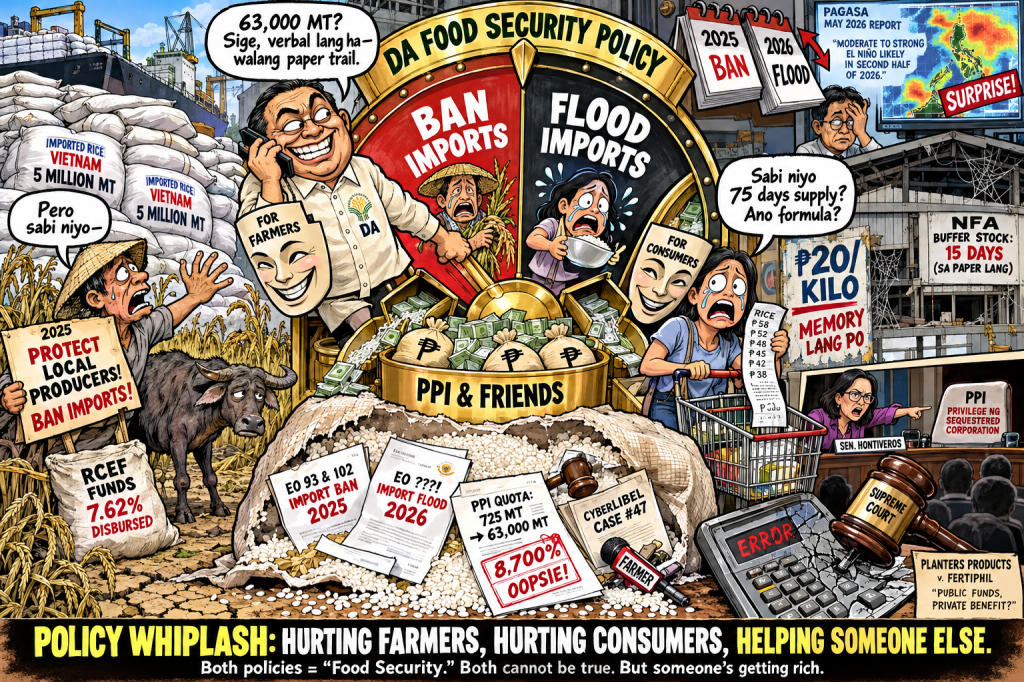
GATHER ’round, mga ka-kweba, for today’s episode of ‘Policy Whiplash’: the Department of Agriculture (DA) spent the better part of 2025 telling Filipino farmers that imports were killing their livelihoods. The government suspended rice imports for four months, issued Executive Order No. 93 (EO 93) and Executive Order No. 102 (EO 102), and proudly declared that it was protecting local producers from “over-importation.”
Then, in October 2026, the same DA announced that rice imports might exceed 5 million metric tons—an all-time record—because El Niño is coming.
The same government that banned imports to protect farmers is now flooding the country with imported rice to protect consumers. Both policies are being justified as “food security.” Both cannot be simultaneously true.
This is not agricultural policy. This is agricultural whiplash. And someone is getting rich while Filipino farmers and consumers both lose.
The Numbers That Don’t Add Up
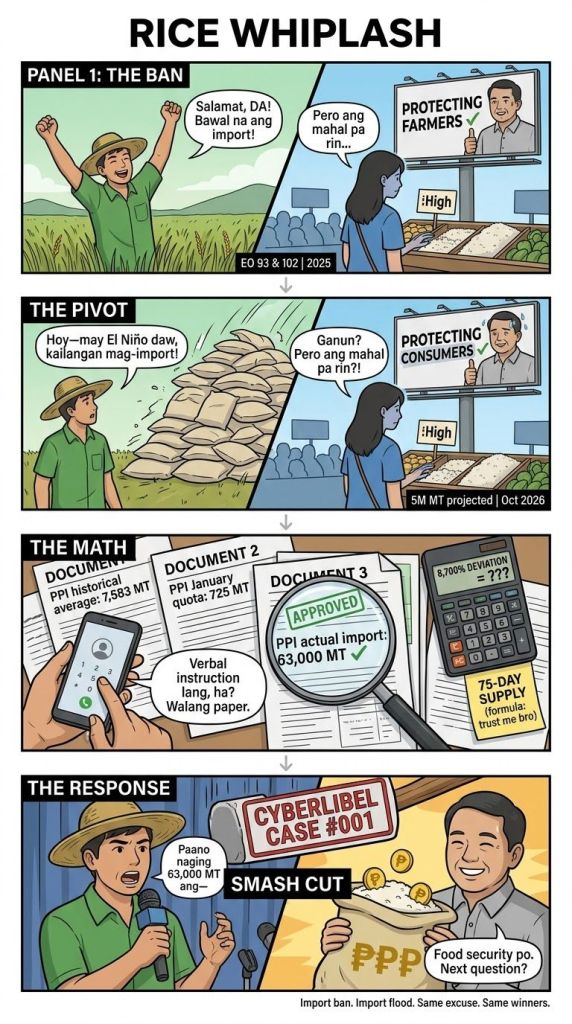
DA Assistant Secretary Arnel de Mesa told reporters that the Philippines had already imported 3.98 million MT of rice as of September 24, 2026—already surpassing the entire 2025 total of 3.39 million MT. The projection is that imports could breach 5 million MT by year-end.
The justification? El Niño. The DA projects a 700,000 MT reduction in palay production and cites P6.78 billion in agricultural damage as of late September.
Here’s the problem: the DA’s own forecast from December 2025 projected imports of only 3.6–3.8 million MT for 2026. That was based on an anticipated strong harvest.
What changed between December 2025 and October 2026? Either the DA’s forecasting model is catastrophically broken, or the “projection” is being reverse-engineered to justify import volumes that were already being negotiated.
Agricultural forecasting is inherently uncertain. Weather, typhoons, irrigation, pest outbreaks, and global prices can shift the balance dramatically. But a swing of 1.2–1.4 million MT in ten months is not uncertainty. That’s a policy pivot disguised as a forecast.
The 75-Day Supply: A Number Without a Formula
The DA claims the country will have a 75-day supply of rice by year-end. This is presented as reassurance. It is actually an evasion.
What does “75-day supply” mean? Is it total rice physically present in the country? Commercially available stocks? Government buffer stocks? Rice equivalent after milling? Does it include imports that haven’t arrived yet? Does it account for regional distribution gaps?
The National Food Authority (NFA) is legally required to maintain a 15-day buffer stock under Republic Act No. 12078 (RA 12078). That’s approximately 555,000 MT. But a 75-day national supply is not the same as a 75-day NFA buffer stock. The DA is conflating two different metrics to create an impression of abundance.
The Constitution guarantees the right to information on matters of public concern, including access to government research data used as the basis for policy development under Article III, Section 7 of the 1987 Constitution. The DA should publish its balance sheet model: beginning stocks, domestic production, milling recovery rates, imports, consumption, carryover, and losses.
Without that disclosure, “75 days” is not a food-security metric. It’s a press release.
The Planters Products Problem
Here is where the story shifts from incompetence to something that smells considerably worse.
In June 2026, former Agriculture Secretary Leonardo Montemayor published a devastating analysis in BusinessMirror documenting what he called “creeping cartelization” in the rice importation sector.
The DA had established a system of monthly import quotas—300,000 MT for January and February, 150,000 MT for March—to be allocated based on importers’ historical performance. But these quotas, Montemayor reported, were “not covered by written official orders, but effected through mere verbal instructions by higher DA officials.”
Then came Planters Products Inc. (PPI).
PPI had imported rice only once before, in 2025, with a volume of 22,750 MT. Its historical average was 7,583 MT annually—roughly 0.19 percent of total imports. Under the DA’s own allocation formula, PPI should have received approximately 725 MT of the January 2026 quota.
Instead, PPI imported 63,000 MT—16.5 percent of all January arrivals.
That is not a rounding error. That is a 8,700 percent deviation from the stated formula.
Senator Risa Hontiveros filed a resolution demanding an investigation, noting that PPI’s audited financial statements showed equity of only P536 million and a net loss for 2023–2024. How does a company with that balance sheet suddenly become one of the country’s largest rice importers?
The answer may lie in PPI’s unique legal status. PPI is a “sequestered corporation” under the DA’s administration—a remnant of the Marcos Sr. era, rescued from bankruptcy through a fertilizer levy that the Supreme Court struck down in Planters Products, Inc. v. Fertiphil Corp., G.R. No. 166006 (March 14, 2008). The Court held that the levy was unconstitutional because it benefited a private entity with public funds.
Now PPI appears to be enjoying preferential treatment in import allocations while its legal status remains ambiguous—private corporation or government-owned entity? If public funds are being used, procurement laws apply. If it’s private, why is it receiving government quotas?
The Libel Strategy
When the Federation of Free Farmers (FFF) and its chairman Leonardo Montemayor questioned PPI’s importation deals, PPI responded not with transparency but with a cyberlibel complaint.
The complaint, filed in May 2026, accused FFF of making “outright falsehoods” and sought criminal prosecution under the Republic Act No. 10175 (Cybercrime Prevention Act or RA 10175). Cyberlibel carries penalties of up to 12 years imprisonment and P1.5 million in fines.
The message is clear: question our rice import deals, and we will send you to jail.
This is not the behavior of a company confident in its legal position. This is the behavior of an entity that knows transparency would be fatal.
The Legal Architecture of Impunity
The DA’s import quota system raises serious legal questions under Republic Act No. 11203 (Rice Tariffication Law), as amended by RA 12078. The RTL explicitly replaced quantitative restrictions with tariffs. The law was designed to liberalize rice trade, not to recreate quotas through informal administrative instructions.
If the DA is effectively imposing de facto import quotas through verbal directives and discretionary allocations, it may be violating the very law it claims to be implementing. The Supreme Court’s Ang Tibay v. Court of Industrial Relations (Ang Tibay doctrine) requires administrative decisions to be supported by substantial evidence, based on the record, and independently considered. A system of undocumented verbal instructions fails every prong of that test.
More fundamentally, the Constitution vests legislative power in Congress under Article VI, Section 1. Tariff powers are specifically delegated under Article VI, Section 28(2), with limits. An administrative agency cannot legislate a new import regime by memorandum—or by phone call.
The El Niño Excuse
Let me be clear: El Niño is real. The Philippine Atmospheric, Geophysical, and Astronomical Services Administration (PAGASA) has projected a moderate to strong El Niño that could persist into early 2027. Rice production is genuinely vulnerable to drought.
But El Niño is also predictable. It is not a typhoon that appears without warning. It is a cyclical climate pattern that scientists have been monitoring for months. The DA knew about this risk. It had time to prepare.
What did it do? It built import dependency rather than climate resilience.
The DA’s El Niño task force was reconvened in May 2026. But the interventions listed—cloud seeding, solar-powered irrigation, adjusted planting calendars—are the same measures that have been announced during every El Niño cycle for the past two decades. If these were working, the Philippines would not be projecting record imports.
The Republic Act No. 8435 (Agriculture and Fisheries Modernization Act or AFMA) allocated 30 percent of its budget to irrigation. Decades later, irrigation coverage remains inadequate. The Rice Competitiveness Enhancement Fund (RCEF) was supposed to mechanize and modernize the sector. In FY2023, the Philippine Center for Postharvest Development and Mechanization (PhilMech) disbursed only 7.62 percent of its allocated funds.
The DA is not managing a crisis. It is managing a permanent emergency that justifies permanent import dependence.
Who Benefits?
Follow the money.
Vietnam supplied 2.72 million MT—68.3 percent of total imports. Thailand and Myanmar supplied most of the rest. This concentration creates both geopolitical vulnerability and commercial opportunity for importers with established relationships in those markets.
The top 10 importers accounted for 21 percent of total volume as of April 2026. The top 30 firms carried approximately 40 percent. That is not a competitive market. That is an oligopoly.
When the DA allocates import quotas, it is allocating money. The difference between a quota of 725 MT and 63,000 MT is the difference between irrelevance and immense profit. The DA is not just regulating a market; it is creating winners and losers through discretionary decisions made without written orders.
The Supreme Court’s warning in Planters Products v. Fertiphil is directly relevant: government economic power must serve a genuine public purpose, not become a vehicle for private advantage. The Court struck down a levy that benefited a private corporation. How is a quota system that benefits favored importers any different?
The Policy Contradiction
In 2025, the government banned rice imports to protect farmers from low farmgate prices. The ban worked—imports fell to 3.39 million MT, down from the record 4.81 million MT in 2024.
But the ban also had consequences. Without import competition, retail rice prices remained high. The government’s promise of P20 per kilo rice became a distant memory.
Now, in 2026, the government is allowing imports to surge to protect consumers from El Niño-induced shortages. But this surge threatens to recreate the very problem the 2025 ban was designed to solve: farmgate prices collapsing as imported rice floods the market.
The DA cannot have it both ways. It cannot protect farmers from imports and protect consumers through imports simultaneously. The policy is not just inconsistent; it is structurally incoherent.
What Should Happen
The DA’s food security argument is not frivolous. Importing rice during a climate emergency is a legitimate precaution. But the DA has not demonstrated that 5 million MT is the least-cost, least-risk response to the projected supply gap.
What the DA should do:
- First, publish the National Rice Balance Sheet monthly, showing beginning stocks, production, imports, consumption, losses, and ending stocks. Make “75 days” an auditable number, not a talking point.
- Second, establish objective, formula-based criteria for import allocations. If Planters Products deserves a quota that exceeds its historical performance by 8,700 percent, explain why in writing.
- Third, refer the import concentration data to the Philippine Competition Commission (PCC) for investigation. Ten firms controlling 21 percent of imports may simply reflect economies of scale. But the PPI anomaly suggests something else.
- Fourth, invest in actual climate resilience: irrigation rehabilitation, drought-tolerant varieties, post-harvest facilities, and crop insurance. Imports buy time. They do not solve the underlying vulnerability.
- Fifth, stop using cyberlibel to silence critics. A government that sues farmers’ organizations for questioning import deals is not protecting food security. It is protecting something else.
The Fundamental Question
Why does the Philippines—after decades of agricultural modernization programs, billions in rice tariffs, irrigation spending, mechanization initiatives, and repeated declarations of self-sufficiency—need to import more rice than any country in the world?
The answer is not El Niño. El Niño is a stress test. The answer is that the Philippine agricultural system has been structurally weakened by policies that prioritize import availability over domestic production capacity.
The DA’s 5 million MT projection is not a solution to a crisis. It is a symptom of a crisis that the government has spent decades pretending doesn’t exist.
Importing 5 million tons may be prudent food-security policy.
Importing 5 million tons while the import allocation system operates through verbal instructions and favors politically connected corporations is a governance scandal.
Importing 5 million tons while domestic production continues to deteriorate is a strategic failure.
And importing 5 million tons while suing farmers for asking questions is something else entirely.
Louis ‘Barok’ C. Biraogo is a professional spectator of constitutional and agricultural disasters. He has been wrong before, but never this entertaining.
Key Citations
A. Legal & Official Sources
- The 1987 Constitution of the Republic of the Philippines. Official Gazette of the Republic of the Philippines, 1987, http://www.officialgazette.gov.ph/constitutions/1987-constitution/.
- Republic Act No. 11203. An Act Liberalizing the Importation, Exportation and Trading of Rice, Lifting for the Purpose the Quantitative Import Restriction on Rice, and for Other Purposes. Official Gazette of the Republic of the Philippines, 14 Feb. 2019, http://www.officialgazette.gov.ph/2019/02/14/republic-act-no-11203/.
- Republic Act No. 12078. An Act Amending Republic Act No. 8178 or the “Agricultural Tariffication Act”, as Amended by Republic Act No. 11203. Official Gazette of the Republic of the Philippines, 6 Dec. 2024, http://www.officialgazette.gov.ph/2024/12/06/republic-act-no-12078/.
- Republic Act No. 8435. Agriculture and Fisheries Modernization Act of 1997. Official Gazette of the Republic of the Philippines, 22 Dec. 1997, http://www.officialgazette.gov.ph/1997/12/22/republic-act-no-8435-s-1997/.
- Republic Act No. 10175. Cybercrime Prevention Act of 2012. Official Gazette of the Republic of the Philippines, 12 Sept. 2012, http://www.officialgazette.gov.ph/2012/09/12/republic-act-no-10175/.
- Executive Order No. 93, s. 2025. Suspending the Importation of Regular Milled and Well-Milled Rice for 60 Days. 29 Aug. 2025, lawphil.net/executive/execord/eo2025/eo_93_2025.html.
- Executive Order No. 102, s. 2025. Extending the Suspension of Importation of Regular Milled and Well-Milled Rice Until 31 December 2025. Official Gazette of the Republic of the Philippines, 30 Oct. 2025, http://www.officialgazette.gov.ph/2025/10/30/executive-order-no-102-s-2025/.
- Planters Products, Inc. v. Fertiphil Corporation, G.R. No. 166006. Supreme Court of the Philippines, 14 Mar. 2008, lawphil.net/judjuris/juri2008/mar2008/gr_166006_2008.html.
- Ang Tibay v. Court of Industrial Relations, G.R. No. 46496. Supreme Court of the Philippines, 27 Feb. 1940, lawphil.net/judjuris/juri1940/feb1940/gr_46496_1940.html.
B. News Reports
- Halili, Adrian Kenneth. “DA: Rice Imports May Breach 5 Million MT.” Philstar.com, 8 Oct. 2026, http://www.philstar.com/headlines/2026/10/08/2561672/da-rice-imports-may-breach-5-million-mt.
- Montemayor, Leonardo Q. “State-sponsored Cartelization in the Rice Importation Sector?” BusinessMirror, 3 June 2026, businessmirror.com.ph/2026/06/03/state-sponsored-cartelization-in-the-rice-importation-sector/.
- “Hontiveros Pushes for Senate Probe into PPI’s ‘Sudden, Aggressive’ Rice Importation.” Manila Bulletin, 7 May 2026, mb.com.ph/2026/05/07/hontiveros-pushes-for-senate-probe-into-ppis-sudden-aggressive-rice-importation.
- “Planters Products Files Cyber Libel, Defamation vs Farmer Groups.” BusinessWorld, 6 May 2026, http://www.bworldonline.com/the-nation/2026/05/06/747939/planters-products-files-cyber-libel-defamation-vs-farmer-groups/.

- ₱8B BBM Pork: CCTV for Every Captain’s Kumpare?
- ₱8.9 Billion, 331 Ghost Police Stations: The TIKAS Scandal Explained

- ₱8.4 Billion, 42,000 Barangays, 1 Election: The “Bawat Barangay Makikinabang” Vote-Buying Masterclass

- ₱75 Million Heist: Cops Gone Full Bandit

- ₱6.77B Ghost Haunts Duterte: RTC Dismisses Mans Carpio’s Desperate Plea
- ₱6.77 Billion and Zero Cash: The Sara Duterte SALN Math That Doesn’t Add Up

- ₱6.7-Trillion Temptation: The Great Pork Zombie Revival and the “Collegial” Vote-Buying Circus

- ₱58.53B, Zero Receipts: The LGSF Pork Barrel Nobody Wants to Name
- ₱53 Million Man Tells ₱695-a-Day Workers to Stop Being ‘Mayabang’: The Audacity of BSP’s Remolona
- ₱4.4 Billion and a Witness Who Can’t Explain It: The Duterte Impeachment’s Most Expensive Non-Answer
- ₱3.06 Billion for Evacuation Centers—But Nobody Knows Where They’ll Stand (Or If They’ll Exist)
- ₱16 Billion, 280 Accounts, 8 Helicopters: Boying Remulla’s Case Against the Yaps Is Not a Drill





Leave a comment