How DILG Memo Circular 2026-038 Turned Public Funds Into a Nationwide Pre-Election Patronage Machine
By Louis ‘Barok‘ C. Biraogo — July 28, 2026
THE sheer audacity is almost admirable. Almost.
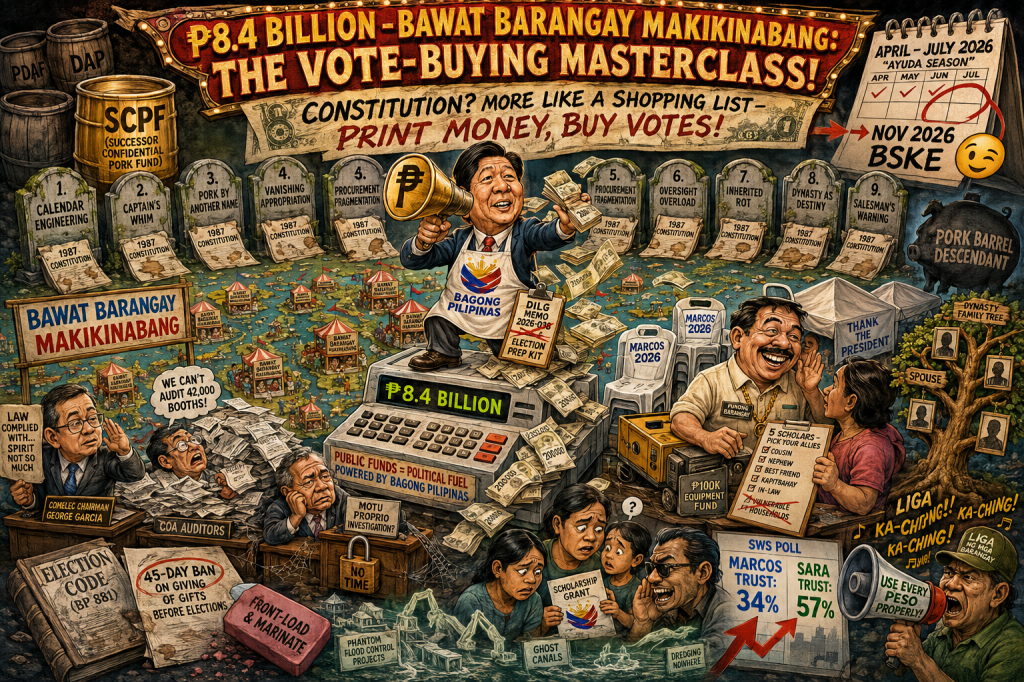
With the ink barely dry on the Sandiganbayan dockets from the flood-control scandal—that magnificent cathedral of graft where billions vanished into ghost canals and phantom dredging—Malacañang has unveiled its newest masterpiece of political alchemy: transmuting public funds into private electoral advantage while calling it “scholarships.” The “Bawat Barangay Makikinabang” Program, formalized through Department of the Interior and Local Government (DILG) Memorandum Circular No. 2026-038, distributes ₱200,000 to each of over 42,000 barangays. That’s ₱8.4 billion in pre-election cash, wrapped in the flag of “Bagong Pilipinas” and delivered with a wink that says: Remember this in November.
Let us count the constitutional sins, shall we? There are nine.
First Sin: Calendar Engineering
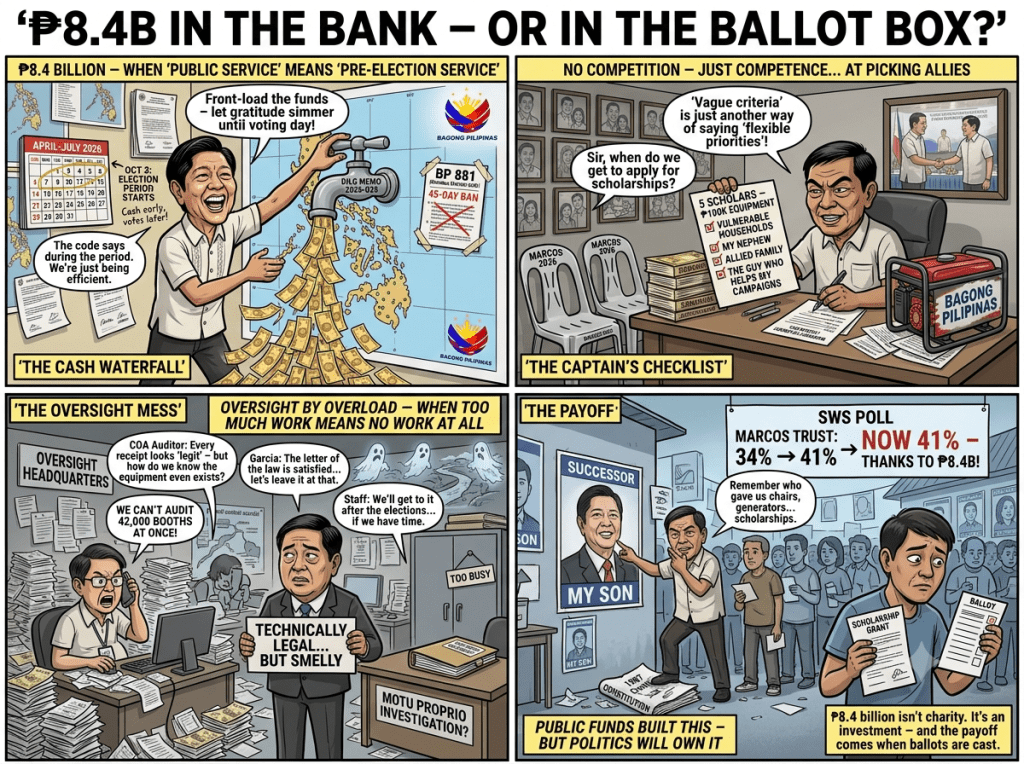
The program’s bulk disbursement ran from April through July 2026—coincidentally, just before the Barangay and Sangguniang Kabataan Elections (BSKE) election period opens on October 3. This is not administrative convenience; this is calendar engineering. Section 261(v) of Batas Pambansa Blg. 881 (Omnibus Election Code) prohibits releasing public funds for public works 45 days before an election. By front-loading the cash waterfall months ahead, the administration technically complies with the letter of the law while thoroughly violating its spirit. Commission on Elections (COMELEC) Chairman George Garcia has already flagged analogous concerns with the AKAP “ayuda ban” controversy. Here, the workaround is even more brazen: disburse early, let the gratitude marinate, and harvest votes when the ban lifts. The legal term for this is electioneering. The colloquial term is vote-buying on an industrial scale.
Second Sin: The Captain’s Whim
Each punong barangay personally selects five scholars and determines how ₱100,000 in equipment gets spent. No competitive process. No independent validation committee. Just the captain’s whims, potentially benefiting relatives, allies, and the politically pliable. Section 3(e) of Republic Act No. 3019 (Anti-Graft and Corrupt Practices Act) penalizes causing undue injury to government or giving unwarranted benefits through manifest partiality. When selection criteria are as vague as “vulnerable households” and documentation requirements can be satisfied with a barangay clearance signed by—you guessed it—the captain’s own office, the architecture of abuse is complete. This isn’t a scholarship program; it’s a patronage printing press.
Third Sin: Pork by Another Name
Here we arrive at the constitutional heart of darkness. The Supreme Court in Belgica v. Ochoa (G.R. No. 208566, 2013) struck down the Priority Development Assistance Fund (PDAF) precisely because post-enactment identification of beneficiaries by individual officials violated the separation of powers and the non-delegability of legislative authority. The Court defined “Presidential Pork Barrel” as “a kind of lump-sum, discretionary fund which allows the President to determine the manner of its utilization.” Replace “President” with “barangay captain” and the SCPF fits the definition perfectly: a lump-sum appropriation with multiple purposes, identified post-release, without genuine item-specific congressional authorization. The administration’s defense—that barangays are proper Local Government Units (LGUs), not legislators—is clever but constitutionally insufficient. The Belgica doctrine targets the architecture of discretion, not the identity of the discretionary actor. An ₱8.4 billion blank check is still a blank check.
Fourth Sin: The Vanishing Appropriation
Government communications interchangeably attribute the ₱200,000 to the Socio-Civic Projects Fund and the Local Government Support Fund—two distinct budget vehicles with different custodians (Office of the Executive Secretary versus Department of Budget and Management (DBM)). Article VI, Section 29(1) of the 1987 Constitution demands that “no money shall be paid out of the Treasury except in pursuance of an appropriation made by law.” Which appropriation? Which law? The shifting labels suggest either bureaucratic incompetence or deliberate commingling of funds to obscure the paper trail—either possibility is disqualifying for a program of this scale.
Fifth Sin: Procurement by Fragmentation
₱100,000 per barangay for equipment, multiplied by 42,000 separate procuring entities, most lacking technical capacity to conduct proper canvassing under Republic Act No. 9184 (Government Procurement Reform Act). The Liga ng mga Barangay-Cebu City chapter already centralized its procurement specifically “to avoid possible Commission on Audit (COA)” issues—an admission, from within the program’s own implementers, that direct-to-barangay purchasing is an audit disaster waiting to happen. Monobloc chairs, generator sets, tents—the same small-value procurement terrain that has produced scandals in every prior barangay equipment program. Fragmentation is not a bug; it’s a feature that guarantees non-detection.
Sixth Sin: Oversight by Overload
COA cannot audit 42,000 simultaneous, geographically dispersed disbursement points. It lacks the personnel, the bandwidth, and the institutional capacity. This is not a criticism of COA; it is a mathematical reality that the program’s designers understood perfectly. The flood-control scandal escaped early detection for exactly this reason: thousands of small-to-midsize contracts drown oversight agencies in sheer volume. The SCPF replicates this vulnerability at national scale, creating de facto immunity through administrative overload.
Seventh Sin: The Inherited Rot
The SCPF is the direct institutional descendant of the Presidential Social Fund under Presidential Decree No. 1869—a fund COA specifically flagged in 2009-2010 for irregular “donation” accounting when funds moved from the Office of the President to Non-Governmental Organization (NGO) conduits. The genetic defect is inherited. The same weak accounting controls, the same discretionary architecture, the same opacity in beneficiary identification. The rebranding from “PSF” to “SCPF” is cosmetic surgery on a rotting constitutional corpse.
Eighth Sin: Dynasty as Destiny
Under Republic Act No. 12232, barangay officials on their third consecutive term cannot run in the November 2026 BSKE. A meaningful share of captains currently distributing SCPF funds are, by law, termed out. For these officials, the political return on generous disbursement lies not in their own re-election but in anointing a successor—often a spouse, child, or sibling. The SCPF thus becomes an instrument for dynastic succession, entrenching political families at the most granular level of governance while the Anti-Political Dynasty Act languishes unpassed in Congress.
Ninth Sin: The Salesman’s Warning
The Liga ng mga Barangay national president publicly appealed to officials to “use every peso properly” because “public confidence had eroded following the flood control scandal.” This is not external criticism; this is an admission from the program’s most senior advocate that it operates under a corruption cloud. When the salesman warns you the product might be defective, believe him.
And what drives this entire machinery? The political calculus of a vulnerable president. Ferdinand Marcos Jr.’s Social Weather Stations (SWS) trust rating sits at a dismal 34% (net -11), cratered by scandal and dwarfed by Vice President Sara Duterte’s 57%. The solution? A pre-election cash cascade that rewards allies, pressures fence-sitters, and frames raw patronage as the smiling face of “Bagong Pilipinas.” He has personally presided over dozens of distribution events—political theater where government checks become campaign advertisements funded by taxpayers.
This is not governance. It is state capture through installment payments.
The Philippine Supreme Court has fought this war before and won. Belgica slayed the congressional pork barrel. Araullo v. Aquino III declared the DAP unconstitutional. Now the battle lines are drawn around the executive pork barrel, and the question is whether the Court—and the citizenry—have the stomach for a third constitutional victory. COA must launch a real-time special audit, not wait for post-disbursement disallowances. The Ombudsman must investigate motu proprio. Congress must demand the specific General Appropriations Act (GAA) line item behind the SCPF—or admit there is none.
To the Filipino citizen: Every scholar-selection list in your barangay is a public document. Every equipment purchase is a potential crime scene. Document. Report. Resist. The Constitution is not a decorative document; it is a weapon against precisely this brand of transactional politics.
There is a better Philippines beyond the grubby machinery of bribery disguised as benevolence—but only if we demand it.
Key Citations
A. Legal & Official Sources
- The 1987 Constitution of the Republic of the Philippines. Official Gazette of the Republic of the Philippines, 1987, http://www.officialgazette.gov.ph/constitutions/1987-constitution/.
- Batas Pambansa Blg. 881. Omnibus Election Code of the Philippines. 1985, lawphil.net/statutes/bataspam/bp1985/bp_881_1985.html.
- Republic Act No. 3019. Anti-Graft and Corrupt Practices Act. 1960, lawphil.net/statutes/repacts/ra1960/ra_3019_1960.html.
- Belgica v. Ochoa. G.R. No. 208566. Supreme Court of the Philippines, 19 Nov. 2013, lawphil.net/judjuris/juri2013/nov2013/gr_208566_2013.html.
- Republic Act No. 9184. Government Procurement Reform Act. 2003, lawphil.net/statutes/repacts/ra2003/ra_9184_2003.html.
- Presidential Decree No. 1869. Consolidating and Amending Presidential Decrees Relative to the Franchise and Powers of the Philippine Amusement and Gaming Corporation (PAGCOR). 11 July 1983, elibrary.judiciary.gov.ph/thebookshelf/showdocs/26/16246.
- Republic Act No. 12232. An Act Setting the Term of Office of Barangay Officials and Members of the Sangguniang Kabataan, and for Other Purposes. 13 Aug. 2025, elibrary.judiciary.gov.ph/thebookshelf/showdocs/2/99551.
- Araullo v. Aquino III. G.R. No. 209287. Supreme Court of the Philippines, 1 July 2014, lawphil.net/judjuris/juri2014/jul2014/gr_209287_2014.html.
- Department of the Interior and Local Government. Memorandum Circular No. 2026-038. Implementing Guidelines on Bawat Barangay Makikinabang: Presidential Assistance under the Socio-Civic Projects Fund. 2026, batasnatin.com/laws/mc-2026-038.
B. News Reports
- Chavez, Chito. “DILG: Over 42,000 Barangays to Receive P200K Each for College Scholarship, Community Development Programs.” Manila Bulletin, 27 July 2026, https://mb.com.ph/2026/07/27/dilg-over-42000-barangays-to-receive-p200k-each-for-college-scholarship-community-development-programs.
- Cabalza, Dexter “Marcos’ trust rating at 34%, Sara Duterte at 57% in SWS June poll.” Inquirer.net, Philippine Daily Inquirer, 20 July 2026, newsinfo.inquirer.net/2266435/marcos-trust-rating-at-34-sara-duterte-at-57-in-sws-june-poll.

- “Ang Hirap Maging Mahirap”: The PAO Scandal That Proves Government Contempt Is Nothing New

- “Far-Off” My Axx: Malacañang’s Claire Castro Drowns in Her Own Legal Gaslighting
- “Forthwith” to Farce: How the Senate is Killing Impeachment—And Why Enrile’s Right (Even If You Can’t Trust Him)
- “HINDI AKO NAG-RESIGN!”

- “I Know Nothing”: Baste Duterte’s Amnesia Defense Meets ₱33M in GenCorp Contracts

- “I’m calling you from my new Globe SIM. Send load!”

- “Mahiya Naman Kayo!” Marcos’ Anti-Corruption Vow Faces a Flood of Doubt

- “Manageable” Debt, Unmanageable Lies: DBM’s ₱21 Trillion Fairy Tale
- “Meow, I’m calling you from my new Globe SIM!”

- “Natrabaho”: One Word, One Ombudsman, and a Judiciary on Trial
- “No Special Jail for Crooks!” Boying Remulla Slams VIP Perks for Flood Scammers
- “Philippine-Controlled” or Yankee Gas Station? The Davao Fuel Depot Farce Exposed







Leave a Reply