
Within the Margin of Error, Beyond the Bounds of Credulity: How a Commissioned Poll Manufactured a Political Comeback
By Louis ‘Barok’ C. Biraogo | October 17, 2026
MGA kababayan, welcome back to the Kweba.
The headline arrived like a gift from the political heavens, wrapped in the respectable blue-and-white branding of Social Weather Stations (SWS) and delivered by the fine folks at Stratbase Consultancy: Marcos Up 2, Duterte Down 1. The spin wrote itself. The administration’s leaky ship had finally found a tiny bucket. The Vice President’s supposedly impregnable fortress had developed its first crack. The narrative gods were smiling on Malacañang.
Do not be fooled.
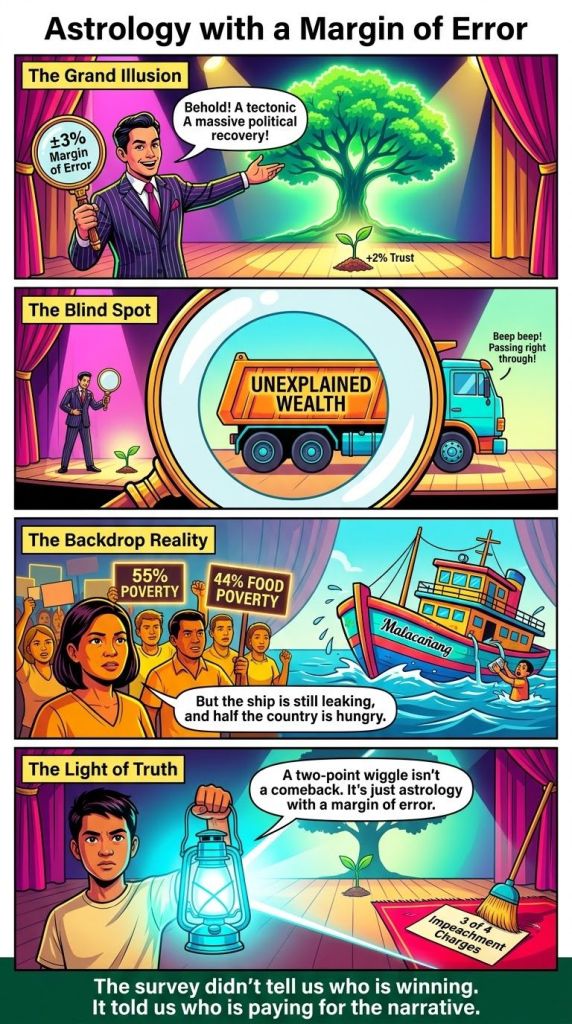
What we witnessed this week was not a political shift. It was a masterclass in statistical kabuki theater—a two-point wiggle dressed up as a comeback, a one-point dip sold as erosion, all packaged within a margin of error so wide you could drive a truck full of unexplained wealth through it. The real story is not that Marcos gained ground. The real story is that the SWS survey, commissioned by a think tank whose founder is making pointed political statements, emerged just days after SWS’s own non-commissioned satisfaction survey showed Marcos drowning at -11. And the real story is that the Filipino people—55% of whom now call themselves poor—are being fed a political horse race while their country burns.
Let me trace the trajectory of this statistical sleight of hand.
The Commissioned Confusion: Two Surveys, Two Stories, One Question
Here is the inconvenient arithmetic that the headline writers conveniently ignored.
On October 8, SWS released its own non-commissioned satisfaction survey. Marcos scored a net satisfaction rating of -11—“poor” in SWS’s own classification, down from -7 in June. Thirty-five percent satisfied. Forty-six percent dissatisfied. That is not a recovery. That is a freefall with a slightly slower acceleration.
Five days later, on October 13, SWS released a commissioned trust survey paid for by Stratbase Consultancy. Marcos’s “much trust” rating rose from 34% to 36%. His “little trust” fell from 45% to 40%. The headlines screamed recovery.
Now, SWS will tell you—correctly—that “trust” and “satisfaction” measure different things. You can trust someone’s intentions while being dissatisfied with their results. Fine. That is a legitimate distinction. But here is the question the SWS press release did not answer: Why did the commissioned survey produce a narrative of improvement while the non-commissioned survey produced a narrative of continued failure, in the same month, among the same population?
The answer may be innocent. The answer may be that trust and satisfaction genuinely diverged in September. But when the commissioning entity is Stratbase Consultancy—whose founder, Dindo Manhit, is quoted in the very same press release making politically charged observations about Marcos’s need to address “rising costs of living” and the “aftermath of high-profile arrests from the flood control scandal”—we are entitled to ask who benefits from the framing.
Stratbase is not a neutral academic institution. It is a consultancy. Its founder issues political commentary. And its commissioned survey, released five days after SWS’s own survey showed Marcos in “poor” territory, conveniently provided a counter-narrative just in time for the Sunday talk shows.
This is not proof of manipulation. It is proof of political situatedness. And in a country where survey results are treated as electoral prophecy, situatedness matters.
The Margin of Error: A Two-Point Miracle
Let us now perform the basic mathematics that the headline writers skipped.
Marcos’s trust rating rose from 34% to 36%. That is a two-percentage-point increase. The survey’s stated national margin of error is ±3 percentage points. A two-point movement is smaller than the margin of error. This means, statistically speaking, that Marcos’s trust rating may not have moved at all. It may have stayed at 34%. It may have dropped to 33%. The survey cannot tell us with confidence that anything changed.
The same applies to Duterte’s one-point decline, from 57% to 56%.
These are not trends. These are vibrations. They are the statistical equivalent of a mosquito landing on a car’s windshield and the driver declaring the vehicle has changed direction.
Yet the headlines—and the Stratbase press release, and the Palace communications apparatus, and the pro-administration social media echo chamber—treated these vibrations as tectonic shifts. Marcos is recovering. Duterte is slipping. The political winds are changing.
This is not analysis. This is astrology with a margin of error.
The Mindanao Mirage: An 18-Point Ghost
The most extraordinary number in the entire survey is this: Marcos’s trust rating in Mindanao rose from 17% in June to 35% in September. An 18-percentage-point jump. In the Duterte family’s ancestral stronghold. Among a population that has every reason to despise the man who cooperated with the International Criminal Court (ICC) to arrest Rodrigo Duterte.
This number is so anomalous that it demands scrutiny, not celebration.
The Mindanao regional sample is 300 respondents. The margin of error for regional estimates is ±6 percentage points. An 18-point shift in a 300-person sample is not impossible, but it is volatile. It could reflect a genuine shift. It could reflect sampling variation. It could reflect a change in the composition of respondents between the June and September surveys—SWS conducted new cross-sectional surveys, not a panel tracking the same individuals. It could reflect Mindanao respondents expressing “much trust” in Marcos not because they actually trust him, but because the question wording allowed for “somewhat much” trust, which is a far cry from enthusiastic endorsement.
And here is the context that makes the Mindanao number even more suspect: Duterte’s trust rating in Mindanao was 87%. Eighty-seven percent. In the same region, in the same survey, the Vice President facing impeachment for unexplained wealth commands near-universal trust while the President who arrested her father has climbed to 35%.
Does that sound like a coherent political landscape? Or does it sound like a region where respondents are answering different questions in their heads—where “trust” in Duterte means loyalty to the tribe, and “trust” in Marcos means something more transactional, more provisional, more confused?
The 18-point Mindanao jump is not evidence of Marcos’s regional rehabilitation. It is evidence that a single regional subsample of 300 people can produce wild swings that tell us almost nothing about durable political change.
The Satisfaction Gap: Why “Poor” Still Matters
While the commissioned trust survey generated headlines about Marcos’s two-point “recovery,” the non-commissioned satisfaction survey told a more brutal story.
Marcos’s net satisfaction rating of -11 is classified by SWS as “poor”. This is not a partisan interpretation. This is SWS’s own classification. The man is underwater. More Filipinos are dissatisfied with his performance than satisfied. And the trend is downward—from -7 in June to -11 in September.
Combine this with the self-rated poverty figures released the same week: 55% of Filipino families now consider themselves poor, up from 49% in June. Self-rated food poverty rose to 44%, up from 36%. Mindanao has the highest self-rated poverty rate at 64%.
So let us assemble the full picture: In Mindanao, where 64% of families call themselves poor, Marcos’s trust rating “soared” by 18 points. In the same region, Duterte’s trust rating remained at 87%. The President is presiding over an economy where more than half the population considers itself poor, and his satisfaction rating is “poor,” but his trust rating ticked up by an amount smaller than the margin of error.
If this is a recovery, I am the Queen of England.
The Impeachment Timing: The Survey Captured the Calm Before the Collapse
Here is the timeline that Stratbase and SWS did not highlight.
The survey was conducted September 21-27. During that period, the impeachment trial of Sara Duterte was ongoing. The Senate had voted to lower the conviction threshold to 14 votes on September 23—during the survey period. The prosecution was still presenting its case. The dramatic collapse of three of the four charges did not occur until October 13—after the survey.
In other words, the survey captured public sentiment at a moment when the impeachment trial’s outcome was still uncertain, when the prosecution’s case appeared robust, and when the full scope of its weaknesses had not yet been exposed.
Now consider what happened on October 13: the prosecution dropped three of the four charges against Duterte, including the confidential funds charge that had generated so much negative coverage. The remaining charge is unexplained wealth. Duterte’s lawyers called the move “completely unfair,” noting that withdrawn allegations had already been aired publicly.
If the prosecution’s case is now collapsing under its own weight, if three of four charges have been abandoned, what does the September trust rating really tell us? It tells us how people felt before they knew the prosecution would retreat. It tells us nothing about how they feel now.
The Stratbase survey is a snapshot of a moment that has already passed. The political landscape has shifted. The prosecution’s retreat is a gift to Duterte’s narrative of persecution and a blow to the administration’s credibility. And yet the survey’s release created a two-day news cycle about Marcos’s “recovery” and Duterte’s “slippage.”
This is not journalism. This is narrative laundering.
The Stratbase Connection: Who Paid for This Story?
Let us be precise about what we know and what we suspect.
We know that Stratbase Consultancy commissioned the trust survey. We know that Stratbase’s president and CEO, Victor Andres “Dindo” Manhit, is quoted in the press release making politically charged observations about Marcos’s need to address “rising costs of living,” the “aftermath of high-profile arrests from the flood control scandal,” and Duterte’s “ongoing impeachment trial”. We know that Stratbase is a “think tank” that regularly participates in policy debates and media commentary.
What we do not know—because SWS has not disclosed it—is the full questionnaire, the question order, the framing, and whether the commissioned items were designed to produce a particular narrative.
SWS has an established reputation. Its methodology is generally sound. But commissioned surveys are not the same as independent research. When an organization with a political profile pays for a poll, the questions may be neutral, but the interpretation is not. The release is not. The timing is not.
The satisfaction survey was released October 8. The trust survey was released October 13. Five days apart. One showed Marcos “poor.” The other showed Marcos “improving.” The sequencing created a narrative arc: bad news, then good news. The Palace could point to the trust survey as evidence that the satisfaction survey was an outlier. The administration’s allies could dismiss the “poor” rating as a statistical blip while embracing the “recovery” as vindication.
This is not a conspiracy. It is public relations. And it worked.
The Real Numbers: A Country in Crisis, a Political Class in Fantasyland
While the chattering classes debate whether Marcos gained two points or Duterte lost one, the actual condition of the Filipino people remains grim.
Fifty-five percent self-rated poverty. Forty-four percent food poverty. A satisfaction rating of “poor” for the sitting president. An impeachment trial that has become a political circus, with the prosecution abandoning three of four charges and the defense claiming vindication. A Vice President who commands 87% trust in her home region while facing allegations of P817.87 million in unexplained wealth. A former President in ICC custody, awaiting trial for crimes against humanity.
And what are we discussing? Whether a two-point movement in a commissioned survey constitutes a political comeback.
The survey-industrial complex has become a mechanism for manufacturing political narratives. Every quarter, new numbers arrive. Every quarter, pundits declare winners and losers. Every quarter, the fundamental questions—Who is benefiting from this economy? Who is being held accountable for corruption? Who is telling the truth about the flood control scandal?—are submerged beneath horse-race coverage.
The Stratbase survey is not an outlier in this regard. It is a particularly stark example of how commissioning, timing, and framing can transform statistical noise into political momentum.
The Barok Verdict
The SWS-Stratbase survey is not fraudulent. SWS’s methodology is professional. The numbers are probably accurate as a snapshot of September sentiment.
But the interpretation of those numbers has been manipulated. A two-point change within the margin of error has been sold as a recovery. A one-point change has been sold as erosion. An 18-point regional anomaly in a 300-person subsample has been treated as evidence of national momentum. And all of this has been released five days after a non-commissioned survey showed the President’s satisfaction rating in “poor” territory—creating a convenient counter-narrative for an administration desperate for good news.
The real story is not Marcos’s two points. The real story is that 55% of Filipinos consider themselves poor, 44% consider themselves food-poor, and the President’s satisfaction rating is classified as “poor” by the same polling firm that just told us he’s recovering.
The real story is that the prosecution’s impeachment case is collapsing, three of four charges have been dropped, and the survey that generated headlines about Duterte’s “slippage” was conducted before that collapse was known.
The real story is that we are being entertained with statistical theater while the country burns.
I am Louis ‘Barok’ C. Biraogo, and this is the view from the Kweba.
The survey did not tell us who is winning. It told us who is paying for the narrative.
Key Citations
- Cabalza, Dexter. “Marcos Trust Rating Climbs to 36%, but VP Duterte Maintains Lead at 56%.” INQUIRER.net, 13 Oct. 2026, newsinfo.inquirer.net/2322695/marcos-trust-rating-climbs-to-36-but-vp-duterte-maintains-lead-at-56.
- Social Weather Stations. SWS Confirms September 2026 Survey Items for Stratbase Consultancy on Public Trust in Ferdinand Marcos, Jr. and Sara Duterte. Social Weather Stations, 13 Oct. 2026, sws.org.ph/sws-confirms-september-2026-survey-items-for-stratbase-consultancy-on-public-trust-in-ferdinand-marcos-jr-and-sara-duterte/.
- Social Weather Stations. Third Quarter 2026 Social Weather Survey: Net Satisfaction with President Ferdinand Marcos, Jr. Falls to -11 in September 2026 from -7 in June 2026. Social Weather Stations, 8 Oct. 2026, sws.org.ph/wp-content/uploads/2026/10/pr20261008-SWR2026-III-Satisfaction-with-the-President-Believability-of-his-SONA-media-release.pdf.
- Social Weather Stations. Third Quarter 2026 Social Weather Survey: Self-Rated Poverty Rises by 6% to 55%, while Self-Rated Food Poverty Rises by 8% to 44%, between June and September 2026. Social Weather Stations, 13 Oct. 2026, sws.org.ph/wp-content/uploads/2026/10/pr20261013-SWR-2026-III-Self-Rated-Poverty-and-Food-Poverty-media-release.pdf.
- Reuters. “Prosecutors Drop Three Impeachment Charges against Philippine VP Duterte.” Reuters, 13 Oct. 2026, www.reuters.com/world/asia-pacific/prosecutors-drop-three-impeachment-charges-against-philippine-vp-duterte-2026-10-13/.
- Reuters. “Philippine Senate Lowers Threshold for Conviction in VP Duterte’s Impeachment Trial.” Reuters, 23 Sept. 2026, www.reuters.com/world/asia-pacific/philippine-senate-lowers-number-votes-needed-convict-vp-sara-duterte-2026-09-23/.
- International Criminal Court. Situation in the Philippines: The Prosecutor v. Rodrigo Roa Duterte. International Criminal Court, www.icc-cpi.int/philippines/duterte.
- Stratbase. Stratbase. Stratbase Consultancy, stratbase.ph.
- Lalu, Gabriel Pabico, et al. “Analyst: VP Sara Didn’t Declare P817-Million Wealth.” Inquirer.net, 10 Oct. 2026, newsinfo.inquirer.net/2320864/analyst-vp-sara-didnt-declare-p817-million-wealth.

- ₱9 Billion in ‘Savings’? DILG’s Fire Truck Deal Smells Like Smoke

- ₱8B BBM Pork: CCTV for Every Captain’s Kumpare?
- ₱8.9 Billion, 331 Ghost Police Stations: The TIKAS Scandal Explained

- ₱8.4 Billion, 42,000 Barangays, 1 Election: The “Bawat Barangay Makikinabang” Vote-Buying Masterclass

- ₱75 Million Heist: Cops Gone Full Bandit

- ₱6.77B Ghost Haunts Duterte: RTC Dismisses Mans Carpio’s Desperate Plea
- ₱6.77 Billion and Zero Cash: The Sara Duterte SALN Math That Doesn’t Add Up

- ₱6.7-Trillion Temptation: The Great Pork Zombie Revival and the “Collegial” Vote-Buying Circus

- ₱58.53B, Zero Receipts: The LGSF Pork Barrel Nobody Wants to Name
- ₱53 Million Man Tells ₱695-a-Day Workers to Stop Being ‘Mayabang’: The Audacity of BSP’s Remolona
- ₱4.4 Billion and a Witness Who Can’t Explain It: The Duterte Impeachment’s Most Expensive Non-Answer
- ₱3.06 Billion for Evacuation Centers—But Nobody Knows Where They’ll Stand (Or If They’ll Exist)






Leave a Reply