Ninety Percent in the Dark: Puno and Tiangco Just Admitted Congress Doesn’t Know What It Voted For
By Louis “Barok” C. Biraogo | November 5, 2026
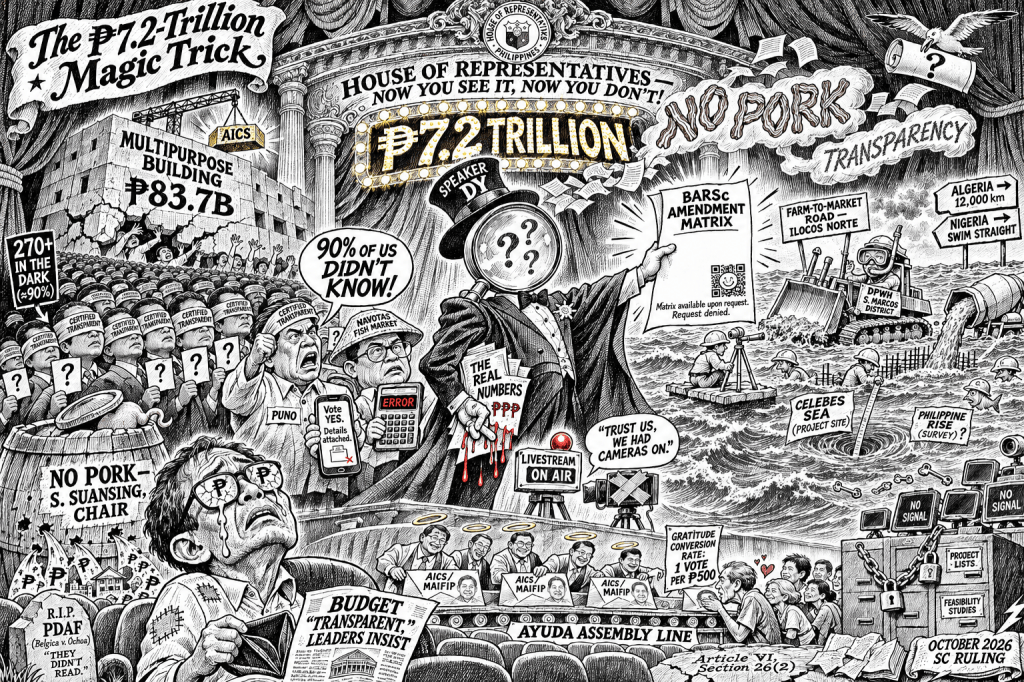
PARDON my provincial arithmetic, but let me get this straight. The House of Representatives—the institution the 1987 Constitution designates as the sole originator of appropriation bills—spent the first week of November 2026 insisting that its ₱7.2-trillion 2027 budget is a marvel of transparency. Speaker Faustino “Bojie” Dy III promised an open process. Appropriations Chair Mikaela Angela Suansing swore there is “no pork.”
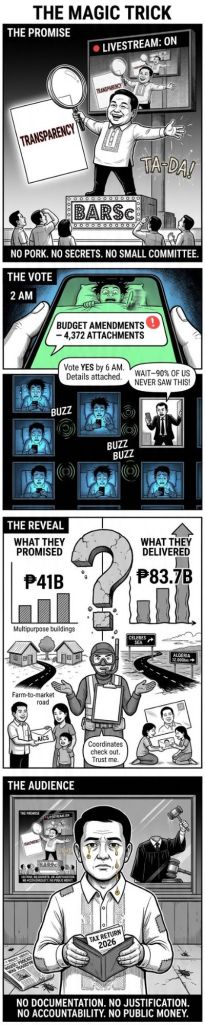
The Budget Amendments Review Sub-committee (BARSc) was unveiled as the anti-Small Committee: livestreamed, line-by-line, civil-society-friendly.
And then, on November 4, 2026, Deputy Speaker Ronaldo Puno and Navotas Rep. Toby Tiangco walked to the microphones and essentially said: we, the legislators, were kept in the dark about our own budget.
If Puno’s allegation—that 90% or more of House members were unaware of significant allocations—is even half true, then the House has achieved something remarkable: a transparency reform so opaque that its own beneficiaries couldn’t see it. That isn’t legislative reform. That’s a magic trick. And the audience, as usual, is the Filipino taxpayer.
The Reform That Wasn’t
Let’s be clear about what BARSc was sold as. According to the House’s own press releases—the ones still sitting on congress.gov.ph, timestamped October 2, 2026—the subcommittee would deliberate openly, livestream its proceedings, present approved amendments line by line, and welcome civil society monitors. The House even touted its abolition of the notorious Small Committee and the opening of bicameral conference proceedings to public observation.
Then the numbers started leaking. Tiangco cites ₱116 billion in BARSc adjustments. The People’s Budget Coalition (PBC) estimates nearly ₱200 billion in total legislative amendments.
And the Coalition’s broader red-flag tally—the one the Manila Tribune reported on November 2, 2026—reaches ₱970 billion, or roughly 13.5% of the entire budget, with the multipurpose building line alone ballooning from ₱41 billion in the executive proposal to ₱83.7 billion. A 104% increase. For multipurpose buildings.
So which is it? Is the discrepancy between ₱116 billion and ₱200 billion the product of innocent reclassification—or is it the mathematical residue of amendments that never saw a livestream? Nobody has reconciled the figures. Nobody has produced the BARSc amendment matrix. And the House’s response to a straightforward demand for documentation has been, essentially, trust us, we had cameras on.
A livestream is not accountability. A meeting can be broadcast while the documents remain in a locked drawer. A line-by-line presentation can disclose amounts while concealing proponents, project locations, feasibility studies, and beneficiaries.
As the House’s own Rules—Section 38 on public hearings and Section 149 on records open to the public—plainly contemplate, transparency is measured by the completeness and verifiability of information, not by whether the webcam was recording.
The Rules Nobody Wants to Read Aloud
Here is where the scandal graduates from optics to law. Article VI, Section 26(2) of the Constitution requires that the final printed form of a bill be distributed to members three days before passage, with no amendments permitted at last reading. Tiangco’s complaint that amendments were “texted to congress members at the last minute” is not a grievance about etiquette. It is a factual predicate for a constitutional challenge.
If the House approved a materially revised General Appropriations Bill (GAB) without the mandated three-day examination window, then the resulting law is vulnerable under the same reasoning the Supreme Court applied in Belgica v. Ochoa (G.R. No. 208566, November 19, 2013). There, the Court struck down the Priority Development Assistance Fund (PDAF) precisely because lump-sum, discretionary, post-enactment legislative control over funds violated separation of powers, specificity, and accountability.
And before anyone protests that Belgica only concerns post-enactment pork, remember the Court’s October 20, 2026 ruling—the one Lagman v. Executive Secretary (G.R. No. 271059) and Pimentel v. Executive Secretary (G.R. No. 271347) produced.
That ruling voided the 2024 General Appropriations Act (GAA)’s ₱449.5-billion unprogrammed appropriations increase and the ₱17.99-billion jump in the 2025 Special Road Fund. It also sternly reminded the Bicameral Conference Committee that its authority is confined to resolving House-Senate disagreements.
The Court has now demonstrated, recently and emphatically, that budget procedures have constitutional consequences. House leaders who assume legislative majority approval cures all defects are litigating against precedent they have plainly not read.
The Ilocos Norte Problem
Now to the part everyone in the Palace press corps is dutifully tiptoeing around. The PBC found ₱4.375 billion in Department of Public Works and Highways (DPWH) projects—405 of them—in the first district of Ilocos Norte. That district is represented by House Majority Leader Sandro Marcos, the President’s son.
The Palace’s response, per Philstar’s October 28 report, was to defend the insertions. The PBC, notably, did not allege that Marcos personally requested or benefited from these projects. And he may not have.
But when the single largest district-level concentration of House-added infrastructure happens to land in the district of the Majority Leader and presidential son, “appearance of conflict” is not a partisan smear. It is the minimum standard of political ethics under Republic Act (R.A.) 6713, which commands public officials to place public interest above personal interest and to act with justness and sincerity.
The remedy is not a denial. The remedy is disclosure: the complete project list, locations, technical documents, cost estimates, and proponents—for Ilocos Norte and for every other district.
If Misamis Occidental’s 2nd District (₱1.8 billion), Davao de Oro’s 2nd District (₱1.7 billion), Isabela’s 4th District (₱1.7 billion), and South Cotabato’s 2nd District (₱1.6 billion) can survive an objective needs assessment, then publish the assessment. The refusal to do so is itself the story.
Roads in the Celebes Sea
Perhaps the most damning detail—and the most absurd—concerns the project coordinates. The PBC reported that certain farm-to-market roads appeared plotted in the Celebes Sea and the Philippine Rise, while some building locations allegedly landed in Algeria and Nigeria. Typographical errors happen.
But when inaccurate geotagging is combined with missing engineering documentation and the Senate’s discovery, reported by the Philippine News Agency (PNA) on October 26, that only 1,418 of 16,244 DPWH projects had supporting documents submitted at that point, the picture changes. The project count itself grew from 11,420 in the executive’s National Expenditure Program (NEP) to 16,244 in the House version. The picture shifts from clerical sloppiness to systemic evidentiary failure.
The Senate has already begun acting. On November 3, Senate President Sherwin Gatchalian announced that 295 DPWH projects worth ₱8.836 billion would be removed for failing DPWH evaluation or lacking documentation.
Read that again: the Senate is stripping projects that the House approved and the executive’s own department could not validate. The House’s institutional defense—that the Senate can fix it—is an admission that the House didn’t.
The AICS Patronage Pipeline
Then there is the soft underbelly of this budget: the assistance programs. The PBC flags roughly ₱140 billion in ayuda, with Assistance to Individuals in Crisis Situations (AICS) and Medical Assistance for Indigent and Financially-Incapacitated Patients (MAIFIP) funding reportedly nearly doubling from the executive’s ₱72 billion to ₱137 billion.
These programs save lives. They also, when access runs through a legislator’s referral or guarantee letter, convert the taxpayer’s peso into a politician’s favor. The beneficiary remembers the patron, not the statute.
If preventive healthcare and universal services are being trimmed to finance discretionary, politician-gated assistance, then we have not merely a budget transparency problem—we have a political dependency machine with an appropriations line.
Who Benefits From the Outrage?
Now, the intrigue. Puno is no ordinary backbencher—he is a Deputy Speaker and a leader of the National Unity Party, which has aired “discontent” over district funding. It is entirely possible that his intervention reflects genuine institutional conviction; it is equally possible it is leverage in an intra-coalition bargaining session conducted via press conference.
Tiangco has a documented history of pushing transparency amendments that the floor rejected—including a proposal to itemize House spending and DPWH projects per district, nixed on October 7. Sincerity and self-interest are not mutually exclusive in Philippine politics; they usually travel together.
But here is the test that separates reformer from posturer: does the critic demand disclosure of all amendments, including those benefiting his own allies and constituents? Puno and Tiangco should publish their own district-level amendment requests. The People’s Budget Coalition, for its part, must release its reproducible dataset and methodology—it has been admirably careful to say it is not alleging corruption in every flagged project, and that distinction is what gives its demand credibility.
And Speaker Dy and Chair Suansing should stop defending the process in press releases and start producing five documents:
- The complete BARSc amendment matrix
- The NEP-to-House GAB line-by-line reconciliation
- BARSc minutes, attendance, and recordings
- Full project documentation for every new DPWH, Department of Agriculture (DA), and Department of Health (DOH) insertion
- The district-level allocation database with named proponents
If those documents vindicate the House, the House wins the argument in a week. If they don’t exist, or can’t be produced, then the refusal to produce them is the finding—and the burden shifts permanently.
The Institutional Question
Strip away the personalities and the Palace’s defensive crouch, and one question remains, the one the House must answer under pain of institutional irrelevance: who actually controls the national budget—the 300-plus elected representatives collectively, or a small circle that controls the flow of information, the timing of amendments, and the final line items?
Puno says 90% of members didn’t know. If that is even approximately true, then the chamber’s formal voting ritual is a Potemkin deliberation concealing a concentrated decision-making reality—and the 2027 GAB would be built on a foundation the Supreme Court has already shown it is willing to demolish.
The 1987 Constitution gives the House the power of the purse. It does not give House leaders the power to keep the purse’s contents a secret from the people who vote on it, from the senators who must concur, or from the taxpayers who fund it. No documentation, no justification, no accountability—no public money.
That was the lesson of Belgica. It was the lesson of Araullo. And the October 2026 ruling suggests the Court is prepared to teach it again.
The House has a choice: publish the matrix, or become the next case digest.
Key Citations
A. Laws, Court Decisions & Official Documents
- “Administrative Code of 1987.” Executive Order No. 292, 25 July 1987. Supreme Court E-Library, elibrary.judiciary.gov.ph/thebookshelf/showdocs/5/53270.
- Araullo v. Aquino III. G.R. No. 209287, Supreme Court of the Philippines, 1 July 2014. Lawphil, lawphil.net/judjuris/juri2014/jul2014/gr_209287_2014.html.
- Belgica v. Ochoa. G.R. Nos. 208566, 208493, and 209251, Supreme Court of the Philippines, 19 Nov. 2013. Supreme Court E-Library, elibrary.judiciary.gov.ph.
- Constitution of the Republic of the Philippines. 1987. Official Gazette of the Republic of the Philippines, officialgazette.gov.ph/constitutions/1987-constitution/.
- House of Representatives of the Philippines. Rules of the House of Representatives: Nineteenth Congress. July 2023, docs.congress.hrep.online/download/docs/hrep.house.rules.adopted.ebook.pdf.
- Philippines. Executive Order No. 2, s. 2016: Operationalizing in the Executive Branch the People’s Constitutional Right to Information and the State Policies to Full Public Disclosure and Transparency in the Public Service and Providing Guidelines Therefor. 23 July 2016. Official Gazette, officialgazette.gov.ph/2016/07/23/executive-order-no-02-s-2016/.
- Philippines. Republic Act No. 3019: Anti-Graft and Corrupt Practices Act. 17 Aug. 1960. Lawphil, lawphil.net/statutes/repacts/ra1960/ra_3019_1960.html.
- Philippines. Republic Act No. 6713: Code of Conduct and Ethical Standards for Public Officials and Employees. 20 Feb. 1989. Official Gazette, officialgazette.gov.ph/1989/02/20/republic-act-no-06713/.
- Philippines. Republic Act No. 7080: An Act Defining and Penalizing the Crime of Plunder. 12 July 1991. Lawphil, lawphil.net/statutes/repacts/ra1991/ra_7080_1991.html.
- Supreme Court of the Philippines. “Representative Edcel C. Lagman, Substituted by Albay First District Representative Krisel B. Lagman, et al. v. The Congress of the Philippines, et al.; Aquilino ‘Koko’ Pimentel III and Pantaleon ‘Bebot’ Alvarez v. Lucas P. Bersamin, et al.” G.R. Nos. 271059, 271347, E-02472, and E-04036, 7 Oct. 2026, sc.judiciary.gov.ph/271059-271347-e-02472-e-04036-representative-edcel-c-lagman-substituted-by-albay-first-district-representative-krisel-b-lagman-et-al-vs-the-congress-of-the-philippines-et-al-aquilino-koko/.
B. News Articles
- Basilio, Kenneth Christiane. “Lawmakers Also ‘Denied’ Transparency in 2027 Budget Bill.” Philippine Daily Inquirer, 4 Nov. 2026, newsinfo.inquirer.net/2335596/lawmakers-also-denied-transparency-in-2027-budget-bill.
- BusinessMirror. “House OKs P7.2-T 2027 Budget on Second Reading.” 7 Oct. 2026, businessmirror.com.ph/2026/10/07/house-oks-p7-2-t-2027-budget-on-second-reading/.
- BusinessMirror. “House Subpanel Ready to Scrutinize National Budget.” 28 Sept. 2026, businessmirror.com.ph/2026/09/28/house-subpanel-ready-to-scrutinize-national-budget/.
- Chi, Cristina. “Watchdogs Urge Senate to Strip House ‘Insertions’ in Pork-Riddled 2027 Budget.” Philstar.com, 26 Oct. 2026, philstar.com/headlines/2026/10/26/2565843/watchdogs-urge-senate-strip-house-insertions-pork-riddled-2027-budget.
- GMA News. “Watchdog Finds P1-T ‘Red Flags’ under House-Approved 2027 Budget; Senate to Check.” 27 Oct. 2026, gmanetwork.com/news/topstories/nation/1007329/watchdog-finds-p1-t-red-flags-under-house-approved-2027-budget-senate-to-check/story/.
- Ombay, Giselle. “Senate Flags P266-B DPWH Projects for Further Scrutiny.” Philippine News Agency, 26 Oct. 2026, pna.gov.ph/article/1282752.
- Oliquino, Edjen. “House Budget Insertions Push Multipurpose Building Allocation to P83.7 Billion.” Daily Tribune, 2 Nov. 2026, tribune.net.ph/2026/11/02/house-budget-insertions-push-multipurpose-building-allocation-to-p837-billion.
- Philstar.com. “Palace Defends Budget Insertions for Sandro.” The Philippine Star, 28 Oct. 2026, philstar.com/headlines/2026/10/28/2566234/palace-defends-budget-insertions-sandro.
- Philstar.com. “295 DPWH Projects to Be Removed.” The Philippine Star, 4 Nov. 2026, philstar.com/headlines/2026/11/04/2567699/295-dpwh-projects-be-removed.
- TV5 News. “Gatchalian: Senate to Axe 295 Infra Projects under 2027 Budget Bill.” 3 Nov. 2026, news.tv5.com.ph/national/read/gatchalian-senate-to-axe-295-infra-projects-under-2027-budget-bill.
C. Official Websites
- House of Representatives of the Philippines. “House Reviews Proposed Amendments to 2027 National Budget.” 2 Oct. 2026, congress.gov.ph/media/press-releases/10277.
- House of Representatives of the Philippines. “House Passes 2027 General Appropriations Bill on Second Reading; Suansing Highlights People-Centered, Super El Niño-Ready Budget.” 8 Oct. 2026, congress.gov.ph/media/press-releases/10301.
- Supreme Court of the Philippines. “SC Holds Unprogrammed Appropriations Subject to Guidelines, Voids Congressional Increases in 2024 and 2025 Budgets.” 20 Oct. 2026, sc.judiciary.gov.ph/sc-holds-unprogrammed-appropriations-subject-to-guidelines-voids-congressional-increases-in-2024-and-2025-budgets/.
- ₱9 Billion in ‘Savings’? DILG’s Fire Truck Deal Smells Like Smoke

- ₱8B BBM Pork: CCTV for Every Captain’s Kumpare?
- ₱8.9 Billion, 331 Ghost Police Stations: The TIKAS Scandal Explained

- ₱8.4 Billion, 42,000 Barangays, 1 Election: The “Bawat Barangay Makikinabang” Vote-Buying Masterclass
- ₱75 Million Heist: Cops Gone Full Bandit

- ₱63 to the Dollar: The Only Thing Falling Faster Than the Peso Is the Government’s Credibility

- ₱6.77B Ghost Haunts Duterte: RTC Dismisses Mans Carpio’s Desperate Plea
- ₱6.77 Billion and Zero Cash: The Sara Duterte SALN Math That Doesn’t Add Up

- ₱6.7-Trillion Temptation: The Great Pork Zombie Revival and the “Collegial” Vote-Buying Circus

- ₱58.53B, Zero Receipts: The LGSF Pork Barrel Nobody Wants to Name
- ₱53 Million Man Tells ₱695-a-Day Workers to Stop Being ‘Mayabang’: The Audacity of BSP’s Remolona
- ₱491-M Right-of-Way Scam: DPWH Paid for Ghost Land, Ombudsman Finally Notices




Leave a Reply