From +18 to +8 in Twelve Months: How the Public Stopped Believing the Flood-Control Prosecution Will Ever Reach a Jail Cell
By Louis ‘Barok‘ C. Biraogo — November 25, 2026
The Headline Number
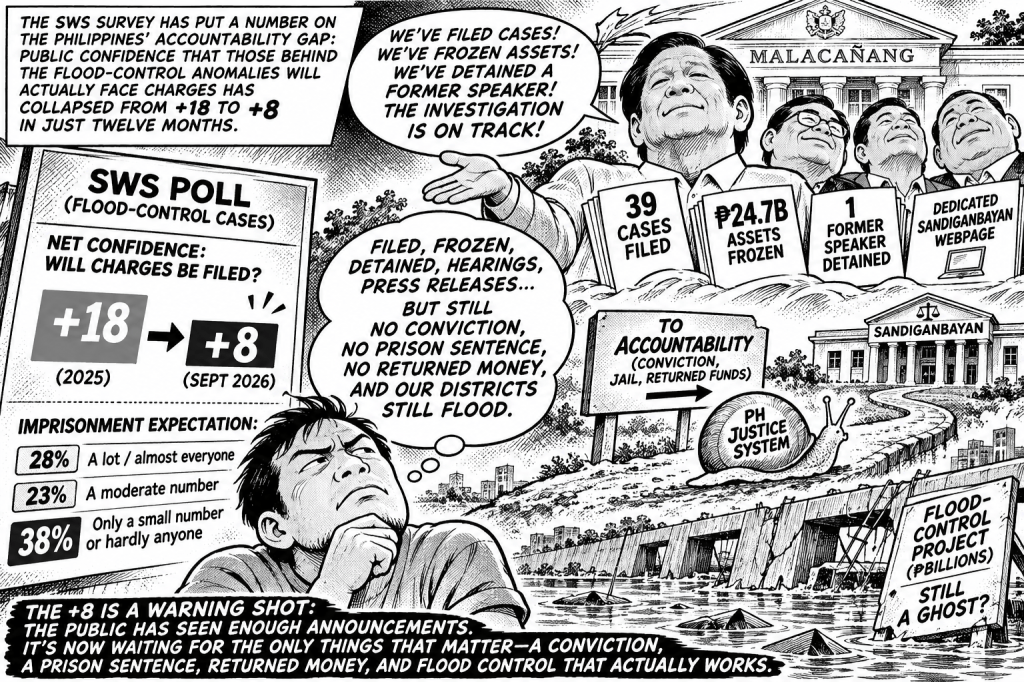
The Social Weather Stations (SWS) has done what Philippine politics excels at avoiding: it has put a number on the gap between announcement and accountability. Net confidence that those behind the flood-control anomalies will actually face charges has collapsed from +18 to +8 in twelve months. That is not a polling fluctuation. That is the sound of a credibility window slamming shut.
But the more damning figure sits beneath the headline. Thirty-eight percent of Filipinos expect only a small number—or hardly anyone—to be jailed. The government can file all the cases it wants. The public has already rendered its verdict on the verdict: it isn’t coming.
What the SWS Survey Actually Measured
Let us be precise about what the SWS September 2026 survey actually measured, because the administration’s defenders will surely try to muddy this. The survey was conducted September 21–27, 2026, face-to-face, 1,500 adults, ±3% national margin. The question was not whether respondents liked the investigation. It was whether they believed charges would be filed.
- Forty-one percent said much confidence.
- Thirty-two percent said little.
- Twenty percent were undecided.
- Seven percent admitted they did not know enough.
The net: +8.
Charging Is Not Punishing
Now compare that to the imprisonment expectations:
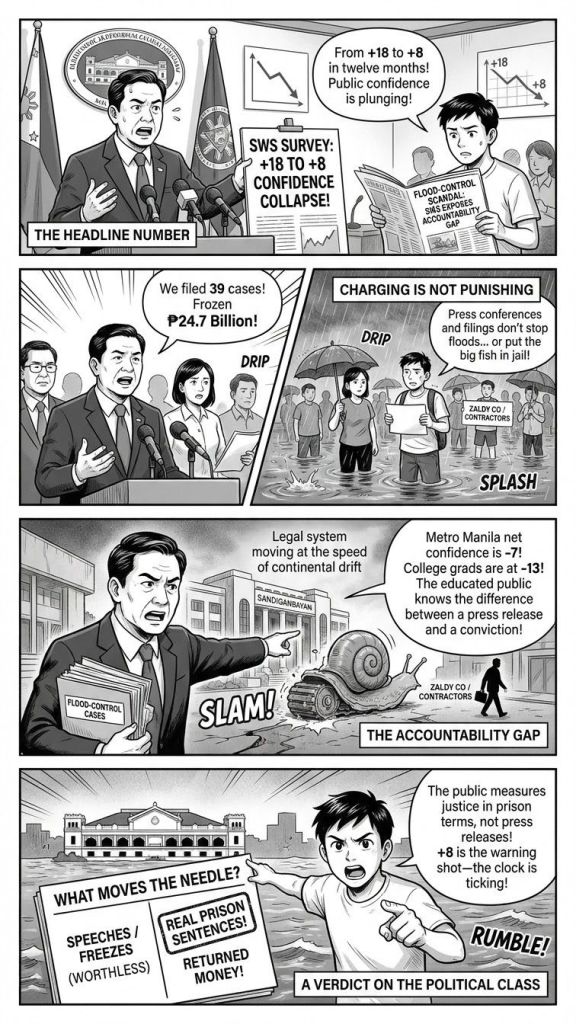
- Twenty-eight percent expect “a lot or almost everyone” to be jailed.
- Twenty-three percent expect a moderate number.
- Thirty-eight percent—the plurality—expect only a small number or hardly anyone.
The public is not confused about the distinction between charging and punishing. It is making that distinction with brutal clarity.
Where Confidence Collapses: Metro Manila and the College-Educated
The regional breakdown is where the political class should start sweating. Metro Manila is the only region with negative net confidence: –7. Mindanao sits at +15, Balance Luzon at +10, Visayas at +6.
The capital, the place where congressional hearings are televised, where Malacañang press briefings are held, where the Sandiganbayan sits, where the journalists actually read the charging documents—that is the place where confidence has gone negative. Proximity to the machinery of accountability has bred contempt for its output.
And then there is the education paradox, which is not really a paradox at all if you think about it for more than four seconds:
- College graduates: –13.
- Elementary graduates: +23.
- Junior high school graduates: +13.
The people with the most exposure to investigative journalism, procurement analysis, and legal commentary are the least convinced that any of this ends in handcuffs. This is not because education makes people cynical. It is because education makes people literate in the difference between a press conference and a conviction.
The Accountability Gap
The government’s response, predictably, has been to point at the case docket:
- Ombudsman Remulla announced 39 flood-control cases filed—35 before the Sandiganbayan, four before regional trial courts—covering 52 accused.
- The Anti-Money Laundering Council (AMLC) has frozen ₱24.7 billion in assets across hundreds of bank accounts, insurance policies, real properties, and yes, air assets.
- The Sandiganbayan has a dedicated webpage for flood-control cases.
- Martin Romualdez’s petition challenging the Ombudsman investigation was dismissed as moot after plunder charges were filed; he has been detained since September.
All of that is real. None of it is a conviction.
This is the accountability gap that the survey has exposed with surgical precision. The state measures progress in filings, freezes, and press releases. The public measures progress in prison sentences and returned money.
Between those two metrics lies a legal system that moves at the speed of continental drift.
What the Public Actually Sees
Consider what the public actually sees:
- Zaldy Co, the former House Appropriations Committee chairman charged in connection with the alleged P289-million ghost project in Oriental Mindoro, remains at large.
- The Discaya couple, whose companies secured billions in flood-control contracts and whose social-media displays of luxury vehicles became a national meme, are facing tax evasion charges.
- Contractors and engineers have been charged.
- A former Department of Public Works and Highways (DPWH) secretary has been charged and is reportedly being considered as a state witness.
The “big fish” are swimming in the same murky water as the minnows, and the public has noticed that the water has not drained.
Pulse Asia Corroborates the Trend
The Pulse Asia data from December 2025 corroborates the trend: confidence that guilty officials would be punished fell from 71 percent in September to 59 percent by December, with Metro Manila showing the sharpest erosion. This is not an SWS artifact. It is a consistent public judgment across polling firms.
The Undecided Bloc Is Still in Play
The undecided bloc—20 percent undecided plus 7 percent who “don’t know enough,” roughly 27 percent of respondents—is the only segment still in play. These are not government supporters. They are people waiting for evidence.
If the first high-profile conviction arrives, they may move toward confidence. If the first high-profile acquittal or dismissal arrives, they will move toward the exits. The government has perhaps one more news cycle of patience left.
What Would Actually Move the Needle
What would actually move the needle? Not another hearing. Not another freeze order. Not another speech about how the President is not the President of his family.
- A conviction.
- A prison sentence.
- Money actually returned to the Treasury, not merely frozen pending litigation.
- A functioning pumping station in a district that flooded last monsoon.
These are the only currencies the public is still accepting.
The Ombudsman’s Stakes
Remulla, to his credit, seems to understand the stakes. In his anniversary address, he noted that the ghost projects alone are roughly 18 times the pork barrel scam and warned that “time, money, connections, or a paid army online” will not save the accused. That is a strong statement. But statements are what got the government into this polling hole in the first place.
A Verdict on the Political Class
The SWS numbers are not a verdict on the courts. They are a verdict on the political class’s ability to sustain belief while the courts do their slow, untelevised work.
The government has filed the cases. It has frozen the assets. It has detained a former Speaker. And still, the public looks at the ledger and sees a system that charges the guilty and then lets them post bail.
The +8 is a warning shot. The next survey will tell us whether anyone in Malacañang, the Ombudsman’s office, or the Sandiganbayan was listening.
Key Citations
A. Reports & Studies
- Social Weather Stations. “SWS Confirms September 2026 Survey Items for Stratbase Consultancy on Public Trust in Ferdinand Marcos, Jr. and Sara Duterte.” Social Weather Stations, 13 Oct. 2026. Accessed 24 Nov. 2026.
B. News Articles
- Ayalin, Adrian. “SC Dismisses Romualdez Petition vs. Ombudsman’s Flood Control Scam Investigation.” ABS-CBN News, 4 Nov. 2026. Accessed 24 Nov. 2026.
- “Fewer Filipinos Believe Guilty Officials in Flood Control Scandal Will Be Punished, Pulse Asia Survey Shows.” Manila Bulletin, 12 Jan. 2026. Accessed 24 Nov. 2026.
- Laqui, Ian. “Ombudsman: 39 Flood Control Cases Filed, More Under Probe.” Philstar.com, 12 Oct. 2026. Accessed 24 Nov. 2026.
- Morong, Joseph. “A Year Into Flood Control Mess, 45 Individuals, 2 Top Contracting Firms Charged.” GMA News Online, 28 July 2026. Accessed 24 Nov. 2026.
- Porcalla, Delon. “AMLC Freezes P24.7 Billion Assets in Flood Mess.” Philstar.com, 24 Sept. 2026. Accessed 24 Nov. 2026.
- “Skepticism Deepens Over Flood Control Probes in SWS Poll.” Malaya Business Insight, 23 Nov. 2026. Accessed 24 Nov. 2026.
C. Official Websites
- “Flood Control and Infrastructure Cases.” Sandiganbayan. Accessed 24 Nov. 2026.
- Office of the Ombudsman. “Ombudsman Vows No Exemptions in Corruption Probe, Calls for Review on ‘Plunder Ruling.’” Office of the Ombudsman, 13 Oct. 2026. Accessed 24 Nov. 2026.

- “Ang Hirap Maging Mahirap”: The PAO Scandal That Proves Government Contempt Is Nothing New

- “Far-Off” My Axx: Malacañang’s Claire Castro Drowns in Her Own Legal Gaslighting

- “Forthwith” to Farce: How the Senate is Killing Impeachment—And Why Enrile’s Right (Even If You Can’t Trust Him)

- “HINDI AKO NAG-RESIGN!”

- “I Have No Reason to Doubt”: Teodoro’s MDT Fairy Tale

- “I Know Nothing”: Baste Duterte’s Amnesia Defense Meets ₱33M in GenCorp Contracts

- “I’m calling you from my new Globe SIM. Send load!”

- “Mahiya Naman Kayo!” Marcos’ Anti-Corruption Vow Faces a Flood of Doubt

- “Manageable” Debt, Unmanageable Corruption: The ₱19.66-Trillion Lie

- “Manageable” Debt, Unmanageable Lies: DBM’s ₱21 Trillion Fairy Tale

- “Meow, I’m calling you from my new Globe SIM!”

- “Natrabaho”: One Word, One Ombudsman, and a Judiciary on Trial






Leave a Reply