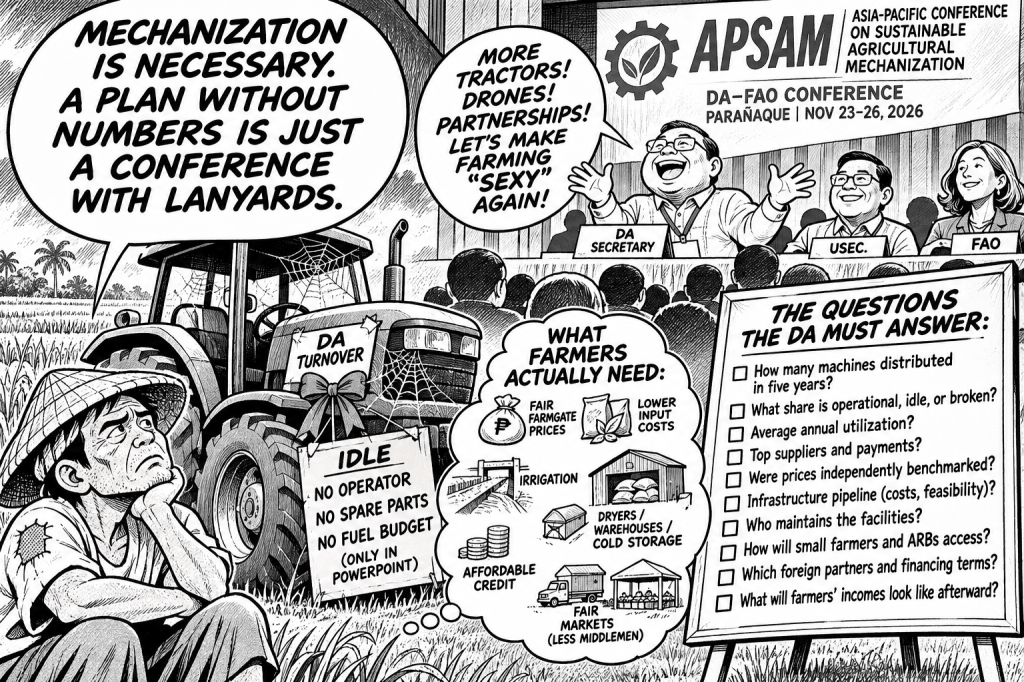
Mechanization is necessary. A plan without numbers is just a conference with lanyards.
By Louis “Barok” C. Biraogo | November 24, 2026
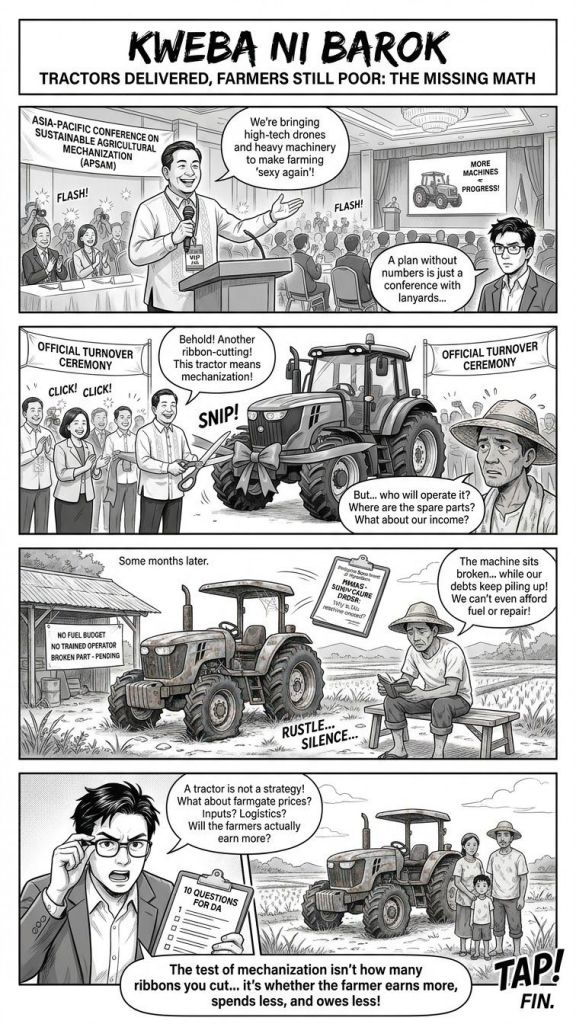
SOMEWHERE in a Philippine barangay, a shiny government tractor sits idle beside a rice paddy. Its cooperative lacks a trained operator, its spare parts have not arrived, and its fuel budget exists only in a PowerPoint. Meanwhile, in Parañaque this week, the Department of Agriculture (DA) is hosting a four-day conference on, of all things, more machines.
The Asia-Pacific Conference on Sustainable Agricultural Mechanization (APSAM) opened today, November 23, and runs through November 26, with the Food and Agriculture Organization (FAO) describing it as a regional platform for machinery, financing, services, and policy. Agriculture Secretary Francisco Tiu Laurel Jr. and Undersecretary Arrey Perez promise drones, heavy equipment, infrastructure, and partnerships. They want to make farming “sexy again.” Forgive me if I remain unseduced.
The Department That Already Knows
Here is what the press release omits. The DA already admits that handing over machines is not the same as delivering benefits. In 2025 it issued Memorandum Circular No. 15, creating the Infrastructure and Machinery Management Assessment System, or IMMAS, to monitor turned-over projects. Think about that. The department built a system to check whether its own machines are being used, maintained, and repaired. You do not build a smoke detector for a house that has never burned.
In July, the Philippine Center for Postharvest Development and Mechanization (PHilMech) confirmed the problem at a mechanization roadshow in Kalinga, saying it validates utilization reports and can issue show-cause orders to cooperatives that leave equipment idle. So the DA is announcing a bigger machine program while enforcing show-cause orders against the owners of the machines it already gave away. Where is the inventory? How many tractors, harvesters, and dryers sit broken or unused? The conference brochure does not say. It never does.
The Tyranny of the Ribbon-Cutting
Machinery is politically irresistible. A tractor has a nameplate, a turnover ceremony, and a photo opportunity. Nobody holds a ribbon-cutting for a farmer’s net income rising by four percent. That is why mechanization programs tend to be graded on machines delivered rather than hectares served. Ask who picks the beneficiaries. Ask whether the cooperative that receives the combine harvester is the one with the most farmland, or the one with the best connections to the congressman. Ask why Belgica v. Ochoa still has to be explained to officials who attend turnover ceremonies in election season.
I will be fair, because the law demands it. Sistoza v. Desierto and Martel v. People remind us that procurement irregularities do not automatically equal graft under Section 3(e) of Republic Act No. 3019 (Anti-Graft and Corrupt Practices Act). Evident bad faith, manifest partiality, or gross inexcusable negligence must be proven. An expensive tractor is not a crime. But an unaudited, unexamined tractor pipeline, running under Republic Act No. 12009 (New Government Procurement Act), is an invitation to the sort of scrutiny that Madera and Manankil v. Commission on Audit (COA) say the COA may apply to any expenditure that is excessive, extravagant, or unconscionable. Suspicion is not proof. It is, however, an excellent reason to demand documents.
The Statistic Nobody Wants to Explain
The Philippine Statistics Authority’s (PSA) 2022 census found threshers in 46.6 percent of 42,020 barangays, transplanters in 42.4 percent, and rice mills in 29.5 percent. The DA may read this as a shortage. A sharper reading is that presence is not access. A machine in a barangay may belong to a private owner who charges unaffordable rates, or it may be broken, or it may be too large for the fragmented parcels it is supposed to serve. The real gap is between equipment that exists and equipment a small farmer can actually rent on time, at a fair price. The DA has not measured that gap, or if it has, it is not sharing.
What the Farmer Actually Needs
Strip away the drones and the conference lanyards. A farmer’s problem is rarely a lack of horsepower. It is farmgate prices, input costs, debt, irrigation, middlemen, and imports that depress what the harvest fetches. A machine can raise yield while the farmer stays poor. Higher production is not higher income. If the DA cannot show that mechanization raises net income per hectare, then it is simply buying expensive machinery and calling it a policy.
And “sexy” is not a labor strategy. Young Filipinos will not return to the land because a drone hovers over it. They will return when farming pays, when land and credit are reachable, and when markets are fair. A drone is a prop. A viable livelihood is a reason.
The Alternatives the Brochure Ignores
There are better models. Mechanization-as-a-service, where cooperatives or private operators own the machines and farmers pay per hectare, would raise utilization and spare small farmers from ruinous capital costs. Machinery-service centers could offer repair, parts, training, and operators. Infrastructure, meaning dryers, warehouses, cold storage, and farm-to-market roads, may deliver more value than another tractor. Undersecretary Perez’s talk of “building the logistical chain” is the most promising line in the entire announcement. It is also the least specified.
Ten Questions for Parañaque
Before another peso is committed, the DA should answer plainly:
- How many machines has it distributed in five years?
- What share is operational, idle, or unserviceable?
- What is the average annual utilization?
- Who are the top suppliers, and what are they paid?
- Were prices independently benchmarked?
- What is the infrastructure pipeline, with costs and feasibility studies?
- Who maintains the facilities once the ribbon is cut?
- How will small farmers and agrarian reform beneficiaries gain access?
- Which foreign partners and financing terms are on the table, and will the agreements be disclosed?
- What will farmers’ incomes look like afterward?
If the answers to these are “forthcoming,” then the conference was a trade show.
The Verdict
Mechanization is necessary. I say so without irony. The aging workforce, the labor shortages, and the postharvest losses are real. But necessity is not competence, and a worthy goal does not excuse a thin plan. The DA has given us intentions, a conference, and a promise of partnerships. It has not given us a machinery inventory, a utilization rate, or a single figure on what farmers will earn.
The test of APSAM is not whether the Philippines buys more machines. It is whether a farmer in November 2028 earns more, spends less, and owes less than she does today. Otherwise we will have replaced the old picture of the struggling farmer with a new one: the struggling farmer, standing beside an expensive, idle machine, while officials cut a ribbon nearby.
Key Citations
A. Legal & Official Sources
- Belgica v. Ochoa. G.R. No. 208566, 19 Nov. 2013. Lawphil, lawphil.net/judjuris/juri2013/nov2013/gr_208566_2013.html.
- Department of Agriculture. “DA, FAO Conference Seeks to Accelerate Farm Mechanization across Asia-Pacific.” Department of Agriculture, 22 Nov. 2026, http://www.da.gov.ph/da-fao-conference-seeks-to-accelerate-farm-mechanization-across-asia-pacific/.
- Department of Agriculture. Memorandum Circular No. 15, Series of 2025: Guidelines in the Conduct of Infrastructure and Machinery Management Assessment System (IMMAS) on Turned-Over Projects of the Department of Agriculture. 8 May 2025, http://www.da.gov.ph/laws-and-issuances/memorandum-circulars/.
- Food and Agriculture Organization of the United Nations. “Asia-Pacific Conference on Sustainable Agricultural Mechanization (APSAM).” FAO Regional Office for Asia and the Pacific: Events, 23–26 Nov. 2026, http://www.fao.org/asiapacific/events/events-detail/1/en.
- Madera v. Commission on Audit. G.R. No. 244128, 8 Sept. 2020. Lawphil, lawphil.net/judjuris/juri2020/sep2020/gr_244128_2020.html.
- Manankil v. Commission on Audit. G.R. No. 217342, 13 Oct. 2020. Supreme Court E-Library, elibrary.judiciary.gov.ph/thebookshelf/showdocs/1/66556.
- Martel v. People. G.R. Nos. 224720–23 and 224765–68, 2 Feb. 2021. Supreme Court E-Library, elibrary.judiciary.gov.ph/thebookshelf/showdocs/1/67194.
- Philippine Center for Postharvest Development and Mechanization. “PHilMech, Partners Hold Press Conference at the 2026 Mechanization Roadshow in Kalinga.” PHilMech, 28 July 2026, http://www.philmech.gov.ph/?action=storyFullView&page=stories&recordID=202673090430AMea2b0f&storyCateg=News&storyMonth=7&storyYear=2026.
- Philippines. Republic Act No. 3019. Anti-Graft and Corrupt Practices Act. 17 Aug. 1960. Lawphil, lawphil.net/statutes/repacts/ra1960/ra_3019_1960.html.
- Philippines. Republic Act No. 12009. New Government Procurement Act. 20 July 2024. Lawphil, lawphil.net/statutes/repacts/ra2024/ra_12009_2024.html.
- Sistoza v. Desierto. G.R. No. 144784, 3 Sept. 2002. Supreme Court E-Library, elibrary.judiciary.gov.ph/thebookshelf/showdocs/1/51505.
B. News Reports
- “Rice, Corn Mills Close Shop over 1,000 Barangays.” Philstar.com, 2 Jan. 2025, philstar.com/business/2025/01/02/2411192/rice-corn-mills-close-shop-over-1000-barangays.
- Romero-Alcazar, Maria Bernadette. “Philippines Embraces Tech to Boost Farming Efficiency and Cut Costs.” Daily Tribune, 23 Nov. 2026, tribune.net.ph/2026/11/23/philippines-seeks-to-end-low-yield-high-cost-farming-via-tech.

- ₱9 Billion in ‘Savings’? DILG’s Fire Truck Deal Smells Like Smoke
- ₱8B BBM Pork: CCTV for Every Captain’s Kumpare?
- ₱8.9 Billion, 331 Ghost Police Stations: The TIKAS Scandal Explained

- ₱8.4 Billion, 42,000 Barangays, 1 Election: The “Bawat Barangay Makikinabang” Vote-Buying Masterclass

- ₱75 Million Heist: Cops Gone Full Bandit

- ₱63 to the Dollar: The Only Thing Falling Faster Than the Peso Is the Government’s Credibility

- ₱6.77B Ghost Haunts Duterte: RTC Dismisses Mans Carpio’s Desperate Plea

- ₱6.77 Billion and Zero Cash: The Sara Duterte SALN Math That Doesn’t Add Up

- ₱6.7-Trillion Temptation: The Great Pork Zombie Revival and the “Collegial” Vote-Buying Circus

- ₱58.53B, Zero Receipts: The LGSF Pork Barrel Nobody Wants to Name
- ₱53 Million Man Tells ₱695-a-Day Workers to Stop Being ‘Mayabang’: The Audacity of BSP’s Remolona

- ₱491-M Right-of-Way Scam: DPWH Paid for Ghost Land, Ombudsman Finally Notices





Leave a Reply