How Manila Got Strong-Armed Into a Trade ‘Deal’ That Violates the Constitution, the Statutes, and Basic Arithmetic
By Louis “Barok” C. Biraogo | November 22, 2026
Who Is Minding the Store?
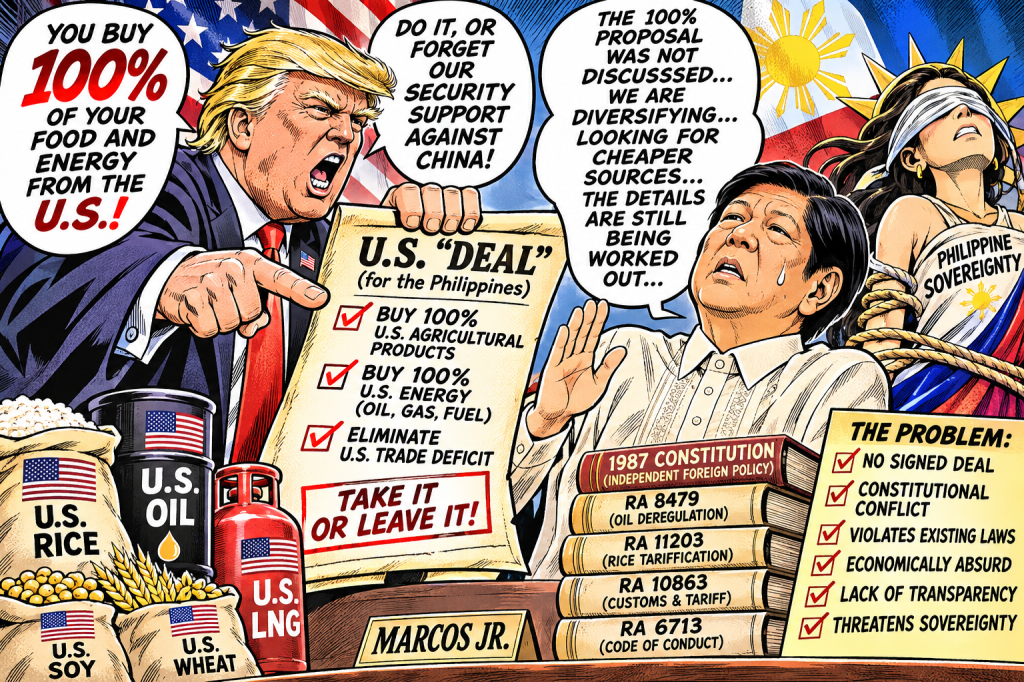
Here is a question for the Marcos administration, posed with the bluntness this controversy deserves: When the President of the United States announces to the world that the Philippines has agreed to buy one hundred percent of its food and energy from America, and your President offers no direct denial — only a carefully worded claim that the 100% proposal ‘was not discussed’ — and only once he is safely in another country, who exactly is minding the store?
The answer, based on the documentary trail, appears to be: nobody with a lawyer’s phone number.
Trump Says It, Marcos Fogs It
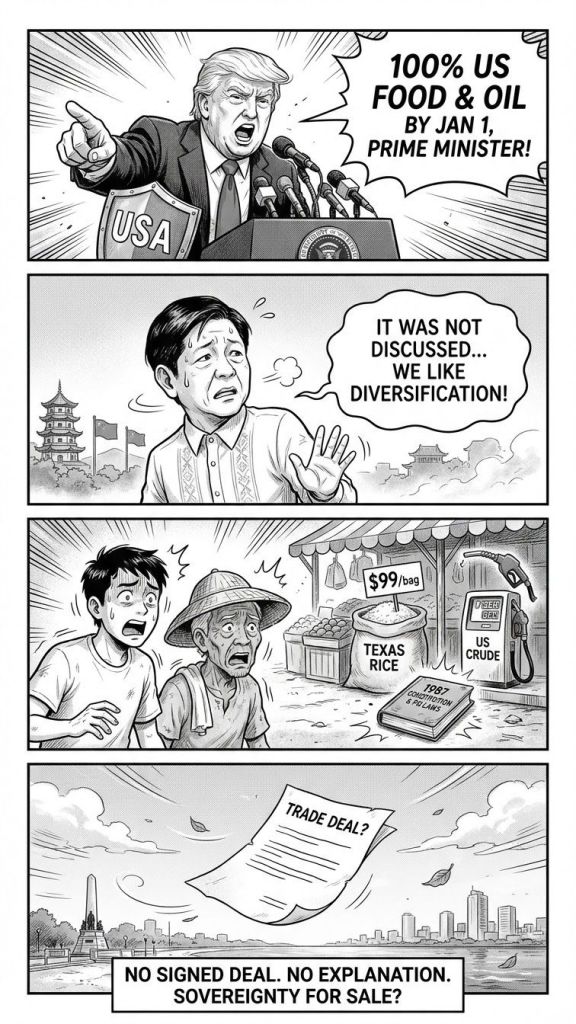
On November 20, Donald Trump told reporters at the White House that he had demanded during his Manila meeting that the Philippines purchase 100 percent of its agricultural and energy requirements from the United States beginning January 1, 2027 — just over a month away. He tied this supposed surrender of Philippine sourcing sovereignty directly to American security guarantees against China, suggesting that Brazil and the Middle East did not deserve Philippine business because they would not shed blood for Manila in a shooting war. He even called Marcos “Prime Minister,” a protocol gaffe that would be comic if the substance were not so ominous.
Marcos’ response, delivered from China four days later, was a masterclass in diplomatic fog. He spoke of “diversification,” of “cheaper sources,” of opening markets that had been closed. “He said the 100% proposal ‘was not discussed. He did not say Trump’s account was false. There is a difference between denying a conversation happened and denying that you agreed to its substance — and Marcos chose the softer, safer denial.
The Fact Sheet That Forgot the Fiction
The White House fact sheet, released the same day as the meeting, tells its own story. It enumerates a $17-billion package across Southeast Asia—Boeing jets, satellites, defense cloud contracts, a fuel depot at Subic Bay. The 99 percent tariff cut belongs to a separate deal with Thailand. What it does say is that both leaders “committed to eliminate the US trade deficit” through increased Philippine imports of American energy and agriculture—a vague pledge, not a 100 percent mandate. Nowhere does it codify 100 percent agricultural or energy exclusivity. The official document does not say what the American President said. And the Philippine President, when given the opportunity, did not say it either.
So what did happen? Either Trump fabricated a commitment out of whole cloth—a serious charge, but one consistent with his habit of treating negotiations as theatrical productions—or Marcos privately assented to something he now lacks the courage to either confirm or repudiate. Neither possibility reflects well on the Republic.
A Handshake Is Not a Statute
The legal reality is even more damning than the political one. Even if Marcos had stood up at the Association of Southeast Asian Nations (ASEAN) Summit and declared, “Yes, Donald, we will buy only from you,” the commitment would be constitutionally stillborn. The 1987 Constitution requires an independent foreign policy. It directs the State to protect Filipino enterprises against unfair foreign competition. It vests tariff and import-quota authority in Congress, delegable to the President only within specified limits. A binding, permanent realignment of national trade policy cannot be executed through a handshake and a press conference.
And the statutes? Republic Act No. 8479 (Downstream Oil Industry Deregulation Act) explicitly guarantees that “any person or entity may import or purchase any quantity of crude oil and petroleum products from a foreign or domestic source.” The President cannot compel Petron, Shell, or any private importer to buy American crude without Congress repealing the Downstream Oil Industry Deregulation Act.
Republic Act No. 11203 (Rice Tariffication Law) liberalized rice trading, replacing quotas with tariffs. Republic Act No. 10863 (Customs Modernization and Tariff Act) allows tariff adjustments only after formal investigation by the Tariff Commission and recommendation from the National Economic and Development Authority (NEDA). None of these procedural prerequisites appear to have been met, because—and this is the part that ought to terrify every Filipino consumer—there appears to be no signed agreement to which they could apply.
Rice From Texas, Crude From Nowhere
Here is the economic absurdity the Palace would rather you not contemplate. The Philippines’ top agricultural import is rice. The United States is not a competitive rice exporter to this market; Vietnam and Thailand are. Philippine refineries are configured for Middle Eastern crude grades; an overnight switch to American oil would require retrofitting, higher freight costs, and a domestic price shock that would make the current inflation crisis look like a rounding error. Trump’s demand is not a trade deal. It is a thought experiment dressed in a suit.
Yet the administration’s response has been neither to publish the framework nor to deny the exclusivity claim with the clarity it demands. Instead, Philippine officials mutter about “details still being worked out.” This is the language of a government that has either lost control of the narrative or is hiding the ball. Both are unacceptable.
Hedging Is Not Surrender
Consider the timing. Four days before meeting Trump, Marcos hosted Brazilian President Lula da Silva to expand agricultural and biofuel cooperation. Immediately after Trump left, Marcos flew to China and returned with over ₱41 billion in investment pledges. This is not the behavior of a leader who has just promised to abandon Brazil and the Middle East. It is the behavior of a leader practicing the middle-power hedging that has defined Philippine foreign policy since the end of the Cold War—and which Trump, in his mercantilist ignorance, has now publicly attempted to foreclose.
Silence Is Not Strategy
The ethical dimension deserves separate indictment. Republic Act No. 6713 (Code of Conduct and Ethical Standards for Public Officials and Employees) requires public officials to uphold public interest over personal interest, to act with justness and sincerity, and to remain loyal to the Republic. If a trade arrangement of this magnitude—affecting food prices, energy costs, farmer livelihoods, and the national trade balance—is being negotiated in conditions of opacity, then the Code of Conduct is not merely being bent. It is being shredded. The public has a right to know what its government has promised, to whom, and at what price. The Palace’s silence is not strategic ambiguity. It is contempt.
The Senate, if it retains any institutional memory of its constitutional role, should compel the Department of Foreign Affairs (DFA) and the Department of Trade and Industry (DTI) to produce the complete text of any signed or initialed document, every side letter, and every memorandum of understanding. If none exists—if this entire episode was a presidential improvisation that the Philippine government is now scrambling to manage—then the Senate should say so explicitly, and the President should explain why he allowed a foreign leader to misrepresent the terms of a bilateral relationship on Philippine soil.
Charitable, Uncharitable, Unacceptable
The most charitable interpretation is that Trump exaggerated. The least charitable interpretation is that Marcos agreed to something he cannot legally deliver and is now hoping the controversy dies before the January 1 deadline arrives. Neither interpretation inspires confidence. Both suggest a government that treats sovereignty as a rhetorical flourish rather than a binding constraint.
Clientelism by Another Name
There is a word for what happens when a smaller ally allows a larger patron to dictate the terms of its economic survival in exchange for security guarantees. That word is not “partnership.” It is not “alliance.” It is “clientelism,” and it has a long and unhappy history in this part of the world.
The Philippines can buy American wheat and soybeans. It can welcome American investment and technology. It can maintain the Mutual Defense Treaty and the Visiting Forces Agreement. What it cannot do—what it must not do—is allow the price of American protection to be denominated in the surrender of its own economic judgment.
Marcos should publish the deal. If there is no deal, he should say so, loudly and in Washington’s direction. And if Trump’s “100 percent” was a fiction, the President of the Philippines owes his people an explanation for why he did not correct it the moment the words left the American President’s mouth.
The alternative is to accept that in the Philippines of 2026, sovereignty is negotiable, transparency is optional, and the President’s silence is for sale. That is not a trade policy. It is a surrender, and it deserves to be named as such.
Key Citations
A. Legal & Official Sources
- Agreement between the Government of the Republic of the Philippines and the Government of the United States of America Regarding the Treatment of United States Armed Forces Visiting the Philippines (Visiting Forces Agreement). 10 Feb. 1998. Lawphil Project, https://lawphil.net/international/treaties/vfa_1998.html.
- “Fact Sheet: President Donald J. Trump Secures Historic Economic Deals for American Workers and Strengthens America’s Leadership in Asia.” The White House, 18 Nov. 2026, https://www.whitehouse.gov/fact-sheets/2026/11/fact-sheet-president-donald-j-trump-secures-historic-economic-deals-for-american-workers-and-strengthens-americas-leadership-in-asia/.
- Mutual Defense Treaty between the Republic of the Philippines and the United States of America. 30 Aug. 1951. The Avalon Project, Yale Law School, https://avalon.law.yale.edu/20th_century/phil001.asp.
- Philippines, Congress. Republic Act No. 6713: Code of Conduct and Ethical Standards for Public Officials and Employees. 20 Feb. 1989. Lawphil Project, https://lawphil.net/statutes/repacts/ra1989/ra_6713_1989.html.
- —. Republic Act No. 8479: Downstream Oil Industry Deregulation Act of 1998. 10 Feb. 1998. Lawphil Project, https://lawphil.net/statutes/repacts/ra1998/ra_8479_1998.html.
- —. Republic Act No. 10863: Customs Modernization and Tariff Act. 30 May 2016. Lawphil Project, https://lawphil.net/statutes/repacts/ra2016/ra_10863_2016.html.
- —. Republic Act No. 11203: An Act Liberalizing the Importation, Exportation and Trading of Rice. 14 Feb. 2019. Lawphil Project, https://lawphil.net/statutes/repacts/ra2019/ra_11203_2019.html.
- The 1987 Constitution of the Republic of the Philippines. Official Gazette of the Republic of the Philippines, 1987, https://www.officialgazette.gov.ph/constitutions/1987-constitution/.
B. News Reports
- Delgado, Harlene. “Trump Announces $17-B Deals, Investment for US Firms Following ASEAN Visit.” ABS-CBN News, ABS-CBN Corporation, 19 Nov. 2026, https://www.abs-cbn.com/news/business/2026/11/19/trump-announces-17-b-deals-investment-for-us-firms-following-asean-visit-1342.
- Guldogan, Diyar. “Trump Announces US-Philippines Trade Deal, Expanded Defense Cooperation.” Anadolu Agency, 18 Nov. 2026, https://www.aa.com.tr/en/asia-pacific/trump-announces-us-philippines-trade-deal-expanded-defense-cooperation/4128499.
- Romero, Alexis, and Louella Desidero. “‘Philippines to Buy 100% of Farm Products, Energy from US.’” The Philippine Star, 22 Nov. 2026, https://www.philstar.com/headlines/2026/11/22/2571814/philippines-buy-100-farm-products-energy-us.
- ₱9 Billion in ‘Savings’? DILG’s Fire Truck Deal Smells Like Smoke
- ₱8B BBM Pork: CCTV for Every Captain’s Kumpare?
- ₱8.9 Billion, 331 Ghost Police Stations: The TIKAS Scandal Explained

- ₱8.4 Billion, 42,000 Barangays, 1 Election: The “Bawat Barangay Makikinabang” Vote-Buying Masterclass
- ₱75 Million Heist: Cops Gone Full Bandit

- ₱63 to the Dollar: The Only Thing Falling Faster Than the Peso Is the Government’s Credibility
- ₱6.77B Ghost Haunts Duterte: RTC Dismisses Mans Carpio’s Desperate Plea
- ₱6.77 Billion and Zero Cash: The Sara Duterte SALN Math That Doesn’t Add Up
- ₱6.7-Trillion Temptation: The Great Pork Zombie Revival and the “Collegial” Vote-Buying Circus

- ₱58.53B, Zero Receipts: The LGSF Pork Barrel Nobody Wants to Name
- ₱53 Million Man Tells ₱695-a-Day Workers to Stop Being ‘Mayabang’: The Audacity of BSP’s Remolona
- ₱491-M Right-of-Way Scam: DPWH Paid for Ghost Land, Ombudsman Finally Notices




Leave a Reply