The ₱97.5-Billion Question: Who Gets Cut, Who Gets Cured, and Who Gets a Free Pass
By Louis ‘Barok‘ C. Biraogo — November 22, 2026
Solomon With a Press Release
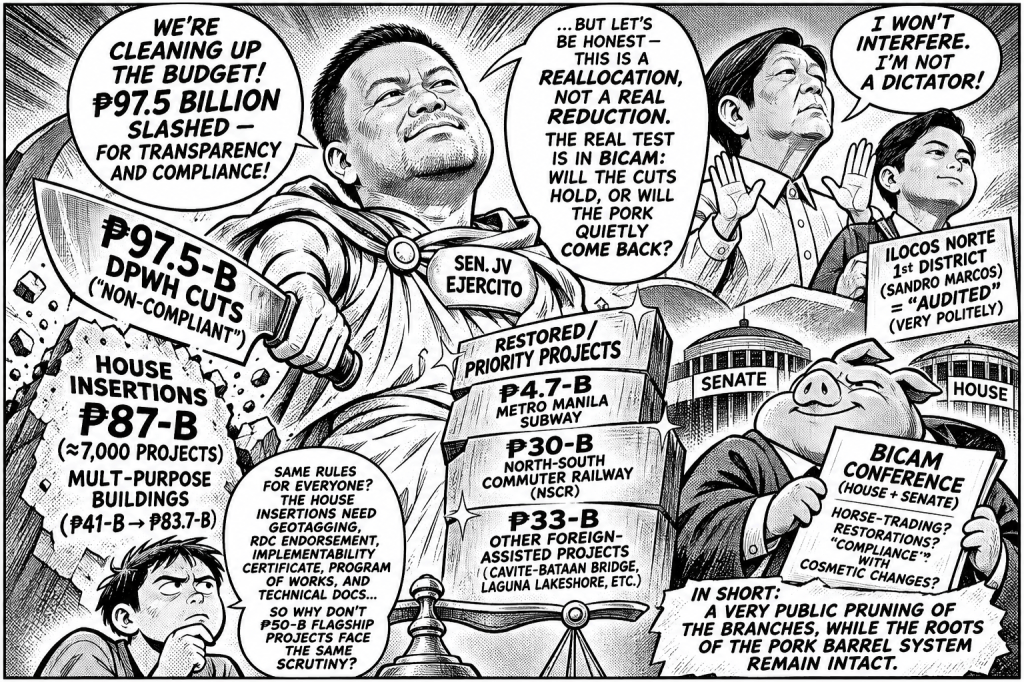
Sen. JV Ejercito wants us to believe he is the guy with the machete hacking away at ₱97.5 billion worth of budget fat. And what a performance it is. The Senate Finance Committee chair has declared that his panel eliminated almost a hundred billion pesos in “non-compliant” Department of Public Works and Highways (DPWH) projects from the proposed 2027 budget, while simultaneously restoring tens of billions for flagship infrastructure, health, education, agriculture, and defense. The headlines followed the arithmetic: ₱87 billion in House insertions, ₱8.8 billion from the Executive’s own National Expenditure Program (NEP), ₱1.7 billion in DPWH buildings. Cut, cut, cut. Purge, purge, purge. Ejercito as budget Solomon, slashing the baby in half while everyone applauds.
But in the grand tradition of Philippine budget theater, what you see is rarely what you get. And if there’s one thing we’ve learned from the pork barrel opera, it’s that the best trick isn’t taking money out of the budget. It’s making sure nobody notices where it went back in.
The House Plays the Designated Villain
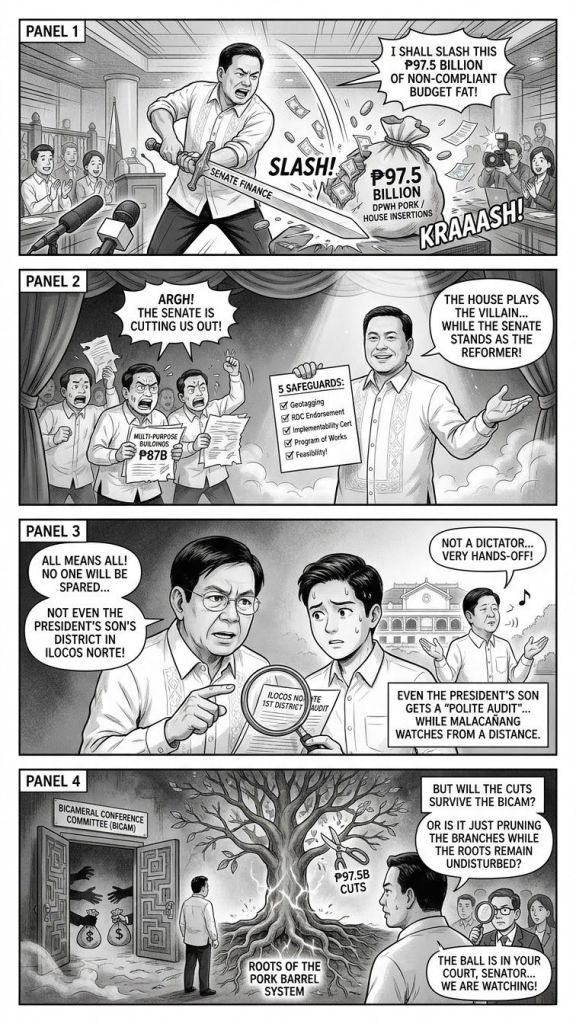
Let’s start with the fundamentals. Ejercito says the Senate removed ₱87 billion in non-compliant projects from the House-approved version of the General Appropriations Bill. Watchdogs like the People’s Budget Coalition had flagged roughly 7,000 House-inserted infrastructure projects worth nearly ₱190 billion lacking public supporting documents, alongside a surge in multi-purpose building funds that ballooned from ₱41 billion in the NEP to ₱83.7 billion in the House version—an increase of ₱42.7 billion, more than double the executive’s proposal. So the Senate found its convenient villain. The House, with its 300-plus members and their insatiable appetite for district-level infrastructure, became the designated pork purveyor. And Ejercito, with his five mandatory safeguards—geotagging, Regional Development Council (RDC) endorsement, Certificate of Implementability, Program of Works, and feasibility/technical documentation—positioned himself as the reformer.
A Reallocation Is Not a Reduction
Here’s the problem. When you cut ₱97.5 billion from DPWH but restore ₱4.7 billion for the Metro Manila Subway, ₱30 billion for the NSCR and subway system, and approximately ₱33 billion for other foreign-assisted projects including the Cavite-Bataan Bridge and Laguna Lakeshore Highway—this is merely a reallocation of priorities, not a genuine reduction in total spending. And the real question—the question that should be on every taxpayer’s lips—is not whether the deleted projects were undocumented. It’s whether the restored projects were subjected to the same scrutiny. Or did the foreign-assisted flagship projects get a pass because they’re politically prestigious, because they’re visible, because they’re the kind of thing a senator can put in a press release?
Ejercito tells us he wants to protect these projects from “costly delays or foreign loan/grant friction.” That’s a lovely rationale. But it’s also exactly the kind of argument that got us into the flood-control scandal mess in the first place: the assumption that certain projects are so important, so big, so nationally significant, that the usual rules don’t apply. If a ₱50-million multi-purpose building in Ilocos Norte must be geotagged and RDC-endorsed and certified implementable before it gets funded, why doesn’t a ₱50-billion subway project need the same treatment? Or does Ejercito’s five-safeguard system only apply to projects that originate from the House—you know, the ones that aren’t his institutional allies?
Not a Dictator, Just Very Hands-Off
And speaking of Ilocos Norte, let’s talk about the political subtext that everybody in Manila knows but nobody wants to say out loud. The Senate’s cleanup unfolded around large DPWH project allocations in prominent legislative districts—including Ilocos Norte’s 1st District, represented by Rep. Ferdinand Alexander “Sandro” Marcos, the President’s son. Sen. Panfilo Lacson declared that “all means all” and “no one [will] be spared.” Malacañang, meanwhile, signaled that President Marcos Jr. would refrain from heavy-handed pre-bicameral intervention in House allies’ adjustments to avoid being labeled a “dictator.” The President’s own son’s district is in the crosshairs, and suddenly the Executive is very hands-off, very restrained, very “not a dictator.” How convenient.
This is what makes Ejercito’s announcement so deliciously layered. He’s not just auditing the budget. He’s auditing the President’s son’s district, while the President is busy pretending he doesn’t want to interfere. And the Senate majority, with Lacson leading the rhetorical charge, is positioning itself as the institution that will actually hold the line. But here’s what nobody wants to admit: if the bicameral conference committee (bicam) gets its hands on these cuts, the Senate’s ₱97.5-billion purge could evaporate faster than a multi-purpose building in a budget reconciliation.
The Press Conference Is Not the Test
Ejercito has promised to open bicameral proceedings to civil society observers. He’s pledged to enforce documentary compliance as a hard gatekeeping criterion. He’s even floated his proposed Masterplan for Infrastructure and National Development (MIND) Act as a long-term reform. All of this sounds wonderful. But the real test isn’t the press conference. It’s the consistency of the process. If projects were deleted because they lacked geotagging, programs of works, implementability certifications, and proper planning documentation, then the same standards must apply to projects proposed by senators, congressmen, allies, opponents, powerful political families, and the executive branch. If a ₱50-million multi-purpose building is rejected because it lacks documentation, a ₱50-billion flagship project must not be exempt from the same spirit of scrutiny merely because it’s politically prestigious or foreign-assisted.
And if the deleted projects return during bicameral negotiations without transparent justification—if the House provides the missing documents, or if the Senate simply accepts cosmetic changes and calls it compliance—then Ejercito’s announcement could become little more than a theatrical pruning of the budget. The real danger isn’t that the cuts were too aggressive. It’s that they might be selectively aggressive, punishing smaller district projects while letting flagship projects slide through on the assumption that they’re too important to fail. And that’s how pork barrel politics works: not through grand larceny, but through a thousand small exemptions, each justified by urgency, each shielded by political importance, each exempted from the very rules that were supposed to apply to everyone.
Let’s also consider the timing. The budget fight unfolds amid heightened political tension ahead of the 2028 electoral cycle, ongoing public debates over ayuda and local infrastructure spending, and high-profile proceedings in the Senate, including the impeachment trial involving Vice President Sara Duterte. The stakes over bicameral bargaining leverage and public trust are enormous. Ejercito’s purge isn’t just about the 2027 budget. It’s about positioning himself as a reform-minded institutional steward, an infrastructure advocate, and a credible counterweight to the House’s pork-driven ambitions. It’s about building a political brand that could pay dividends in the coming years. And there’s nothing wrong with that—as long as the reform is real.
Pruned Branches, Intact Roots
But is it? Ejercito says he wants to institutionalize transparency, promote long-term infrastructure planning, and enforce documentary compliance. Those are excellent goals. But the Senate’s committee report is just the first step. The plenary debates begin November 23. The bicameral conference committee comes next. And the President’s item veto is the final backstop. If the Senate’s cuts survive plenary and bicam, and if the President exercises his veto power against undocumented or unimplementable amendments, then maybe—just maybe—Ejercito’s purge will have accomplished something meaningful. But if the cuts get quietly restored in bicam, if the House and Senate horse-trade their way to a budget that looks remarkably similar to the original, if the foreign-assisted flagship projects glide through without the same scrutiny applied to the House insertions, then we’ll know exactly what happened: a very public pruning of the branches, while the roots of the pork barrel system remained undisturbed.
Watchdogs like the People’s Budget Coalition have been pressing House leaders for formal commitments on transparency and questioning “parliamentary courtesy” and increases to the House’s own budget. They’ve been monitoring the plenary, bicameral, and enrolment stages, tracking every line-item change to detect revived or altered insertions. They’ve been conducting citizen audits, publishing scorecards, and comparing the NEP, House GAB, Senate GAB, and bicameral versions. And they’ll be watching what Ejercito does next. Because the real measure of his reform isn’t the size of the cut. It’s the consistency of the scrutiny. If the Senate’s ₱97.5-billion purge survives the bicameral process intact, and if the five safeguards are applied uniformly across all projects—not just the ones that happen to originate from the House—then Ejercito will have earned his reformer’s reputation. But if the purge gets quietly reversed, or if the safeguards are applied selectively, then the Senate’s announcement will join the long list of Philippine budget reforms that looked impressive on paper but meant nothing in practice.
The Ball Is in Ejercito’s Court
The ball is in Ejercito’s court. He can hold the line in plenary and bicam, enforcing the five documentary safeguards uniformly and resisting efforts to quietly restore non-compliant insertions. He can allow conditional or cured inclusion only where documentation is formally verified on record, ensuring that the process is transparent and fair. He can institutionalize transparency rules, codifying documentary and masterplan standards into permanent legislation. Or he can let the whole thing get horse-traded away in a conference room, while the foreign-assisted flagship projects sail through without the same scrutiny applied to the House’s multi-purpose buildings.
The choice is his. And the public should be watching.
Key Citations
A. Legal & Official Sources
- The 1987 Constitution of the Republic of the Philippines. Official Gazette of the Republic of the Philippines, 1987, http://www.officialgazette.gov.ph/constitutions/1987-constitution/.
- Belgica v. Ochoa. G.R. No. 208566, 19 Nov. 2013. Supreme Court of the Philippines, LawPhil, lawphil.net/judjuris/juri2013/nov2013/gr_208566_2013.html.
B. News Reports
- “2027 Budget Insertions Test The Records, Not The Ceiling.” Hemo, Nov. 2026, hemosph.com/2027-budget-insertions-test-the-records-not-the-ceiling.
- Abante, Joseph Bernard A. “‘ALL TALK ON BUDGET REFORMS’: Budget Watchdog Seeks Written House Pledge to Open 2027 Bicam.” Daily Guardian, 16 Nov. 2026, http://www.dailyguardian.com.ph/blog/all-talk-on-budget-reforms-budget-watchdog-seeks-written-house-pledge-to-open-2027-bicam.
- Abante, Kenneth Isaiah. “Over P1 Trillion Allocation in Proposed 2027 Budget a ‘Red Flag’—Watchdog.” ABS-CBN News, 26 Oct. 2026, http://www.abs-cbn.com/news/nation/2026/10/26/over-p1-trillion-allocation-in-proposed-2027-budget-a-red-flag-watchdog-1033.
- Blocktec Editorial Team. “Senate Majority Backs Purge of 6,271 House-Added DPWH Projects.” Blocktec, 2 Nov. 2026, http://www.blocktec.ph/blog/news-4/senate-majority-backs-purge-of-6271-house-added-dpwh-projects-570.
- Chi, Cristina. “Not a ‘Dictator’: Marcos Won’t Rein in House Allies on 2027 Budget.” The Philippine Star, 4 Nov. 2026, http://www.philstar.com/headlines/2026/11/04/2567598/wary-dictator-tag-marcos-wont-touch-budget-approved-house-allies.
- Divina, Thea. “Senate Cuts ₱97.5 Billion in Non-Compliant DPWH Projects for 2027 – Ejercito.” DZRH News, 21 Nov. 2026, http://www.dzrh.com.ph/post/senate-cuts-peso975-billion-in-non-compliant-dpwh-projects-for-2027-ejercito.
- “House Budget Analysis 2027 Leaderboards — DPWH Offices and Districts.” BetterGov.ph Budget Tracker, budget.bettergov.ph/hgab/2027/leaderboard.
- “House Budget Insertions Push Multipurpose Building Allocation to P83.7 Billion.” Daily Tribune, 2 Nov. 2026, tribune.net.ph/2026/11/02/house-budget-insertions-push-multipurpose-building-allocation-to-p837-billion.
- “JV Ejercito, DPWH to Remove Non-Compliant Infra Projects from 2027 Budget.” Manila Bulletin, 30 Oct. 2026, mb.com.ph/2026/10/30/jv-ejercito-dpwh-to-remove-non-compliant-infra-projects-from-2027-budget.
- “JV’s Panel Axes P97-B Inserts.” Daily Tribune, 20 Nov. 2026, tribune.net.ph/2026/11/20/jvs-panel-axes-p97-b-inserts.
- “Melt That Pork Barrel.” The Manila Times, 3 Nov. 2026, http://www.manilatimes.net/2026/11/03/opinion/editorial/melt-that-pork-barrel/2459617.
- Murcia, Alvin. “SC Ruling Limits Bicam Budget Changes — Cayosa.” Daily Tribune, 22 Oct. 2026, tribune.net.ph/2026/10/22/sc-ruling-limits-bicam-budget-changes-cayosa.
- Ombay, Giselle. “Bicam Talks on 2027 Budget to Be Opened to CSOs — JV Ejercito.” GMA News Online, GMA Network, 2 Nov. 2026, http://www.gmanetwork.com/news/topstories/nation/1007969/bicam-talks-on-2027-budget-to-be-opened-to-csos-jv-ejercito/story/.
- Oliquino, Edjen. “Senate Panel Axes P97-B DPWH Projects.” Daily Tribune, 20 Nov. 2026, tribune.net.ph/2026/11/20/senate-panel-axes-p97-b-dpwh-projects.
- Philippine News Agency. “Senate Flags P266-B DPWH Projects for Further Scrutiny.” Philippine News Agency, 26 Oct. 2026, http://www.pna.gov.ph/article/senate-flags-p266-b-dpwh-projects-for-further-scrutiny.
- “Senate Finance Panel to Ensure Complete Docs in Infra Projects.” Philippine Daily Inquirer, 14 Nov. 2026, newsinfo.inquirer.net/2341246/senate-finance-panel-to-ensure-complete-docs-in-infra-projects.
- “Senate Panel Guts P97-B Worth of DPWH Projects in 2027 Budget.” ABS-CBN News, 20 Nov. 2026, http://www.abs-cbn.com/news/nation/2026/11/20/senate-panel-guts-p97-b-worth-of-dpwh-projects-in-2027-budget-2304.
- Servallos, Neil Jayson. “Senate Slashes P97.5 Billion From 2027 DPWH Budget.” The Philippine Star, 21 Nov. 2026, http://www.philstar.com/headlines/2026/11/21/2571545/senate-slashes-p975-billion-2027-dpwh-budget.
- Servallos, Neil Jayson. “Senate Slashes P97.5 Billion From 2027 DPWH Budget.” OneNews.PH, 21 Nov. 2026, http://www.onenews.ph/senate-slashes-p975-billion-from-2027-dpwh-budget.
- “Senate Slashes P97 Billion Worth of Projects from DPWH Budget.” Manila Bulletin, 20 Nov. 2026, mb.com.ph/2026/11/20/senate-slashes-p97-billion-worth-of-projects-from-dpwh-budget. Accessed 22 Nov. 2026.
- “Watchdogs Urge Senate to Strip House ‘Insertions’ in Pork-Riddled 2027 Budget.” The Philippine Star, 26 Oct. 2026, http://www.philstar.com/headlines/2026/10/26/2565843/watchdogs-urge-senate-strip-house-insertions-pork-riddled-2027-budget.

- “Ang Hirap Maging Mahirap”: The PAO Scandal That Proves Government Contempt Is Nothing New

- “Far-Off” My Axx: Malacañang’s Claire Castro Drowns in Her Own Legal Gaslighting

- “Forthwith” to Farce: How the Senate is Killing Impeachment—And Why Enrile’s Right (Even If You Can’t Trust Him)

- “HINDI AKO NAG-RESIGN!”

- “I Have No Reason to Doubt”: Teodoro’s MDT Fairy Tale

- “I Know Nothing”: Baste Duterte’s Amnesia Defense Meets ₱33M in GenCorp Contracts

- “I’m calling you from my new Globe SIM. Send load!”

- “Mahiya Naman Kayo!” Marcos’ Anti-Corruption Vow Faces a Flood of Doubt

- “Manageable” Debt, Unmanageable Corruption: The ₱19.66-Trillion Lie

- “Manageable” Debt, Unmanageable Lies: DBM’s ₱21 Trillion Fairy Tale
- “Meow, I’m calling you from my new Globe SIM!”

- “Natrabaho”: One Word, One Ombudsman, and a Judiciary on Trial







Leave a Reply