The Ambassador Said ‘I’m Told.’ The Constitution Says ‘No.’ Musk Says Nothing
By Louis ‘Barok‘ C. Biraogo — November 20, 2026
I. The Gospel According to Babe
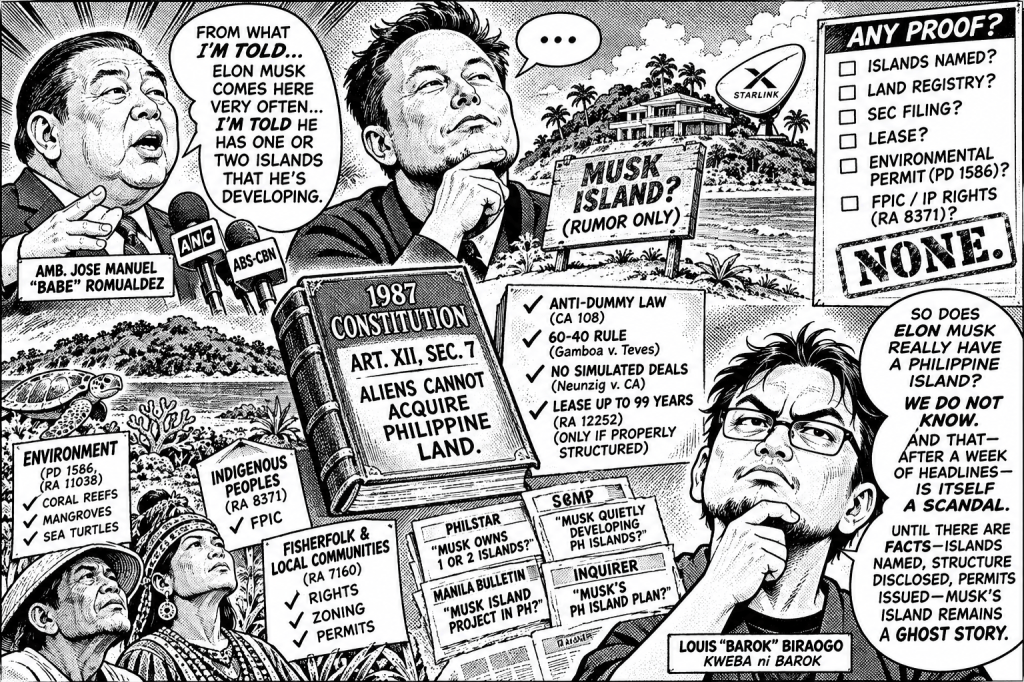
I HAVE spent a week chasing a rumor so thin it makes the average press release look like a sworn affidavit. The story: Elon Musk is reportedly developing “one or two islands” in the Philippines. The source: Ambassador Jose Manuel “Babe” Romualdez, whose statements carry the weight of the Republic and, in this case, the evidentiary weight of a neighborhood tip.
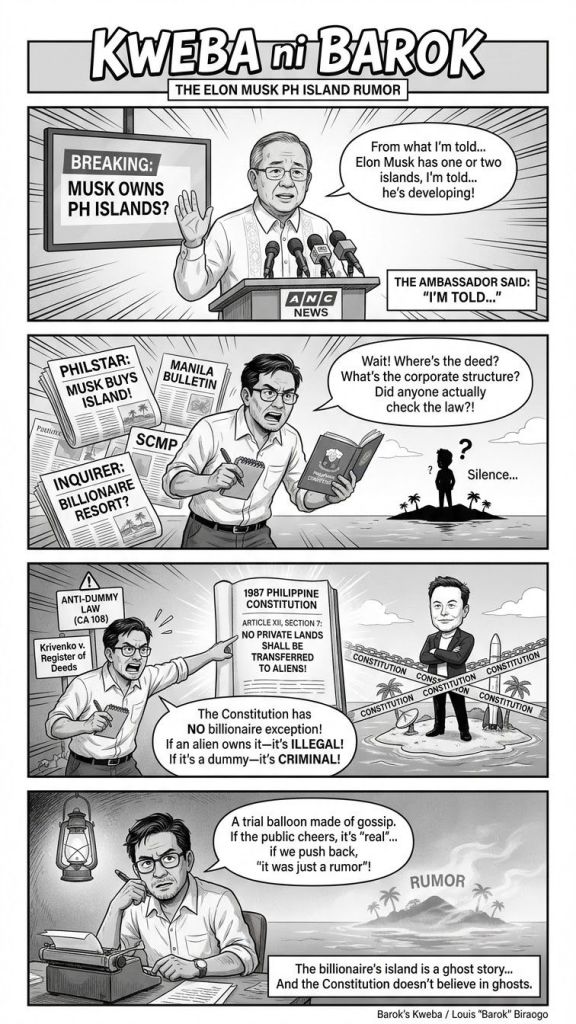
“From what I’m told,” Romualdez said in a November 19 interview with ABS-CBN News Channel (ANC), “Elon Musk comes here quietly very often because he has one or two islands, I’m told, that he’s developing” (ABS-CBN News). The phrase “I’m told” appears twice. This is not diplomatic clarity. This is a man repeating a rumor and dressing it in the borrowed robes of officialdom.
The story raced across Philstar, the Manila Bulletin, GMA News, the Inquirer, and the South China Morning Post (SCMP) before anyone asked the simplest questions. Where are the islands? Who sold them? What permits exist? What is the corporate structure? Has Musk confirmed a single syllable?
The answer, as of this writing, is no. Musk, Tesla, SpaceX, and every other entity in the Musk cosmos have remained silent (SCMP). No land registry record. No Securities and Exchange Commission (SEC) filing. No lease. No environmental compliance certificate. Nothing.
We are asked to believe that the world’s richest man has quietly acquired Philippine real estate—a constitutionally sensitive and politically explosive proposition—on the strength of a diplomat’s hearsay.
II. The Constitution Has No Billionaire Exception
Here the story stops being amusing and starts being legally dangerous.
Article XII, Section 7 of the 1987 Constitution:
“Save in cases of hereditary succession, no private lands shall be transferred or conveyed except to individuals, corporations, or associations qualified to acquire or hold lands of the public domain.”
Krivenko v. Register of Deeds (1947) held that aliens cannot acquire Philippine residential land. Gamboa v. Teves (2012) reinforced strict construction of the 60-40 Filipino-foreign ownership rule. Neunzig v. Court of Appeals (2025) voided simulated contracts and dummy arrangements, leaving parties in pari delicto.
Translation: if Musk personally owns Philippine land, he cannot. If he owns it through a Filipino nominee—a “dummy”—he is criminally liable under the Anti-Dummy Law, Commonwealth Act No. 108, as amended, with penalties including imprisonment and fines for both the foreign principal and the Filipino collaborator.
And yet the headlines said “has” and “owns.” None said what legal vehicle could possibly make this work. The answer, if anyone bothered to look, is that it could—if structured correctly. Republic Act No. 12252 (Amended Investors’ Lease Act), signed in September 2025, allows qualified foreign investors an aggregate lease term of up to 99 years on private land for approved projects, including tourism ventures with a minimum investment of US$5 million (Lawphil). A genuine Filipino-majority corporation could own the land. None of these were mentioned. None were confirmed. This is not journalism. This is astrology with a law degree.
III. The Ambassador and the Art of Strategic Ambiguity
Romualdez is not a random bureaucrat. He is a long-serving envoy to the United States, reappointed under President Marcos Jr., and—by widely reported accounts—a second cousin to the President and related to House Speaker Martin Romualdez (Wikipedia). His statements carry the weight not merely of a diplomat but of a family network deeply embedded in Philippine political power.
When such a figure tells a national broadcaster that Musk “has one or two islands,” he is not making idle conversation. He is sending a signal. The question is to whom, and for what purpose.
The charitable reading: Romualdez, a patriotic investment promoter, is highlighting a genuine development. Starlink already operates in the Philippines as its first Association of Southeast Asian Nations (ASEAN) market. Globe Telecom announced a direct-to-cell partnership with Starlink in January 2026 with President Marcos in attendance. A Musk-linked island project could bring capital, connectivity, and technology transfer.
The less charitable reading: Romualdez is trading on a billionaire’s brand to generate headlines that flatter the administration’s investment agenda—by repeating an unverified rumor on the rawest nerve in Philippine constitutional politics: national patrimony.
Republic Act No. 6713 (Code of Conduct and Ethical Standards for Public Officials and Employees) requires public officials to act with “justness and sincerity.” Article XI, Section 1 declares that “public office is a public trust.” An ambassador who repeats a rumor as quasi-official fact violates these provisions in no criminal sense. But he does something subtler and more corrosive: he muddies the public sphere with speculation dressed as diplomacy, leaving the government room to deny and the public with nothing but confusion.
This is the Kweba test. Is a powerful person using access and ambiguity to shape a narrative without accountability? The “I’m told” double-hedge suggests exactly that.
IV. The Silence of the Billionaire
Musk’s silence is eloquent. His companies operate in a world of press releases, SEC filings, and staged product reveals. When SpaceX wins a contract, the world knows. When Tesla opens a factory, there is a ribbon-cutting.
The absence of any such announcement here is telling. Either the project is so preliminary it barely exists—a conversation, a handshake, a maybe—or it is being deliberately kept quiet because public scrutiny would be inconvenient.
There is a plausible business logic. The Philippines offers a US-aligned location amid South China Sea tensions, a newly liberalized lease regime, and a market where Starlink has gained a foothold. A personal retreat for the world’s richest man is hardly implausible; billionaires buy islands the way other people buy watches. But plausible is not confirmed. In the absence of confirmation, the responsible posture is to demand the facts.
V. The Environmental and Community Time Bomb
Suppose the rumor is true. What then?
Presidential Decree No. 1586 (Environmental Impact Statement System) requires environmental impact assessment for environmentally critical projects. Republic Act No. 11038 (Expanded National Integrated Protected Areas System Act) restricts development within protected areas. Oposa v. Factoran (1993) established the right to a balanced and healthful ecology and intergenerational responsibility. If the island contains coral reefs, mangroves, or sea turtle nesting grounds—and most Philippine islands do—a luxury development could trigger legal challenges that would make the Boracay closure look like a zoning dispute.
Then there are the people. The Indigenous Peoples’ Rights Act, Republic Act No. 8371, protects ancestral domains and requires Free, Prior, and Informed Consent. Fisherfolk who have lived on these islands for generations have rights. Local government units under Republic Act No. 7160 (Local Government Code of 1991) have zoning and permitting authority. A development that ignores these stakeholders is not an investment; it is a lawsuit waiting to happen.
The cruel irony is that the ambiguity of the rumor prevents these questions from being asked. As long as no island is named, no structure disclosed, and no lease registered, the public cannot scrutinize what it cannot see. The billionaire gets the benefit of silence; the public gets the bill.
VI. The Game of Shadows
Let me be clear about what I am not saying. I am not saying Musk has broken Philippine law. I am not saying Romualdez has committed an ethics violation. I am not saying the project is a scam or a foreign land grab.
I am saying we do not know. And that not knowing, after a week of headlines, is itself a scandal.
The real story is not Elon Musk. It is the ease with which an unverified claim from a politically connected ambassador became a global news event, the absence of any mechanism to verify or debunk it, and the willingness of a press corps to amplify a billionaire’s ghost without demanding proof.
This is how corruption works in the modern era. Not with envelopes of cash, but with ambiguity. A wink. A nod. A “from what I’m told.”
The powerful float a trial balloon, watch which way the wind blows, and adjust. If the public cheers, the project becomes real. If the public objects, it was never anything at all—just a misunderstanding, just a rumor, just a diplomat speaking loosely.
The Philippines deserves better. A nation that has fought for its land, its sovereignty, and its constitutional patrimony should not be reduced to guessing whether a foreign billionaire has quietly acquired a piece of it. The government should either confirm the project with specifics—islands named, structures disclosed, permits issued—or correct the record. The media should stop reporting rumors as news. And Musk, if he has nothing to hide, should say so.
Until then, the billionaire’s island remains what it has always been: a ghost story. And in the Philippines, where ghosts are taken seriously, the burden of proof lies with the living.
Key Citations
A. Legal & Official Sources
- Commonwealth Act No. 108. An Act to Punish Acts of Evasion of the Laws of the Philippines Regarding the Nationalization of Certain Rights, Franchises or Privileges. 1936, lawphil.net/statutes/comacts/ca_108_1936.html.
- The 1987 Constitution of the Republic of the Philippines. Official Gazette of the Republic of the Philippines, 1987, http://www.officialgazette.gov.ph/constitutions/1987-constitution/.
- Gamboa v. Teves. G.R. No. 176579, Supreme Court of the Philippines, 9 Oct. 2012, lawphil.net/judjuris/juri2012/oct2012/gr_176579_2012.html.
- Krivenko v. Register of Deeds. G.R. No. L-630, Supreme Court of the Philippines, 15 Nov. 1947, lawphil.net/judjuris/juri1947/nov1947/gr_l-630_1947.html.
- Neunzig v. Court of Appeals. G.R. No. 260983, Supreme Court of the Philippines, 10 Feb. 2025, lawphil.net/judjuris/juri2025/feb2025/gr_260983_2025.html.
- Oposa v. Factoran. G.R. No. 101083, Supreme Court of the Philippines, 30 July 1993, lawphil.net/judjuris/juri1993/jul1993/gr_101083_1993.html.
- Presidential Decree No. 1586. Establishing an Environmental Impact Statement System Including Other Environmental Management Related Measures and for Other Purposes. 1978, lawphil.net/statutes/presdecs/pd1978/pd_1586_1978.html.
- Republic Act No. 6713. An Act Establishing a Code of Conduct and Ethical Standards for Public Officials and Employees. 1989, lawphil.net/statutes/repacts/ra1989/ra_6713_1989.html.
- Republic Act No. 7160. An Act Providing for a Local Government Code of 1991. 1991, lawphil.net/statutes/repacts/ra1991/ra_7160_1991.html.
- Republic Act No. 8371. An Act to Recognize, Protect and Promote the Rights of Indigenous Cultural Communities/Indigenous Peoples. 1997, lawphil.net/statutes/repacts/ra1997/ra_8371_1997.html.
- Republic Act No. 11038. An Act Declaring Protected Areas and Providing for Their Management. 2018, lawphil.net/statutes/repacts/ra2018/ra_11038_2018.html.
- Republic Act No. 12252. An Act Liberalizing the Lease of Private Lands by Foreign Investors, Establishing the Stability of Long-Term Lease Contracts. 2025, lawphil.net/statutes/repacts/ra2025/ra_12252_2025.html.
B. News Reports
- “Elon Musk ‘Very Interested’ in PH, Developing ‘One or Two Islands’—Envoy.” ABS-CBN News, ABS-CBN, 19 Nov. 2026, http://www.abs-cbn.com/news/nation/2026/11/19/elon-musk-very-interested-in-ph-developing-one-or-two-islands-envoy-1009.
- “Elon Musk Quietly Developing ‘1 or 2’ Philippine Islands, Manila Envoy Says.” South China Morning Post, SCMP, 19 Nov. 2026, http://www.scmp.com/week-asia/people/article/3375057/elon-musk-quietly-developing-one-or-two-philippine-islands-manila-envoy-says.
- “Jose Manuel Romualdez.” Wikipedia, Wikimedia Foundation, en.wikipedia.org/wiki/Jose_Manuel_Romualdez. Accessed 20 Nov. 2026.
- Lee-Brago, Pia. “Elon Musk in Philippines, Plans Projects on 1 or 2 Islands.” Philstar.com, The Philippine Star, 20 Nov. 2026, http://www.philstar.com/headlines/2026/11/20/2571387/elon-musk-philippines-plans-projects-1-or-2-islands.
- ₱9 Billion in ‘Savings’? DILG’s Fire Truck Deal Smells Like Smoke

- ₱8B BBM Pork: CCTV for Every Captain’s Kumpare?
- ₱8.9 Billion, 331 Ghost Police Stations: The TIKAS Scandal Explained

- ₱8.4 Billion, 42,000 Barangays, 1 Election: The “Bawat Barangay Makikinabang” Vote-Buying Masterclass
- ₱75 Million Heist: Cops Gone Full Bandit

- ₱63 to the Dollar: The Only Thing Falling Faster Than the Peso Is the Government’s Credibility
- ₱6.77B Ghost Haunts Duterte: RTC Dismisses Mans Carpio’s Desperate Plea
- ₱6.77 Billion and Zero Cash: The Sara Duterte SALN Math That Doesn’t Add Up

- ₱6.7-Trillion Temptation: The Great Pork Zombie Revival and the “Collegial” Vote-Buying Circus

- ₱58.53B, Zero Receipts: The LGSF Pork Barrel Nobody Wants to Name
- ₱53 Million Man Tells ₱695-a-Day Workers to Stop Being ‘Mayabang’: The Audacity of BSP’s Remolona
- ₱491-M Right-of-Way Scam: DPWH Paid for Ghost Land, Ombudsman Finally Notices



Leave a Reply