By Louis “Barok” C. Biraogo — November 19, 2026
The Ninety-Percent Deal
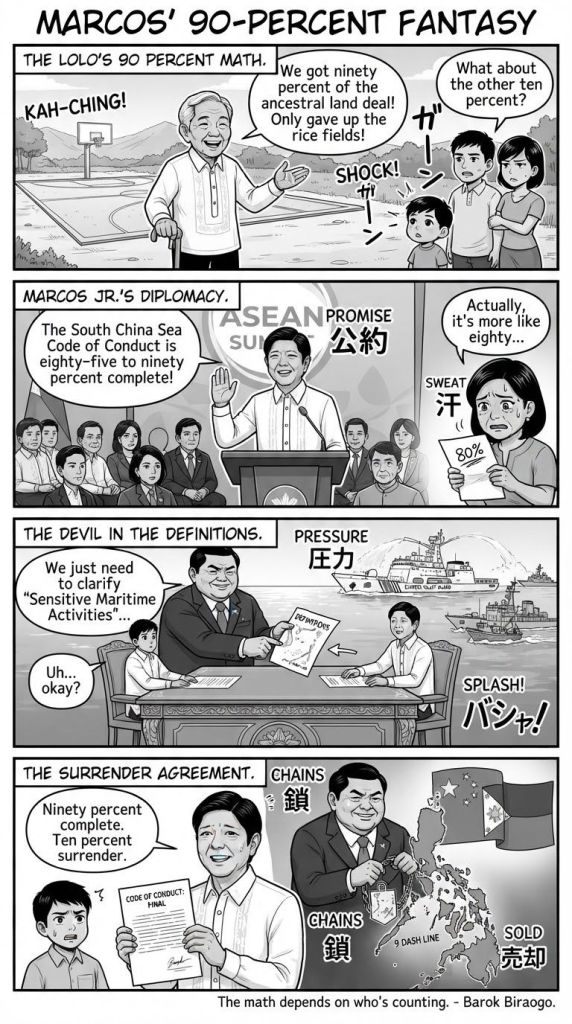
Allow me to introduce the day my lolo sold our ancestral rice field. He came home beaming, told the whole barangay he’d secured “ninety percent” of a deal. Turned out he’d traded ten hectares for a handshake, a bottle of tuba, and a vague promise that the buyer “wouldn’t be mean about it.” The family never saw the remaining ten percent. We got a concrete basketball court instead. Thanks, lolo.
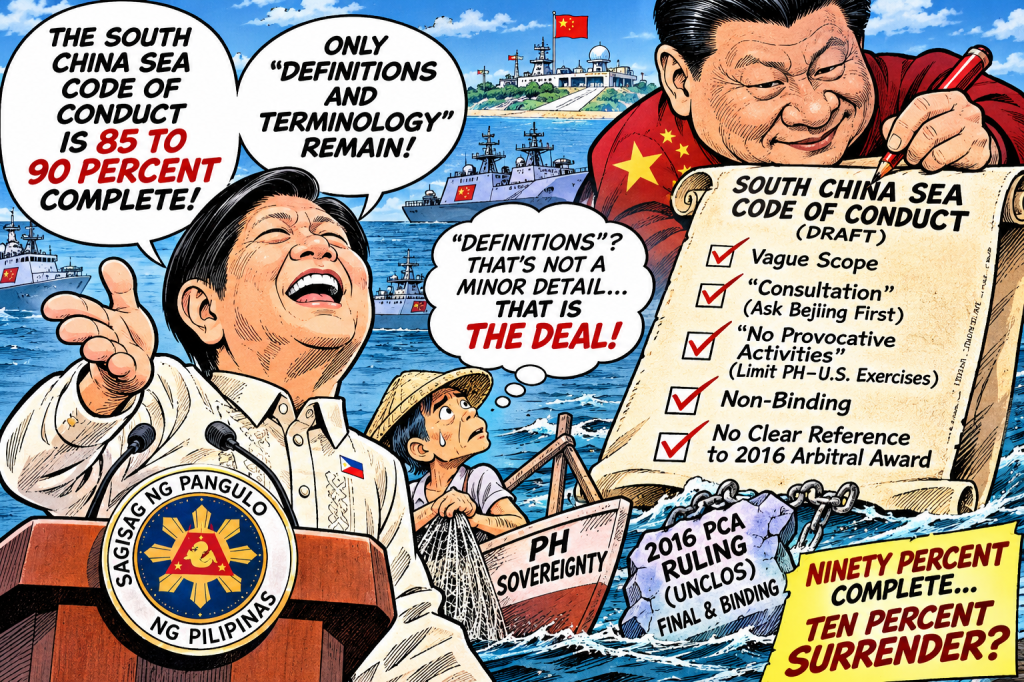
President Ferdinand Marcos Jr. would like you to believe his South China Sea Code of Conduct (COC) negotiations are “85 to 90 percent complete.” Bless his heart. The man has inherited his father’s gift for percentage-based optimism—though at least Senior had the decency to call his math “national development statistics.” Junior just calls it diplomacy.
Eighty Percent, According to His Own Secretary
Here’s what actually happened: Marcos stood before cameras on November 17, 2026, and announced that the large issues were “done and decided and agreed upon,” with only “definitions and terminology” remaining. Two days earlier, his own Foreign Affairs Secretary Ma. Theresa Lazaro admitted the figure was closer to 80 percent—and that fundamental questions about legal bindingness, geographical scope, and “differences in the parties’ understanding of important provisions” remained outstanding. When your own team is lowballing you by ten points before you’ve even opened your mouth, that’s not a negotiating position. That’s a warning flare.
But let’s play along. Let’s pretend 90 percent completion means something in international law. I’ve got a bridge in Mischief Reef I’d like to sell you. It’s 90 percent complete too—just missing the part where it doesn’t violate the Permanent Court of Arbitration (PCA)’s 2016 ruling that said, oh I don’t know, China has no historic rights there.
What Is Actually Left Unresolved
The research materials tell a delicious story. Reuters and Channel NewsAsia report that the remaining disagreements include whether this Code of Conduct will be legally binding, what geographical areas it covers, and—my personal favorite—”the treatment of sensitive maritime activities and the interests of other states.” Translation: China wants to know if it can still water-cannon Filipino fishermen while pretending to be peaceful, and whether the United States is allowed to exist in the same ocean.
Why “Definitions” Are the Whole Agreement
Marcos specifically identified “definitions” as a major remaining obstacle. This is like saying your marriage is 90 percent successful except for the unresolved question of whether monogamy applies to you. In international agreements, definitions aren’t clerical details—they are the agreement.
- Define “South China Sea” broadly enough, and you’ve implicitly recognized China’s nine-dash line.
- Define “military activities” restrictively enough, and Philippine joint exercises with the U.S. become “provocative.”
- Define “consultation” as “obtain Beijing’s permission first,” and congratulations, you’ve just outsourced your foreign policy to a country that publishes racist monkey cartoons about your citizens.
Speaking of which: remember July 2026? China Daily ran AI-generated content depicting Filipinos as monkeys. Marcos summoned Ambassador Jing Quan, who responded with what the President accurately characterized as sounding “like a threat.” This is the negotiating partner we’re supposed to trust with defining terms.
The same partner whose military attaché sent handwritten notes rejecting the 2016 arbitral award to our Defense Secretary. The same partner that has fully militarized three artificial islands in waters the PCA ruled belong to Philippine maritime zones.
But sure, 90 percent complete. Let’s pop the champagne.
Twenty-Four Years of “Self-Restraint”
The historical farce here is genuinely impressive. The 2002 Declaration on the Conduct of Parties (DOC) has existed for twenty-four years. Twenty-four years of “self-restraint,” “confidence-building,” and Chinese coast guard vessels ramming Philippine resupply missions. The DOC’s paragraph 5 calls for restraint. Paragraph 6 identifies cooperation areas. Paragraph 10 anticipated the COC. What it didn’t anticipate was China’s innovative interpretation of “self-restraint” as “restrain yourself while we build military runways.”
Now Marcos proposes building the COC on this foundation. The research materials dryly note: “A new instrument should not merely reproduce the old declaration in more elaborate language.” No kidding. But here’s the thing about foundations built on sand—and I mean this literally, given China’s island reclamation—you don’t get better architecture by adding more floors.
The Constitutional Comedy: Senate Concurrence
The constitutional comedy deserves its own Netflix special. Article VII, Section 21 of the 1987 Constitution requires Senate concurrence for treaties. The Supreme Court in Bayan v. Zamora and Saguisag v. Ochoa established that executive agreements implementing existing treaties may bypass this requirement, but agreements of “permanent character” or involving “political issues or changes of national policy” cannot.
So which is the COC? An implementing agreement for the United Nations Convention on the Law of the Sea (UNCLOS)? Or a new treaty potentially restricting Philippine defense cooperation, resource rights, and maritime jurisdiction?
The administration’s answer appears to be: “We’ll tell you after we sign it.”
This is not how constitutional democracy works. This is how you end up before the Supreme Court explaining why you traded Scarborough Shoal for a non-binding memorandum of understanding and a photo op.
Managed Strategic Advantage
The geopolitical analysis in the research materials is almost too polite. Let me translate from diplomatese: China is negotiating not for peace, but for managed strategic advantage. Every concession Manila makes on “definitions” is a concession on sovereignty by another name.
- A COC that prohibits “dangerous maneuvers” without defining them gives Beijing veto power over what constitutes danger.
- A COC that requires “consultation” before military exercises with allies gives Beijing veto power over the U.S.-Philippine Mutual Defense Treaty.
- A COC that covers “disputed waters” without specifying which waters implicitly validates claims the 2016 arbitral award explicitly invalidated.
The research identifies ten non-negotiable safeguards. Number one: “Explicit recognition of UNCLOS.” Number two: “Preservation of the 2016 arbitral award.” These are not negotiating positions. These are the preconditions for having negotiations at all. Yet here we are, twenty years into this circus, still debating whether the foundational legal framework applies.
Arugay’s Lose-Lose Verdict
Professor Aries Arugay of the University of the Philippines gets quoted in Al Jazeera with the kind of academic understatement that makes me want to buy him a drink: “You can’t win it because if you get a good document, you’ll be accused of railroading or it would come across as self-serving. But if it’s a bad document, the Marcos Jr administration will be seen as a weak government.”
Here’s my unscholarly translation: Marcos is screwed either way, so he might as well not screw the country while he’s at it.
The Restrictive COC: A Protection Racket
The most dangerous scenario isn’t no agreement. It’s Scenario C from the research materials: “A restrictive COC” that constrains Philippine activities more than Chinese activities, restricts military cooperation with external powers, and creates “consultation requirements” that function as Chinese approval mechanisms. This isn’t peace. This is the diplomatic equivalent of a protection racket—nice alliance you got there, be a shame if something happened to it.
And let’s be clear about what “consultation” means in Beijing’s dictionary. It means “we talk, you listen, then you don’t do the thing.” Notice that China keeps steering sovereignty disputes toward “bilateral or direct consultations” and away from multilateral frameworks or third-party adjudication. It’s the negotiating style of a man who wants to discuss your fence while the bulldozer idles in your yard. Gee, I wonder why. Could it be because bilateral consultations with a superpower work out so well for smaller states? Ask Tibet. Ask the Uyghurs. Ask Vietnam circa 1979.
A Burglary Code of Conduct
The 2016 arbitral award is “final and binding” under UNCLOS Article 296. China has rejected it as “null and void.” Now we’re negotiating a Code of Conduct that might—or might not, depending on those pesky definitions—reference this award. This is like negotiating a burglary code of conduct with the thief who stole your television, who insists the television was never yours, while the police report sits in a drawer marked “binding but unenforced.”
Four Scenarios, No Good Ones
Let’s identify four possible scenarios:
- Scenario A: strong, binding COC. Probability: low, because “China unlikely to accept constraints.”
- Scenario B: weak, nonbinding COC. Probability: moderate, and the likely outcome “if concluded.”
- Scenario C: restrictive COC dangerous to Philippine interests. Probability: moderate to high.
- Scenario D: no agreement. Probability: low for no agreement, moderate to high for weak agreement.
Notice what’s missing? There’s no scenario for “Philippines gets what it wants.” There’s no scenario for “China respects international law.” There’s no scenario for “2016 arbitral award actually enforced.” The best-case outcome is a weak agreement that doesn’t actively make things worse, and the research estimates even that as only moderately probable.
Legacy Over Law
Marcos’ political motivations are transparent enough to see through. The man wanted to conclude this during his Association of Southeast Asian Nations (ASEAN) chairship. He failed. Now he’s rebranding failure as “85 to 90 percent success” and handing the mess to Singapore’s 2027 chairship. This is the diplomatic equivalent of leaving a flaming bag of dog feces on your neighbor’s porch and calling it a housewarming gift.
Note that “establishing a diplomatic legacy” and “avoiding the appearance of failure” are plausible motivations. I’ll add another: the Marcos family has historically excelled at converting national assets into personal political capital. This time the asset is Philippine maritime sovereignty, and the conversion rate depends on how many “definitions” Beijing gets to write.
What Should Happen Now
What should happen? The Senate should hold hearings now, not after signing. The negotiating text should be published—not every sensitive bracketed clause, but the structural provisions on bindingness, scope, military activities, and dispute settlement. The Solicitor General should issue a formal opinion on whether Senate concurrence is required. And Marcos should answer, publicly and specifically, whether any provision under discussion would restrict Philippine cooperation with the United States, Japan, or Australia.
He won’t, of course. Because the answers would reveal what “85 to 90 percent complete” actually means: we’ve agreed on the easy stuff, and we’re hoping nobody notices the hard stuff until after the photo op.
A Proposed Addition
Since sovereignty tends to survive better in treaty text than in photo-op captions, I propose the following Philippine negotiating position:
“The Code of Conduct shall be interpreted and implemented consistently with the United Nations Convention on the Law of the Sea… Nothing in the Code shall prejudice the territorial sovereignty, sovereign rights, maritime entitlements, jurisdiction, or lawful defense and security arrangements of any participating state.”
Beautiful language. The kind of language that belongs in the agreement, not in a policy paper. The kind of language China has spent twenty years negotiating around, over, under, and through.
Here’s my proposed addition: “Any percentage figure announced by any party shall be subject to independent audit, and any President claiming 90 percent completion while his own Foreign Secretary admits 80 percent shall be required to explain the missing ten percent before appearing on television again.”
Too long for a treaty clause, I know. But it scans nicely as a constitutional amendment.
The Bottom Line
Marcos can have his diplomatic legacy, or he can have a Code of Conduct that protects Philippine interests. He almost certainly cannot have both. And if he chooses legacy over law, if he signs a document that “manages” Chinese coercion rather than preventing it, if he trades UNCLOS rights for a handshake and a headline—then he will have accomplished something his father never quite managed.
He will have made the Marcos name synonymous with selling out the Philippines not to one occupying power, but to two.
Ninety percent complete. Ten percent surrender. The math, as always with this family, depends on who’s counting.
Key Citations
A. Legal Instruments & Court Decisions
- Association of Southeast Asian Nations. Charter of the Association of Southeast Asian Nations. 20 Nov. 2007. The World and Japan Database, University of Tokyo. Accessed 18 Nov. 2026.
- Association of Southeast Asian Nations. Declaration on the Conduct of Parties in the South China Sea. 4 Nov. 2002. The World and Japan Database, University of Tokyo. Accessed 18 Nov. 2026.
- Permanent Court of Arbitration. The South China Sea Arbitration (The Republic of the Philippines v. The People’s Republic of China). PCA Case No. 2013-19, 12 July 2016. Permanent Court of Arbitration. Accessed 18 Nov. 2026.
- Philippines. Supreme Court. Bayan v. Zamora. G.R. No. 138570, 10 Oct. 2000. Accessed 18 Nov. 2026.
- Philippines. Supreme Court. Saguisag v. Ochoa. G.R. Nos. 212426 and 212444, 12 Jan. 2016. Accessed 18 Nov. 2026.
- Republic of the Philippines. 1987 Constitution of the Republic of the Philippines. 2 Feb. 1987. Accessed 18 Nov. 2026.
- Republic of the Philippines. Republic Act No. 12064: Philippine Maritime Zones Act. 2024. Accessed 18 Nov. 2026.
- Republic of the Philippines and United States of America. Mutual Defense Treaty between the Republic of the Philippines and the United States of America. 30 Aug. 1951. Accessed 18 Nov. 2026.
- United Nations. United Nations Convention on the Law of the Sea. 10 Dec. 1982. Treaties and International Agreements, University of Oslo Faculty of Law. Accessed 18 Nov. 2026.
B. News Articles
- Al Jazeera. “Pact on South China Sea Code of Conduct Unlikely, as ASEAN Leaders Gather.” Al Jazeera, 15 Nov. 2026. Accessed 18 Nov. 2026.
- Arugay, Aries. Quoted in Al Jazeera, “Pact on South China Sea Code of Conduct Unlikely, as ASEAN Leaders Gather.” Al Jazeera, 15 Nov. 2026. Accessed 18 Nov. 2026.
- Carlos, Ruth Abbey. “Marcos: South China Sea Code of Conduct Talks 85-90% Complete.” Philippine News Agency, 17 Nov. 2026. Accessed 18 Nov. 2026.
- Chi, Cristina. “Marcos: South China Sea Code ’85 to 90%’ Complete.” Philstar.com, 17 Nov. 2026. Accessed 18 Nov. 2026.
- Leo, Lakeisha. “Why Is a South China Sea Code of Conduct Still Unfinished after Decades of Talks?” Channel NewsAsia, 17 Nov. 2026. Accessed 18 Nov. 2026.
- Reuters. “ASEAN, China Committed to Follow South China Sea Declaration until Code of Conduct Is Completed.” Reuters, 17 Nov. 2026. Accessed 18 Nov. 2026.
- Reuters. “ASEAN, China Fail to Conclude South China Sea Code of Conduct.” Reuters, 15 Nov. 2026. Accessed 18 Nov. 2026.
- Siregar, Kiki. “ASEAN, China Reach Provisional Agreement on 80% of South China Sea Code, Says Philippines.” Channel NewsAsia, 15 Nov. 2026. Accessed 18 Nov. 2026.
- “Palace: China’s AI Video Unacceptable to Marcos.” Philippine Daily Inquirer, 20 July 2026. Accessed 18 Nov. 2026.
- “DFA Lodges Protest over China Video Depicting Filipinos as Monkeys.” Philippine Daily Inquirer, 17 July 2026. Accessed 18 Nov. 2026.
C. Additional Readings
- Philippines. Supreme Court. Magallona v. Ermita. G.R. No. 187167, 16 Aug. 2011. Accessed 18 Nov. 2026.
- Philippines. Supreme Court. Pimentel, Jr. v. Executive Secretary. G.R. No. 158088, 6 July 2005. Accessed 18 Nov. 2026.
- Republic of the Philippines. Republic Act No. 9522: An Act to Amend Certain Provisions of Republic Act No. 3046, as Amended, to Define the Archipelagic Baselines of the Philippines, and for Other Purposes. 10 Mar. 2009. Accessed 18 Nov. 2026.
- Republic of the Philippines. Republic Act No. 12065: Philippine Archipelagic Sea Lanes Act. 2024. Accessed 18 Nov. 2026.
- Storey, Ian. “Pitfalls for ASEAN in Negotiating a Code of Conduct in the South China Sea.” Trends in Southeast Asia, ISEAS-Yusof Ishak Institute, 2019, www.iseas.edu.sg. Accessed 18 Nov. 2026.
- United Nations. Charter of the United Nations. 26 June 1945. Accessed 18 Nov. 2026.
- United Nations. Vienna Convention on the Law of Treaties. 23 May 1969. Treaties and International Agreements, University of Oslo Faculty of Law. Accessed 18 Nov. 2026.
- ₱9 Billion in ‘Savings’? DILG’s Fire Truck Deal Smells Like Smoke

- ₱8B BBM Pork: CCTV for Every Captain’s Kumpare?
- ₱8.9 Billion, 331 Ghost Police Stations: The TIKAS Scandal Explained

- ₱8.4 Billion, 42,000 Barangays, 1 Election: The “Bawat Barangay Makikinabang” Vote-Buying Masterclass
- ₱75 Million Heist: Cops Gone Full Bandit

- ₱63 to the Dollar: The Only Thing Falling Faster Than the Peso Is the Government’s Credibility

- ₱6.77B Ghost Haunts Duterte: RTC Dismisses Mans Carpio’s Desperate Plea

- ₱6.77 Billion and Zero Cash: The Sara Duterte SALN Math That Doesn’t Add Up

- ₱6.7-Trillion Temptation: The Great Pork Zombie Revival and the “Collegial” Vote-Buying Circus

- ₱58.53B, Zero Receipts: The LGSF Pork Barrel Nobody Wants to Name
- ₱53 Million Man Tells ₱695-a-Day Workers to Stop Being ‘Mayabang’: The Audacity of BSP’s Remolona

- ₱491-M Right-of-Way Scam: DPWH Paid for Ghost Land, Ombudsman Finally Notices




Leave a Reply