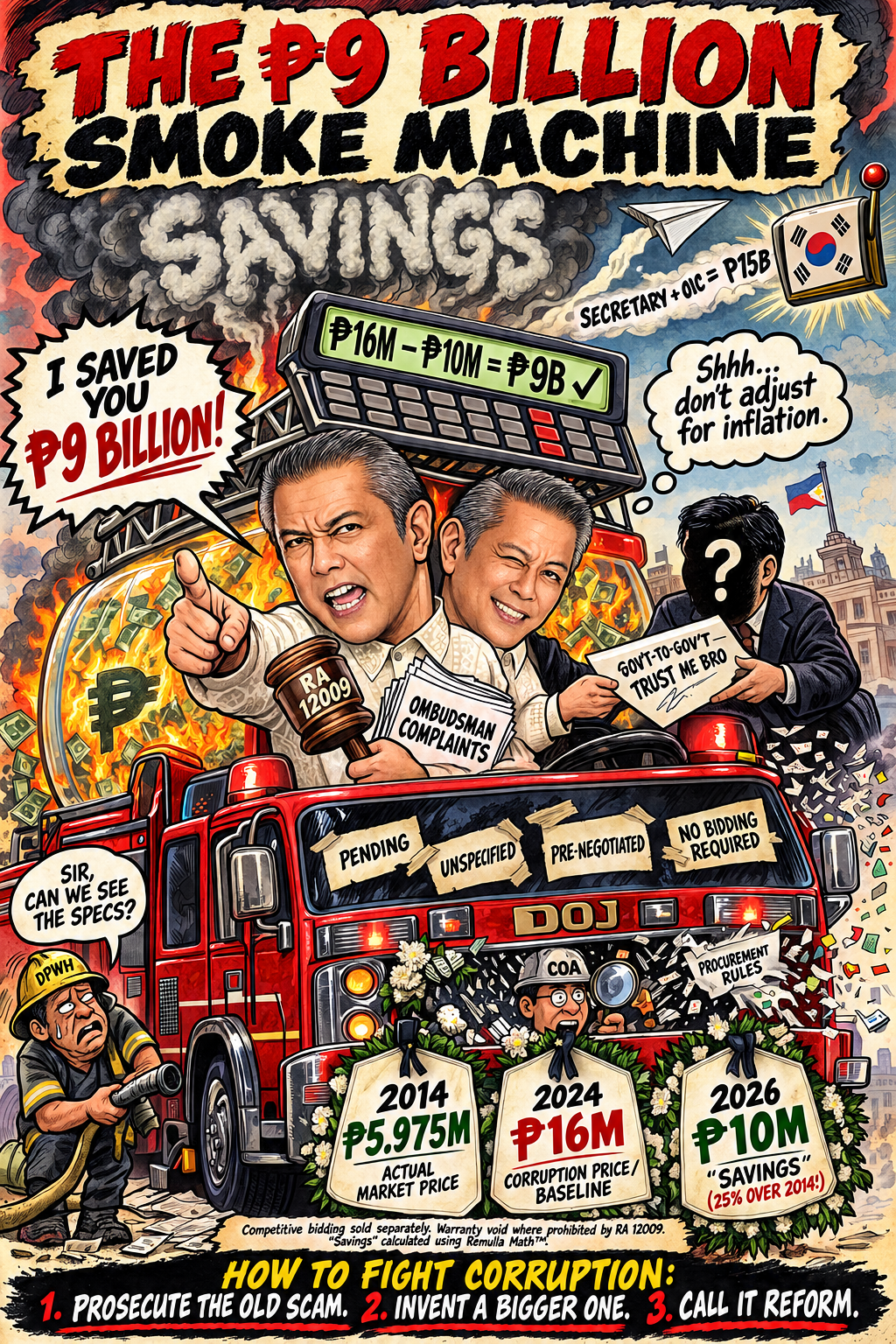
Or: How to Use a Corruption Scandal as a Marketing Campaign for the Next Corruption Scandal
By Louis ‘Barok‘ C. Biraogo — October 11, 2026
LET’S get something straight right away: I want to believe Jonvic Remulla. I really do. The man is out here filing graft charges against 49 Bureau of Fire Protection (BFP) officials for allegedly turning the agency’s fire truck procurement into a personal ATM. He’s calling out a price escalation from P5.975 million per truck in 2014 to nearly P15 million in 2024 — a 250% increase that cannot possibly be explained by inflation, unless the Philippine peso has been secretly replaced by Monopoly money. He’s naming names: Palmer Asia Inc. and F. Cura Industries, the two suppliers who somehow managed to be the only qualified bidders for years while import declarations were allegedly undervalued by over 30%.
This is the kind of anti-corruption energy that makes you want to stand up and applaud.
And then Remulla announces he’s going to fix all of this by flying to South Korea, shaking hands with some unspecified government officials, and buying 1,500 fire trucks at P10 million each — saving the government P9 billion — through a “government-to-government” arrangement that has apparently been agreed upon but not yet signed, not yet specified, and certainly not yet subjected to the kind of competitive bidding that the very law he’s invoking requires.
The chutzpah is breathtaking.
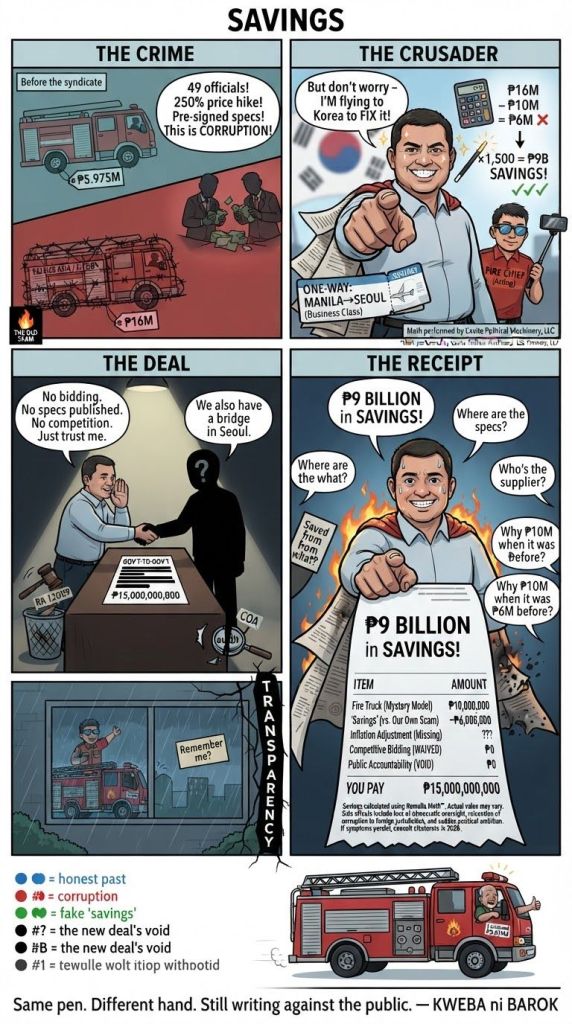
The Arithmetic That Would Make a Used Car Salesman Blush
Let’s do the math that Remulla wants us to do. P16 million minus P10 million equals P6 million. Times 1,500 trucks equals P9 billion in savings. The calculation is flawless — as long as you accept that P16 million is the “real” price of a fire truck, that the P10 million truck is functionally equivalent to the P16 million truck, and that a government-to-government deal with an unnamed Korean entity automatically eliminates corruption rather than simply relocating it to a different set of intermediaries.
Here’s the thing about baselines: they’re magical. If the previous administration was overpaying by, say, 100% due to corruption, then the “prevailing price” of P16 million isn’t a market price at all. It’s a corruption price. Comparing your new deal to a corruption price and calling the difference “savings” is like stealing your neighbor’s car, selling it for half its value, and claiming you saved the buyer money because the dealership would have charged more.
The 2014 price was P5.975 million. That’s the actual comparable. Adjusted for a decade of inflation and currency movement, you might get to P7 or P8 million. So when Remulla says P10 million is a bargain, what he’s really saying is that his deal is worse than the pre-corruption baseline by at least P2 million per truck. That’s not savings. That’s a 25% premium over what the government was paying before the alleged syndicate took over.
But sure, let’s call it P9 billion in “savings.” Words are flexible when you’re running for something.
The Legal Framework: Optional, Apparently
Under Republic Act No. 12009 (New Government Procurement Act), the government’s default mode is competitive bidding. Alternative methods — including government-to-government arrangements — are permitted, but they must be justified, documented, and proportional to the procurement’s needs. The law’s implementing rules require an Annual Procurement Plan that specifies the mode of procurement and the rationale for choosing it.
So where is the Department of the Interior and Local Government (DILG)’s written legal justification for bypassing competitive bidding? Where is the market scoping study? Where are the technical specifications that would allow an independent evaluator to determine whether the Korean trucks are actually equivalent to what other suppliers could provide?
Nowhere. Because the deal was announced on a Wednesday during a vehicle turnover ceremony in Quezon province, not through a published procurement notice.
Remulla and BFP Officer-in-Charge (OIC) Wilberto Rico Neil Kwan Tiu personally traveled to Korea to “work on” the arrangement. That’s not procurement. That’s a field trip with a purchase order. Under any reasonable reading of RA 12009’s transparency and competitiveness principles, a government-to-government deal that was pre-negotiated by the Secretary himself, with no published specifications and no opportunity for other qualified suppliers to compete, is not a procurement modality. It’s a fait accompli.
The Supreme Court has been clear in cases like Information Technology Foundation of the Philippines v. Commission on Elections (G.R. No. 159139) that procurement processes designed to produce a predetermined result are anathema to the law. The Court has also upheld graft convictions where officials bypassed competitive bidding to favor a chosen supplier, as in Libunao v. People (G.R. Nos. 214336-37). Remulla, who has never practiced law but has spent decades navigating the machinery of Cavite politics, surely has staff who can explain this to him. Which raises the question: does he care?
The Anti-Corruption Paradox
Here’s the part that should make every Filipino taxpayer’s head spin. Remulla is prosecuting BFP officials for allegedly tailoring technical specifications to favor two suppliers. He’s accusing them of limiting competition, manipulating bidding, and pocketing kickbacks. And his solution is… to bypass competitive bidding entirely and hand a P15 billion contract to a single, unnamed foreign entity based on a trip he took with the BFP’s interim chief.
If this is the cure, I’d hate to see the disease.
The logic seems to be: “The old procurement process was corrupt, therefore we’ll use a completely different process that has no safeguards at all.” It’s like discovering that your bank has been embezzling your money and deciding the solution is to keep your cash under your mattress. Sure, the bank can’t steal from you anymore. But you’ve also eliminated all the protections that might have prevented the theft in the first place.
A government-to-government deal is not inherently corrupt. Korea has a legitimate defense industry, and bilateral procurement arrangements can offer real advantages in standardization and logistics. But the absence of competition is not a feature of anti-corruption reform. It is a vulnerability. Every peso of the P15 billion will flow through a process that, as currently described, involves no public bidding, no published specifications, no transparent evaluation criteria, and no independent verification that P10 million is actually a competitive price.
Remulla says the deal will “remove corruption”. What it actually removes is accountability. You can’t audit a process that was never documented. You can’t challenge a price that was never benchmarked. You can’t sue over a contract that hasn’t been signed yet.
The Political Optics: A Masterclass in Timing
The announcement comes amid a barrage of BFP corruption revelations. Fernandez has been charged with receiving P14.7 million in kickbacks from an ambulance procurement. Forty-nine BFP officials are facing complaints over the fire truck deals. The Ombudsman has been busy.
And Remulla, the man overseeing all of this, is also the man who wants to buy 1,500 fire trucks from Korea.
Is it possible that he is genuinely committed to reform? Absolutely. Is it possible that he is also positioning himself as the anti-corruption champion of the Marcos administration, building a national profile that could be useful in 2028? Also absolutely. These motivations are not mutually exclusive. But when the same person who is prosecuting procurement corruption is also announcing a P15 billion procurement deal with minimal transparency, the burden of proof shifts heavily onto him to demonstrate that his deal is different.
So far, he hasn’t.
The Questions That Demand Answers
Before a single peso is appropriated, before a single truck is ordered, the DILG should be required to answer the following:
- What is the specific legal authority for this procurement mode? Not “government-to-government” as a vague label, but the precise section of RA 12009 or its implementing rules that permits this arrangement. If it’s an executive agreement, produce the agreement. If it’s a treaty, produce the ratification documents.
- What are the technical specifications of the P10 million truck? Tank capacity, pump performance, chassis, safety features, warranty terms, spare parts availability, maintenance requirements. Without these, “P10 million” is a number without meaning.
- What is the true market price? Not the corruption-inflated P16 million, not the potentially cherry-picked P10 million, but an independent assessment of what a functionally equivalent fire truck costs from multiple qualified suppliers.
- Who is the Korean counterparty? A government agency? A state-owned manufacturer? A private company with government blessing? Who owns it? Who profits from it? What are the commission and intermediary arrangements?
- Will the entire process be subject to Commission on Audit (COA) pre-audit and post-audit? Or will the government-to-government framing be used to shield the transaction from the scrutiny that would apply to ordinary procurement?
- What happens if the trucks don’t work? What are the warranty and performance guarantees? What remedies does the Philippine government have if the vehicles are defective, delivered late, or fail to meet operational requirements?
- Will the DILG publish the full contract before signing? Or will the public learn the details only after the trucks have arrived and the money has been spent?
These are not unreasonable questions. They are the minimum requirements of a procurement process that claims to be a model of transparency.
The Uncomfortable Conclusion
Jonvic Remulla may be sincere. He may genuinely believe that the only way to fix the BFP’s procurement rot is to bypass the system entirely and negotiate directly with a foreign government. He may be right that the old supplier network is irredeemably corrupt and that competitive bidding in the Philippines is a fiction.
But sincerity is not a procurement modality. Good intentions are not a substitute for due diligence. And a P9 billion “saving” that is measured against a corruption-inflated baseline is not a saving at all — it’s an accounting trick.
The DILG’s fire truck deal is not yet corrupt. It is not yet illegal. It is not yet a scandal. But it is pre-suspicious. It has all the hallmarks of a transaction that was negotiated before it was announced, announced before it was justified, and justified by a savings figure that depends entirely on accepting the word of the same official who is prosecuting the people who allegedly created the inflated baseline.
If Remulla wants to prove that this deal is different — that it is clean, transparent, and genuinely in the public interest — he knows what to do. Publish the legal basis. Publish the specifications. Publish the contract. Subject the whole thing to independent audit. Invite competing offers from other qualified suppliers and prove that P10 million is actually the best price.
If he does that, I’ll be the first to applaud. If he doesn’t, then the P9 billion “savings” will remain what it is today: a press release, not a policy.
And the BFP — the agency he claims to be rescuing — will remain what it has always been: an institution whose procurement process is shaped by whoever holds the pen, and whoever holds the pen never seems to write in the public’s favor.
Key Citations
A. Legal & Official Sources
- Republic Act No. 12009. An Act Revising Republic Act No. 9184, Otherwise Known as the “Government Procurement Reform Act,” and for Other Purposes. 20 July 2024, lawphil.net/statutes/repacts/ra2024/ra_12009_2024.html.
- The Implementing Rules and Regulations of Republic Act No. 12009 or the New Government Procurement Act. 10 Feb. 2025, lawphil.net/statutes/repacts/ra2025/irr_12009_2025.html.
- Information Technology Foundation of the Philippines v. Commission on Elections. G.R. No. 159139, Supreme Court of the Philippines, 13 Jan. 2004, lawphil.net/judjuris/juri2004/jan2004/gr_159139_2004.html.
- Libunao v. People. G.R. Nos. 214336-37, Supreme Court of the Philippines, 15 Feb. 2022, lawphil.net/judjuris/juri2022/feb2022/gr_214336-37_2022.html.
B. News Reports
- “DILG eyes P9-B savings in P15-B fire truck procurement deal.” Philippine Daily Inquirer, 9 Oct. 2026, newsinfo.inquirer.net/2320331/dilg-eyes-p9-b-savings-in-p15-b-fire-truck-procurement-deal.
- Ombay, Giselle. “DILG to file complaints vs 45 BFP officials over ‘anomalous’ fire truck deal.” GMA News Online, 19 Mar. 2026, http://www.gmanetwork.com/news/topstories/nation/980587/dilg-to-file-complaints-vs-45-bfp-officials-over-anomalous-fire-truck-deal/story/.
- Rita, Joviland. “DILG: 49 BFP officials face Ombudsman raps over alleged fire truck procurement irregularities.” GMA News Online, 8 May 2026, http://www.gmanetwork.com/news/topstories/nation/986901/dilg-bfp-officials-ombudsman-raps-fire-truck-procurement-irregularities/story/.
- Rita, Joviland. “DILG files raps vs BFP chief Fernandez, supplier over alleged P14.7-M ambulance kickbacks.” GMA News Online, 5 Mar. 2026, http://www.gmanetwork.com/news/topstories/nation/978846/dilg-files-raps-vs-bfp-chief-supplier-over-alleged-p14-7-m-ambulance-kickbacks/story/.
- ₱9 Billion in ‘Savings’? DILG’s Fire Truck Deal Smells Like Smoke
- ₱8B BBM Pork: CCTV for Every Captain’s Kumpare?
- ₱8.9 Billion, 331 Ghost Police Stations: The TIKAS Scandal Explained

- ₱8.4 Billion, 42,000 Barangays, 1 Election: The “Bawat Barangay Makikinabang” Vote-Buying Masterclass
- ₱75 Million Heist: Cops Gone Full Bandit

- ₱6.77B Ghost Haunts Duterte: RTC Dismisses Mans Carpio’s Desperate Plea
- ₱6.77 Billion and Zero Cash: The Sara Duterte SALN Math That Doesn’t Add Up

- ₱6.7-Trillion Temptation: The Great Pork Zombie Revival and the “Collegial” Vote-Buying Circus

- ₱58.53B, Zero Receipts: The LGSF Pork Barrel Nobody Wants to Name
- ₱53 Million Man Tells ₱695-a-Day Workers to Stop Being ‘Mayabang’: The Audacity of BSP’s Remolona
- ₱4.4 Billion and a Witness Who Can’t Explain It: The Duterte Impeachment’s Most Expensive Non-Answer
- ₱3.06 Billion for Evacuation Centers—But Nobody Knows Where They’ll Stand (Or If They’ll Exist)



Leave a Reply