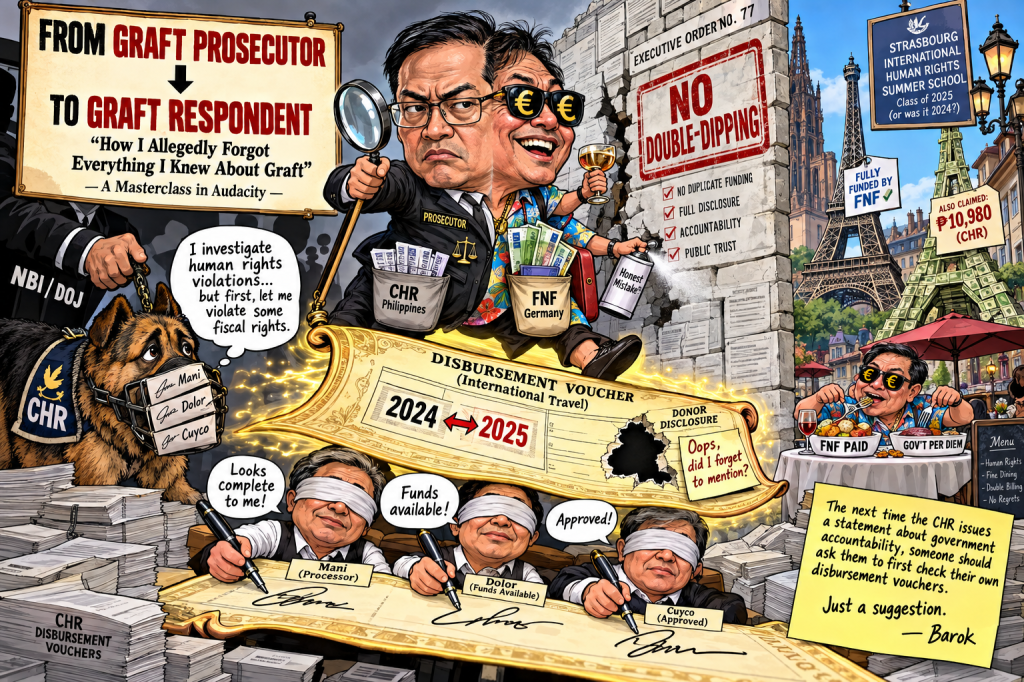
Or: How a Former Graft Prosecutor Allegedly Forgot Everything He Knew About Graft
By Louis ‘Barok‘ C. Biraogo — October 11, 2026
ALLOW me to disappoint the CHR’s fan club: I have no love for the Commission on Human Rights (CHR). In my more generous moments, I call it a bureaucratic monument to good intentions. In my less generous ones, I call it what it often is—a press release factory with a constitutional mandate and a budget.
But even I didn’t expect this.
The National Bureau of Investigation (NBI) has filed a graft complaint against CHR Chairperson Richard Palpal-latoc and three of his subordinates over allegations that he claimed government allowances for a trip to France that was already fully funded by a German foundation. The amount involved? According to one report, roughly $10,980 in daily subsistence allowance alone, based on the United Nations rate for Strasbourg, plus representation expenses.
Palpal-latoc, for those keeping score, is a former graft investigator for the Office of the Ombudsman. He served as an assistant prosecutor in Quezon City. He was a deputy executive secretary for legal affairs in Malacañang before President Marcos appointed him to head the CHR in 2022.
In other words, the man who is now accused of graft spent a significant portion of his career prosecuting graft. If the allegations are true, this isn’t just irony. It’s a masterclass in audacity.
The Anatomy of a Perfectly Avoidable Scandal
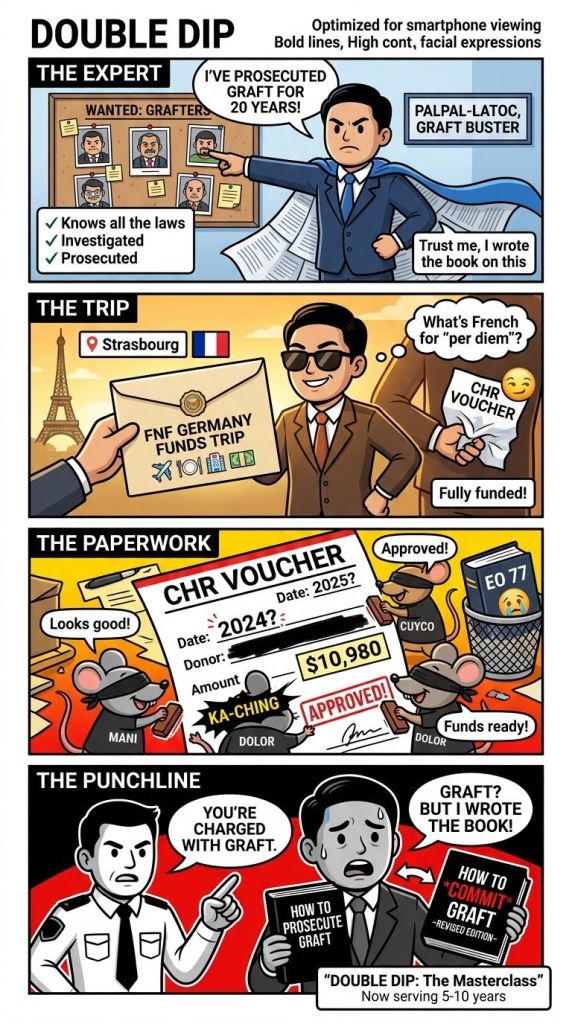
Here’s what the NBI says happened, based on its investigation:
Palpal-latoc attended the 54th International Institute for Human Rights Summer School in France in 2025. The Friedrich Naumann Foundation for Freedom (FNF)—a German liberal foundation with a long history of funding democracy and human rights programs—allegedly covered airfare, accommodation, meals, and subsistence.
So far, so good. A CHR chairperson attending an international human rights training program is not inherently scandalous. It’s arguably part of the job.
But then, according to the NBI, Palpal-latoc claimed daily subsistence allowance and representation expenses from the CHR for the same period. The disbursement voucher allegedly concealed the foreign funding arrangement. The program agenda attached to the voucher was reportedly for the 53rd Summer School held in 2024, not the 54th in 2025. Despite all this, the voucher sailed through every control point—certified as complete by Russel Mani, certified for fund availability by Maria Teresa Dolor, and approved by Onesimo Cuyco.
Let me translate that from bureaucratic Filipino into plain English: The paperwork was allegedly wrong, the funding was hidden, the dates didn’t match, and nobody noticed. Or nobody wanted to notice.
Executive Order No. 77: The Rule That Everyone Forgot
This is where the case gets legally interesting, and where Palpal-latoc’s defense—whatever it turns out to be—runs into a brick wall called Executive Order No. 77, series of 2019 (EO 77).
EO 77 is not obscure. It’s the governing framework for official foreign travel by government personnel. And it says, quite clearly, that officials traveling on scholarships, fellowships, trainings, or donor-funded trips are not entitled to representation expenses. It also prohibits daily subsistence allowances when the sponsor has already provided lodging, meals, and incidental expenses.
The logic is embarrassingly simple: You don’t get to double-dip. If someone else is paying for your meals, you don’t get a government per diem for meals. If a donor covers your accommodation, you don’t claim a hotel allowance. This isn’t advanced accounting. This is the kind of thing that should be covered in the first hour of any government financial management seminar.
Palpal-latoc, of all people, should know this. He investigated graft for a living.
The NBI also alleges that the disbursement voucher violated EO 77’s disclosure requirement by failing to identify the foreign donor. This isn’t a minor clerical omission. The disclosure requirement exists precisely so that reviewing officers can determine which expenses are legally payable and which are not. Concealing the sponsor’s identity isn’t just bad paperwork. It’s the mechanism by which the alleged double-claim became possible.
The Control Chain: A Case Study in Institutional Failure
Let’s talk about the three other CHR officials named in the complaint, because their inclusion is both legally necessary and institutionally damning.
Russel Mani allegedly certified the supporting documents as “complete.” Maria Teresa Dolor allegedly certified that funds were available. Onesimo Cuyco allegedly approved the voucher for payment.
Each of these certifications serves a distinct function in the government’s internal control system. The completeness certification is supposed to ensure that all required documents are present and accurate. The funds-availability certification is supposed to confirm that there’s a lawful appropriation to cover the expense. The approval is supposed to be the final gate—the moment when a responsible official says, “Yes, this payment is proper.”
If the NBI’s allegations are accurate, all three gates failed. And they failed not because of subtle accounting fraud, but because of defects that should have been visible on the face of the documents: a missing donor disclosure, a program agenda from the wrong year, and a claim that was expressly prohibited by an executive order.
The NBI’s language is damning: “Despite missing mandatory documents, the mismatched program documentation, the prohibited claims, and the undisclosed sponsorship, the voucher passed through every control point.”
This is the kind of sentence that makes internal auditors weep. It suggests either breathtaking incompetence or deliberate circumvention. Neither is a good look for an agency whose entire constitutional mandate rests on the premise that it holds others accountable.
The Legal Standard: Why “I Didn’t Know” Might Not Save Him
Let’s be clear about what the NBI has actually alleged. It has filed a complaint, not obtained a conviction. The Office of the Ombudsman will conduct a preliminary investigation. Palpal-latoc is presumed innocent. The burden is on the prosecution to establish probable cause, and eventually, guilt beyond reasonable doubt.
But the legal framework here is not particularly friendly to the “honest mistake” defense.
Section 3(e) of Republic Act No. 3019 (Anti-Graft and Corrupt Practices Act) penalizes public officers who cause undue injury to the government or give unwarranted benefits to private parties through manifest partiality, evident bad faith, or gross inexcusable negligence. The prosecution doesn’t need to prove all three. One is enough.
“Gross inexcusable negligence” is the theory that should worry Palpal-latoc and his co-respondents the most. It doesn’t require proof that they intended to defraud the government. It requires proof that they failed to exercise even the minimal care required by their positions, in a manner that resulted in an unlawful payment.
If the documents were as defective as the NBI claims, a reasonable certifying officer should have caught the problems. A reasonable approving officer should have asked questions. And the claimant—a former graft prosecutor—should have known that claiming expenses already covered by a sponsor was prohibited.
The Supreme Court has consistently held that good faith can negate bad faith, but good faith requires more than a bare assertion. It requires a reasonable basis for believing that one’s actions were lawful. In Sistoza v. Desierto, the Court cautioned against automatically inferring malice or fraudulent intent from a signature on a voucher, noting that heads of offices must rely to a reasonable extent on their subordinates. But that same jurisprudence also emphasizes that “there should be other grounds than the mere signature or approval appearing on a voucher to sustain a conspiracy charge and conviction.”
Here, the NBI alleges there are other grounds: mismatched dates, undisclosed sponsorship, prohibited claims. If those allegations hold up, “I didn’t know” starts to sound less like a defense and more like an admission of negligence.
The Political Context: Timing Is Everything
I would be derelict in my duties as a cynic if I didn’t note the political dimensions of this case.
Palpal-latoc was appointed by President Marcos in 2022. He is a Marcos appointee. And the CHR, under his leadership, has not exactly been a reliable ally of the administration. The Commission has investigated extrajudicial killings from the Duterte drug war, criticized police policies, and generally behaved like an independent constitutional body—which is to say, like an institution that occasionally annoys the people in power.
The NBI, meanwhile, is under the Department of Justice, which is under the Executive branch. The timing of the complaint—filed in October 2026, after the midterm elections and during a period of political consolidation—invites speculation about motives.
But here’s the thing: political motivation and legal validity are not mutually exclusive. A case can be politically convenient and still legally sound. A target can be a political opponent and still be guilty of what he’s accused of.
The CHR’s defenders will frame this as persecution. The administration’s allies will frame it as accountability. Both narratives are predictable, and both are insufficient. The only question that matters is whether the evidence supports the charge.
And based on what’s publicly available, the evidence looks bad for Palpal-latoc.
The Institutional Damage: A Watchdog That Can’t Watch Itself
The CHR’s constitutional mandate is to investigate human rights violations. Its moral authority depends on the perception that it holds itself to the same standards it demands of others.
A graft scandal involving its chairperson doesn’t just damage Palpal-latoc. It damages the institution. It gives ammunition to every police officer, every military official, and every administration critic who has ever dismissed the CHR as a hypocritical nuisance. It makes it harder for the Commission to demand accountability from others when its own leadership is under investigation for financial impropriety.
The irony is almost too perfect: The agency that investigates abuses of power is now being investigated for an abuse of power. The watchdog is on the leash.
And the three subordinate officials—Mani, Dolor, and Cuyco—are now collateral damage. Their careers, their reputations, and potentially their liberty are on the line because they allegedly certified and approved a voucher they should have questioned. Whether they were following orders, afraid to challenge their boss, or simply negligent, they are now part of a criminal complaint that could have been avoided if someone had just said, “Wait, we can’t do this.”
What Happens Next?
The Office of the Ombudsman will conduct a preliminary investigation. It will determine whether there is probable cause to believe that the respondents committed the offenses alleged. If it finds probable cause, it will file an information with the Sandiganbayan, the anti-graft court.
The possible outcomes range from dismissal of the complaint to a full criminal trial. Palpal-latoc could be cleared, reprimanded, suspended, or convicted. He could resign, fight, or negotiate. The CHR could be paralyzed by the leadership crisis, or it could demonstrate that institutional accountability works even when the institution’s own leader is the target.
But regardless of the legal outcome, the political and institutional damage is already done. The CHR’s credibility has been dented. The narrative that human rights institutions are just another part of the corrupt system has been reinforced. And the man who spent his career prosecuting graft will spend the foreseeable future defending himself against it.
If the allegations are true, the irony is not lost on anyone. If they are false, the damage to Palpal-latoc’s reputation is still real.
Either way, the CHR—and the cause of human rights in the Philippines—loses.
Barok’s final thought: The next time the CHR issues a statement about government accountability, someone should ask them to first check their own disbursement vouchers. Just a suggestion.
Key Citations
A. Legal & Official Sources
- The 1987 Constitution of the Republic of the Philippines. Official Gazette of the Republic of the Philippines, 1987, http://www.officialgazette.gov.ph/constitutions/1987-constitution/.
- Executive Order No. 77, s. 2019. Official Gazette of the Republic of the Philippines, 15 Mar. 2019, http://www.officialgazette.gov.ph/2019/03/15/executive-order-no-77-s-2019/.
- Republic Act No. 3019. Anti-Graft and Corrupt Practices Act, 1960, http://www.officialgazette.gov.ph/1960/08/17/republic-act-no-3019/.
- Sistoza v. Desierto. G.R. No. 144784, Supreme Court of the Philippines, 3 Sept. 2002, elibrary.judiciary.gov.ph/thebookshelf/showdocs/1/51505.
- Rivera v. People, G.R. No. 228154, Supreme Court of the Philippines, 16 Oct. 2019, http://www.lawphil.net/judjuris/juri2019/oct2019/gr_228154_2019.html.
- Tapales Villarosa v. People, G.R. Nos. 233155-63, Supreme Court of the Philippines, 23 June 2020, lawphil.net/judjuris/juri2020/jun2020/gr_233155-63_2020.html.
- Memorandum Circular No. 50, s. 2024. Office of the President, 2024, lawphil.net/executive/mc/mc2024/mc_50_2024.html.
B. News Reports
- Bolledo, Jairo. “CHR Chair Faces Graft Complaint over Alleged Corruption in Allowance.” Rappler, 9 Oct. 2026, http://www.rappler.com/philippines/chr-chairperson-graft-complaint-richard-palpal-latoc-ombudsman/.
- Damicog, Jeffrey G. “NBI Files Raps vs. Palpal-lotoc, 3 CHR Officials.” Daily Tribune, 10 Oct. 2026, tribune.net.ph/2026/10/09/nbi-files-raps-vs-palpal-lotoc-3-chr-officials.
- Nolasco, Gwyneth. “NBI Files Graft Raps vs. CHR Officials.” Manila Standard, 9 Oct. 2026, manilastandard.net/news/314803758/nbi-files-graft-raps-vs-chr-officials.html.
- “Ang Hirap Maging Mahirap”: The PAO Scandal That Proves Government Contempt Is Nothing New

- “Far-Off” My Axx: Malacañang’s Claire Castro Drowns in Her Own Legal Gaslighting
- “Forthwith” to Farce: How the Senate is Killing Impeachment—And Why Enrile’s Right (Even If You Can’t Trust Him)

- “HINDI AKO NAG-RESIGN!”

- “I Know Nothing”: Baste Duterte’s Amnesia Defense Meets ₱33M in GenCorp Contracts

- “I’m calling you from my new Globe SIM. Send load!”

- “Mahiya Naman Kayo!” Marcos’ Anti-Corruption Vow Faces a Flood of Doubt

- “Manageable” Debt, Unmanageable Lies: DBM’s ₱21 Trillion Fairy Tale
- “Meow, I’m calling you from my new Globe SIM!”

- “Natrabaho”: One Word, One Ombudsman, and a Judiciary on Trial
- “No Special Jail for Crooks!” Boying Remulla Slams VIP Perks for Flood Scammers

- “Philippine-Controlled” or Yankee Gas Station? The Davao Fuel Depot Farce Exposed




Leave a Reply