
The Mayor Who Forgot His Sister’s Business, The VP Who Swore She Had One, and The SEC That Can’t Find Either
By Louis ‘Barok’ C. Biraogo — September 24, 2026
FORGIVE me while I untangle this pretzel of Duterte logic.
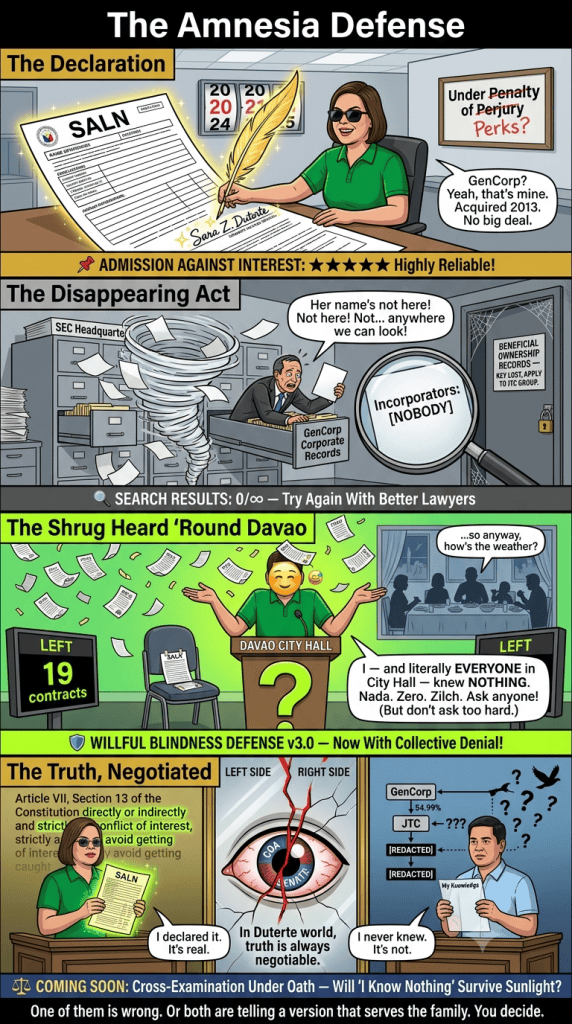
The Vice President of the Republic of the Philippines declares in two consecutive sworn Statements of Assets, Liabilities and Net Worth (SALNs) that she is a shareholder of GenCorp Industries Inc. The House prosecutors call this an “admission against interest”. The Securities and Exchange Commission (SEC) then testifies that her name appears nowhere in the company’s corporate records — not as incorporator, not as director, not as stockholder.
And the Vice President’s brother, the Mayor of Davao City, responds to this by saying… he had no idea.
Mayor Sebastian “Baste” Duterte wants us to believe that his sister declared a business interest in a company that won 19 contracts worth ₱33.2 million from the city he governs, and he knew absolutely nothing about it. He wants us to believe that the Duterte family — the most tightly-wound political dynasty in modern Philippine history, a family that has turned “loyalty” into an art form and “secrecy” into a governing philosophy — somehow failed to mention this at Sunday lunch.
This is either the most astonishing case of sibling non-communication in Philippine political history, or Baste is taking us for fools.
Let’s examine the evidence.
The Mathematical Miracle of the Disappearing Shareholder
The prosecution’s case rests on a beautiful, almost poetic irony: Sara Duterte is the star witness against herself.
She swore under oath that GenCorp was her business interest. She declared it in 2024 and 2025. The interest was “acquired in 2013,” she said. This is not a rumor, not an allegation, not a prosecution fabrication. It is the Vice President’s own signature on a legally binding document.
The House prosecution panel calls this an “admission against interest,” and they’re right to do so. In evidence law, an admission against interest is considered supremely reliable precisely because no rational person would voluntarily make a statement that damages their own position. Sara Duterte had every incentive to hide a GenCorp interest if one existed. She declared it anyway. Why?
Three possibilities:
- Scenario 1: She genuinely believed she had an interest. Maybe she was a beneficial owner through a nominee arrangement that never made it into the corporate records. Maybe she held shares through a trust. Maybe her interest was real but formally undocumented.
- Scenario 2: She made a mistake. A very sophisticated, very expensive, very repeated mistake across two consecutive SALNs. The prosecution’s response to this is blunt: “It was not an honest mistake”.
- Scenario 3: She knew exactly what she was doing. She declared an interest she knew existed but that existed in a form she didn’t want the SEC to see. This is the theory that makes Baste’s “I know nothing” defense so suspicious.
Let’s be clear: the SEC’s testimony does not exonerate Sara. It establishes that her name isn’t in the corporate records. That’s a different proposition from “she has no interest.” The SEC’s own beneficial ownership framework exists precisely because registered shareholders are not always the real owners. The SEC’s Company Registration and Monitoring Department, which testified, doesn’t even have access to beneficial ownership declarations.
So the documentary gap cuts both ways. But it does not help Baste.
The Mayor’s Convenient Amnesia
Baste’s statement is a masterpiece of legal hedging wrapped in folksy Davao bravado. Let’s parse it.
Note the construction: “I, and all other officials and employees.” This is not merely a personal denial. It’s a collective denial, a sweeping assertion that nobody in the entire Davao City government knew anything. This is a remarkably broad claim, especially given that:
- GenCorp received 19 contracts from the city;
- 15 of those were “small value procurement”;
- The Duterte family has governed Davao for decades;
- Sara was Mayor of Davao from 2016 to 2022 — right up until she became Vice President.
Baste says the “Duterte” name doesn’t appear in GenCorp’s documents. But the SEC has now identified JTC Group of Companies Philippines Inc. as holding 54.99% of GenCorp. The ultimate beneficial owners of JTC remain unknown. The court hasn’t seen those records.
So Baste’s defense amounts to: “We didn’t see her name, so we didn’t know.” This is the willful blindness defense dressed up as civic virtue.
The Procurement Theater
Baste’s procurement defense has a certain superficial appeal. Four competitive bids. Fifteen small-value procurements. All published on the Philippine Government Electronic Procurement System (PhilGEPS). GenCorp was the “lowest calculated responsive bid”.
But let’s examine this more carefully.
Small-value procurement is not “no-competition procurement.” It requires requests for quotations, and it has thresholds. More importantly, 15 out of 19 transactions using SVP is a pattern. Repeatedly awarding contracts to the same company through a less-scrutinized procurement method is exactly the kind of thing that should raise eyebrows in a Commission on Audit (COA) audit.
Baste says GenCorp was the “lowest calculated responsive bid.” The Supreme Court has repeatedly held that being the lowest bidder does not immunize a procurement from scrutiny. Specifications can be tailored. Competitors can be excluded. Procurement can be split. The lowest bidder can still be the beneficiary of an unlawful process.
And then there’s the numbers discrepancy — a detail that should be flashing red on every senator-judge’s screen.
Baste says: 19 Davao City transactions, ₱33,263,161.
PhilGEPS says: 15 Davao City awards, ₱34,216,900.
Same city. Same company. Different counts. Different totals. Which is it?
Baste says 19. PhilGEPS says 15. The difference — four transactions — could be amendments, purchase orders, or something else entirely. But Baste didn’t explain the discrepancy. He just asserted his numbers and moved on. This is not transparency. This is information control.
The Constitutional Elephant in the Room
Here’s what Baste’s statement doesn’t address: Article VII, Section 13 of the 1987 Constitution of the Republic of the Philippines (1987 Constitution).
This provision bars the Vice President from “directly or indirectly” participating in any business or being “financially interested in any contract with… the Government” during their tenure. It also requires them to “strictly avoid conflict of interest.”
The House prosecutors have argued that Sara’s continued GenCorp interest — if it existed — violated this provision. Baste’s response doesn’t engage with this at all. He focuses on what city officials knew, not on what the Constitution prohibits.
This is telling. Baste can claim ignorance of his sister’s affairs. He cannot claim that Article VII, Section 13 doesn’t apply to her. The only question is whether she had an interest — and her own SALN says she did.
The Family That Knows Everything Except This One Thing
The Duterte family’s political operation is built on information control. They know who’s loyal. They know who’s not. They know who’s been talking. They know everything.
Baste Duterte is not some naive local official who stumbled into City Hall. He is part of a political machine that has governed Davao for decades. He succeeded his sister as mayor. He inherited her political network. He knows where the bodies are buried — perhaps literally.
And now he wants us to believe that his sister declared a business interest in a company that kept winning city contracts, and he was completely in the dark.
The prosecution has already characterized Sara’s SALN disclosure as an “admission against interest”. Baste’s statement, by contrast, is an assertion of ignorance — a much weaker evidentiary proposition. Anyone can claim they didn’t know. The question is whether the documents prove it.
Baste says the Duterte name isn’t in GenCorp’s documents. But JTC Group’s 54.99% stake creates a corporate veil that hasn’t been pierced. The beneficial ownership records — the ones that would show who really controls GenCorp — haven’t been examined. Baste’s defense is built on the absence of evidence, not the presence of innocence.
The Bottom Line
Baste Duterte’s statement is legally defensible. It is politically precarious. And it is evidentially incomplete.
He says Davao City’s transactions with GenCorp were aboveboard. Maybe they were. But “aboveboard” depends on what the procurement folders actually show — not what a press statement claims.
He says nobody in City Hall knew about Sara’s interest. Maybe they didn’t. But “nobody knew” is not the same as “there was nothing to know.”
He says the Duterte name isn’t in GenCorp’s documents. Maybe it isn’t. But the SEC’s beneficial ownership framework exists precisely because registered shareholders are not always the real owners.
The central question remains unanswered: What was Sara Duterte’s actual relationship with GenCorp? Her own SALN says she had one. The SEC says it can’t find her in the records. JTC Group sits on top of the ownership chain, its own owners hidden from view.
Baste’s “I know nothing” defense is the political equivalent of a shrug. It may satisfy his base. It will not satisfy the Senate impeachment court. And it should not satisfy the Filipino public.
The Vice President declared a business interest under oath. Her brother says the family knew nothing. One of them is wrong.
Or, more likely, both are telling a version of the truth that serves the family’s interests. In Duterte world, the truth is always negotiable. The only question is who gets to define it.
The Senate will get its chance. Baste will testify under oath. And then we’ll see whether “I know nothing” holds up under cross-examination — or whether it joins the long list of Duterte family explanations that crumble when exposed to sunlight.
Louis ‘Barok’ C. Biraogo is the author of the Kweba ni Barok blog. He has never declared a business interest in a company that won ₱33 million in government contracts and then claimed he didn’t know about it. But then again, he’s not a Duterte.
Key Citations
A. Legal & Official Sources
- The 1987 Constitution of the Republic of the Philippines. Official Gazette of the Republic of the Philippines, 1987, http://www.officialgazette.gov.ph/constitutions/1987-constitution/.
- The 1987 Constitution of the Republic of the Philippines, Article VII. Official Gazette of the Republic of the Philippines, http://www.officialgazette.gov.ph/constitutions/the-1987-constitution-of-the-republic-of-the-philippines/the-1987-constitution-of-the-republic-of-the-philippines-article-vii/.
- Republic Act No. 6713. An Act Establishing a Code of Conduct and Ethical Standards for Public Officials and Employees. 20 Feb. 1989, http://www.officialgazette.gov.ph/1989/02/20/republic-act-no-06713/.
- Republic Act No. 9184. An Act Providing for the Modernization, Standardization and Regulation of the Procurement Activities of the Government and for Other Purposes (Government Procurement Reform Act). 10 Jan. 2003, http://www.officialgazette.gov.ph/2003/01/10/republic-act-no-9184/.
- Implementing Rules and Regulations of Republic Act No. 9184. Official Gazette of the Republic of the Philippines, 29 Aug. 2016, http://www.officialgazette.gov.ph/2016/08/29/implementing-rules-and-regulations-of-republic-act-no-9184/.
- Securities and Exchange Commission. Home, http://www.sec.gov.ph/.
- Philippine Government Electronic Procurement System. Home, philgeps.gov.ph/.
- Commission on Audit. Home, http://www.coa.gov.ph/.
- Supreme Court of the Philippines. Home, sc.judiciary.gov.ph/.
B. News Reports
- Suelto, Diana Lhyd. “Sara Holds No Interest in GenCorp – Baste.” Philstar.com, The Philippine Star, 23 Sept. 2026, http://www.philstar.com/headlines/2026/09/23/2558338/sara-holds-no-interest-gencorp-baste.
- Rita, Joviland. “Baste Duterte Says He’s Unaware of VP Sara’s Alleged Link to GenCorp.” GMA News Online, GMA Network, 22 Sept. 2026, http://www.gmanetwork.com/news/topstories/nation/1003221/baste-duterte-says-he-s-unaware-of-vp-sara-s-alleged-link-to-gencorp/story/.
- Panti, Llanesca T. “Prosecution: Baste Duterte’s Statement on GenCorp ‘a Confession of Sins.’” GMA News Online, GMA Network, 22 Sept. 2026, http://www.gmanetwork.com/news/topstories/nation/1003252/prosecution-baste-duterte-s-statement-on-gencorp-a-confession-of-sins/story/.
- “Duterte-Linked Firm Got 49 Govt Contracts.” The Manila Times, 23 Sept. 2026, http://www.manilatimes.net/2026/09/23/news/duterte-linked-firm-got-49-govt-contracts/2430688.
- Peralta-Malonzo, Third Anne. “Sara Duterte-Linked Firm Bags P34.2M in Davao City Hall Contracts.” SunStar, 22 Sept. 2026, http://www.sunstar.com.ph/manila/sara-duterte-linked-firm-bags-p342m-in-davao-city-hall-contracts.
- Avendaño, Christine O. “SEC Official Reveals Duterte Corporate Role in Food Firm.” CoverStory.ph, 22 Sept. 2026, coverstory.ph/2026/09/22/sec-official-reveals-duterte-business-interests/.
- “Ang Hirap Maging Mahirap”: The PAO Scandal That Proves Government Contempt Is Nothing New

- “Far-Off” My Axx: Malacañang’s Claire Castro Drowns in Her Own Legal Gaslighting
- “Forthwith” to Farce: How the Senate is Killing Impeachment—And Why Enrile’s Right (Even If You Can’t Trust Him)
- “HINDI AKO NAG-RESIGN!”

- “I Know Nothing”: Baste Duterte’s Amnesia Defense Meets ₱33M in GenCorp Contracts

- “I’m calling you from my new Globe SIM. Send load!”

- “Mahiya Naman Kayo!” Marcos’ Anti-Corruption Vow Faces a Flood of Doubt

- “Manageable” Debt, Unmanageable Lies: DBM’s ₱21 Trillion Fairy Tale

- “Meow, I’m calling you from my new Globe SIM!”

- “Natrabaho”: One Word, One Ombudsman, and a Judiciary on Trial

- “No Special Jail for Crooks!” Boying Remulla Slams VIP Perks for Flood Scammers

- “Philippine-Controlled” or Yankee Gas Station? The Davao Fuel Depot Farce Exposed









Leave a Reply