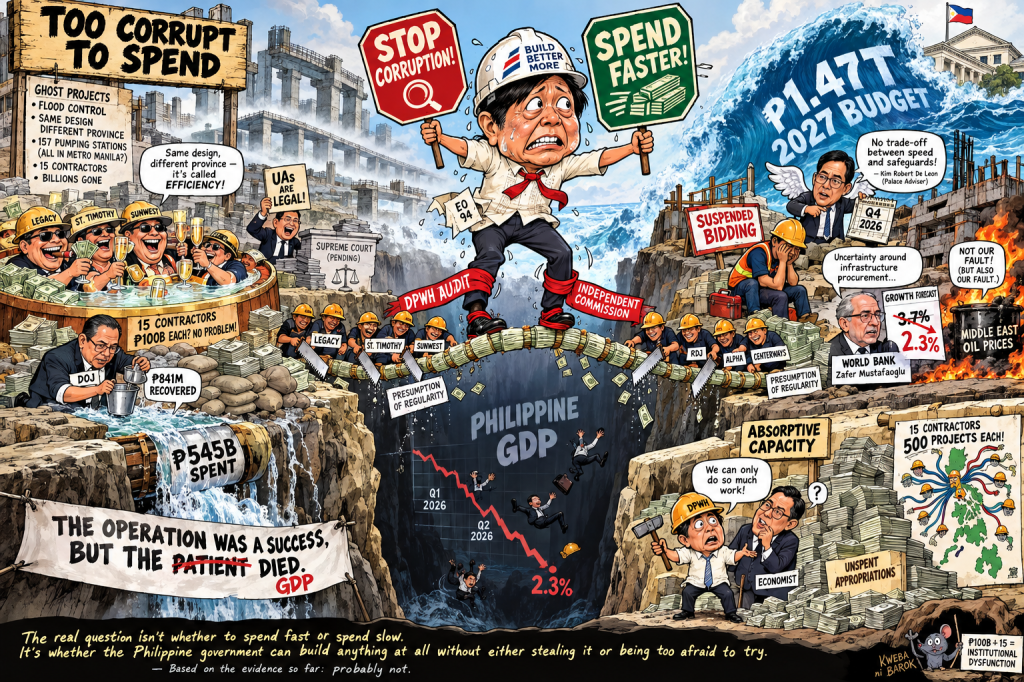
A government that can’t spend fast enough, can’t spend slow enough, and can’t explain why either option is a disaster.
By Louis ‘Barok‘ C. Biraogo — September 24, 2026
FORGIVE me, I must have skipped the seminar on how to lose money and call it integrity.
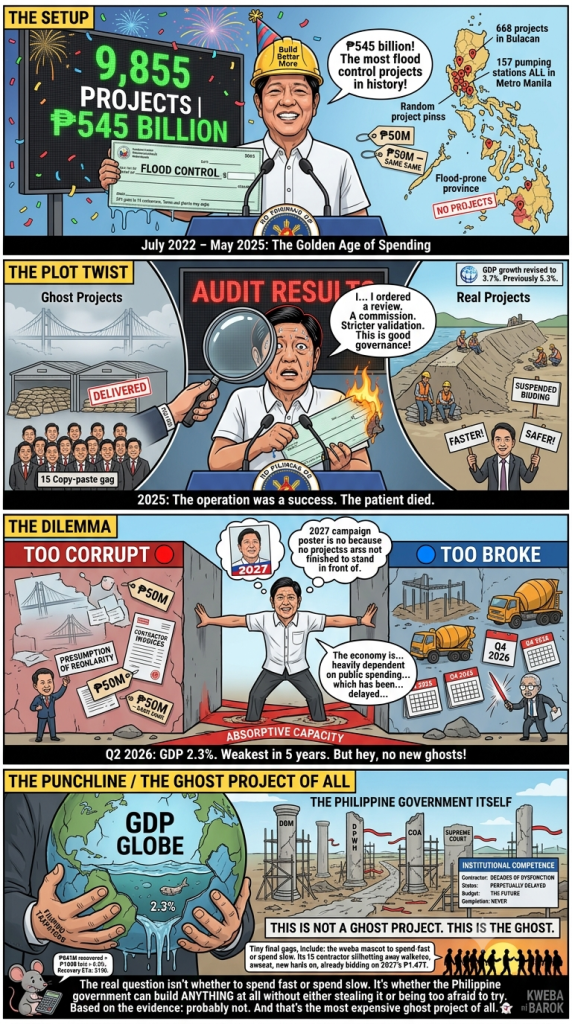
The Philippine government spent roughly ₱545 billion on 9,855 flood-control projects between July 2022 and May 2025. An audit later found that 20% of that spending—about ₱100 billion—went to just 15 contractors. Some projects didn’t exist. Some were substandard. Some had suspiciously identical costs despite being in different locations.
And now the economy is in the toilet because the government stopped hemorrhaging money on potentially fake infrastructure?
Fascinating.
Welcome to the Marcos administration’s version of “the operation was a success, but the patient died.” Only in this case, the patient is the Philippine Gross Domestic Product (GDP), and the operation was an anti-corruption cleanup that somehow managed to become the problem.
Let’s dissect this masterclass in governance, shall we?
The Setup: A Scandal So Big It Became the Excuse
The story, as officially told, goes something like this: In 2025, the flood-control corruption scandal erupted. Marcos, sensing political peril (or perhaps genuinely horrified—we’ll never know), ordered a massive review. Bidding on locally funded flood-control projects was suspended. Stricter billing validation was imposed. The Independent Commission for Infrastructure was created.
The result? Infrastructure spending contracted by 42.9% in the first five months of 2026. GDP growth slumped to 2.3% in Q2 2026. The World Bank slashed its forecast to 3.7% for 2026, down from a previous expectation of 5.3%, explicitly citing “uncertainty around infrastructure procurement” as a key factor.
Marcos, apparently unaware that “we deliberately stopped spending” is not a growth strategy, now says the economy is “heavily dependent on public spending” and that it “has been delayed”.
You don’t say.
The Uncomfortable Question Nobody Wants to Ask
Here’s what bothers me about this entire saga. The administration’s defense—that it had to slow spending because the projects were corrupt—is simultaneously obvious and insane.
Obvious: Of course you shouldn’t spend ₱545 billion on infrastructure that may or may not exist. A bridge that isn’t there doesn’t improve GDP, and a flood-control project that’s actually just a pile of sandbags in a warehouse doesn’t stop floods. Paying for ghost projects is literally lighting money on fire, except the fire produces no heat and the money produces no GDP.
But here’s the insane part: If 20% of your infrastructure budget is allegedly going to 15 contractors, your problem isn’t that you’re spending too slowly. Your problem is that your entire procurement system is a criminal enterprise with a budget line.
The Marcos administration is now caught in a trap of its own making. It can’t spend fast without risking new scandals. It can’t spend slow without tanking the economy. And it’s apparently incapable of spending selectively—separating the clean projects from the fraudulent ones and letting the legitimate ones proceed.
Why? Because that would require institutional competence, and the Philippines has spent decades perfecting the art of institutional dysfunction.
The “Absorptive Capacity” Excuse
Marcos has also argued that government agencies and contractors “can only do so much work”. This is economically plausible—you can’t instantly turn ₱100 billion in delayed appropriations into completed infrastructure. There are design constraints, right-of-way issues, contractor capacity limits, materials shortages, and the universal problem that government engineers are not, as a species, known for their ability to move quickly.
But here’s the thing: Absorptive capacity is not an excuse for the slowdown. It’s evidence of the pre-existing dysfunction that the corruption made worse.
If the Department of Public Works and Highways (DPWH) could only execute so much infrastructure per quarter, then how did 15 contractors manage to absorb ₱100 billion in projects? That’s not absorptive capacity—that’s absorptive corruption.
The GDP Accounting Shell Game
Now, let’s talk about the macroeconomic nonsense being peddled by both sides.
The Q2 data showed government final consumption expenditure increased by 8.3%, even as overall GDP grew only 2.3% and gross capital formation fell 9.2%. This means the political narrative that “government spending collapsed” is, strictly speaking, false. Government consumption—salaries, goods, services—actually grew.
What collapsed was government investment—construction, infrastructure, capital formation. The infrastructure review didn’t stop the government from paying salaries. It stopped the government from building things.
But here’s where the administration’s argument gets slippery: It wants you to believe that infrastructure delays caused the GDP slowdown. That’s partly true. But infrastructure is not the only driver of GDP. Household consumption grew 2.8%. Exports and manufacturing showed signs of life. The slowdown is a complex interplay of factors, and the World Bank itself identified global energy prices from the Middle East conflict as a simultaneous drag.
So the intellectually honest framing is this: Infrastructure delays contributed to the slowdown, but they are not the sole cause. The administration is using the GDP numbers to justify accelerating spending, but it’s being selective about which GDP numbers to cite.
The Real Scandal: Institutional Paralysis
If you want to understand the true failure here, don’t look at the ghost projects. Look at the government’s inability to respond to the ghost projects.
The administration knew there was a corruption problem. It ordered a review. It suspended bidding. It created a commission.
And then… it apparently had no plan for what to do next.
The Department of Budget and Management (DBM) now says it wants “faster implementation and procurement alongside stronger project scrutiny”. Acting Budget Secretary Kim Robert De Leon insists there’s “no trade-off” between speed and safeguards. That’s a lovely sentiment. It’s also demonstrably false, because the government has been living the trade-off for a year.
The government had the tools to do this better. It could have implemented risk-based screening—fast-tracking low-risk, fully documented projects while deep-reviewing suspicious ones. It could have deployed geotagging and satellite imagery to verify physical existence. It could have established a public infrastructure ledger linking appropriations to contractors to physical accomplishments.
Instead, it appears to have done something far simpler: it stopped everything and hoped the scandal would blow over before the 2027 budget.
The Supreme Court Looms
Adding to the chaos is the pending Supreme Court case on Unprogrammed Appropriations (UAs)—the “shadow budget” mechanism that critics say was used to funnel money to ghost projects. The UAs for 2027 are proposed at ₱111.984 billion, the lowest since 1991, but watchdogs argue they remain a corruption vulnerability.
Senate President Gatchalian has said UAs will proceed unless the Supreme Court issues a Temporary Restraining Order (TRO), because “the presumption of regularity applies.” That’s a lovely legal principle. It’s also the exact same logic that allowed the ghost projects to happen in the first place.
If the Court strikes down UAs, the government loses a key fiscal flexibility tool. If the Court upholds them, the corruption pipeline remains open. Either way, someone loses—and it’s probably not the contractors.
The Contractors Who Won’t Go Away
Let’s not forget the contractors. The same firms that allegedly received billions in suspicious flood-control contracts are still in the system. The Discayas, the companies linked to Elizaldy Co, the 15 contractors who somehow absorbed ₱100 billion in projects.
The government says it’s prosecuting 45 individuals and two firms. It says ₱841 million has been recovered. Against a potential loss of ₱100 billion or more, that’s a recovery rate of approximately 0.8%.
At that rate, the government will recover the full amount sometime around the year 2150.
The 2027 Budget: More of the Same?
The proposed ₱7.2 trillion 2027 budget includes ₱1.467 trillion for infrastructure—a 13.8% increase over 2026. The DBM says this will support growth by “generating jobs, creating demand across local industries, improving connectivity.”
But the DBM also says the key is “not simply to spend more or spend faster, but to ensure that appropriated funds are translated into well-planned, properly implemented, and beneficial infrastructure projects”.
That’s a lovely aspiration. It’s also exactly what the government said before the ghost-project scandal erupted.
The Bottom Line: A Governance Failure, Not a Spending Dilemma
The Marcos administration wants you to believe it faces a “dilemma”—a tragic choice between fighting corruption and promoting growth.
That’s not a dilemma. That’s a failure of imagination and institutional capacity.
A competent government would have designed a system to do both: investigate the fraudulent projects while continuing the legitimate ones. It would have deployed technology to verify physical existence. It would have published contractor data and project coordinates. It would have established real-time monitoring instead of retrospective audits.
Instead, the Philippine government did what it has always done: it panicked, froze, and blamed the resulting economic damage on the corruption it failed to prevent in the first place.
The ghost projects were a scandal. The government’s response to the ghost projects is a bigger scandal, because it reveals that the institutions responsible for preventing corruption are the same institutions incapable of responding to it without paralyzing the entire economy.
Marcos says “throwing money at the problem simply doesn’t solve it”. He’s right. But neither does not throwing money at it, which is apparently the current strategy.
The real question isn’t whether to spend fast or spend slow. It’s whether the Philippine government can build anything at all without either stealing it or being too afraid to try.
Based on the evidence so far, the answer is: probably not.
And that’s the most expensive ghost project of all.
Key Citations
A. Reports & Studies
- World Bank. Philippines Macro Poverty Outlook. World Bank Group, Apr. 2026, https://thedocs.worldbank.org/en/doc/c6aceb75bed03729ef4ff9404dd7f125-0500012021/related/mpo-phl.pdf.
- Latoza, Guinevere, and Christian Chua. “Five Reveals from the Flood-Control Data.” Philippine Center for Investigative Journalism, 31 Aug. 2025, https://pcij.org/2025/08/31/5-reveals-from-the-flood-control-data.
B. News Articles
- Bajo, Anna Felicia. “Marcos Bares Total Cost of Flood Control Projects since July 2022 at over P500B.” GMA News Online, 11 Aug. 2025, https://www.gmanetwork.com/news/topstories/nation/955455/marcos-flood-control-projects-p500b/story/.
- Cupin, Bea. “These 15 Contractors Cornered 1 of 5 Flood Control Projects Nationwide.” Rappler, 11 Aug. 2025, https://www.rappler.com/philippines/list-top-contractors-flood-control-projects-marcos-administration/.
- “Philippine Economy Posts Slowest Growth in Five Years in Second Quarter.” Reuters, 7 Aug. 2026, https://www.reuters.com/world/asia-pacific/philippines-q2-gdp-grows-23-yryr-slower-than-expected-2026-08-07/.
- “GDP Slows to 2.3 Percent, Weakest in 5 Years.” Philstar.com, 8 Aug. 2026, https://www.philstar.com/business/2026/08/08/2547700/gdp-slows-23-percent-weakest-5-years.
- “Flood Control Corruption Cleanup Spooks Investors, Drags PH Growth – World Bank.” Rappler, 3 Aug. 2026, https://www.rappler.com/business/world-bank-philippines-economic-update-midyear-2026-edition/.
- “From Ghost Projects to Growth Slump, Marcos Now Faces a Spending Dilemma.” Rappler, 14 Aug. 2026, https://www.rappler.com/business/ghost-projects-growth-slump-marcos-spending-dilemma/.
- “Recovery in Infrastructure Spending Not Likely until Q4.” BusinessWorld, 21 Aug. 2026, https://bworldonline.com/top-stories/2026/08/21/771571/recovery-in-infrastructure-spending-not-likely-until-q4/.
- “Marcos Admin’s Infra Budget Set at P1.47-T for 2027—DBM.” GMA News Online, 27 Aug. 2026, https://www.gmanetwork.com/news/money/economy/1000028/marcos-admin-s-infra-budget-set-at-p1-47-t-for-2027-dbm/story/.
- “DBM Identifies Projects under ‘Historic Low’ P111.9-B Unprogrammed Appropriations for 2027.” GMA News Online, 14 Aug. 2026, https://www.gmanetwork.com/news/money/economy/998565/dbm-identifies-projects-under-historic-low-p111-9-b-unprogrammed-appropriations-for-2027/story/.
- Morong, Joseph. “A Year into Flood Control Mess, 45 Individuals, 2 Top Contracting Firms Charged.” GMA News Online, 28 July 2026, https://www.gmanetwork.com/news/topstories/nation/996486/flood-control-projects-contractors-charged/story/.
- Pulta, Benjamin. “DOJ: Recovered Money from Ghost Flood Control Projects Hits P841-M.” Philippine News Agency, 29 July 2026, https://www.pna.gov.ph/articles/1280638.
- “Gatchalian: SC Can Declare Unprogrammed Funds as Unconstitutional.” Manila Bulletin, 6 Jan. 2026, https://mb.com.ph/2026/01/06/gatchalian-sc-can-declare-unprogrammed-funds-as-unconstitutional.
C. Official Websites
- Presidential Communications Office. “PBBM: 20% of Flood Control Projects Worth P100B Went to Only 15 Contractors.” PCO, 11 Aug. 2025, https://mirror.pco.gov.ph/news_releases/pbbm-20-of-flood-control-projects-worth-p100b-went-to-only-15-contractors/.
- Presidential Communications Office. “President Marcos Signs EO 94 Creating Independent Commission for Infrastructure.” PCO, 11 Sept. 2025, https://pco.gov.ph/news_releases/president-marcos-signs-eo-94-creating-independent-commission-for-infrastructure/.
- Department of Budget and Management. “DBM: No Trade-Off between Faster Infra Rollout, Stronger Safeguards.” Facebook, 27 Aug. 2026, https://www.facebook.com/DBMgovph/posts/1385112037108996/.
- Department of Public Works and Highways. Official Website, https://www.dpwh.gov.ph/.
- Department of Budget and Management. Official Website, https://www.dbm.gov.ph/.

- “Ang Hirap Maging Mahirap”: The PAO Scandal That Proves Government Contempt Is Nothing New

- “Far-Off” My Axx: Malacañang’s Claire Castro Drowns in Her Own Legal Gaslighting
- “Forthwith” to Farce: How the Senate is Killing Impeachment—And Why Enrile’s Right (Even If You Can’t Trust Him)

- “HINDI AKO NAG-RESIGN!”

- “I Know Nothing”: Baste Duterte’s Amnesia Defense Meets ₱33M in GenCorp Contracts

- “I’m calling you from my new Globe SIM. Send load!”

- “Mahiya Naman Kayo!” Marcos’ Anti-Corruption Vow Faces a Flood of Doubt

- “Manageable” Debt, Unmanageable Lies: DBM’s ₱21 Trillion Fairy Tale
- “Meow, I’m calling you from my new Globe SIM!”

- “Natrabaho”: One Word, One Ombudsman, and a Judiciary on Trial

- “No Special Jail for Crooks!” Boying Remulla Slams VIP Perks for Flood Scammers

- “Philippine-Controlled” or Yankee Gas Station? The Davao Fuel Depot Farce Exposed









Leave a Reply