They Cut Your Vaccine and Funded Your Hospital Bill: The Logic of Visible Politics
By Louis ‘Barok‘ C. Biraogo — October 15, 2026
IF YOU want to understand the pathology of Philippine politics, don’t read the Constitution. Read a budget bill. Specifically, read the 2027 General Appropriations Bill that the House of Representatives vomited out on October 13, 2026.
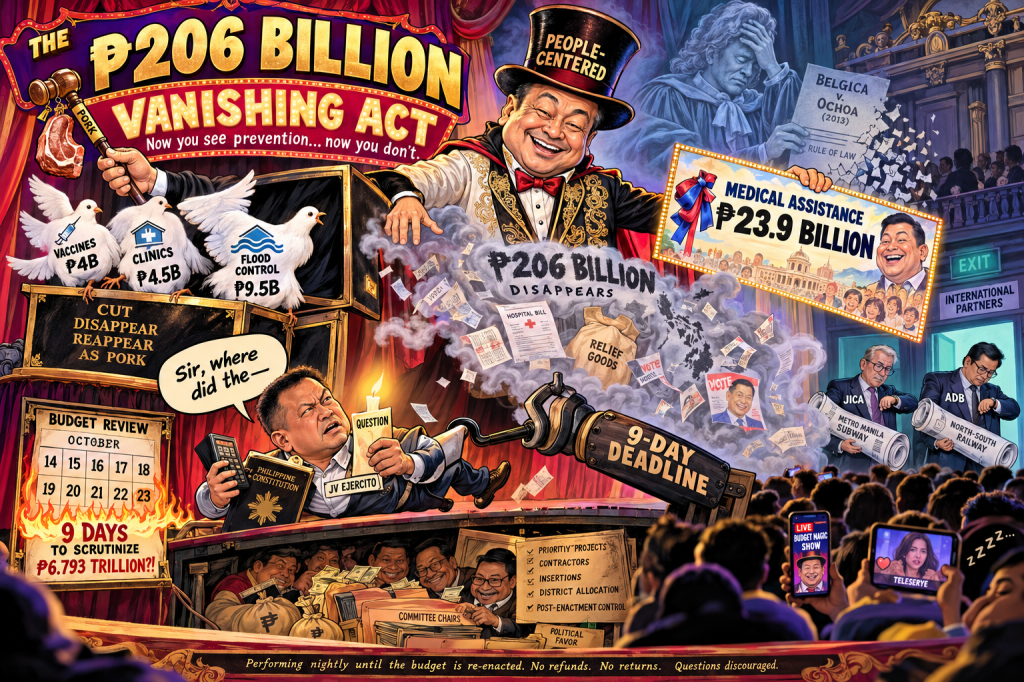
The House, in its infinite wisdom, took the President’s proposed ₱7.2-trillion National Expenditure Program and decided it needed a little… spice. A ₱206-billion spice, to be exact. And when you stare into that abyss of realigned pesos, one man stands at the edge, squinting: Senator JV Ejercito, the chair of the Senate Finance Committee, who apparently didn’t get the memo that in this country, we don’t ask where the money went. We just clap.
Ejercito’s crime? He asked a question. And for that, he deserves both our admiration and our suspicion. Because in the grand theater of Philippine governance, the person who points at the emperor’s new clothes is either a hero or a patsy. Sometimes both. Let’s investigate.
#PHBudget #JVEjercito #PorkBarrel”
The Mathematics of Miracles
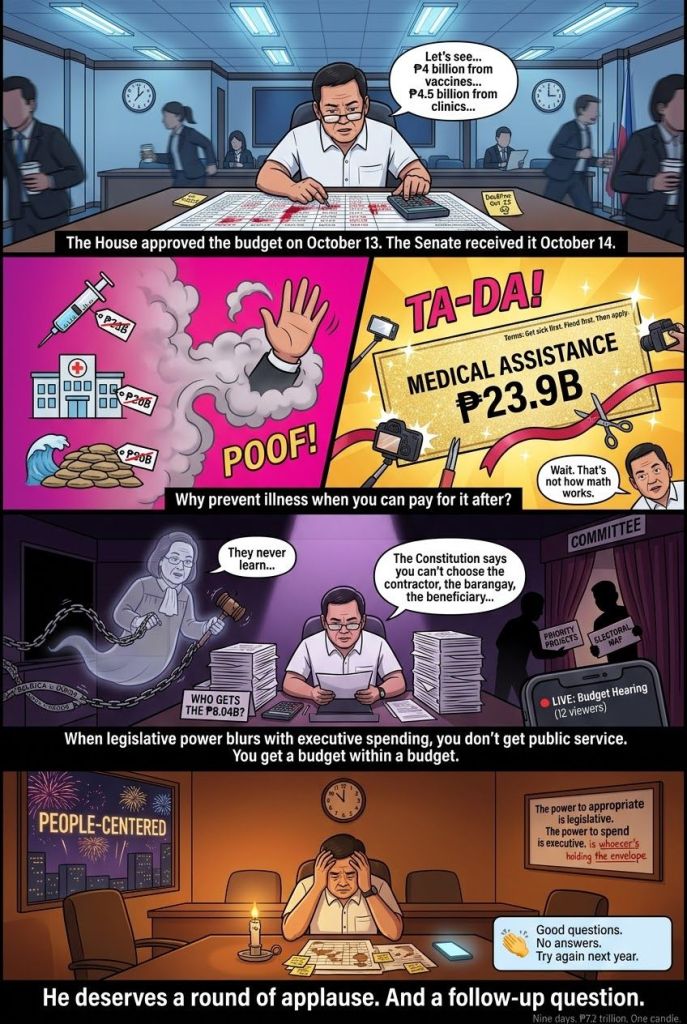
Here is the headline that should terrify every Filipino who has ever tried to get a vaccine or survive a flood: the House reduced immunization funding by ₱4 billion, cut the Health Facilities Enhancement Program by ₱4.5 billion, slashed calamity funds by ₱9.5 billion, and shaved ₱4.6 billion from flood mitigation in major river basins.
But fear not, citizen. They increased medical assistance by ₱23.9 billion.
Do you see the logic yet? I’ll spell it out for you, slowly, because the audacity is almost beautiful. The House’s position, when translated from politician-speak to English, is essentially: “Why prevent illness when you can pay for it after? Why build clinics when you can reimburse hospital bills? Why stop the flood when you can hand out relief goods?”
Senator Ejercito called this a “puzzle”. I call it a business model. A business model where the customer is the sick patient, the flood victim, the farmer whose crops drowned, and the product is a brief, visible, politically-credit-claimable transaction that can be photographed, livestreamed, and converted into a campaign jingle. Preventive healthcare, by contrast, is invisible. You can’t hold a ribbon-cutting ceremony for a measles outbreak that didn’t happen.
But here is where I must pause and offer the Devil his due. The House’s defenders have a point that would be legitimate if they actually made it with evidence. The Health Facilities Enhancement Program has a documented history of inefficiency. Commission on Audit reports have flagged billions in delayed and idle projects. If the Department of Health can’t spend the money it already has, reducing its allocation isn’t sabotage—it’s fiscal hygiene.
The problem is the House never said that. They said “people-centered” and “transparent.” Those are adjectives, not justifications. Adjectives are what you use when you don’t have numbers.
The Belgica Ghost in the Machine
Now, let’s talk about the elephant in the room—or rather, the pork in the budget. Because every time the House adds ₱10 billion for a new “Presidential Assistance to Farmers and Fisherfolk” program and ₱8.04 billion for “additional” Department of Public Works and Highways flood mitigation structures, the ghost of Belgica v. Ochoa starts rattling its chains.
The Supreme Court, in its 2013 magnum opus, didn’t just strike down the Priority Development Assistance Fund (PDAF). It articulated a constitutional principle that should make every budget insertion blush: legislators cannot exercise post-enactment control over public funds. The power to appropriate is legislative. The power to spend—to choose the specific contractor, the specific barangay, the specific beneficiary—is executive. When those lines blur, you don’t get public service. You get a budget within a budget.
The House’s changes raise a question that Ejercito is too polite to ask directly but which every taxpayer should be screaming: Who is actually going to decide where that ₱8.04 billion in DPWH flood structures goes? Will it be the Department of Public Works and Highways (DPWH), operating under transparent procurement rules? Or will it be a committee chairperson’s office, armed with a list of “priority projects” that just happen to coincide with electoral geography?
The ₱130-billion cut to foreign-assisted projects is equally suspicious, but for a different reason. These are not just peso amounts. These are commitments to the Japan International Cooperation Agency (JICA), the Asian Development Bank (ADB), and other lenders who expect the Philippine government to hold up its end of a loan agreement. Slashing these allocations doesn’t just delay infrastructure. It sends a signal to the international community that Philippine budget priorities are as stable as a house of cards in a typhoon. The Metro Manila Subway and the North-South Commuter Railway aren’t just projects. They’re tests of credibility.
The Senate’s Nine-Day Scrutiny
Here is the part that should make you laugh, or cry, or both.
The House approved its version on October 13. The Senate received it on October 14. Ejercito set a deadline of October 23 for committee reports.
Nine days. To review a ₱7.2-trillion budget with ₱206 billion in House-introduced changes. To determine whether every realignment is justified. To catch every pork insertion. To restore every unjustly cut program. Nine days.
This is not oversight. This is a speed-reading contest with the national treasury as the prize. And the House knows it. They know the Senate’s constitutional power to amend is rendered largely theoretical when the clock is running and the alternative is a re-enacted budget that freezes everyone’s favorite programs.
Ejercito’s response—livestreaming the bicameral conference committee and meeting with civil society on October 26—is the right instinct. But a livestream is not a safeguard. Transparency is not the same as accountability. You can watch a crime happen live and still not be able to stop it.
The Inconvenient Truth About Ejercito
Let me be complementary now, because the man deserves it. JV Ejercito, son of a former president, half-brother to a plunder convict, has spent much of his political career being underestimated. He lost a Senate seat in 2019, clawed his way back in 2022, and now finds himself in the improbable role of Senate Finance Committee chair—the chamber’s chief fiscal interrogator.
And he is asking the right questions. Not just about the numbers, but about the philosophy embedded in those numbers. His most devastating observation is almost philosophical: “What are we supposed to do with this? Remove funding for immunization and health promotion, then provide medical assistance when people get sick?”
That is not a budget question. That is a governance question. It asks whether the state sees its citizens as patients to be treated or as people to be protected. Whether governance is a transaction or a trust.
But Ejercito is also a politician. He is positioning himself for 2028, building a reputation as the Senate’s conscience on health and disaster resilience, and drawing a contrast with a House leadership that has decided its legacy will be “people-centered” adjective usage. The fact that his self-interest aligns with the public interest doesn’t make him wrong. It just makes him a politician. The two are not mutually exclusive.
The Verdict
So where does this leave us? With a budget that prioritizes visible assistance over invisible prevention. With a House that has the constitutional power to originate money bills but no apparent obligation to explain what it did with them. With a Senate that has nine days to pretend it can fix everything. And with a senator who is asking the right questions but may not have the votes, the time, or the institutional leverage to force answers.
The ₱206 billion is not a scandal in the legal sense. No court has ruled it unconstitutional. No audit has labeled it pork. But it is a scandal in the civic sense. It is a reminder that in the Philippines, the budget is not a policy document. It is a political instrument. And the people who wield it will always prefer the kind of spending that creates a photograph to the kind that creates a future.
Ejercito’s most important contribution may not be restoring the immunization funds or protecting the flood control allocations. It may be proving, one more time, that the question “Where did the money go?” is still askable—and that asking it still makes you the enemy of the comfortable.
For that, he deserves something rare in this country: a round of applause and a follow-up question.
Barok C. Biraogo is a recovering former government official and the author of “Pork: A Love Story.” His blog, Kweba ni Barok, has been described as “the only place where budget hearings are more entertaining than teleseryes.”
Key Citations
A. Legal & Official Sources
- Commission on Audit. Annual Audit Report on the Department of Health. Quezon City: Commission on Audit, 2025. https://www.coa.gov.ph/.
- Official Gazette. Belgica v. Ochoa, G.R. No. 208566. 2013. https://elibrary.judiciary.gov.ph/thebookshelf/showdocs/1/66038.
- Commission on Audit. Performance Audit Report on the Health Facilities Enhancement Program. Quezon City: Commission on Audit, 2017. https://www.coa.gov.ph/reports/performance-audit-reports/2017-2/health-facilities-enhancement-program/.
B. News Articles
- Rappler. “JV Ejercito Flags Major Changes in the House-Approved 2027 Budget Bill.” Rappler, 14 Oct. 2026. https://www.rappler.com/philippines/national-news/jv-ejercito-flags-major-changes-house-representatives-version-2027-budget-bill/.
- Servallos, Neil Jayson. “House Realigned P206 Billion in 2027 National Budget.” The Philippine Star, 15 Oct. 2026. https://www.philstar.com/headlines/2026/10/15/2563333/house-realigned-p206-billion-2027-national-budget.
C. Official Websites
- Asian Development Bank. Asian Development Bank. 2026. https://www.adb.org/.
- Department of Budget and Management. National Expenditure Program. 2026. https://www.dbm.gov.ph/.
- Department of Health. Department of Health. 2026. https://doh.gov.ph/.
- Department of Public Works and Highways. Department of Public Works and Highways. 2026. https://www.dpwh.gov.ph/.
- Japan International Cooperation Agency. Japan International Cooperation Agency. 2026. https://www.jica.go.jp/english/.
- Senate of the Philippines. Senator JV Ejercito. 2026. https://www.senate.gov.ph/senators/sen_bio/ejercito_jv_bio.asp.
- Senate of the Philippines. Senate of the Philippines. 2026. https://www.senate.gov.ph/.
- Supreme Court of the Philippines. Supreme Court of the Philippines. 2026. https://sc.judiciary.gov.ph/.

- ₱9 Billion in ‘Savings’? DILG’s Fire Truck Deal Smells Like Smoke
- ₱8B BBM Pork: CCTV for Every Captain’s Kumpare?
- ₱8.9 Billion, 331 Ghost Police Stations: The TIKAS Scandal Explained

- ₱8.4 Billion, 42,000 Barangays, 1 Election: The “Bawat Barangay Makikinabang” Vote-Buying Masterclass
- ₱75 Million Heist: Cops Gone Full Bandit

- ₱6.77B Ghost Haunts Duterte: RTC Dismisses Mans Carpio’s Desperate Plea
- ₱6.77 Billion and Zero Cash: The Sara Duterte SALN Math That Doesn’t Add Up

- ₱6.7-Trillion Temptation: The Great Pork Zombie Revival and the “Collegial” Vote-Buying Circus

- ₱58.53B, Zero Receipts: The LGSF Pork Barrel Nobody Wants to Name
- ₱53 Million Man Tells ₱695-a-Day Workers to Stop Being ‘Mayabang’: The Audacity of BSP’s Remolona
- ₱4.4 Billion and a Witness Who Can’t Explain It: The Duterte Impeachment’s Most Expensive Non-Answer
- ₱3.06 Billion for Evacuation Centers—But Nobody Knows Where They’ll Stand (Or If They’ll Exist)



Leave a Reply