Inside the Impeachment Retreat That Left Even the Prosecution’s Own Allies Asking: What Just Happened?
Louis ‘Barok‘ C. Biraogo | October 15, 2026
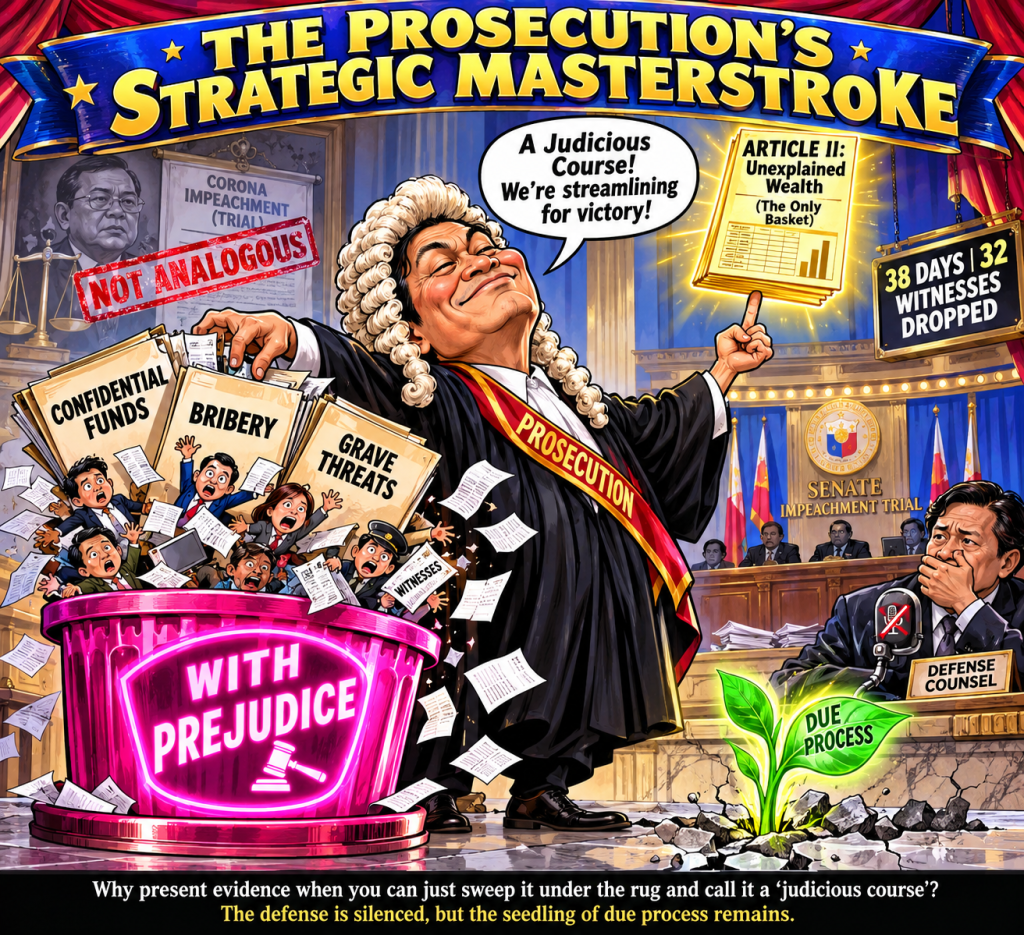
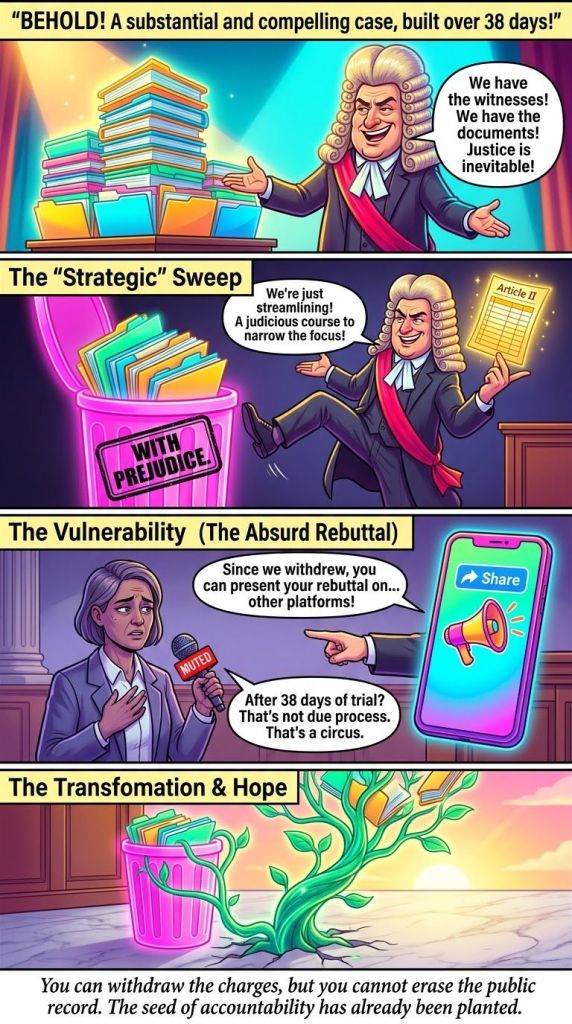
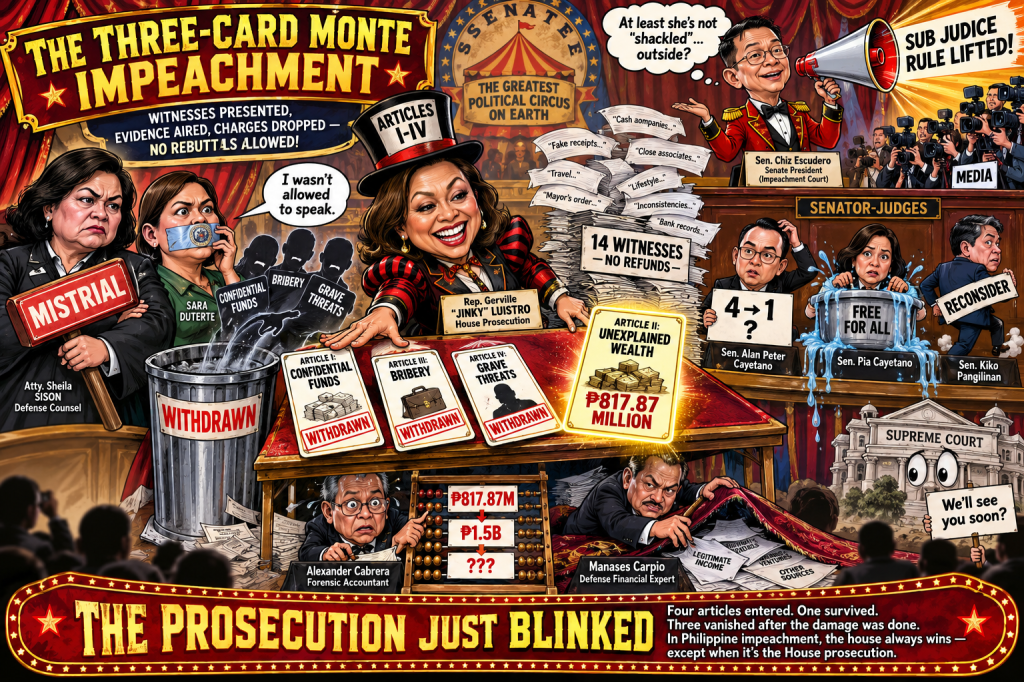
HERE’S a legal strategy so brilliant it deserves its own case study at the Harvard Law School’s “How to Snatch Defeat from the Jaws of Victory” seminar: The House prosecution panel spent 38 days, countless public funds, and the credibility of the entire impeachment mechanism presenting evidence against Vice President Sara Duterte on four articles of impeachment. Then, having built what they called a “substantial and compelling” case, they withdrew three of those articles—including two on which they had already presented evidence—and declared victory.
That’s not prosecutorial discretion. That’s a retreat masquerading as a masterstroke.
The Arithmetic of Abdication
Let’s do the math the prosecution seems allergic to. Article I (confidential funds): 11 of 27 listed witnesses presented. Article III (bribery): zero of five witnesses presented. Article IV (grave threats): three of ten witnesses presented . Total witnesses dropped from the stand: approximately 32. Total articles abandoned after evidence was already heard: two.
Lead prosecutor Rep. Gerville Luistro—who now apparently moonlights as the panel’s official spinner—framed this as a “judicious course” that would “narrow the matters requiring the impeachment court’s consideration”. Translation: We spent weeks presenting evidence, and now we’d like you to pretend we didn’t.
The withdrawal of Articles I and IV was approved “with prejudice”, meaning these charges cannot be revived or refiled against Duterte during the 20th Congress. The bribery charge—on which, let’s be fair, the prosecution never bothered to present a single witness—was withdrawn “without prejudice.” How generous.
The “They Have No Evidence” Canard
Manila Rep. Joel Chua and Atty. Benjamin Tolosa Jr. have spent the days since the withdrawal insisting that the defense has “no evidence” and would merely “lengthen this process” through dilatory tactics. Tolosa pointed to the defense’s pretrial brief and answer as consisting only of “general denials and technicalities.” He claimed the defense “copied” the prosecution’s witness list without offering substantive counter-evidence.
Let’s examine this logic, shall we? A criminal defendant who pleads not guilty and forces the prosecution to prove its case is not “without evidence”—they are exercising the most fundamental procedural right in any adversarial system. A demurrer to evidence is not a confession of weakness; it is a legal assertion that the prosecution’s own evidence fails to establish a prima facie case. If Chua and Tolosa don’t understand this distinction, they have no business prosecuting an impeachment trial under Article XI, Section 3 of the 1987 Constitution. If they do understand it and are saying it anyway, they’re engaged in something considerably less honorable.
The prosecution’s argument, stripped of its rhetorical varnish, amounts to this: “The defense didn’t present evidence, so we withdrew our charges, which proves they had no evidence.” This is circular reasoning dressed up as litigation strategy. It is also, as the defense’s lead counsel Sheila Sison correctly noted, “ridiculous”.
The Due Process Casualty
Sison’s objection cuts to the heart of the matter: “They presented their evidence. The court allowed them time, gave them opportunity, gave them platform, but now, since they withdrew, your Vice President can no longer speak or defend herself from those allegations”. She called the procedure “completely unfair”.
The prosecution’s response? Luistro suggested Duterte could use “other platforms” to present her evidence. After three months of hearings and 38 days of public trial, the Vice President is being told to take her rebuttal to Facebook or a press conference. That’s not due process. That’s due process if due process were administered by a social media manager.
Presiding Officer Francis Escudero attempted a Solomonic compromise by lifting the sub judice rule on the withdrawn articles, theoretically allowing Duterte to respond publicly. But this ruling was itself problematic—defense spokesperson Michael Poa noted that a separate gag order from the Quezon City Regional Trial Court on the grave threats criminal case might prevent Duterte from discussing Article IV. And Senator Pia Cayetano expressed shock at the prosecution’s decision, stressing that Duterte’s reputation was at stake and the defense needed time to process the development.
The Corona Precedent: A Distinction That Matters
The prosecution has leaned heavily on the 2012 impeachment of former Chief Justice Renato Corona as precedent, citing that prosecutors withdrew five of eight articles. Luistro claims this “recognized the prosecution’s privilege to determine which articles to pursue”.
But Sison made a critical distinction that the prosecution has yet to adequately address: In Corona, the withdrawn articles were dropped before evidence was presented on them. In Duterte’s case, evidence had already been presented on Articles I and IV. The defense was prepared to rebut that evidence. The public had heard it. The senator-judges had sat through it.
The prosecution’s Corona precedent is not analogous. It’s a rhetorical prop.
The Senator-Judges’ Dilemma
Here’s what the senator-judges are now faced with: A single article of impeachment—unexplained wealth—on which the prosecution’s star witness, forensic accountant Alexander Cabrera, testified that Duterte and her husband had approximately P817.87 million in allegedly undeclared assets from 2022 to 2025. That figure could allegedly reach P1.5 billion under broader accounting, though Cabrera himself clarified this was a “possible higher estimate” [[kwebanibarok.com]].
The prosecution says this is enough. They’ve bet everything on it. As University of Makati professor Ederson Tapia observed, “The prosecution has effectively placed all its eggs in one basket”. A more focused case, he noted, “does not automatically make conviction more likely” [[kwebanibarok.com]].
The math is unforgiving: Conviction requires two-thirds of all senators—16 votes. Under Article XI, Section 3(6) of the 1987 Constitution, no person shall be convicted in an impeachment trial without the concurrence of two-thirds of all members of the Senate. The Senate recently ruled that the basis for conviction votes shall only cover senators “legally and factually capable” of participating, and four senators are currently unable to perform their duties due to detention, unknown whereabouts, or medical leave abroad. That ruling may lower the effective threshold, but the arithmetic still requires convincing a supermajority of the remaining senator-judges that a single financial charge warrants removal from office and permanent disqualification from public service.
The Accountability That Wasn’t
Perhaps the most damning indictment of this withdrawal comes not from the defense, but from the progressive groups who fought hardest to put Duterte on trial in the first place.
Bagong Alyansang Makabayan (Bayan) president Renato Reyes called the abandonment of the confidential funds charge “a great disservice to the Filipino people and a huge missed opportunity”. He noted that the issue—P612.5 million in confidential funds at the Office of the Vice President (OVP) and the Department of Education (DepEd), including P125 million allegedly spent in just 11 days in December 2022—helped drive the impeachment effort beginning in 2023.
Former ACT Teachers Party-list Rep. France Castro, who was among the first to question Duterte’s confidential fund spending, said the evidence was clear: “milyun-milyong confidential funds na ginastos sa loob lamang ng ilang araw, walang maayos na liquidation, at mga pinakitang mga resibo ay hindi kapani-paniwala”. Millions spent in days, no proper liquidation, unbelievable receipts. And now, thanks to the prosecution’s “strategy,” none of it will be resolved by the impeachment court.
Castro raised a question that the prosecution would rather not answer: “Are they worried that this issue would boomerang to President Marcos? Tandaan natin: si Marcos mismo ang nagbigay ng confidential funds kay VP Duterte noong 2022”. Is the withdrawal designed to protect the President who authorized those funds?
That’s a question the prosecution has not addressed. Their silence is deafening.
The Politics Beneath the Procedure
Let’s be clear about what’s actually happening here. The Marcos-Duterte political alliance collapsed spectacularly after the 2022 elections. The House, dominated by Marcos allies, impeached Duterte. The Senate trial has been proceeding for months. Duterte has announced her candidacy for the 2028 presidential election and leads in multiple opinion polls.
The prosecution’s decision to narrow the case to a single financial charge achieves several political objectives simultaneously: It expedites the trial, potentially concluding it before the 2027 budget deliberations consume the Senate’s attention. It avoids the messy, politically dangerous terrain of confidential funds—funds that, as Castro noted, originated with Marcos himself. And it gives the prosecution a face-saving exit if Article II fails: “We had other charges, but we chose to focus on the strongest one.”
But it also achieves something else: It denies the Filipino people a comprehensive reckoning with alleged abuses of power. The confidential funds scandal was the issue that galvanized public attention. The grave threats allegation—that Duterte threatened to have Marcos, the First Lady, and Speaker Romualdez assassinated if she were killed—was the most shocking. The bribery allegation, weak as it apparently was, went to the heart of corruption in the education system.
All of it, now consigned to the ash heap of “strategic withdrawal.”
The Ethical Question No One Is Asking
The Code of Professional Responsibility and Accountability (CPRA) obligates lawyers to serve their clients with competence, diligence, and fidelity. It also imposes duties of candor and fairness to the court. Prosecutors—whether in criminal cases or impeachment trials—have additional responsibilities as ministers of justice.
The question that Chua, Tolosa, and Luistro should be asked, but almost certainly won’t be: Did they withdraw Articles I and IV because the evidence was weak, or because the evidence was strong but politically inconvenient?
If the evidence was weak, why did they present it? Why did they parade witnesses and documents before the Senate and the public, only to abandon the charges? If the evidence was strong, why did they withdraw? What were they afraid of?
The prosecution’s public posture—that they’re “concentrating on the strongest case”—collapses under scrutiny. If Article II is strong enough to warrant removal on its own, why were the other articles filed at all? If they were filed without sufficient evidence, what does that say about the House’s impeachment process? If they were filed with sufficient evidence, what does withdrawing them accomplish except to spare the respondent the inconvenience of answering?
The Defense’s Next Move
Sison has made clear that the defense will proceed with its presentation of evidence regardless of the prosecution’s withdrawa. She has also raised the possibility that the withdrawal should be grounds for dismissing the entire impeachment case. That may be a bridge too far procedurally, but the underlying argument—that the prosecution cannot dictate the scope of the defense after forcing the defense to prepare for a four-article trial—is sound.
The defense will now focus on Article II. It will challenge the methodology of Cabrera’s forensic accounting. It will argue that assets attributed to Duterte may belong to others or be subject to legitimate explanations. It will question whether any alleged discrepancy rises to the level of “culpable violation of the Constitution” or “betrayal of public trust” warranting removal under Article XI, Section 2 of the 1987 Constitution.
And it will do so without ever having had the opportunity to rebut the evidence presented on the withdrawn articles. The public record now contains accusations that Duterte misused confidential funds and threatened the life of the President. Those accusations will never be tested in the impeachment court. They will remain, permanently, in the gray zone between allegation and proof.
The Bottom Line
The prosecution’s withdrawal of three impeachment articles is not a strategic masterstroke. It is a calculated retreat, dressed up in the language of efficiency and prosecutorial discretion. It prioritizes speed over thoroughness, political expediency over accountability, and the appearance of strength over the substance of justice.
Sison called the move “ridiculous”. Senator Cayetano was “shocked”. Even the prosecution’s own allies in the progressive movement are denouncing it. When you’ve lost the Makabayan bloc, you’ve lost the argument.
The senator-judges now face a binary choice: convict on a single financial charge, or acquit and allow Duterte to continue her political ascent. The prosecution has made that choice easier to frame but harder to justify. They have narrowed the case to a single article, but they have also narrowed the scope of accountability. They have expedited the trial, but at the cost of the comprehensive reckoning that impeachment was supposed to provide.
If Article II fails, the prosecution will have no one to blame but themselves. They had four articles. They chose to pursue one. They had evidence. They chose to abandon it. They had the opportunity to hold a Vice President accountable for alleged misuse of public funds, bribery, and threats against the President. They chose to bet it all on a forensic accountant’s spreadsheet.
That’s not justice. That’s a gamble. And if the Filipino people lose, it won’t be because the defense had no evidence. It will be because the prosecution decided they didn’t need to present it.
Louis ‘Barok’ C. Biraogo is the author of the Kweba ni Barok blog. He is not a lawyer, but he writes about the law with the confidence of someone who has never been held in contempt. He has been described as “equally insufferable in both journalism and jurisprudence.”
Key Citations
A. Legal & Official Sources
- The 1987 Constitution of the Republic of the Philippines. Official Gazette of the Republic of the Philippines, 1987, http://www.officialgazette.gov.ph/constitutions/1987-constitution/.
- Code of Professional Responsibility and Accountability. Supreme Court of the Philippines, A.M. No. 22-09-01-SC, 11 Apr. 2023, sc.judiciary.gov.ph/wp-content/uploads/2023/05/22-09-01-SC-FINAL.pdf.
- Republic Act No. 1379. An Act Declaring Forfeiture in Favor of the State Any Property Found to Have Been Unlawfully Acquired by Any Public Officer or Employee. 1955, lawphil.net/statutes/repacts/ra1955/ra_1379_1955.html.
- Senate of the Philippines. Rules of Procedure on Impeachment Trials. 2011, chanrobles.com/legal11impeachmentrules.htm.
- Sara Z. Duterte v. House of Representatives, G.R. Nos. 278353 and 278359. Supreme Court of the Philippines, 25 July 2025, lawphil.net/judjuris/juri2025/jul2025/gr_278353_2025.html.
B. News Reports
- “House prosecution drops 3 impeachment articles, believes unexplained wealth charge enough to oust VP Sara.” House of Representatives, 13 Oct. 2026, http://www.congress.gov.ph/media/press-releases/10322.
- Reganit, Jose Cielito. “VP impeachment trial: What the prosecution presented in 3 articles.” Philippine Daily Inquirer, 13 Oct. 2026, newsinfo.inquirer.net/2322993/vp-impeachment-trial-what-the-prosecution-presented-in-3-articles.
- “Prosecution drops all cases vs Sara Duterte except unexplained wealth.” Rappler, 14 Oct. 2026, http://www.rappler.com/philippines/prosecution-motion-drop-cases-except-unexplained-wealth-sara-duterte-impeachment/.
- “Withdrawal of impeach charges denied Sara Duterte a chance to clear her name – Spox.” Philstar.com, 14 Oct. 2026, http://www.philstar.com/headlines/2026/10/14/2563183/withdrawal-impeach-charges-denied-sara-duterte-chance-clear-her-name-spox.
- “Makabayan Groups Decry Dropping of Sara Confidential Funds Charge.” Philstar.com, 14 Oct. 2026, http://www.philstar.com/headlines/2026/10/14/2563191/makabayan-groups-decry-dropping-sara-confidential-funds-charge/amp/.
- “Five impeachment articles withdrawn.” Philstar.com, 29 Feb. 2012, http://www.philstar.com/headlines/2012/02/29/781867/five-impeachment-articles-withdrawn.
- “Ang Hirap Maging Mahirap”: The PAO Scandal That Proves Government Contempt Is Nothing New
- “Far-Off” My Axx: Malacañang’s Claire Castro Drowns in Her Own Legal Gaslighting
- “Forthwith” to Farce: How the Senate is Killing Impeachment—And Why Enrile’s Right (Even If You Can’t Trust Him)
- “HINDI AKO NAG-RESIGN!”

- “I Know Nothing”: Baste Duterte’s Amnesia Defense Meets ₱33M in GenCorp Contracts

- “I’m calling you from my new Globe SIM. Send load!”

- “Mahiya Naman Kayo!” Marcos’ Anti-Corruption Vow Faces a Flood of Doubt

- “Manageable” Debt, Unmanageable Lies: DBM’s ₱21 Trillion Fairy Tale

- “Meow, I’m calling you from my new Globe SIM!”

- “Natrabaho”: One Word, One Ombudsman, and a Judiciary on Trial
- “No Special Jail for Crooks!” Boying Remulla Slams VIP Perks for Flood Scammers

- “Philippine-Controlled” or Yankee Gas Station? The Davao Fuel Depot Farce Exposed




Leave a Reply