
He indicted the President’s cousin but forgot to calendar the helpline
By Louis ‘Barok‘ C. Biraogo | October 15, 2026
LET me be the first to admit it: Jesus Crispin Remulla has done more for Philippine accountability in one year than his predecessors managed in a decade — and I’m starting to think he might actually be the hero we didn’t deserve.
I’m not happy about this either.
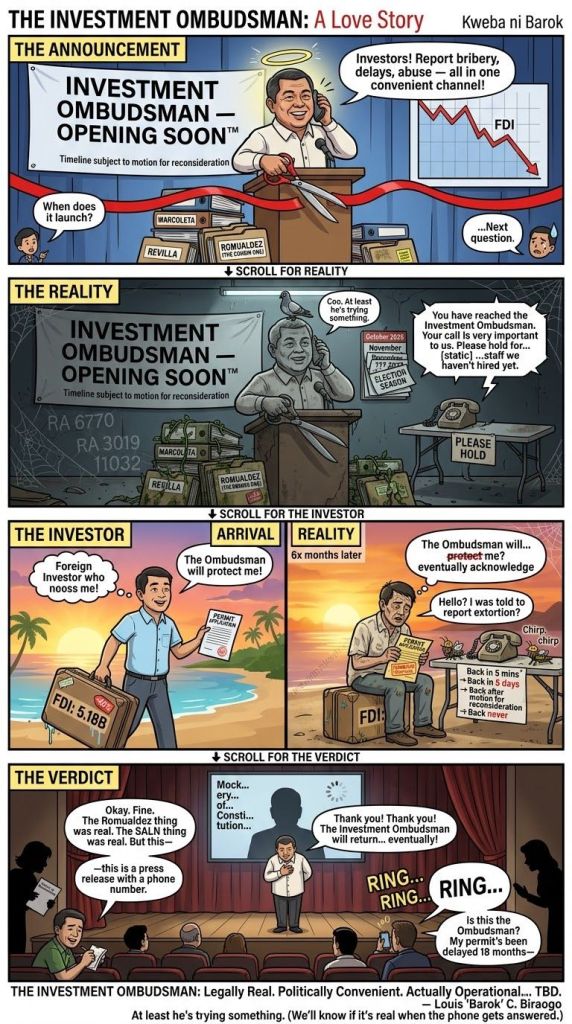
The man who once defended the government’s position on the International Criminal Court (ICC) withdrawal, who served as Justice Secretary under Marcos Jr., who was called a “mockery of the Constitution” by a Duterte, has announced the creation of an “Investment Ombudsman” — a dedicated channel for investors to report bribery, permit delays, and regulatory abuse.
And the internet has already decided this is theater.
The Cynics Are Wrong (Mostly)
Here’s the standard critique, which you’ve probably already typed into your group chat:
- It’s redundant. The Ombudsman already accepts complaints “in any form or manner” under Article XI, Section 12 of the 1987 Constitution of the Republic of the Philippines (1987 Constitution). Why do investors need a special lane?
- It’s deflection. Remulla’s appointment was controversial. His role in the Duterte ICC arrest made him politically radioactive. This is just a shiny object to distract from the flood control scandal.
- There’s no timeline. Which is true. BusinessWorld noted there’s “no official expected timeline” for the channel. That’s… not great.
All valid. All suspicious. All the kind of stuff you’d expect from an institution that ranks 114th out of 180 in Transparency International’s Corruption Perceptions Index.
But here’s the thing: the cynics are missing the point.
What Remulla Actually Did in Year One
Let’s look at the receipts, because unlike most Philippine officials, Remulla has some.
In his first year, the Ombudsman filed 39 criminal cases related to the flood control scandal — 35 before the Sandiganbayan, four before regional trial courts. The defendants include:
- A sitting senator (Rodante Marcoleta)
- A former senator (Ramon Revilla Jr.)
- Former House Speaker Ferdinand Martin Romualdez — Marcos’ own cousin
Wait. Let me repeat that. The Ombudsman filed charges against the President’s cousin.
If this were pure political theater, you’d expect the cases to stop at the Duterte-era officials. You’d expect the Romualdez name to get a polite pass. Instead, Remulla charged him.
That’s not nothing. That’s actually… something.
He also dismantled the Statement of Assets, Liabilities, and Net Worth (SALN) secrecy that had protected officials for years. Under his directive, the Ombudsman granted 1,770 SALN disclosure requests, redacting only sensitive personal information. His quote: “The wealth of a public servant is not a private matter.”
That’s the kind of line that sounds like a PR slogan until you realize it actually changed institutional policy. The legal framework for this, of course, rests on Article XI, Section 17 of the 1987 Constitution (SALN Provision) and Republic Act No. 6713 (Code of Conduct and Ethical Standards for Public Officials and Employees), which mandate asset disclosure as a check against unexplained wealth.
The Investment Ombudsman: Legally Boring, Politically Fascinating
Now, the actual proposal.
Legally, it’s about as exciting as a tax seminar. The Ombudsman already has the power to investigate any public official for any act that appears “illegal, unjust, improper or inefficient” under Republic Act No. 6770 (Ombudsman Act of 1989). Article XI, Section 13 of the 1987 Constitution gives the office broad investigative and corrective powers.
Creating a dedicated channel is an administrative reorganization, not a new constitutional office. It’s the equivalent of a police department creating a “Fraud Division” — same powers, different intake form.
So why does it matter?
Because investors don’t trust the current system.
The Philippines received $5.18 billion in net foreign direct investment (FDI) inflows from January to August 2025 — a 40.5% drop from the previous year. The corruption scandal has been directly blamed for dampening investor confidence “into 2026.”
When Remulla says “extortion forces investors away,” he’s not speaking in hypotheticals. He’s describing the actual business environment.
The legal tools exist. Republic Act No. 3019 (Anti-Graft and Corrupt Practices Act) criminalizes “neglecting or refusing, after due demand or request, without sufficient justification, to act within a reasonable time on any matter pending before him for the purpose of obtaining… some pecuniary or material benefit.” That’s the permit-delay racket in statutory form. Republic Act No. 11032 (Ease of Doing Business and Efficient Government Service Delivery Act of 2018) sets processing deadlines and creates the Anti-Red Tape Authority (ARTA) to enforce them.
The problem isn’t the law. It’s the enforcement.
The Suspicious Part (Because There’s Always a Suspicious Part)
Here’s where my complimentary tone must, regrettably, end.
The timeline is absent. BusinessWorld explicitly reported: “The Ombudsman has yet to specify an official expected timeline for the new anti-graft channel.”
This is the detail that separates a genuine reform from a press release. If Remulla wanted this to be credible, he would have announced a launch date, a staffing plan, and a budget line. He did none of those things.
The capacity question is unanswered. The Ombudsman’s office is already handling 39 flood control cases involving 52 defendants. Adding an investor complaint channel without additional personnel is like adding a new highway lane without hiring more traffic cops. The backlog will simply migrate.
And then there’s the Imee Marcos problem. Senator Marcos still has a pending Motion for Reconsideration against the Ombudsman’s dismissal of her complaints against Remulla. If that MR is granted, Remulla’s position becomes legally precarious — and the Investment Ombudsman dies with his tenure.
The Flood Control Nexus: Timing Is Everything
Let’s connect the dots that Remulla’s critics are connecting.
The announcement came during his first-year anniversary address — a livestreamed event designed to project transparency. The same address where he touted the 39 flood control cases.
This is not coincidence. This is narrative management.
Remulla faces a fundamental credibility problem: he was appointed by Marcos, he served in Marcos’ Cabinet, and he’s now investigating Marcos’ allies. The “Investment Ombudsman” gives him a second front — one where he can claim credit for economic reform without waiting for the slow grind of Sandiganbayan convictions.
It’s smart politics. It’s also, potentially, smart governance.
The question is whether it’s both.
The Duterte Factor: A Sword of Damocles
We cannot discuss Remulla without addressing the elephant in the room: the ICC arrest of Rodrigo Duterte.
As Justice Secretary, Remulla facilitated the transfer of the former president to The Hague. This made him a hero to some, a traitor to others, and a walking lawsuit to the Duterte political bloc.
Paolo Duterte called his appointment “a mockery of our Constitution.” Sebastian Duterte filed separate complaints. Imee Marcos — the President’s own sister — filed administrative and criminal complaints.
The Ombudsman dismissed those complaints, allowing Remulla to qualify for the Judicial and Bar Council (JBC) shortlist. But the motion for reconsideration remains pending.
This matters because it creates a credibility paradox: Remulla is investigating corruption while facing allegations of abuse of authority himself. His critics see hypocrisy. His defenders see a man targeted for doing his job.
The Investment Ombudsman becomes, in this context, a reputational shield. Every investor who uses the channel is a vote of confidence in Remulla’s legitimacy.
The Economic Case: More Than Rhetoric
Let me give Remulla the credit he deserves here.
The Philippines’ corruption problem isn’t just a moral failing — it’s an economic tax. Investors calculate the cost of doing business, and “informal payments” are part of that calculation. A bribe demanded at the permit office is a line item. A delayed approval is a carrying cost.
When Remulla says “removing graft will help lower business expenses and generate employment,” he’s repeating what economists have been saying for decades.
The channel, if it works, could do something the current system doesn’t: aggregate data on where corruption happens. If 50 investors report the same permitting office demanding bribes, that’s a pattern. Patterns enable systemic reform. Individual complaints enable individual investigations.
That’s the theory. It’s a good theory.
The execution, as always, is where Philippine governance goes to die.
But let’s be precise about the legal architecture. The Ombudsman’s power to “direct the officer concerned… to perform and expedite any act or duty required by law, or to stop, prevent, and correct any abuse or impropriety” comes from Republic Act No. 6770. That’s not a new power. It’s an existing power that has been underutilized. The Investment Ombudsman is, at its core, an attempt to operationalize a dormant statutory authority.
The question is whether the Ombudsman has the institutional will — and the political insulation — to use it against the people who matter.
The Verdict (For Now)
Here’s my assessment, and I’m aware it will please no one:
Remulla is not a saint. His appointment was political. His Duterte prosecution was politically loaded. His timing on the Investment Ombudsman is suspect.
But he’s not a fraud either. The flood control cases are real. The Romualdez indictment is real. The SALN transparency is real.
The Investment Ombudsman is legally unremarkable and politically audacious. It creates no new powers, but it signals that the Ombudsman wants to be seen as an economic institution, not just a legal one.
The missing timeline is a legitimate concern. The capacity questions are real. The Imee Marcos MR remains an existential threat.
But here’s what I’ll say to the cynics who’ve already dismissed this as theater:
At least he’s trying something.
The Philippines has been stuck at 33 on the Corruption Perceptions Index for years. The flood control scandal revealed that infrastructure funds can be stolen at industrial scale. FDI is cratering.
If a dedicated investor complaint channel — even a flawed one — can create a single case that wouldn’t have existed otherwise, it’s worth trying.
And if it’s all theater?
Well, then we’ll know. Because unlike most Philippine anti-corruption initiatives, this one has a measurable output: complaints filed, cases opened, permits expedited.
The absence of a timeline isn’t a dealbreaker. It’s a test. If Remulla announces a launch date and staffing plan in the coming months, the initiative is real. If he doesn’t, it’s a headline.
The next chapter belongs to the courts — and to the clock.
Louis ‘Barok’ C. Biraogo is the author of Kweba ni Barok, where he writes about Philippine politics, corruption, and the occasional redemption arc. He remains skeptical of all institutions, including his own skepticism.
Key Citations
A. Legal & Official Sources
· The 1987 Constitution of the Republic of the Philippines. Official Gazette of the Republic of the Philippines, 1987, http://www.officialgazette.gov.ph/constitutions/the-1987-constitution-of-the-republic-of-the-philippines/the-1987-constitution-of-the-republic-of-the-philippines-article-xi/.
· Republic Act No. 3019. Anti-Graft and Corrupt Practices Act. 1960, http://www.officialgazette.gov.ph/1960/08/17/republic-act-no-3019/.
· Republic Act No. 6713. An Act Establishing a Code of Conduct and Ethical Standards for Public Officials and Employees. 1989, http://www.officialgazette.gov.ph/1989/02/20/republic-act-no-06713/.
· Republic Act No. 6770. An Act Providing for the Functional and Structural Organization of the Office of the Ombudsman, and for Other Purposes (Ombudsman Act of 1989). 1989, lawphil.net/statutes/repacts/ra1989/ra_6770_1989.html.
· Republic Act No. 11032. An Act Promoting Ease of Doing Business and Efficient Delivery of Government Services. 2018, http://www.officialgazette.gov.ph/2018/05/28/republic-act-no-11032/.
B. News Reports
· BusinessWorld. “Ombudsman to Create Dedicated Anti-Graft Channel for Investors.” BusinessWorld Online, 12 Oct. 2026, bworldonline.com/the-nation/2026/10/12/786413/ombudsman-to-create-dedicated-anti-graft-channel-for-investors/.
· Philstar.com. “BSP: Foreign Direct Investments Drop 40 Percent.” The Philippine Star, 11 Nov. 2025, http://www.philstar.com/business/2025/11/11/2486244/bsp-foreign-direct-investments-drop-40-percent.
· Philstar.com. “Ombudsman: 39 Flood Control Cases Filed, More Under Probe.” The Philippine Star, 12 Oct. 2026, http://www.philstar.com/headlines/2026/10/12/2562675/ombudsman-39-flood-control-cases-filed-more-under-probe.
· Transparency International. “Philippines.” Corruption Perceptions Index, transparency.org/en/countries/philippines.

- “Ang Hirap Maging Mahirap”: The PAO Scandal That Proves Government Contempt Is Nothing New

- “Far-Off” My Axx: Malacañang’s Claire Castro Drowns in Her Own Legal Gaslighting

- “Forthwith” to Farce: How the Senate is Killing Impeachment—And Why Enrile’s Right (Even If You Can’t Trust Him)

- “HINDI AKO NAG-RESIGN!”

- “I Know Nothing”: Baste Duterte’s Amnesia Defense Meets ₱33M in GenCorp Contracts

- “I’m calling you from my new Globe SIM. Send load!”

- “Mahiya Naman Kayo!” Marcos’ Anti-Corruption Vow Faces a Flood of Doubt

- “Manageable” Debt, Unmanageable Lies: DBM’s ₱21 Trillion Fairy Tale

- “Meow, I’m calling you from my new Globe SIM!”

- “Natrabaho”: One Word, One Ombudsman, and a Judiciary on Trial

- “No Special Jail for Crooks!” Boying Remulla Slams VIP Perks for Flood Scammers

- “Philippine-Controlled” or Yankee Gas Station? The Davao Fuel Depot Farce Exposed







Leave a Reply