The DA’s 25% broken rice rule is protectionism for the connected. Read how PPI, Tiu Laurel, and a ₱700M smuggling scandal expose broken governance.
By Louis “Barok” C. Biraogo — November 22, 2026
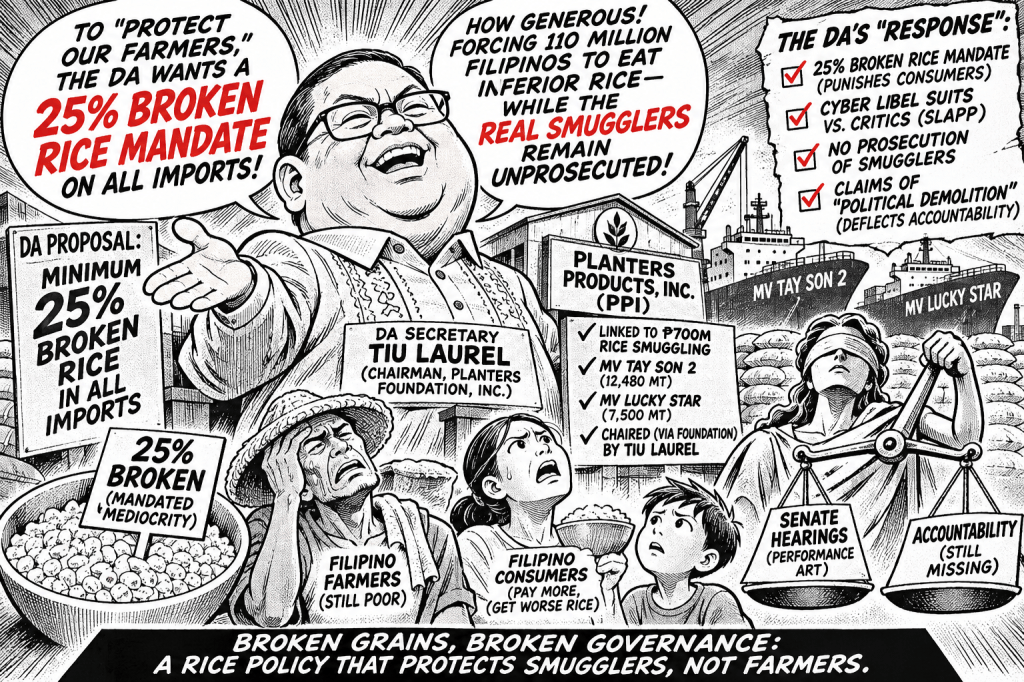
ONLY in the Philippines would the solution to “our farmers can’t compete” be “let’s legally force everyone to eat worse rice.” The government—which imports over 60% of its rice from Vietnam—now wants a 25% minimum broken-grain mandate on all imports, all to protect Filipino farmers from premium Vietnamese DT8. Because nothing says “support local agriculture” like mandating national mediocrity. This isn’t protectionism; it’s regulatory sabotage in a barong.
But here’s the deliciously suspicious part: This proposal emerged directly from a ₱700-million rice smuggling scandal involving the MV Tay Son 2 (12,480 metric tons (MT) seized in Davao) and the MV Lucky Star (7,500 MT seized in Bataan)—both shipments linked, per Bureau of Customs (BOC) records and Sanitary and Phytosanitary Import Clearance (SPSIC) applications, to Planters Products, Inc. (PPI), an agricultural firm whose majority shareholder is chaired ex officio by Agriculture Secretary Francisco Tiu Laurel Jr. himself.
The man proposing to “protect farmers” from premium imports chairs the foundation controlling the company accused of smuggling in those premium imports. If this were a movie, the script would be rejected for being too obvious.
The PPI Shell Game: Private Corporation or GOCC When Convenient?
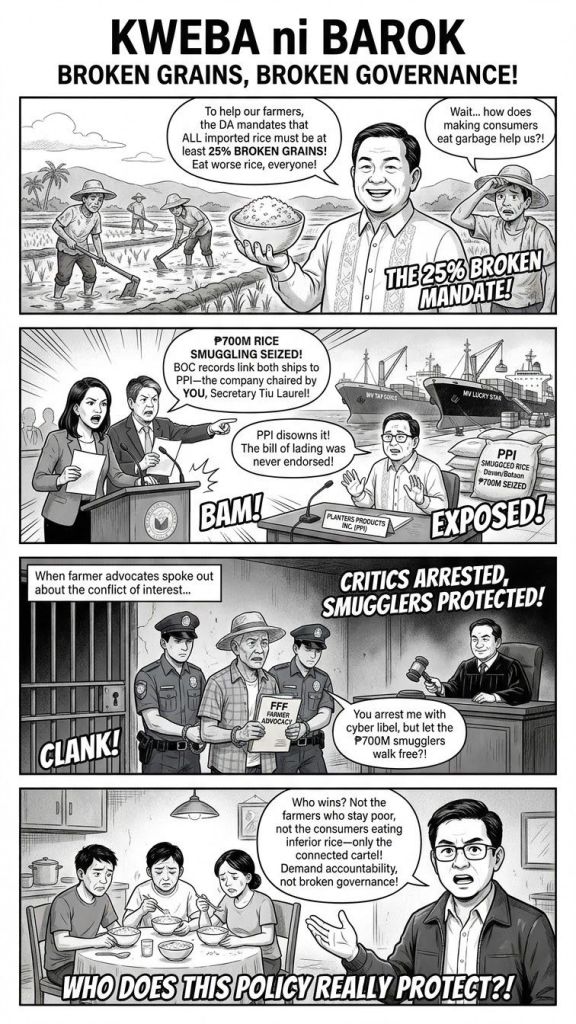
BOC records listed PPI as consignee/notify party for the MV Tay Son 2 shipment—12,480 MT declared as 25% broken rice but allegedly containing premium 5% broken rice. Seized sacks bore PPI markings. Yet PPI disowned the shipment during the November 2026 Senate hearing, claiming the bill of lading was never endorsed to it. Convenient, isn’t it? When you’re caught with contraband, suddenly you’re just a bystander.
Senator Risa Hontiveros flagged PPI in May 2026 for an “aggressive” surge in rice imports—over 86,000 MT in under a year—questioning whether PPI was evading tariffs by masquerading as a Government-Owned or Controlled Corporation (GOCC) engaging in Government-to-Government (G2G) transactions. The Governance Commission for GOCCs and the Department of Budget and Management actually listed PPI in their GOCC directories. Yet Makati prosecutors and Tiu Laurel characterized PPI as a private entity.
The Supreme Court settled this in Planters Products, Inc. v. Fertiphil Corporation (G.R. No. 166006, March 14, 2008), holding PPI is a private corporation—not a public entity. So PPI is legally private when avoiding G2G scrutiny, but listed as a GOCC when convenient for import allocations. This is not regulatory ambiguity; it is regulatory arbitrage.
And who chairs the foundation controlling 79.24% of PPI? Secretary Tiu Laurel. The Federation of Free Farmers (FFF) demanded he take a leave of absence, citing systemic conflict of interest. He refused.
The Cyber Libel SLAPP: Silencing Whistleblowers
When former Agriculture Secretary Leonardo Montemayor and the FFF publicly questioned PPI’s import surge and Tiu Laurel’s conflict of interest in March 2026, PPI and Food Terminal Inc. filed criminal cyber libel and slander suits against Montemayor. He was arrested in October 2026 and posted ₱84,000 bail.
A former cabinet secretary and respected farmer advocate is arrested for speaking out about a potential conflict of interest involving the sitting Agriculture Secretary and a company his foundation controls. This is not justice; this is a Strategic Lawsuit Against Public Participation (SLAPP), designed to intimidate and silence. The message is clear: Question our import deals, and we will prosecute you.
The 25% Broken Rice Mandate: Solving the Wrong Problem
The Department of Agriculture (DA) wants Congress to amend Republic Act No. 11203 (Rice Tariffication Law), as amended by Republic Act No. 12078 (Amended Rice Tariffication Law), to mandate that all rice imports contain at least 25% broken grains. The argument: this will protect Filipino farmers from premium Vietnamese rice.
But the mandate does not address the root causes of farmer poverty: inefficient irrigation, fragmented land holdings, lack of mechanization, poor post-harvest drying and storage, inadequate extension services, high logistics costs, limited access to credit and crop insurance. Instead, it addresses the symptom—import competition—by legally mandating that consumers eat lower-quality rice. This is not agricultural policy; it is consumer punishment masquerading as farmer protection.
Economically, it doesn’t even make sense. Rice prices are determined by variety, aroma, grain length, moisture content, milling quality, and market demand. Broken grain percentage is just one variable. A 25% broken shipment from Vietnam could still be more expensive than domestic rice if it’s a premium variety. Conversely, a 5% broken shipment could be cheaper if global prices are low and the peso is strong. The DA is regulating the wrong variable.
The Legal Vulnerabilities: RA 11203, WTO, and the Non-Delegation Doctrine
RA 11203 explicitly limits the Bureau of Plant Industry’s (BPI) authority to issuing Sanitary and Phytosanitary Import Clearances for food safety and plant health. The law bars BPI from imposing non-tariff barriers, volume caps, or commercial grade restrictions without congressional amendment. RA 12078 expanded DA’s regulatory powers—warehouse registries, food security emergency declarations, increased Rice Competitiveness Enhancement Fund (RCEF) funding to ₱30 billion—but still did not empower the DA Secretary to restrict import grades.
Secretary Tiu Laurel himself admitted he cannot impose the 25% broken requirement by administrative fiat—an implicit acknowledgment that the DA lacks legal authority. Hence the request for Congress to amend the law.
But even if Congress amends RA 11203, the measure faces serious legal challenges:
- World Trade Organization (WTO) Agreement on Agriculture, Article 4.2: Prohibits agricultural non-tariff border measures. A 25% broken grain mandate could be challenged as a disguised non-tariff barrier.
- General Agreement on Tariffs and Trade (GATT) Article XI: Prohibits import restrictions other than duties, taxes, and charges. If the 25% requirement operates as a practical restriction on imports, it could violate GATT Article XI.
- Technical Barriers to Trade (TBT) Agreement: Requires that technical regulations not be more trade-restrictive than necessary. The DA must justify why 25% is the correct threshold, why not 10% or 15%, and what evidence supports this number. Spoiler alert: No such evidence exists.
- Non-Delegation Doctrine: Under Article VI, Section 1 of the 1987 Constitution, legislative power is vested in Congress. As the Supreme Court held in Ople v. Torres (G.R. No. 127685, July 23, 1998), executive issuance cannot usurp legislative power by creating substantive obligations absent clear statutory delegation.
The DA’s proposal is legally vulnerable on multiple fronts. Vietnam could file a WTO dispute. Importers could challenge the measure before Philippine courts. And the measure could be struck down as an unconstitutional delegation of legislative power.
The Real Scandal: Regulatory Capture and the Theater of Accountability
The Philippines passed Republic Act No. 12022 (Anti-Agricultural Economic Sabotage Act of 2024), imposing life imprisonment and fines three times the value of smuggled goods for agricultural smuggling valued at ₱10 million or more—the strictest anti-smuggling law in Philippine history.
And yet, ₱700 million worth of rice was allegedly smuggled in two vessels, with BOC records linking the shipment to PPI—a company controlled by a foundation chaired by the sitting Agriculture Secretary. PPI disowned the shipment, and no one has been prosecuted under RA 12022.
Instead, the response has been: a proposal to mandate 25% broken rice imports (which doesn’t address smuggling); cyber libel suits against farmer advocates (which silences whistleblowers); and claims of a “political demolition job” by Tiu Laurel (which deflects accountability).
This is not governance; this is Kabuki theater. The DA is performing concern for farmers while protecting connected importers. The Senate is holding hearings while actual smugglers remain unprosecuted. And the public is left wondering why rice prices remain high while farmers remain poor.
The Senate Hearings: Oversight or Performance Art?
The November 2026 Senate inquiry led by Senator Francis “Kiko” Pangilinan has been revealing, but not in the way intended. Senator Hontiveros flagged PPI’s import surge in May 2026. Senator Pangilinan demanded documentary proof of a separate import clearance for a 12,000+ MT 25%-broken shipment arriving in Davao on September 10 (alleged by Montemayor). But where are the prosecutions? Where are the subpoenas for PPI’s corporate records? Where is the referral to the Office of the Ombudsman for conflict of interest under Republic Act No. 6713 (Code of Conduct and Ethical Standards for Public Officials and Employees) and Republic Act No. 3019 (Anti-Graft and Corrupt Practices Act)?
The hearings have produced headlines but not accountability. This is oversight as performance art—designed to create the appearance of scrutiny without the substance.
The Consumer Welfare Angle: Who Pays for This Protectionism?
If the 25% broken rice mandate is enacted: consumers will have fewer choices; premium imported rice will become scarce or unavailable; retail prices for remaining premium rice will increase; low-income households will be forced to buy lower-quality rice; and the overall quality of rice available will decline.
The DA claims this will protect farmers. But what about the 110 million Filipino consumers who eat rice every day? This is the central flaw: The DA treats farmer welfare and consumer welfare as zero-sum. They’re not. A well-designed agricultural policy can protect farmers while ensuring affordable food. The 25% broken rice mandate does neither.
The Alternative: Real Solutions for Real Problems
If the DA genuinely wants to protect farmers, it should:
- Enforce existing anti-smuggling laws: Prosecute actual smugglers under RA 12022. Don’t let PPI hide behind the “unendorsed bill of lading” defense. Use SPSIC applications, sack markings, and corporate records to pierce the corporate veil.
- Address the conflict of interest: Secretary Tiu Laurel should divest from Planters Foundation, Inc., or resign as ex officio chairman. The DA cannot credibly regulate rice imports while its Secretary chairs a foundation controlling a major rice importer.
- Strengthen BPI’s monitoring capacity: Require pre-shipment inspection at the port of origin for all rice imports. This would prevent misdeclaration without imposing a non-tariff barrier.
- Invest in agricultural productivity: Fund irrigation, mechanization, post-harvest facilities, extension services, and credit programs. The RCEF exists precisely for this purpose. Use it.
- Enforce harvest-season import restrictions: RA 12078 allows the DA to declare food security emergencies and regulate imports during harvest periods. Use this authority instead of a blanket 25% broken rice mandate.
- Protect consumer choice: Allow 5% broken rice to remain legal. Let consumers decide what quality of rice they want to buy. Don’t mandate inferiority.
The Bottom Line: Suspicion, Not Trust
I don’t trust the DA’s motives. I don’t trust PPI’s claim that it didn’t know about the shipment. I don’t trust the cyber libel suits against Montemayor. And I certainly don’t trust the 25% broken rice mandate as a genuine farmer-protection measure.
This entire saga reeks of regulatory capture, conflict of interest, and the weaponization of government power to protect connected interests. The DA is proposing a policy that would harm consumers, violate trade commitments, and fail to address the root causes of farmer poverty—all while actual smugglers remain unprosecuted.
The Senate hearings have revealed much but accomplished little. The farmers are still poor. The smugglers are still free. And the consumers are still paying high prices for rice.
So the next time Secretary Tiu Laurel tells you he’s protecting farmers, ask him: Why is your foundation chairing a company that tried to smuggle in the very rice you’re now trying to ban? Why are you suing farmer advocates instead of prosecuting smugglers? And why should Filipino consumers eat inferior rice so that your connected friends can maintain their market share?
The answers, I suspect, will be as broken as the rice you want to force us to eat.
Key Citations
A. Legal & Official Sources
- Agreement on Agriculture. World Trade Organization, http://www.wto.org/english/docs_e/legal_e/14-ag_01_e.htm.
- Agreement on Technical Barriers to Trade. World Trade Organization, http://www.wto.org/english/docs_e/legal_e/17-tbt_e.htm.
- General Agreement on Tariffs and Trade 1947. World Trade Organization, http://www.wto.org/english/docs_e/legal_e/gatt47_02_e.htm.
- Philippines, Congress. Republic Act No. 3019: Anti-Graft and Corrupt Practices Act. 17 Aug. 1960. LawPhil Project, lawphil.net/statutes/repacts/ra1960/ra_3019_1960.html.
- —. Republic Act No. 6713: An Act Establishing a Code of Conduct and Ethical Standards for Public Officials and Employees. 20 Feb. 1989. LawPhil Project, lawphil.net/statutes/repacts/ra1989/ra_6713_1989.html.
- —. Republic Act No. 11203: An Act Liberalizing the Importation, Exportation and Trading of Rice, Lifting for the Purpose the Quantitative Import Restriction on Rice, and for Other Purposes. 14 Feb. 2019. LawPhil Project, lawphil.net/statutes/repacts/ra2019/ra_11203_2019.html.
- —. Republic Act No. 12022: An Act Defining the Crimes of Agricultural Economic Sabotage, Prescribing Penalties Therefor, Vesting Jurisdiction Over Such Offenses with the Court of Tax Appeals, and for Other Purposes. 26 Sept. 2024. LawPhil Project, lawphil.net/statutes/repacts/ra2024/ra_12022_2024.html.
- —. Republic Act No. 12078: An Act Amending Republic Act No. 8178 or the “Agricultural Tariffication Act,” as Amended by Republic Act No. 11203. 6 Dec. 2024. LawPhil Project, lawphil.net/statutes/repacts/ra2024/ra_12078_2024.html.
- Philippines, Supreme Court. Ople v. Torres. G.R. No. 127685, 23 July 1998. LawPhil Project, lawphil.net/judjuris/juri1998/jul1998/gr_127685_1998.html.
- —. Planters Products, Inc. v. Fertiphil Corporation. G.R. No. 166006, 14 Mar. 2008. LawPhil Project, lawphil.net/judjuris/juri2008/mar2008/gr_166006_2008.html.
- The 1987 Constitution of the Republic of the Philippines. Official Gazette of the Republic of the Philippines, 1987, http://www.officialgazette.gov.ph/constitutions/1987-constitution/.
B. News Reports
- “Ex-DA Chief Montemayor Posted P84,000 Bail, and His Case Turns on Whether Planters Products Is a GOCC.” ASTIG: Philippine News & Reviews, ASTIG PR, 27 Oct. 2026, astig.ph/montemayor-arrest-84000-bail-planters-products-gocc-2026/.
- Nazario, Dhel. “DA Seeks Stricter Rice Import Rules to Protect Local Farmers.” Manila Bulletin, 20 Nov. 2026, mb.com.ph/2026/11/20/da-seeks-stricter-rice-import-rules-to-protect-local-farmers.
- Oliquino, Edjen. “PPI Disowns P424-M Rice Shipment Seized in Davao, BOC’s Record Names Firm as Consignee.” Daily Tribune, 20 Nov. 2026, tribune.net.ph/2026/11/20/ppi-disowns-p424-m-rice-shipment-seized-in-davao-bocs-record-names-firm-as-consignee.
- Pilapil, Kevin. “DA Seeks Legal Authority to Require 25% Broken Rice Imports.” Bilyonaryo News Channel, Nov. 2026, bnc.bilyonaryo.com/da-seeks-legal-authority-to-require-25-broken-rice-imports/news/.
- “Senate Probe Looms Over P700-M Rice ‘Smuggling’ Case.” Philippine News Agency, 28 Oct. 2026, http://www.pna.gov.ph/article/senate-probe-looms-over-p700-m-rice-smuggling-case.
- Zapanta, Logan Kal-El M. “PPI: No ‘Persecution’ in Libel Case Against Ex-DA Chief.” Philippine Daily Inquirer, 30 Oct. 2026, business.inquirer.net/618856/ppi-no-persecution-in-libel-case-against-ex-da-chief.
- “Ang Hirap Maging Mahirap”: The PAO Scandal That Proves Government Contempt Is Nothing New
- “Far-Off” My Axx: Malacañang’s Claire Castro Drowns in Her Own Legal Gaslighting
- “Forthwith” to Farce: How the Senate is Killing Impeachment—And Why Enrile’s Right (Even If You Can’t Trust Him)
- “HINDI AKO NAG-RESIGN!”

- “I Have No Reason to Doubt”: Teodoro’s MDT Fairy Tale
- “I Know Nothing”: Baste Duterte’s Amnesia Defense Meets ₱33M in GenCorp Contracts
- “I’m calling you from my new Globe SIM. Send load!”

- “Mahiya Naman Kayo!” Marcos’ Anti-Corruption Vow Faces a Flood of Doubt

- “Manageable” Debt, Unmanageable Corruption: The ₱19.66-Trillion Lie
- “Manageable” Debt, Unmanageable Lies: DBM’s ₱21 Trillion Fairy Tale
- “Meow, I’m calling you from my new Globe SIM!”

- “Natrabaho”: One Word, One Ombudsman, and a Judiciary on Trial




Leave a Reply