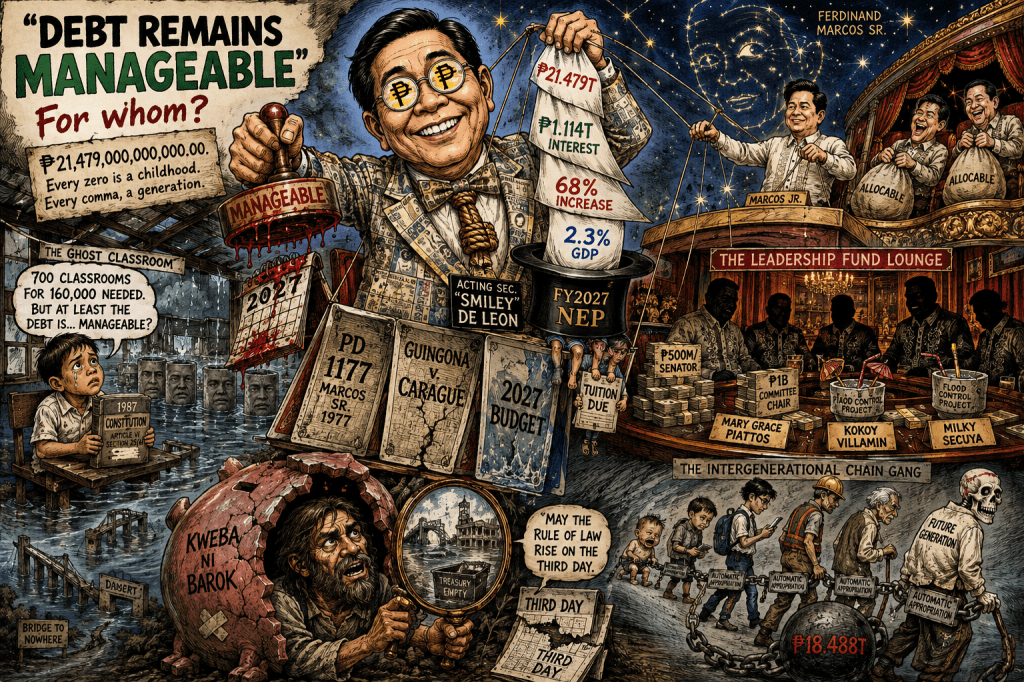
The Marcos Administration’s Greatest Fiction Since Martial Law: Debt Is Fine
By Louis ‘Barok‘ C. Biraogo — August 19, 2026
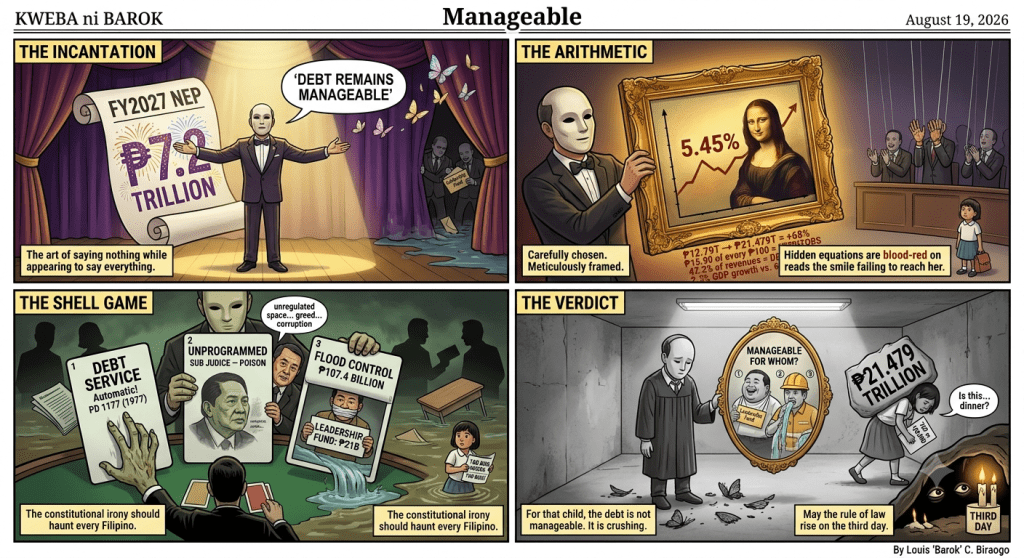
ON August 17, 2026, Acting Budget Secretary Kim Robert C. De Leon—a 35-year-old former assistant professor who now holds the unenviable distinction of being the third person to occupy that chair in under a year—stood before Congress and delivered what can only be described as a masterclass in the art of saying nothing while appearing to say everything.
“Debt remains manageable,” he intoned, as if repetition alone could transform a prayer into a fact.
The proposed ₱7.2-trillion FY2027 National Expenditure Program, he assured the assembled legislators, proves the government can honor its obligations “without sacrificing investments in people, infrastructure, [and the] economy.”
The performance was pitch-perfect. The delivery was smooth. The PowerPoint slides, one imagines, were immaculate.
And every single word was technically true—in the same way that a condemned man’s last meal is technically “dinner.”
PART I: THE ARITHMETIC OF ANXIETY
Let us begin where the Department of Budget and Management (DBM) would prefer we not look: the actual numbers.
The press release speaks lovingly of deficit-to-GDP ratios—5.45% in 2026, the “lowest since the start of the Administration.” It is a beautiful statistic, carefully chosen, meticulously framed.
But here is what the press release does not tell you: The debt stock is ₱18.488 trillion as of March 2026—up 10.81% year-on-year. By 2027, DBM’s own projections show it reaching ₱21.479 trillion—a 68% increase since the Marcos administration inherited ₱12.79 trillion in 2022.
Read that again. Sixty-eight percent. In five years.
Financial expenses—interest payments—will consume ₱1.143 trillion in 2027, a 17.3% increase that outpaces the 6% overall budget growth by nearly threefold. For every ₱100 the government spends, approximately ₱15.90 goes directly to creditors before a single classroom is built, a hospital bed added, or a flood-control project completed.
In 2025, debt service consumed 47.2% of national government revenues. Nearly half of everything collected in taxes went to paying creditors. Not to education. Not to health. Not to infrastructure. To interest and principal on loans accumulated by politicians who will be long retired—or long dead—by the time the final peso is repaid.
The Philippines is not borrowing to build its future; it is borrowing to pay for its past, and charging the bill to its children.
PART II: THE CONSTITUTIONAL SHELL GAME
The DBM’s assertion that “debt servicing is explicitly provided for in the budget” is technically accurate. What it omits is that this provision is not a policy choice—it is a legal straitjacket imposed by Presidential Decree No. 1177, issued by Ferdinand Marcos Sr. in 1977, which created an “automatic appropriation” for debt service that bypasses annual congressional review.
The Supreme Court upheld this in Guingona v. Carague (1991), reasoning that Congress can appropriate automatically through standing law. It is a doctrine that has served successive administrations well: no matter how disastrously they manage finances, the debt gets paid first, and everything else competes for whatever remains.
The constitutional irony should haunt every Filipino: the 1987 Constitution was written specifically to prevent the abuses of the Marcos dictatorship, and yet its drafters preserved the very mechanism Marcos created to ensure his debts could never be questioned. Now Ferdinand Marcos Jr. inherits both the mechanism and its consequences.
The constitutional questions do not end there. The Supreme Court currently has before it a challenge to unprogrammed appropriations—that budgetary device allowing the executive to spend money it has not actually secured. The DBM boasts that the 2027 UA allocation of ₱111.98 billion is the “lowest nominal amount since 2019.”
What the press release does not mention is that the entire mechanism is sub judice—two lawmakers, Edgar Erice and Leila de Lima, have petitioned the Court to declare it unconstitutional. Justice Ramon Paul Hernando called UA “an unregulated space where discretion replaces discipline and where the temptations of greed and corruption inevitably find room to operate.”
The DBM’s response? To propose using the same mechanism again, at a reduced scale, as if lowering the dose of poison makes it medicine.
PART III: THE CORRUPTION THAT EATS EVERYTHING
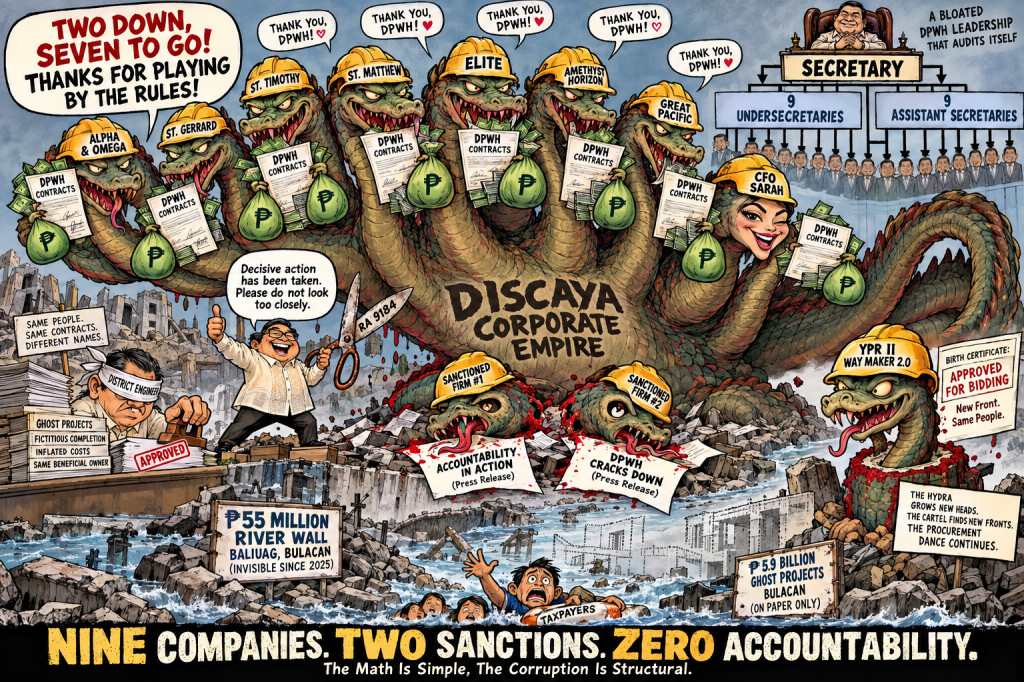
The flood-control scandal is not a footnote to this story—it is the story’s beating heart.
Former Department of Public Works and Highways (DPWH) Secretary Manuel Bonoan testified before the Sandiganbayan on August 12, 2026—five days before De Leon’s polished presentation—that a “Senate Leadership Fund” had quietly operated inside DPWH’s budget since 2024. Roughly ₱500 million per senator, up to ₱1 billion for committee chairs. ₱13.29 billion availed in 2024. Approximately ₱21 billion in 2025.
Bonoan’s account describes a mechanism tracing to 2023, when foreign-assisted DPWH project funding was cut by as much as 88.8% and the deducted amounts—plus additional allocations totaling ₱292.7 billion—were converted into 8,075 “inserted projects” in the 2023 General Appropriations Act (GAA). The President, Bonoan testified, was “alarmed” when he reported it.
Alarmed enough to stop it? Apparently not. Alarmed enough to institutionalize it under a cleaner name? That is what Bonoan describes.
The Philippine Center for Investigative Journalism reports that the President’s own son, Ilocos Norte Rep. Sandro Marcos, and former Speaker Martin Romualdez received the largest shares of “allocable” funds from 2023 to 2025.
And the 2027 budget? It restores ₱107.4 billion for flood-control projects—the very program at the center of the scandal—while targeting only about 700 new public-school classrooms against a nationwide shortage of roughly 160,000.
Let those numbers sit together: ₱107.4 billion for flood control in a department that admitted, through its former secretary’s testimony, to operating an undisclosed allocation channel for three consecutive budget cycles. Seven hundred classrooms for a country that needs one hundred sixty thousand.
This is not governance. This is looting with better lighting.
PART IV: THE CONFIDENTIAL FUNDS CONUNDRUM
The proposed 2027 budget includes ₱10.773 billion in confidential and intelligence funds. The DBM assures us these are “subject to existing budgeting, utilization, liquidation, and auditing rules.”
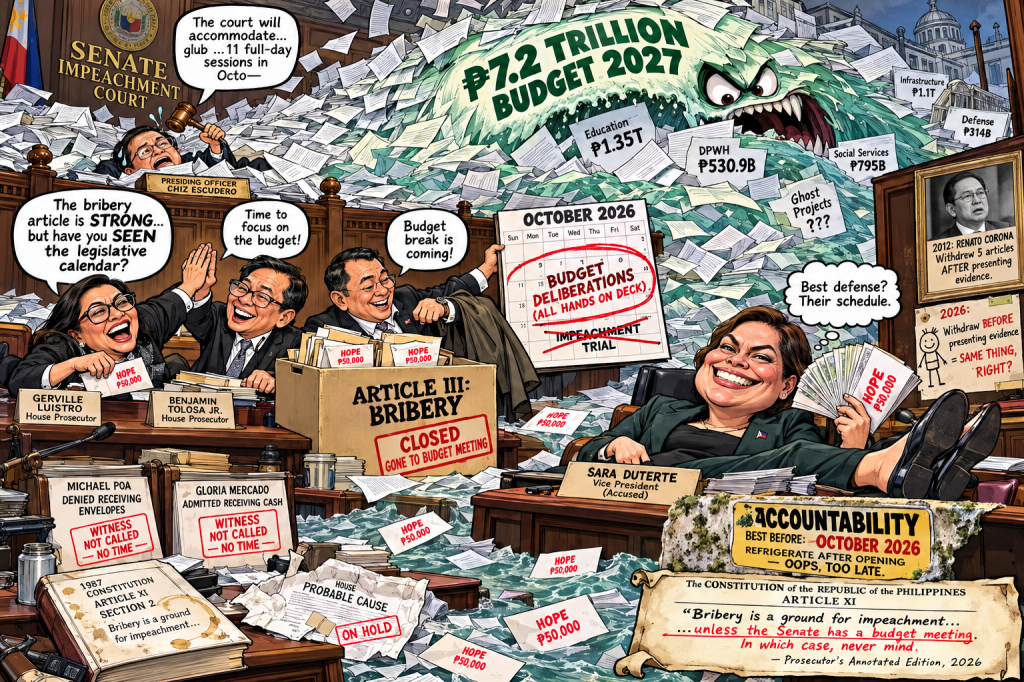
But the Senate impeachment trial of Vice President Sara Duterte has already demonstrated what those rules are worth. More than ₱600 million in CIFs were “quickly disbursed” by the Office of the Vice President and the Department of Education—including ₱125 million spent in just 11 days in December 2022, with liquidation documents bearing names like “Mary Grace Piattos,” “Milky Secuya,” and “Kokoy Villamin”—names that could not be verified with PSA records.
These are not accounting irregularities. They are evidence of systemic fraud—a parallel budget operating outside the constitutional requirement that “no money shall be paid out of the Treasury except in pursuance of an appropriation made by law.”
Article VI, Section 25(6) of the 1987 Constitution requires that discretionary funds be disbursed “only for public purposes to be supported by appropriate vouchers.”
“Mary Grace Piattos” is not a public purpose. “Kokoy Villamin” is not a voucher.
PART V: THE INTERGENERATIONAL THEFT
Economist Benjamin Diokno—someone who has actually managed public finances rather than merely described them—put it bluntly: “Subsequent administrations—and future generations of Filipinos—have to bear the brunt of adjustment in terms of higher taxes or constrained public services.”
This is the hidden violence of the “manageable debt” narrative. It transforms current consumption into future obligation. It allows politicians to spend today what the nation’s children will be forced to repay tomorrow, with interest, at the expense of their own children’s education, health, and future.
The DBM’s fiscal strategy assumes sustained 6%+ GDP growth, stable or appreciating currency, continued revenue improvement, and political discipline across two more election-adjacent budget cycles.
But actual Q2 2026 GDP growth came in at 2.3%—well below the already-lowered 3.5%–4.5% target. Fitch downgraded its outlook from “stable” to “negative” in April 2026. The peso is projected at ₱62 to the dollar, meaningfully weaker than the ₱49.6 level when much pandemic-era debt was contracted.
Every one of the assumptions underpinning “manageable” is currently failing.
PART VI: THE POLITICAL ECONOMY OF DENIAL
Why does the government insist on the “manageable debt” narrative? The answer is not complicated.
Because the alternative is unthinkable within the current political structure.
If the debt is genuinely problematic—if fiscal room is actually narrow, if interest is crowding out productive spending, if corruption is systemic—then the entire edifice of patronage sustaining the administration’s coalition collapses.
The “leadership fund” exists because legislators need projects. Flood-control projects exist because they are visible, geographically specific, and contractor-friendly. Debt exists because the political system demands spending that exceeds the government’s willingness to tax.
“Manageable debt” is not a fiscal assessment. It is a political necessity—a shield against the uncomfortable truth that the Philippines is trapped in a cycle where borrowing funds corruption, corruption necessitates more borrowing, and more borrowing deepens the corruption.
PART VII: WHAT MUST BE DONE
First: Abolish unprogrammed appropriations entirely. No constitutional mechanism should allow spending beyond what Congress has actually appropriated.
Second: Subject automatic debt-service appropriation to annual congressional review. Guingona was decided when debt was a fraction of its current size. Congress must exercise genuine oversight over the single largest budget item.
Third: Establish a statutory debt ceiling. The International Monetary Fund (IMF) recommended this in 2019. The Philippines ignored it. Debt has grown 68% in five years without any legislative check.
Fourth: Create an independent fiscal council to provide nonpartisan analysis of debt sustainability. No government agency should grade its own homework.
Fifth: Publish a real-time debt dashboard showing debt-to-GDP, interest-to-revenue, debt-service-to-revenue, primary balance, maturity profile, and contingent liabilities. If the debt is truly “manageable,” the government should welcome scrutiny.
Sixth: Criminalize budget insertions and the “leadership fund” mechanism. Belgica v. Ochoa struck down the PDAF for violating separation of powers. The “leadership fund” is PDAF by another name—worse, because it operates without even the transparency of a formal line item.
Seventh: Strengthen the Commission on Audit’s (COA) audit capacity. An auditor that cannot audit effectively is not a watchdog—it is a decoration.
Eighth: Convert debt from burden to investment. Every peso borrowed should be traceable to a specific, verifiable, productive asset.
PART VIII: THE VERDICT
The DBM’s press release is not dishonest. It is worse—it is selective, which in public finance means deceptive.
The debt is “manageable” only in the technical sense that the Philippines is not currently in default. But so does every country that eventually defaults. The question is not whether debt is manageable today but whether it is sustainable tomorrow—and the answer depends on variables currently moving in the wrong direction.
The government’s own projections assume growth it is not achieving, revenue it is not collecting, and fiscal discipline it is not demonstrating. The corruption scandals are not aberrations; they are the logical consequence of a system that borrows without accountability, spends without transparency, and audits without enforcement.
The DBM says the debt is manageable. The real question is: manageable for whom?
For politicians who use borrowed money to build patronage networks? Yes.
For contractors who overcharge for substandard flood-control projects? Certainly.
For senators who quietly avail of “leadership funds” while publicly denouncing corruption? Absolutely.
But for the Filipino child who will inherit a nation mortgaged to creditors—a nation that spent its future on ghost projects and ghost employees and ghost accountability—for that child, the debt is not manageable.
It is crushing.
EPILOGUE: THE THIRD DAY
The Kweba ni Barok has long maintained: the rule of law must rise on the third day. First comes denial; then exposure; then accountability.
For the Philippines’ debt, we remain in denial, though exposure nears—Sandiganbayan testimony, the impeachment trial, the Supreme Court’s pending ruling. The cracks are forming. Whether accountability follows depends on Filipinos demanding it—Congress exercising its power, the Court upholding Belgica and Araullo, COA actually auditing.
The debt is ₱18.488 trillion and climbing. Every day, interest accrues. Every year, another generation is mortgaged.
The question is not whether the debt is manageable. The question is whether the Filipino people will manage to hold their government accountable before the third day arrives—or whether, like so many promises of reform, it will be buried under the weight of the very debt that was supposed to be “manageable.”
May the rule of law rise on the third day.
May the truth find its voice.
And may the Filipino people finally demand a debt that serves them—not one that enslaves their children.
— Barok
Key Citations
A. Official Reports & Court Decisions
- Bureau of the Treasury. “NG debt reaches P18.49 trillion as of end-March 2026.” Bureau of the Treasury, 2026, https://www.treasury.gov.ph/?p=75312.
- Department of Budget and Management. “DBM: PH debt manageable as gov’t cuts deficit, protects growth in proposed 2027 budget.” DBM.gov.ph, 17 Aug. 2026, https://www.dbm.gov.ph/index.php/management-2/4170-dbm-ph-debt-manageable-as-gov-t-cuts-deficit-protects-growth-in-proposed-2027-budget.
- Belgica v. Ochoa, G.R. No. 208566. Supreme Court of the Philippines, 19 Nov. 2013, https://lawphil.net/judjuris/juri2013/nov2013/gr_208566_2013.html.
- Guingona, Jr. v. Carague, G.R. No. 94571. Supreme Court of the Philippines, 22 Apr. 1991, https://www.lawphil.net/judjuris/juri1991/apr1991/gr_94571_1991.html.
- Presidential Decree No. 1177. Lawphil.net, 1977, https://lawphil.net/statutes/presdecs/pd1977/pd_1177_1977.html.
B. News Articles & Investigations
- “Bonoan: ‘All senators’ got share of ‘leadership fund’.” Inquirer.net, 13 Aug. 2026, https://newsinfo.inquirer.net/2283475/bonoan-all-senators-got-share-of-leadership-fund.
- “De Lima, Erice ask Supreme Court to strike down P150-B unprogrammed funds.” Philstar.com, 8 Jan. 2026, https://www.philstar.com/headlines/2026/01/08/2499585/de-lima-erice-ask-supreme-court-strike-down-p150-b-unprogrammed-funds.
- “PH gov’t debt seen surging to record high P21.5T in ’27.” Inquirer Business, 12 Aug. 2026, https://business.inquirer.net/605260/ph-govt-debt-seen-surging-to-record-high-p21-5t-in-27.
- Philippine Center for Investigative Journalism. “‘Allocables’ are the new pork and Sandro Marcos…” PCIJ.org, 29 Nov. 2025, https://pcij.org/2025/11/29/allocables-are-the-new-pork/.
- “Sara Duterte won’t explain why ‘Piattos,’ ‘Chippy’ received confidential funds.” Philstar.com, 11 Dec. 2024, https://www.philstar.com/headlines/2024/12/11/2406657/sara-duterte-wont-explain-why-piattos-chippy-received-confidential-funds.
- “Unprogrammed funds in any form unconstitutional, says SC justice.” Inquirer.net, 9 Dec. 2025, https://newsinfo.inquirer.net/2152558/unprogrammed-funds-in-any-form-unconstitutional-says-sc-justice.
C. Economic Data & Analysis
- Diokno, Benjamin E. “UP School of Economics Discussion Papers.” Econstor, 1990s, https://www.econstor.eu/bitstream/10419/46673/1/574680748.pdf.
- Fitch Ratings. “Fitch Revises the Philippines’ Outlook to Negative; Affirms at BBB.” FitchRatings.com, 20 Apr. 2026, https://www.fitchratings.com/research/sovereigns/fitch-revises-philippines-outlook-to-negative-affirms-at-bbb-20-04-2026.
- Philippine Statistics Authority. “GDP Grows by 2.3 Percent in the Second Quarter of 2026.” PSA.gov.ph, 7 Aug. 2026, https://psa.gov.ph/content/gdp-grows-23-percent-second-quarter-2026.

- ₱8B BBM Pork: CCTV for Every Captain’s Kumpare?
- ₱8.9 Billion, 331 Ghost Police Stations: The TIKAS Scandal Explained

- ₱8.4 Billion, 42,000 Barangays, 1 Election: The “Bawat Barangay Makikinabang” Vote-Buying Masterclass
- ₱75 Million Heist: Cops Gone Full Bandit

- ₱6.77B Ghost Haunts Duterte: RTC Dismisses Mans Carpio’s Desperate Plea
- ₱6.7-Trillion Temptation: The Great Pork Zombie Revival and the “Collegial” Vote-Buying Circus

- ₱53 Million Man Tells ₱695-a-Day Workers to Stop Being ‘Mayabang’: The Audacity of BSP’s Remolona
- ₱3.06 Billion for Evacuation Centers—But Nobody Knows Where They’ll Stand (Or If They’ll Exist)
- ₱10B Ghost in New Clark City: Matibag’s Haunted Séance for Cayetano

- ₱1.9 Billion for 382 Units and a Rooftop Pool: Poverty Solved, Next Problem Please

- ₱1.35 Trillion for Education: Bigger Budget, Same Old Thieves’ Banquet

- ₱1 Billion Congressional Seat? Sorry, Sold Out Na Raw — Si Bello Raw Ang Hindi Bumili




Leave a comment