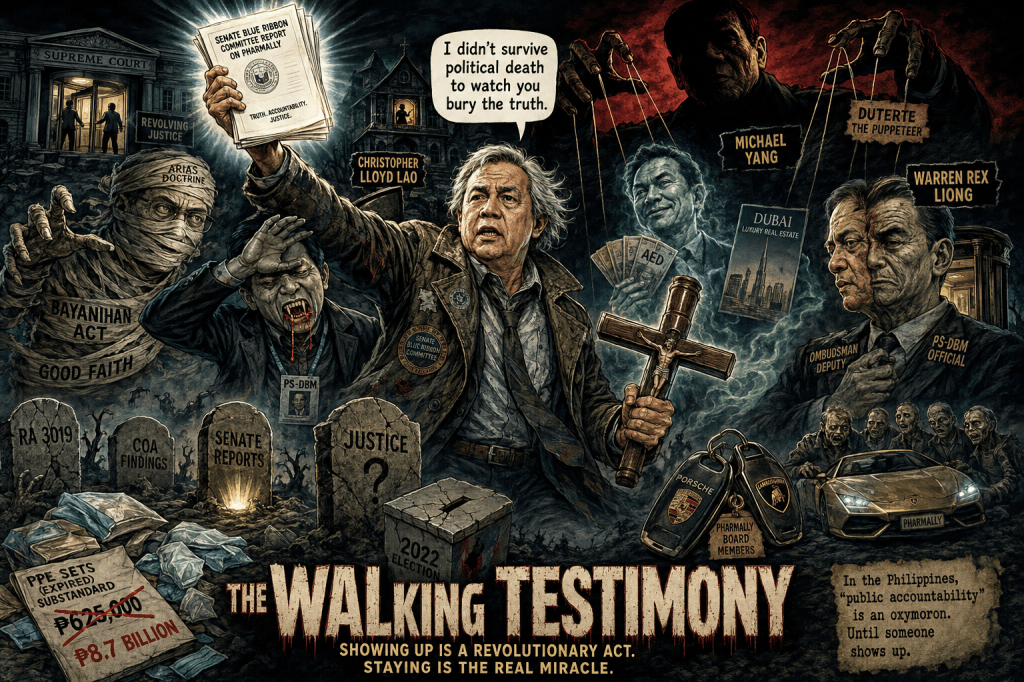
In a nation where the corrupt never die and the honest rarely survive, one man staggers back from the electoral grave to demand a reckoning
By Louis ‘Barok‘ C. Biraogo — August 19, 2026
THERE is a particular species of Philippine political theater that deserves its own taxonomic classification. It is the genre wherein a former public official, safely ensconced in the twilight of their career, suddenly develops a case of moral clarity so acute it threatens to blind the very institutions they once served. We have seen this movie before. The twist ending is always the same: nothing happens.
But the news that former Senator Richard Gordon is “willing” to testify in the Sandiganbayan graft trial against former Health Secretary Francisco Duque III and former PS-DBM Undersecretary Christopher Lloyd Lao demands we pause the projector. Because for once, the hero of this particular film is not waiting for a book deal or a cable news contract. He is simply showing up.
And in the Philippines, where the phrase “public accountability” is often an oxymoron rivaling “military intelligence” or “honest politician,” showing up is a revolutionary act.
Let us be clear about what this moment represents. Gordon is not a sitting senator leveraging his position for prime-time exposure. He is not a Cabinet secretary attempting to outrun a scandal by performing transparency. He is a man who has already paid the political price for his investigation. He lost his reelection bid in 2022. He was attacked by the most powerful man in the country. His Senate report was never even formally adopted by his own committee—a bureaucratic failure that would have sent lesser men into quiet retirement with a bottle of single malt and a ghost-written memoir.
Yet here he stands, volunteering to enter the arena once more, this time under oath, subject to cross-examination, with no political armor left to protect him.
This is not merely commendable. This is almost unheard of.
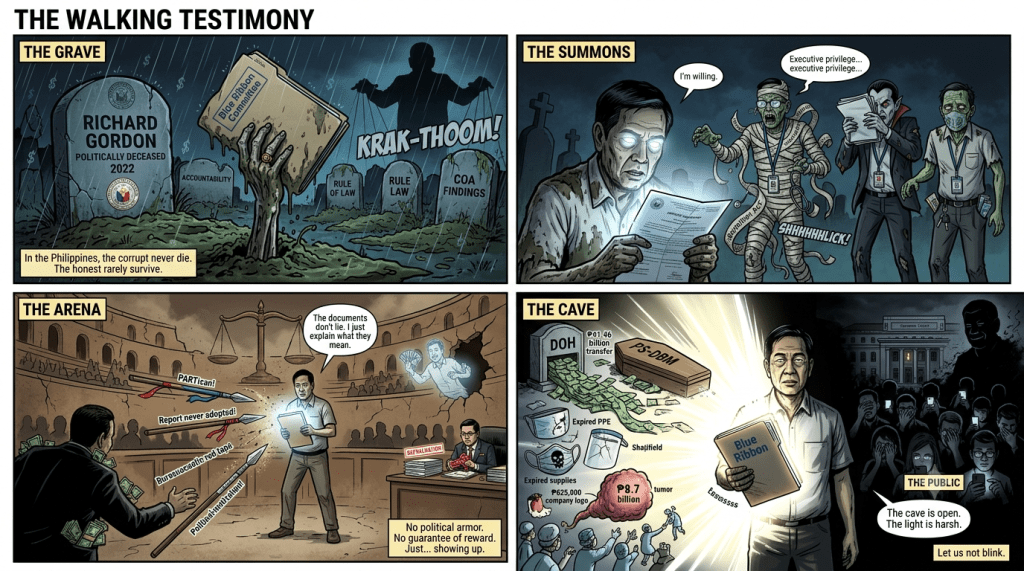
A Few Good Men, but make it Filipino graft trial. Gordon edition.
The Comparative Anatomy of Courage
Consider the normative baseline against which Gordon’s decision must be measured. In the Philippine political ecosystem, the standard response to scandal is a carefully choreographed performance of evasion. Officials invoke executive privilege. They claim failing memory. They send lawyers to read prepared statements. They discover sudden medical emergencies. They retreat into the fortified bunkers of their political alliances, emerging only when the news cycle has moved on to fresher outrages.
The Pharmally scandal itself provides the perfect counterpoint. Michael Yang, the alleged financier and Duterte confidant, has never been charged. He has denied everything while reportedly acquiring luxury real estate in Dubai. President Duterte himself barred his Cabinet from appearing before Gordon’s committee—a constitutional middle finger that the Supreme Court would later slap down, but only after the damage to the investigation’s momentum had been done.
And what of the current administration? The Ombudsman under Boying Remulla has withdrawn six Pharmally-adjacent cases for “reevaluation”, a move that can be read as either diligent case-building or convenient foot-dragging, depending on your level of cynicism. Whether this represents diligence or delay is a question that only time—and the eventual refiling decisions—will answer.
Into this morass of avoidance and equivocation walks Richard Gordon, a man who has nothing left to gain and everything left to lose. His legacy is already written. His political career is over. He could easily justify silence. He could argue that he has done his part, that the Senate hearings were enough, that the judicial process will take its course without him.
Instead, he has chosen to testify. Voluntarily. Without coercion. After the cost has already been paid.
This is what public service is supposed to look like. This is what the Constitution means when it declares that “public office is a public trust.” This is what accountability requires: not the convenient performance of virtue when the cameras are rolling, but the quiet, costly, inconvenient commitment to truth when no one is watching and no reward is forthcoming.
Gordon’s decision ennobles the Senate’s oversight legacy. It demonstrates that the Blue Ribbon Committee’s investigation was not merely political theater but a genuine exercise in constitutional duty. It strengthens public trust in the integrity of the Sandiganbayan proceedings, suggesting that the evidence gathered was substantial enough to warrant this level of commitment. And it sets a precedent—a dangerous one for the corrupt—that public service means upholding the truth even when it costs you personally.
The Case Beyond the Man
But let us not confuse the political martyr with the mission. Gordon’s testimony matters not because he is a good man doing a good thing. It matters because of what he can establish for the prosecution.
His evidentiary value rests on four pillars:
First, he can verify and introduce the findings and documentary record of the Senate Blue Ribbon Committee. The committee reviewed thousands of pages of documents, questioned dozens of witnesses, and constructed a timeline of the P41.46 billion transfer from DOH to PS-DBM. Gordon’s testimony transforms that political report into a legal instrument.
Second, he can articulate the pattern of irregularities. The P625,000 paid-up capital of Pharmally. The lack of due diligence. The middleman markups. The expired and substandard supplies. The luxury car purchases by Pharmally board members immediately after securing contracts. These are not isolated incidents; they form a coherent narrative of malfeasance.
Third, he can contextualize the political pressure. The Duterte administration’s obstruction of the Senate hearings was not a minor inconvenience; it was a full-throated assault on the constitutional separation of powers. Gordon witnessed this firsthand. He can testify to the threats, the attacks, and the systematic effort to delegitimize the investigation.
Fourth, he can present the comparative analysis. The prosecution is already introducing DOH witnesses to prove that the agency could have procured medical supplies directly. Gordon can corroborate and amplify this point, explaining why the P1.66 billion service fee paid to PS-DBM was an unnecessary and costly detour.
This is the substance that will matter in court.
The Legal Battlefield: A Sober Assessment
Now, let us temper our enthusiasm with the cold water of legal reality. The defense has formidable arguments, and we must confront them honestly.
The Bayanihan defense is real. RA 11469 (Bayanihan to Heal as One Act) authorized emergency procurement measures. The GPPB issued implementing circulars. The defense will argue that the transfer to PS-DBM was a reasonable response to an unprecedented crisis, not a criminal conspiracy.
The Arias doctrine looms. Duque can argue that he relied in good faith on the expertise of PS-DBM and the advice of subordinates. The prosecution must prove that his reliance was not merely mistaken but fraudulent—that he acted with “evident bad faith” or “gross inexcusable negligence.”
And the Supreme Court’s own jurisprudence is a hurdle. In Libunao v. People and People v. Villasin, the Court has repeatedly held that procurement irregularities do not automatically equate to graft. The prosecution must prove the specific mental state required by Section 3(e) of RA 3019 (Anti-graft And Corrupt Practices Act). A bad decision is not necessarily a criminal one.
This is where Gordon’s testimony becomes strategically crucial. The prosecution’s case is not built on Gordon’s conclusions. It is built on the independent documentary record—the COA findings, the procurement documents, the payment records, the audit trails. Gordon’s role is to authenticate and contextualize that evidence. He is the bridge between the mountain of paper and the narrative of deliberate malfeasance.
The defense will attack him as a partisan. They will question his motives. They will point out that his committee report was never formally adopted. They will suggest that his investigation was politically motivated.
But the prosecution’s response is simple: whatever Gordon’s political motivations may have been, the documents don’t lie. The P41.46 billion transfer happened. The P625,000 company received billions in contracts. The supplies were defective. The service fees were wasted.
Gordon is not the case. The evidence is the case. Gordon is merely the messenger who can explain what the evidence means.
The Unanswered Questions
And yet, even as this trial proceeds, the larger scandal continues to fester. The questions that Gordon’s investigation raised have not been answered. They have been buried, deflected, and ignored.
Why has Michael Yang never been charged? The alleged financier of the entire scheme remains free, his connections to Duterte shielding him from accountability. His continued freedom is a monument to the selective nature of Philippine justice.
What is the true status of the parallel cases? The Ombudsman’s withdrawal of six cases for “reevaluation” is suspicious, especially given the appointment of Warren Rex Liong—a former PS-DBM official implicated in the scandal—as Overall Deputy Ombudsman. The revolving door between the accused and the accusers spins merrily on.
What about the mastermind? The Blue Ribbon draft recommended charges against Duterte himself. His presidential immunity has expired. Why has no complaint been filed? Does justice apply only to the foot soldiers, never to the general who ordered the charge?
And what of the broader systemic failures? The same patterns of weak oversight, reliance on self-reporting, and political pressure that enabled the Pharmally scam are present in other sectors. The housing crisis. The flood-control scandals. The perpetual erosion of institutional integrity.
The trial of Duque and Lao is important. But it is not enough. It is a single battle in a larger war—a war for the soul of the Philippine state, a war that is being lost on multiple fronts simultaneously.
Recommendations
To the Sandiganbayan: Prioritize substantive justice over procedural technicality. This trial is not about two men. It is about whether the rule of law can survive contact with powerful interests. The nation is watching.
To the Ombudsman: Stop playing political games. The withdrawal and “reevaluation” of cases must be conducted transparently, with clear timelines and public explanations. The people deserve to know whether justice is being pursued or buried.
To the political class: Gordon has thrown down a gauntlet. Will any of you pick it up? Will any of you follow his example, or will you remain complicit in the culture of silence that protects the corrupt and punishes the honest?
To the public: Do not look away. The trial is a test of our collective vigilance. The “corruption of the century” demands a verdict that echoes through the century—a verdict that proves, once and for all, that in the Philippines, even the powerful can be held to account.
The Final Reckoning
There is a scene in the movie A Few Good Men where Jack Nicholson’s Colonel Jessup, confronted with the truth, screams: “You can’t handle the truth!”
In the Philippines, we have been told for generations that we cannot handle the truth. That the truth is too dangerous, too destabilizing, too inconvenient. That it is better to look away, to accept the official narrative, to trust that the powerful know what they are doing.
Richard Gordon’s testimony is a refutation of that lie. It is a declaration that the truth can be handled, that it must be handled, that the alternative is a slow descent into a darkness from which no nation returns.
He is not a perfect man. His investigation was not perfect. His politics were not pure. But in this moment, he has chosen to do something that too few of his peers have done: he has chosen to tell the truth, at cost to himself, without guarantee of reward.
That is not heroism. That is citizenship. That is the minimum that public service requires.
And if that minimum is too much for the rest of our officials to meet, then the Pharmally scandal will not be an anomaly. It will be a prophecy—a preview of a future in which the truth is a luxury that only the brave can afford, and justice is a commodity that only the powerful can purchase.
The Sandiganbayan trial will render its verdict. But the larger trial—the trial of the Philippine state itself—continues. The evidence is overwhelming. The witnesses are ready. The only question is whether we, the people, are prepared to render judgment.
The cave is open. The light is harsh. Let us not blink.
— Barok out.
Key Citations
A. Reports & Studies
- Buan, Lian. “Pharmally had P625,000 capital before bagging P8 billion in COVID-19 contracts.” Rappler, 30 Aug. 2021, https://www.rappler.com/newsbreak/in-depth/pharmally-pharmaceutical-corporation-capital-billion-covid-contracts/.
- “Pharmally scandal.” Wikipedia, https://en.wikipedia.org/wiki/Pharmally_scandal.
B. News Articles
- “Richard Gordon ‘willing’ to testify in Sandiganbayan Pharmally trial.” Inquirer.net, https://newsinfo.inquirer.net/2286024/richard-gordon-willing-to-testify-in-sandiganbayan-pharmally-trial.
- “Duque, Lao graft trial begins over alleged irregular transfer of ₱41-B DOH funds for COVID-19 supplies.” Manila Bulletin, 8 June 2026, https://mb.com.ph/2026/06/08/duque-lao-graft-trial-begins-over-alleged-irregular-transfer-of-41-b-doh-funds-for-covid-19-supplies.
- Buan, Lian. “After pandemic deals, Pharmally bosses buy P1-B Dubai properties.” Rappler, 5 Nov. 2024, https://www.rappler.com/newsbreak/investigative/pharmally-linked-personalities-buy-dubai-properties/.
- “Remulla orders recall, review of Pharmally cases in antigraft court.” Inquirer.net, 14 Oct. 2025, https://newsinfo.inquirer.net/2124466/remulla-orders-recall-review-of-pharmally-cases-in-antigraft-court.
- “Gordon concedes in 2022 senatorial race.” Inquirer.net, 10 May 2022, https://newsinfo.inquirer.net/1595817/gordon-concedes-in-2022-senatorial-race.
- “Gordon, Drilon slam Duterte’s order barring Cabinet members from Senate inquiry.” Inquirer.net, 2 Oct. 2021, https://newsinfo.inquirer.net/1496024/gordon-drilon-slam-dutertes-order-barring-cabinet-members-from-senate-inquiry.
- “CA upholds dismissal of PS-DBM official over Pharmally case.” Inquirer.net, 15 Apr. 2026, https://newsinfo.inquirer.net/2212351/ca-upholds-dismissal-of-ps-dbm-official-over-pharmally-case.
C. Official Websites & Legal Sources
- 1987 Constitution of the Republic of the Philippines. Constitute Project, https://www.constituteproject.org/constitution/Philippines_1987.
- Republic Act No. 11469. Lawphil, https://www.lawphil.net/statutes/repacts/ra2020/ra_11469_2020.html.
- People of the Philippines v. Villasin. G.R. No. 255567, 29 Jan. 2024, https://lawphil.net/judjuris/juri2024/jan2024/gr_255567_2024.html.
- Libunao v. People. G.R. Nos. 214336-37, https://elibrary.judiciary.gov.ph/thebookshelf/showdocs/1/68050.
- “Ang Hirap Maging Mahirap”: The PAO Scandal That Proves Government Contempt Is Nothing New
- “Far-Off” My Axx: Malacañang’s Claire Castro Drowns in Her Own Legal Gaslighting
- “Forthwith” to Farce: How the Senate is Killing Impeachment—And Why Enrile’s Right (Even If You Can’t Trust Him)
- “HINDI AKO NAG-RESIGN!”

- “I Know Nothing”: Baste Duterte’s Amnesia Defense Meets ₱33M in GenCorp Contracts
- “I’m calling you from my new Globe SIM. Send load!”

- “Mahiya Naman Kayo!” Marcos’ Anti-Corruption Vow Faces a Flood of Doubt

- “Manageable” Debt, Unmanageable Lies: DBM’s ₱21 Trillion Fairy Tale
- “Meow, I’m calling you from my new Globe SIM!”

- “Natrabaho”: One Word, One Ombudsman, and a Judiciary on Trial
- “No Special Jail for Crooks!” Boying Remulla Slams VIP Perks for Flood Scammers
- “Philippine-Controlled” or Yankee Gas Station? The Davao Fuel Depot Farce Exposed



Leave a Reply